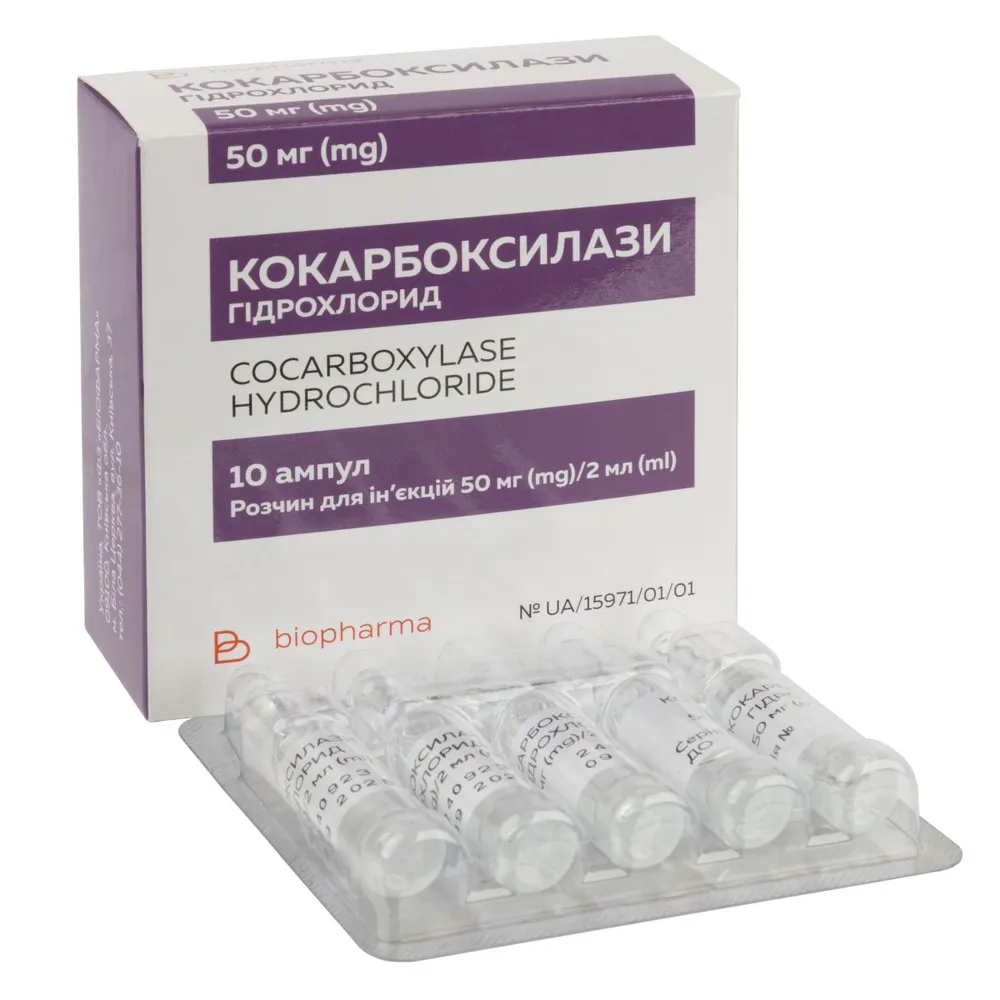
COCARBOXYLASE HYDROCHLORIDE
UkraineThe drug is used as part of complex therapy for carbohydrate metabolism disorders, complications of diabetes mellitus, heart diseases with rhythm disturbances (extrasystole), and peripheral neuritis.
Frequently asked questions
How should Cocarboxylase hydrochloride be taken correctly?
The drug is administered intramuscularly, subcutaneously, or intravenously. The dose is determined by a physician depending on the patient's condition. Adults are usually prescribed 50–100 mg per day as a single dose for 15–30 days, after which they transition to maintenance therapy (50 mg once daily). For children, the dosage depends on age.
What are the possible side effects of Cocarboxylase hydrochloride?
Possible allergic reactions (itching, swelling, shortness of breath, anaphylactic shock), changes in arterial blood pressure, injection site reactions, as well as general symptoms: weakness, chills, fever, impaired consciousness, or lower back pain.
Who should not use this drug?
Contraindications include hypersensitivity to the components of the product. It is also not recommended for use during pregnancy and breastfeeding.
Can you drive a car during treatment?
It is not recommended, as in some people the drug may cause weakness, sluggishness, or impaired consciousness.
How does the drug interact with other medicines?
Cocarboxylase enhances the effect of cardiac glycosides and improves their tolerability.
Can the drug be administered intravenously to children?
No, this drug must not be administered intravenously to children.
Instructions for use
INSTRUCTION FOR MEDICAL USE OF THE MEDICINAL PRODUCT COCARBOXYLASE HYDROCHLORIDE (COCARBOXYLASE HYDROCHLORIDE)
Composition:
Active substance: cocarboxylase hydrochloride;
One ampoule (2 ml) contains 50 mg of cocarboxylase hydrochloride;
Excipients: sodium citrate, disodium edetate, maleic acid, water for injections.
Pharmaceutical form. Solution for injection.
Main physicochemical properties: clear, colorless or almost colorless solution.
Pharmacotherapeutic group. Simple vitamin B1 preparations. ATC code A11D A.
Pharmacological properties.
Pharmacodynamics.
Cocarboxylase is a non-protein component (coenzyme) of enzymes that regulate metabolic processes. It is formed in the body from thiamine as a result of its phosphorylation. It plays an especially important role in carbohydrate metabolism, particularly in the oxidative decarboxylation of keto acids (pyruvic acid, α-ketoglutaric acid), as well as in the pentose phosphate pathway of glucose breakdown. It reduces the levels of lactic and pyruvic acids in the body, improves glucose utilization, enhances nutrition of nervous tissue, and promotes normalization of cardiovascular system function.
Cocarboxylase should not be used for the treatment of vitamin B1 deficiency (hypovitaminosis or avitaminosis), since its biological properties do not fully correspond to those of thiamine.
Pharmacokinetics.
It is not stored (deposited) in the body. It is excreted in the urine.
Clinical characteristics.
Indications. As part of complex therapy:
- pathological conditions involving carbohydrate metabolism disorders;
- complications caused by diabetes mellitus;
- heart diseases accompanied by rhythm disturbances (extrasystoles);
- peripheral neuritis.
Contraindications. Hypersensitivity to the components of the medicinal product.
Interaction with other medicinal products and other types of interactions. Cocarboxylase enhances the cardiotonic effect of cardiac glycosides and improves their tolerance.
Special precautions for use.
When conducting combination therapy, it is necessary to consider the property of cocarboxylase to enhance the cardiotonic effect of cardiac glycosides.
This medicinal product contains less than 1 mmol (23 mg)/dose of sodium, i.e. it is practically sodium-free.
Use during pregnancy or breastfeeding. The efficacy and safety of using “Cocarboxylase hydrochloride” for treatment during pregnancy or breastfeeding have not been established; therefore, the drug is not recommended for use during these periods.
Ability to affect reaction speed when driving or operating machinery. Since the medicinal product may cause weakness, impaired consciousness, or sluggishness in some patients, its use when driving vehicles or operating machinery is not recommended.
Dosage and Administration.
Usually used as a component of complex therapy. The medicinal product is administered intramuscularly, less frequently subcutaneously or intravenously. For intravenous bolus injection, the solution volume should be adjusted to 10–20 ml; for intravenous infusion, to 200–400 ml by adding 0.9% sodium chloride solution or 5% glucose solution. The administered dose is determined individually, depending on the nature of the disease and the severity of the patient's condition. Adults should receive a single daily dose of 50–100 mg. The treatment course lasts 15–30 days. If necessary, the specified dose may be repeated after 1–2 hours. Subsequently, supportive therapy with 50 mg once daily should be initiated.
For children, administer subcutaneously or intramuscularly: from birth to 3 months of age – 25 mg once daily; from 4 months to 7 years – 25–50 mg once daily; from 8 to 18 years – 50–100 mg once daily. If necessary, the indicated daily doses may be divided into two administrations.
Children. May be used from birth. Do not administer the drug intravenously.
Overdose. Manifests as a more pronounced form of adverse reactions. Discontinuation of the drug is recommended, along with symptomatic treatment aimed at normalizing respiration and cardiovascular function.
Side effects.
Immune system side effects: hypersensitivity reactions, including: itching, urticaria, angioneurotic edema, dyspnea, eyelid swelling, skin hyperemia, acrocyanosis, anaphylactic shock.
Cardiovascular system side effects: arterial hypotension, arterial hypertension.
Local reactions: reactions at the injection site, including: hyperemia, itching, swelling at the injection site.
General disorders: weakness, chills, hyperthermia, consciousness disturbances, lethargy, back pain.
Shelf life. 2 years.
Storage conditions. Store in the original packaging, protected from light, at a temperature of 2 to 8 °C. Keep out of reach of children.
Incompatibility. The solution should not be mixed with other medicinal products, except those specified in the section “Dosage and administration”.
Packaging. 2 ml of the drug in ampoules. 5 ampoules per blister, 1 or 2 blisters per cardboard pack.
Prescription status. Prescription only.
Manufacturer: LLC "FZ "STADA", Ukraine.
Manufacturer's address and place of business.
37, Kyivska Street, Bila Tserkva, Kyiv region, 09100, Ukraine.
Similar drugs
| Brand name | Dosage form | Active substance / Dosage | Manufacturer |
|---|---|---|---|
| COCARBOXYLASE-BIOTEK | solution for injection |
|
PJSC «Lekhim - Kharkiv» |
The original data is available in the language of the country of manufacture.
Data source: State Register of Medicinal Products of Ukraine
Data last verified: August 13, 2026