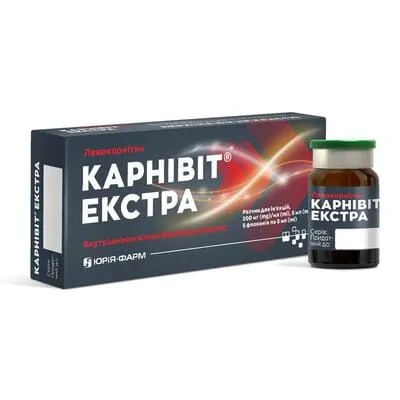
CARNIVIT® EXTRA
UkraineThe drug is used in case of carnitine deficiency (systemic or muscular), fatty acid beta-oxidation deficiency, as well as secondary carnitine deficiency in patients with organic aciduria. It is prescribed when oral administration is impossible or not feasible (e.g., in case of food intolerance, diarrhea, or during surgery).
Frequently asked questions
How should Carnivit® extra be taken correctly?
The drug is administered intravenously (slowly) or intramuscularly. The dosage for adults and children is 25–75 mg per kilogram of body weight per day.
What are the possible side effects of Carnivit® extra?
Possible side effects include nausea, vomiting, diarrhea, abdominal pain, muscle cramps or pain, itching, urticaria, sweating, and a specific skin odor. In case of overdose, diarrhea with a fishy odor may occur.
Can the drug be taken together with other medicines?
If you are taking vitamin K antagonists, Carnivit® extra may enhance their effect and increase the risk of bleeding, therefore careful monitoring is required. Additionally, patients with diabetes mellitus receiving insulin or other diabetes medications should regularly monitor their blood sugar levels, as a decrease in blood sugar levels is possible.
Who should not use this drug?
The drug should not be used in case of hypersensitivity to the active substance or excipients. Patients with severe renal impairment should be cautious and avoid high doses for prolonged periods.
Can the drug be used during pregnancy or breastfeeding?
Use in these cases is only possible when the expected benefit to the mother outweighs the potential risk to the child, as there are insufficient clinical studies in humans for these conditions.
Instructions for use
INSTRUCTION FOR MEDICAL USE OF THE MEDICINAL PRODUCT KARNAVIT® EXTRA (CARNIVIT EXTRA)
Composition:
Active substance: levocarnitine;
1 ml of solution contains levocarnitine 200 mg;
Excipients: concentrated hydrochloric acid, water for injections.
Pharmaceutical form. Solution for injection.
Main physicochemical properties: clear, colorless or slightly yellowish solution.
Pharmacotherapeutic group. Amino acids and their derivatives. ATC code A16AA01.
Pharmacological Properties.
Pharmacodynamics.
Levocarnitine is a natural component of the body and plays a fundamental role in lipid utilization. It is essentially the only carrier that transports long-chain fatty acids across the inner mitochondrial membrane for their participation in beta-oxidation. In addition, levocarnitine participates in intermediate metabolism by transporting acetylated fragments generated during beta-oxidation, thus helping to maintain intramitochondrial coenzyme A levels and increasing cellular energy availability by:
- stimulating oxidative utilization of pyruvate;
- stimulating decarboxylation of branched-chain amino acids;
- participating in hepatic ketogenesis.
Pharmacokinetics.
After a single slow intravenous administration (over 5 minutes) of 30 mg/kg of levocarnitine, plasma concentrations of free and total carnitine reach their maximum levels immediately after infusion. Return to normal baseline levels occurs slowly, as concentrations in plasma remain higher than pre-dose levels 24 hours after injection.
The mean apparent distribution half-life is approximately 0.8 hours (alpha-phase), and the mean apparent elimination half-life is approximately 24 hours (beta-phase).
Levocarnitine is excreted in urine; approximately 80% of the administered dose is eliminated within 24 hours after injection.
Preclinical Safety Data
Preclinical toxicity studies of levocarnitine conducted in animals at doses significantly exceeding the therapeutic range did not reveal any signs of toxicity.
Mutagenicity studies performed in Salmonella typhimurium, Saccharomyces cerevisiae, and Schizosaccharomyces pombe showed that levocarnitine is not mutagenic.
Long-term carcinogenicity studies of levocarnitine in animals have not been conducted.
Reproductive function studies were performed in rats and rabbits. In male or female rats, levocarnitine did not affect mating ability, fertility parameters, embryonic/fetal development, or testicular weight. Offspring of both first and second generations showed normal development and behavior.
No evidence of teratogenic effects was observed in animals. However, in rabbits, a slightly increased number of post-implantation fetal deaths was observed at the highest dose tested (600 mg/kg/day) compared to the control group. This increase was not substantial.
Considering the small magnitude of the change and the lack of statistical significance, the biological relevance of these findings to humans is considered low.
Clinical characteristics.
Indications.
Indicated in cases where the oral route of administration is unacceptable, impossible, or contraindicated (e.g., acute decompensation, resuscitation constraints, complete food intolerance, severe uncontrolled diarrhea, fasting in pre-, intra-, and postoperative periods):
- primary systemic or muscular carnitine deficiency;
- secondary carnitine deficiency in patients with organic aciduria;
- fatty acid beta-oxidation deficiency.
Contraindications.
Hypersensitivity to the active substance or to any of the excipients of the medicinal product.
Interaction with other medicinal products and other types of interactions.
Concomitant use with other medicinal products
Vitamin K antagonists
When levocarnitine is used concomitantly with vitamin K antagonists, the effect of the latter is enhanced and the risk of bleeding increases.
More frequent monitoring of the international normalized ratio (INR) is required. Dose adjustment of vitamin K antagonists should be performed during levocarnitine treatment and for eight days after its discontinuation (see section "Special precautions").
Special precautions for use.
In patients with diabetes mellitus receiving treatment with insulin and/or oral hypoglycemic agents, the use of levocarnitine may lead to hypoglycemia. Such patients are recommended to regularly monitor blood glucose levels.
In patients who received levocarnitine concomitantly with vitamin K antagonists, cases of increased INR have been reported. Patients receiving levocarnitine together with vitamin K antagonists should be closely monitored (see sections "Interaction with other medicinal products and other forms of interaction" and "Side effects").
Use during pregnancy or breastfeeding.
Pregnancy
Animal studies have not shown teratogenic effects of levocarnitine. In animals, administration of the highest dose (600 mg/kg/day) increased the risk of post-implantation fetal loss. The significance of these findings for humans is unknown.
There are no reliable clinical studies on the use of levocarnitine in pregnant women. The use of levocarnitine during pregnancy should be considered only if the expected benefit to the mother outweighs the potential risk to the fetus.
Since reproductive function studies in animals are not always representative of human responses, the use of levocarnitine in pregnant women should be considered only when the expected benefit to the mother exceeds the potential risk to the fetus.
Breastfeeding period
There are no reliable clinical studies on the passage of levocarnitine into breast milk. The use of levocarnitine by nursing mothers should be considered only if the expected benefit to the mother outweighs the potential risk to the newborn, who may be affected by excess levocarnitine.
Fertility
Animal studies have not shown any effect of levocarnitine on fertility (see section "Pharmacological properties. Preclinical safety data").
Ability to influence reaction speed when driving or operating machinery.
The medicinal product Carnivit**®** Extra has no effect or has a negligible effect on the ability to drive or operate machinery.
Dosage and Administration
Dosage
The dose of levocarnitine for children and adults is 25–75 mg/kg per day.
Administration
Carnivit® Extra should be administered intravenously slowly or intramuscularly.
Special patient groups
Patients with renal impairment
Patients with severe renal impairment should not receive high doses of levocarnitine for prolonged periods due to accumulation of trimethylamine and trimethylamine N-oxide metabolites.
Elderly patients
Levocarnitine should be used with caution in elderly patients, who may have reduced renal function; dose adjustment may be required depending on renal function (see "Patients with renal impairment").
Children
Levocarnitine can be used in children.
Overdose
High doses of levocarnitine may cause diarrhea with a fishy odor. Levocarnitine is removed by dialysis.
Adverse reactions
Adverse reactions are listed by MedDRA system organ class and classified according to the following frequency categories: very common (≥ 1/10), common (≥ 1/100, < 1/10), uncommon (≥ 1/1000, < 1/100), rare (≥ 1/10000, < 1/1000), very rare (< 1/10000), frequency not known (cannot be estimated from available data).
Immune system disorders
Frequency not known: hypersensitivity reactions.
Gastrointestinal disorders
Frequency not known: vomiting, nausea, diarrhea, abdominal pain.
Skin and subcutaneous tissue disorders
Frequency not known: specific skin odor, hyperhidrosis, erythema, urticaria, pruritus.
Musculoskeletal and connective tissue disorders
Frequency not known: muscle cramps, myalgia.
Investigations
Frequency not known: increased INR.
Reporting of adverse reactions
Reporting suspected adverse reactions after drug registration is important. It allows continuous monitoring of the benefit-risk balance of the medicinal product. Medical and pharmaceutical professionals, as well as patients or their legal representatives, are encouraged to report all suspected adverse reactions and lack of efficacy via the Automated Information System for Pharmacovigilance at the following link: https://aisf.dec.gov.ua
Shelf life. 2 years.
Storage conditions.
Store at a temperature not exceeding 30 °C in the original packaging.
Keep out of reach and sight of children.
Incompatibilities.
Information not available.
Packaging.
5 ml in glass vials; 5 vials in a blister pack in a cardboard box.
Prescription status. Prescription only.
Manufacturer. TOV "Yuria-Farm".
Manufacturer's address and place of business.
108, Kobzarska Street, Cherkasy, Cherkasy region, Ukraine. Tel. (044) 281-01-01.
Similar drugs
| Brand name | Dosage form | Active substance / Dosage | Manufacturer |
|---|---|---|---|
| ALCARINIT | solution for injection |
|
PJSC "Lekhim - Kharkiv" |
| ALMIBA | solution for injection |
|
Mefar Ilac San A.S. |
| CARDONAT L-CARNITINE | solution for injection |
|
WORLD MEDICINE ILAC SAN. VE TIC. A.S. |
| CARNELIUS | solution for injection |
|
HELP S.A. |
| CARNIVIT | solution for injection |
|
Yuria-Pharm LLC |
| CARTAN | solution for injection |
|
DEMO SA Pharmaceutical Industry |
| LECARNITA | solution for injection |
|
HELP S.A. |
| LEVOCARNITINE | solution for injection |
|
JSC "Lubnipharm" |
| LIKARTIN-N | solution for injection |
|
Farmasel LLC |
| LIKARTIN-N | solution for injection |
|
Farmasel LLC |
| METACARTIN | solution for injection |
|
WORLD MEDICINE ILAC SAN. VE TIC. A.S. |
| STEATEL | solution for injection |
|
HELP S.A. |
The original data is available in the language of the country of manufacture.
Data source: State Register of Medicinal Products of Ukraine
Data last verified: August 13, 2026