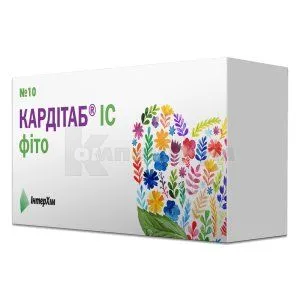
CARDITAB® IC FITО
UkraineThe drug is used for insomnia and increased nervous excitability, as well as as part of complex therapy for mild cardiovascular disorders.
Frequently asked questions
How should Carditab® ic fitо be taken correctly?
Adults are usually prescribed 1–2 tablets 2–3 times a day before meals. The dosage and duration of the course should be determined by a physician.
What side effects may Carditab® ic fitо cause?
Possible allergic reactions (rash, itching, edema), drowsiness, dizziness, weakness, decreased concentration, depression, nausea, vomiting, or difficulty breathing.
Who should not take this drug?
Contraindicated in children under 18 years of age, pregnant women, and breastfeeding women. It should also not be taken in case of hypersensitivity to the components, severe liver or kidney problems, low blood pressure, bradycardia, and conditions accompanied by depression of the nervous system.
Can you drive a vehicle during treatment?
It is not recommended to engage in activities that require rapid reaction and high concentration, specifically driving vehicles or working with dangerous mechanisms.
With which substances should the drug not be combined?
Avoid consuming alcohol and stimulating beverages (coffee, tea). The drug may enhance the effects of alcohol, hypnotics, sedatives, and analgesics.
Can the drug be taken for a long time?
Long-term use is not recommended due to the risk of bromine accumulation in the body, which may lead to poisoning.
Instructions for use
INSTRUCTIONS for medical use of the medicinal product CARDITAB® PHYTO
Composition:
Active substances: dry aqueous-alcoholic extract of valerian (Extractum Valerianae siccum) (4–8:1) (extractant – ethanol 30 %) / (Rhizoma cum radicibus Valerianae) (5–6:1) (extractant – ethanol 70 %), ethyl ether of α-bromoisovaleric acid, peppermint oil;
One tablet contains: dry aqueous-alcoholic extract of valerian (Extractum Valerianae siccum) (4–8:1) (extractant – ethanol 30 %) / (Rhizoma cum radicibus Valerianae) (5–6:1) (extractant – ethanol 70 %) 40 mg, ethyl ether of α-bromoisovaleric acid 8.2 mg, peppermint oil 0.58 mg;
Excipients: β-cyclodextrin, calcium hydrogen phosphate dihydrate, StarLac® (lactose monohydrate, corn starch), sodium croscarmellose, crospovidone, colloidal anhydrous silicon dioxide, magnesium stearate, hypromellose (hydroxypropylmethylcellulose), polyethylene glycol (macrogol), talc, titanium dioxide (E 171), iron oxide yellow (E 172).
Pharmaceutical form. Film-coated tablets.
Main physico-chemical characteristics: round, biconvex film-coated tablets of yellow to mustard color.
Pharmacotherapeutic group.
Hypnotics and sedatives. Combinations of hypnotics and sedatives, excluding barbiturates. ATC code N05CX.
Pharmacological properties.
Sedative, spasmolytic, and vasodilating agent. Helps reduce excitability of the central nervous system, exerts a calming effect, and facilitates the onset of natural sleep. The valerian extract and ethyl ether of α-bromoisovaleric acid exert sedative and spasmolytic effects. Peppermint oil produces a reflex vasodilating and spasmolytic effect.
Clinical characteristics.
Indications.
Increased nervous excitability, insomnia.
As part of combination therapy in mild functional disorders of the cardiovascular system.
Contraindications.
Hypersensitivity to any component of the medicinal product or to bromides; severe impairment of liver and/or kidney function, marked arterial hypotension, bradycardia, depression and other conditions associated with central nervous system depression. Pregnancy or lactation period. Childhood.
Interaction with other medicinal products and other forms of interaction.
The medicinal product may enhance the effects of alcohol, anxiolytics, sedatives, hypnotics, analgesics, and spasmolytic agents.
Special precautions for use.
Concomitant intake of stimulant beverages (coffee, tea) is not recommended. Alcohol consumption should be avoided during treatment with this medicinal product.
During treatment with this medicinal product, activities requiring increased attention and rapid psychomotor reactions should be avoided.
Caution is advised when administering the medicinal product to patients with arterial hypotension (see section "Contraindications"), or with a history of severe hepatic dysfunction or severe liver disease.
Valerian may exert a moderate depressant effect; therefore, concomitant use of this medicinal product with synthetic sedatives is not recommended due to potential potentiation of the effect.
In cases of pronounced atherosclerosis of cerebral vessels, the medicinal product should be used only under medical supervision.
Specific sensitivity to the odor of valerian may occur.
Prolonged use of the medicinal product is not recommended due to the risk of bromide accumulation in the body and possible development of bromism.
The medicinal product contains lactose and therefore should not be used in patients with rare hereditary galactose intolerance, lactase deficiency, or glucose-galactose malabsorption.
Recommended doses of the medicinal product should not be exceeded.
Use during pregnancy or breastfeeding.
Do not use (see section "Contraindications").
Ability to affect reaction speed when driving or operating machinery.
When using this medicinal product, patients should refrain from driving vehicles or operating potentially hazardous machinery.
Dosage and Administration.
The dosage and duration of treatment depend on the course of the disease and are determined individually by a physician.
For adults, the usual dose is 1–2 tablets of the medicinal product 2–3 times daily, taken before meals.
Children.
There is no experience with the use of the medicinal product in children (under 18 years of age). Therefore, the use of this medicinal product is contraindicated in this age group.
Overdose.
Overdose is possible with frequent or prolonged use of the medicinal product, associated with the accumulation of its components.
Symptoms of poisoning with valerian extract: nausea, abdominal cramps and pain, headache, lethargy, drowsiness, dizziness, general weakness, mental excitement, increased fatigue, hand tremors, dilated pupils, sensation of chest tightness, decreased hearing and visual acuity, tachycardia.
Treatment: discontinue the medicinal product, perform gastric lavage, administer activated charcoal. Symptomatic therapy.
Symptoms of bromine poisoning: central nervous system depression, depression, confusion, ataxia, apathy, conjunctivitis, rhinitis, lacrimation, acne, purpura.
Treatment: elimination of bromide ions from the body can be accelerated by administering a large amount of sodium chloride solution along with saluretic agents.
In case of hypersensitivity reactions, desensitizing medicinal products should be prescribed.
Adverse reactions.
In individual cases, the following adverse effects may occur:
Immune system side effects: hypersensitivity reactions, including allergic reactions (skin rashes, itching, urticaria, hyperemia, skin swelling, etc.);
Nervous system side effects: general weakness, increased fatigue, drowsiness, dizziness, decreased concentration, suppression of emotional responses, depression, reduced mental and physical performance;
Gastrointestinal side effects: nausea, vomiting, feeling of heaviness in the epigastric area;
Respiratory system side effects: difficulty breathing.
Usually these manifestations disappear with dose reduction.
If any adverse reactions occur, consult a physician.
Shelf life. 3 years.
Storage conditions.
Store in the original packaging at a temperature not exceeding 25 °C.
Keep out of reach of children.
Packaging.
10 tablets per blister; 1 blister per carton.
Availability. Over-the-counter (without prescription).
Manufacturer.
Limited liability company "INTERSIM".
Manufacturer's address and place of business.
40-A, 21st km, Starokyivska Road, Odesa, Ukraine, 65025.
The original data is available in the language of the country of manufacture.
Data source: State Register of Medicinal Products of Ukraine
Data last verified: August 13, 2026