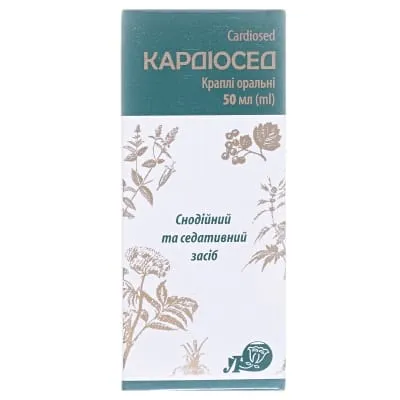
CARDIOSED
UkraineThe drug is used to treat increased nervous excitability, mild forms of neurasthenia (accompanied by anxiety, fear, and fatigue), sleep disturbances due to nervous tension, cardiovascular neuroses, and at the early stages of elevated blood pressure.
Frequently asked questions
How should Cardiosed be taken correctly?
Adults should take 20–30 drops 3 times a day. The drops should be pre-diluted in a small amount of water. It is not recommended to take the drug during meals.
What are the possible side effects of Cardiosed?
Possible side effects include nausea, heartburn, abdominal pain, constipation, headache, dizziness, drowsiness, lethargy, decreased concentration, as well as cardiac arrhythmia, low blood pressure, and allergic reactions (rash, itching, edema).
Who should not take this drug?
Contraindications include alcoholism, gastric or duodenal ulcers, liver cirrhosis, gallstone disease, pregnancy and breastfeeding, depression, low blood pressure, childhood (under 18 years of age), as well as individual sensitivity to the composition.
Can the drug be combined with other medicines or alcohol?
Alcohol should be completely avoided during treatment. The drug may enhance the effects of sedatives, hypnotics, cardiac, and other medicines, as well as enhance the effect of ethanol. Co-administration with synthetic sedatives, third-generation antiarrhythmic drugs, and cisapride is not recommended.
Does the drug affect the ability to drive a vehicle?
Yes, due to possible drowsiness and decreased concentration during use, it is not recommended to drive vehicles or operate dangerous mechanisms.
Instructions for use
INSTRUCTIONS FOR MEDICAL USE OF THE MEDICINAL PRODUCT CARDIOSED (Cardiosed)
Composition:
Active substances:
1 ml of drops contains:
1 ml of tincture (1 : 5–6) from a mixture of herbal raw materials: rhizomes with roots of valerian (Rhizomata cum radicibus Valerianae), hawthorn fruits (Crataegi fructus), motherwort herb (Herba Leonuri), lemon balm herb (Herba Melissae) (2/1/2/2) (extraction solvent — 70% ethanol v/v);
Excipients: apart from the extraction solvent, none.
Pharmaceutical form. Oral drops.
Main physicochemical characteristics: liquid, ranging in color from light brown to dark brown, with a characteristic odor of valerian. Formation of a slight sediment during storage is permissible.
Pharmacotherapeutic group. Hypnotics and sedatives. ATC code N05CM.
Pharmacological Properties
The drug's action is due to the synergistic combination of therapeutic effects of medicinal plants contained in its composition: valerian roots and rhizomes, hawthorn fruits, valerian herb, and lemon balm herb. The medicinal plants contained in the preparation exhibit sedative, hypotensive, and spasmolytic effects. The calming effect is caused by enhancement of inhibitory processes and reduction of central nervous system excitability. The drug does not cause habituation or psychological and physical dependence.
Clinical Characteristics
Indications. To be used as part of complex treatment for increased nervous excitability; mild forms of neurasthenia accompanied by irritability, anxiety, fear, increased fatigue, and mental exhaustion; sleep disturbances due to nervous tension; cardiovascular neuroses; early stages of arterial hypertension.
Contraindications
History of alcoholism. Concurrent use of medicinal products containing alcohol. Gastric and duodenal peptic ulcer. Liver cirrhosis. Cholelithiasis. Pregnancy or breastfeeding period. Depression and other disorders accompanied by central nervous system depression. Somnolence. Marked arterial hypotension and bradycardia. Hypersensitivity to the components of the medicinal product, bronchial asthma, and spasmophilia. Pediatric age (under 18 years).
Special precautions
If symptoms do not disappear, or if leg swelling occurs, or if symptoms of unknown origin develop, medical advice must be sought. In case of chest pain that may radiate to the arms, epigastric or neck area, or if shortness of breath occurs, immediate medical attention is required.
During the period of using this medicinal product, consumption of alcoholic beverages should be avoided.
Interaction with other medicinal products and other types of interactions
If you are taking any other medicinal products, you must consult your doctor regarding the possibility of using this medicinal product.
The drug may enhance the effects of tranquilizers, neuroleptics, hypnotics, sedatives, analgesics, spasmolytics, cardiac agents, antihypertensives, anxiolytics, nootropics, anesthetics, curare-like muscle relaxants, and anticoagulants, as well as enhance the effect of ethanol.
Concomitant use with alkaloid salts is not recommended due to the possibility of forming undesirable complexes. The medicinal product should not be used together with class III antiarrhythmic agents or with cisapride. The drug enhances the effects of cardiac glycosides.
Concomitant use with synthetic sedative drugs is not recommended.
Alcohol consumption should also be avoided during treatment.
Special precautions for use
The medicinal product is not recommended to be taken during meals to avoid interaction with food components.
The medicinal product may have a moderate depressant effect; therefore, concomitant use with synthetic sedatives is not recommended due to potentiation of the effect.
In cases of pronounced atherosclerosis of cerebral vessels, the medicinal product may be used only under medical supervision.
Recommended doses of the medicinal product should not be exceeded.
Specific sensitivity to the smell of valerian may occur.
This medicinal product contains 70% v/v ethanol (alcohol), i.e. 414.2 mg/dose, equivalent to 10.5 ml of beer or 5.2 ml of wine per dose. Harmful for individuals suffering from alcoholism.
Use with caution in patients with epilepsy.
Patients with impaired liver function or those who have had a severe liver disease in the past should exercise caution when taking this medicinal product.
Alcoholic beverages should be avoided during treatment with this medicinal product.
Prolonged use is not recommended.
Use during pregnancy or breastfeeding. Use of this medicinal product is contraindicated.
Ability to affect reaction speed while driving or operating machinery. When using this medicinal product, driving vehicles and operating potentially hazardous machinery should be avoided.
Method of Administration and Dosage
The medicinal product should be taken orally by adults, 20–30 drops three times a day, after diluting the drops in a small amount of water.
The duration of treatment is determined individually by a physician for each patient, depending on the nature and severity of the pathological process, characteristics of the disease course, drug tolerance, and stability of the therapeutic effect achieved.
If the bottle does not have a dropper cap, use a glass medical pipette to measure the medicinal product; the dosage remains unchanged.
Children. Not recommended for children (under 18 years of age), as safety and efficacy have not been established.
Overdose
A single intake of a dose 2–3 times higher than the recommended dose usually does not cause adverse effects. In such cases, the medicinal product should continue to be used according to the instructions. However, with a significant overdose, the risk of adverse reactions increases.
Symptoms: headache, drowsiness, lethargy, abdominal pain, nausea, decreased hearing and visual acuity, tachycardia.
Treatment: discontinue the use of the medicinal product, perform gastric lavage, administer activated charcoal.
Adverse Reactions
Gastrointestinal system: nausea, heartburn, diarrhea, abdominal cramps and pain; with prolonged use, possible suppression of digestion, constipation.
Hepatobiliary system: signs of hepatotoxicity.
Cardiovascular system: arterial hypotension, chest tightness, palpitations, chest pain, cardiac rhythm disturbances (including bradycardia, tachycardia).
Immune system: allergic reactions; in cases of individual hypersensitivity to components of the medicinal product, skin rashes, itching, urticaria, hyperemia, skin swelling, dyspnea, bronchial asthma are possible.
Central and peripheral nervous system: headache, dizziness, lethargy, drowsiness, suppression of emotional responses, depression, general weakness, decreased mental and physical performance, reduced attention and concentration; in individual cases – psychic excitement, anxiety, insomnia.
The frequency of occurrence of such adverse reactions is unknown.
If any adverse events occur, the use of the medicinal product must be discontinued and medical advice should be sought.
Reporting suspected adverse reactions
Reporting of adverse reactions following medicinal product registration is of great importance. It enables ongoing monitoring of the benefit-risk balance of the medicinal product. Healthcare and pharmaceutical professionals, as well as patients or their legal representatives, are encouraged to report all suspected adverse reactions and lack of efficacy via the Automated Pharmacovigilance Information System at: https://aisf.dec.gov.ua.
Shelf life. 4 years.
Storage conditions. Store in the original packaging at a temperature not exceeding 25 °C.
Keep out of reach and sight of children.
Packaging. 25 mL in a bottle No. 1, or 40 mL in a bottle No. 1, or 50 mL in a bottle No. 1.
Availability. Over-the-counter.
Manufacturer. JSC "Lubnipharm".
Manufacturer's address and place of business. 16, Barvinkova St., Lubny, Poltava region, 37500, Ukraine.
Similar drugs
| Brand name | Dosage form | Active substance / Dosage | Manufacturer |
|---|---|---|---|
| BELISA | drops, oral |
mixture of aqueous alcoholic extracts of passionflower herb, lime flowers, motherwort herb, sage leaves and lemon balm herb
·
100 mg + 100 mg + 66.7 mg + 33.3 mg + 33.3 mg (extracts) per 1 ml
|
DKP "Pharmaceutical Factory" LLC |
| SEDAFITON® | drops, oral |
alcohol extract mixture of hawthorn fruits valerian roots and passionflower herb
·
0.275 ml + 0.295 ml + 0.43 ml in 1 ml
|
PJSC "Fitofarm" |
| VALOCORMID | drops, oral |
|
DKP "Pharmaceutical Factory" LLC |
| VALOCORMID | drops, oral |
|
Ternofarm LLC |
The original data is available in the language of the country of manufacture.
Data source: State Register of Medicinal Products of Ukraine
Data last verified: August 13, 2026