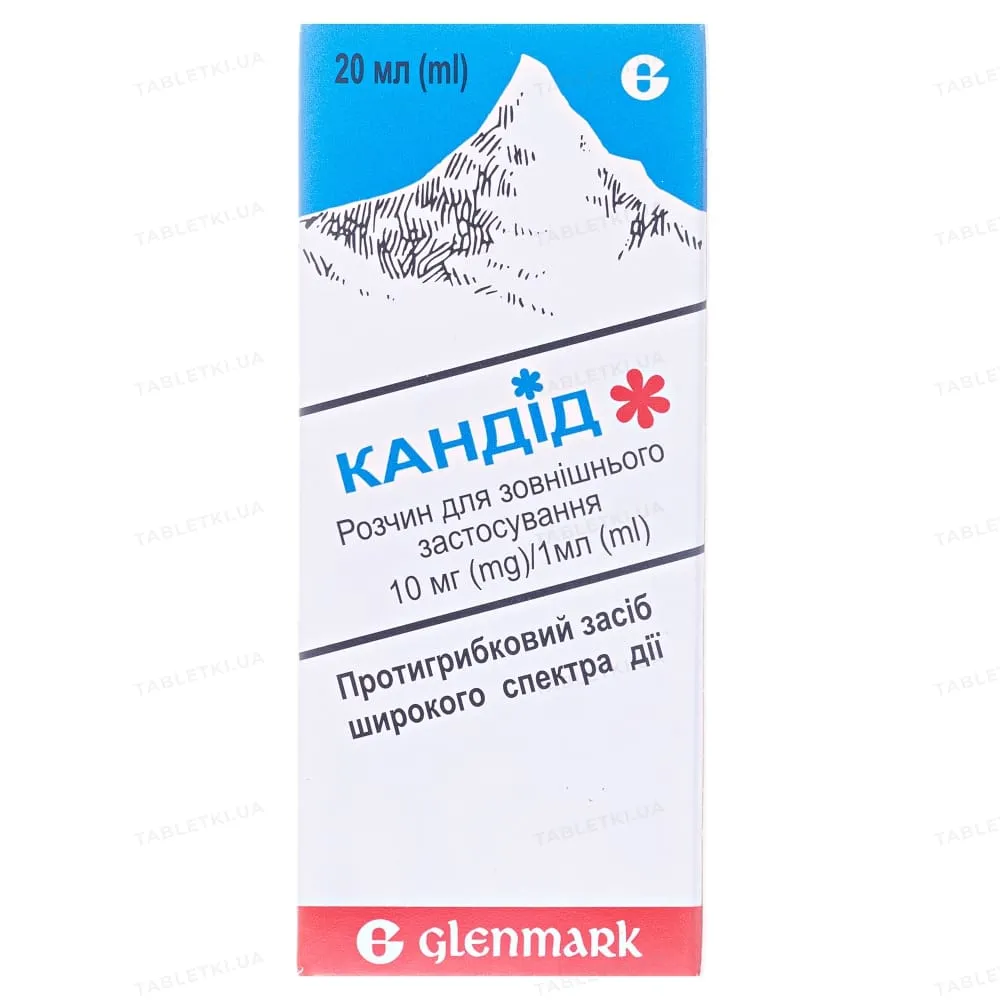
CANDID
UkraineThe drug is used for the local treatment of oral candidiasis and pharyngomycosis.
Frequently asked questions
How to use Candid correctly?
Apply 10-20 drops to all affected areas of the oral mucosa using a cotton swab 3-4 times a day. It is important not to swallow the solution, as it is not intended for internal use.
What side effects can Candid cause?
Possible allergic reactions, pain or irritation at the application site, rash, itching, burning, swelling, contact dermatitis, and in some cases, shortness of breath, fainting, or low blood pressure.
Who should not take this drug?
The drug is contraindicated in individuals with hypersensitivity to clotrimazole or to other components of the composition (propylene glycol or glycerin).
Can the product be used during pregnancy or breastfeeding?
Use is only possible in cases where the physician considers that the expected benefit to the mother outweighs the potential risk to the fetus or child.
What should be done if there is no improvement after starting treatment?
In some cases, fungal resistance to the active substance may be observed. If there is no therapeutic effect, you should consult a physician to change the treatment method.
Can the product be used in children?
There is insufficient data regarding the use of the drug in children.
Instructions for use
INSTRUCTIONS FOR MEDICAL USE OF THE MEDICINAL PRODUCT CANDID (CANDID)
Composition:
active substance: clotrimazole;
1 ml of solution contains 10 mg of clotrimazole;
excipients: propylene glycol, glycerin.
Pharmaceutical form. Oral solution.
Main physicochemical properties: colorless, transparent, viscous liquid.
Pharmacotherapeutic group. Agents used in dentistry.
Antimicrobial and antiseptic agents for topical use.
ATC code A01AB18.
Pharmacological properties.
Pharmacodynamics.
The pharmacological effect of Candid is due to the properties of clotrimazole, which is part of its composition. Clotrimazole is a broad-spectrum antifungal agent from the group of imidazole derivatives. Dermatophytes, yeasts, and molds are sensitive to clotrimazole.
The effect of clotrimazole is associated with inhibition of ergosterol synthesis, a component of the fungal cell membrane, resulting in alterations in membrane structure and function, leading to cell lysis.
When applied topically, only negligible amounts of clotrimazole are absorbed into the bloodstream; therefore, systemic effects are absent.
Pharmacokinetics.
When applied topically, only negligible amounts of clotrimazole are absorbed into the bloodstream; therefore, systemic effects are absent.
Clinical characteristics.
Indications.
Local treatment of oral candidiasis. Pharyngomycoses.
Contraindications.
Hypersensitivity to clotrimazole or to any of the excipients, including propylene glycol and glycerol.
Interaction with other medicinal products and other forms of interaction.
Data not available.
Special precautions for use.
The medication is not intended for oral administration, therefore it should not be swallowed when used.
Avoid contact of the medication with the eyes.
In some cases, bacterial resistance to clotrimazole may occur. If there is no therapeutic effect from the medication, an alternative treatment method should be used.
Use during pregnancy or breastfeeding.
The use of this medication during pregnancy is possible only if, in the opinion of the physician, the expected benefit to the mother outweighs the potential risk to the fetus.
There is no data available regarding the passage of clotrimazole into breast milk. Therefore, the medication may be used during breastfeeding only if, in the opinion of the physician, the expected benefit to the mother outweighs the potential risk to the infant.
Ability to influence reaction rate while driving or operating machinery.
Has no effect.
Dosage and Administration.
Apply 10–20 drops of Candidum onto the affected areas of the oral mucosa using a cotton swab 3–4 times daily. All affected areas of the oral mucosa should be treated with the medication. A positive response is usually observed within 3–5 days of treatment; however, in individual cases, treatment may be continued until all signs of infection have completely disappeared. During and after treatment, special attention should be given to eliminating any factors that could lead to recurrence of the infection.
The treatment course is determined by a physician.
Children.
There is insufficient data regarding the use of the drug in children.
Overdose.
Symptoms of overdose are unlikely to occur when the drug is used according to the recommended regimen.
Side effects.
Allergic reactions are possible. Pain and irritation at the application site.
Syncope, arterial hypotension, dyspnea, skin rash, urticaria, erythema, burning sensation, tingling, itching, swelling, contact dermatitis may occur.
Shelf life.
3 years.
Storage conditions.
Store in a protected from light place at temperature not exceeding 25 °C.
Keep out of reach of children.
Packaging.
15 ml of the preparation in bottles with dropper cap and tamper-evident cap, 1 bottle in a cardboard pack.
Supply category.
Over-the-counter.
Manufacturer.
Glenmark Pharmaceuticals Ltd./Glenmark Pharmaceuticals Ltd.
Manufacturer's address and place of business.
Plot No E-37/39, M.I.D.C., Industrial Estate, Satpur, Nasik – 422 007, India/
Plot No E-37/39, M.I.D.C., Industrial Estate, Satpur, Nasik – 422 007, India.
The original data is available in the language of the country of manufacture.
Data source: State Register of Medicinal Products of Ukraine
Data last verified: August 13, 2026