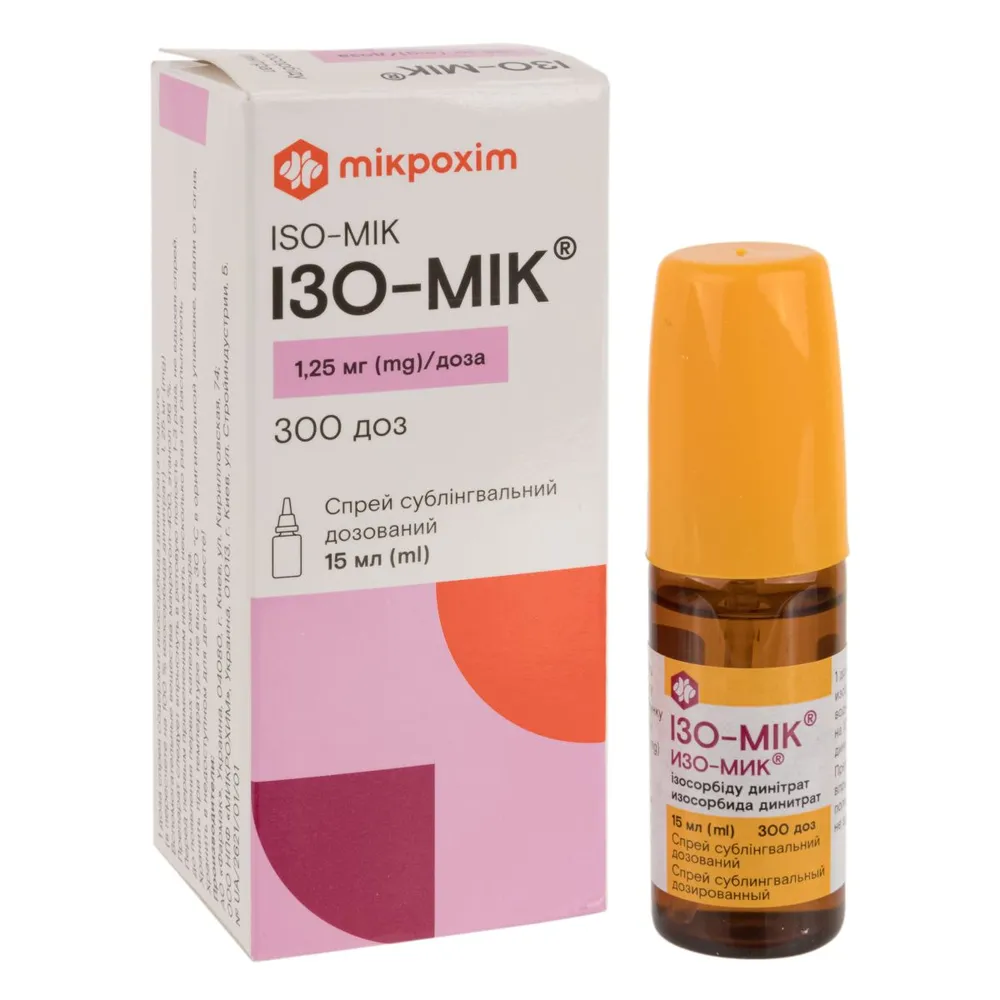
ISO-MIK
UkraineThe drug is used by adults for the treatment and prevention of angina attacks, in acute myocardial infarction, as well as in acute left ventricular heart failure.
Frequently asked questions
How should Iso-mik be taken correctly?
The spray is administered into the oral cavity. To stop an angina attack or before physical exertion, 1–3 sprays should be administered with a 30-second interval between them. In case of acute infarction or heart failure, start with 1–3 sprays; if there is no effect within 5 minutes, another spray may be administered, repeating the procedure as necessary under blood pressure monitoring.
Who should not use this drug?
Use is contraindicated in cases of hypersensitivity to the components, acute vascular insufficiency (shock, collapse), cardiogenic shock, hypertrophic obstructive cardiomyopathy, severe arterial hypotension (below 90 mmHg), glaucoma, hemorrhagic stroke, head injuries, bleeding, or severe liver or kidney disorders.
What are the possible side effects of Iso-mik?
The most common side effects are 'nitrate' headache (which usually diminishes over time), dizziness, drowsiness, tachycardia, decreased blood pressure, feelings of weakness, nausea, vomiting, or allergic reactions (rash, redness).
Can the drug be combined with other medicines?
The drug must not be used together with phosphodiesterase inhibitors (e.g., sildenafil, vardenafil, tadalafil), as this may lead to life-threatening complications. Use with riociguat is also contraindicated. When taken simultaneously with other vasodilators or alcohol, the effect of the drug may be enhanced.
Does the drug affect the ability to drive a vehicle?
Yes, the drug may cause dizziness or reduce reaction speed; therefore, during treatment, one should refrain from driving cars or other vehicles.
Instructions for use
Table of contents
INSTRUCTIONS FOR MEDICAL USE OF THE MEDICINAL PRODUCT ISO-MIК® (ISO-MIК)
Composition:
Active substance: isosorbide dinitrate;
1 spray dose contains isosorbide dinitrate aqueous (calculated as 100 % isosorbide dinitrate) – 1.25 mg;
Excipients: macrogol-400; ethanol 96 %.
Pharmaceutical form. Metered sublingual spray.
Main physicochemical properties: clear, colorless liquid with a characteristic alcoholic odor.
Pharmacotherapeutic group.
Vasodilators used in cardiology. Organic nitrates. ATC code C01D A08.
Pharmacological properties.
Pharmacodynamics.
Isosorbide dinitrate relaxes vascular smooth muscle, causing vasodilation. This relaxation affects both peripheral arteries and veins. Such an effect promotes venous pooling of blood and reduces venous return to the heart, thereby decreasing left ventricular end-diastolic pressure and volume (preload). The effect on arteries, and at higher doses on arterioles, leads to a reduction in systemic vascular resistance (afterload). This, in turn, reduces the workload of the heart.
The impact on both preload and afterload results in a further decrease in myocardial oxygen demand.
Isosorbide dinitrate also promotes redistribution of blood flow to subendocardial regions of the heart when coronary circulation is partially impaired by atherosclerotic lesions. This effect is likely explained by selective dilation of large coronary vessels. Nitrate-induced dilation of collateral arteries may improve perfusion of post-stenotic myocardium. In addition, nitrates prevent and relieve coronary spasms.
In patients with congestive heart failure, nitrates improve hemodynamics both at rest and during exercise. This beneficial effect results from several pathogenetic mechanisms, including improvement of valvular regurgitation (due to ventricular size reduction) and decreased myocardial oxygen demand.
By reducing oxygen demand and increasing oxygen supply, nitrates limit myocardial damage during myocardial infarction. Thus, the use of isosorbide dinitrate may be beneficial in patients who have suffered myocardial infarction.
Effects on other organ systems include relaxation of bronchial smooth muscle, as well as smooth muscles of the gastrointestinal tract, biliary and urinary tracts. There are also reports of relaxation of uterine smooth muscle.
Mechanism of action.
Like all organic nitrates, isosorbide dinitrate acts as a donor of nitric oxide (NO). Nitric oxide induces relaxation of vascular smooth muscle by stimulating guanylyl cyclase, leading to increased intracellular levels of cyclic guanosine monophosphate (cGMP). This activates cGMP-dependent protein kinase, resulting in altered phosphorylation of proteins in smooth muscle cells. Consequently, dephosphorylation of myosin light chains occurs, leading to reduced contractility.
Pharmacokinetics.
After oral spray administration, the active substance—isosorbide dinitrate—is rapidly absorbed. The effect of the drug begins within 1–3 minutes after administration, and maximum plasma concentration is achieved within 3–6 minutes. The elimination half-life is 30–60 minutes. Within 90–120 minutes, plasma concentration returns to baseline levels. Isosorbide dinitrate is metabolized to isosorbide-2-mononitrate and isosorbide-5-mononitrate, with elimination half-lives of approximately 1.5–2 hours and 4–6 hours, respectively. Both metabolites are pharmacologically active.
When administered via the oral route, isosorbide dinitrate bypasses the rapid first-pass metabolism in the liver, resulting in significantly higher bioavailability—60–100% (compared to 15–30% with oral administration).
Clinical characteristics.
Indications.
For use in adults:
- for the treatment of angina attacks, except in cases caused by hypertrophic obstructive cardiomyopathy;
- for the prevention of angina attacks;
- in acute myocardial infarction;
- in acute left ventricular heart failure.
Contraindications.
The medicinal product is contraindicated in:
- hypersensitivity to isosorbide dinitrate, other nitrate compounds, or any of the excipients;
- acute circulatory failure (shock, vascular collapse);
- cardiogenic shock, if end-diastolic pressure of the left ventricle cannot be corrected by appropriate measures;
- hypertrophic obstructive cardiomyopathy;
- constrictive pericarditis;
- cardiac tamponade;
- severe arterial hypotension (systolic blood pressure below 90 mm Hg);
- severe hypovolemia (isosorbide dinitrate may reduce venous return and cause syncope);
- severe anemia;
- head trauma;
- hemorrhage;
- aortic and/or mitral stenosis;
- closed-angle glaucoma;
- hemorrhagic stroke;
- hypothermia;
- severe hepatic or renal disorders.
The drug must not be used during therapy with phosphodiesterase-5 inhibitors (e.g., sildenafil, vardenafil, tadalafil) (see sections "Special precautions" and "Interaction with other medicinal products and other forms of interaction").
Soluble guanylate cyclase stimulator riociguat must not be used during nitrate therapy (see section "Interaction with other medicinal products and other forms of interaction").
Interaction with other medicinal products and other forms of interaction.
When used concomitantly with other vasodilators such as β-blockers, calcium channel blockers, vasodilators, neuroleptics, tricyclic antidepressants, or ethanol, the hypotensive effect of the drug may be enhanced. Angiotensin-converting enzyme (ACE) inhibitors, monoamine oxidase (MAO) inhibitors, phenothiazines, other nitrates/nitrites, quinidine, procainamide, and narcotic analgesics potentiate the hypotensive effect of isosorbide dinitrate, and orthostatic collapse may occur.
The interaction when isosorbide dinitrate is used concomitantly with ACE inhibitors or arterial vasodilators may be beneficial, provided the antihypertensive effect is not excessive and a dose reduction of one or both drugs is required.
The hypotensive effect of the drug is enhanced when used concomitantly with phosphodiesterase inhibitors (e.g., sildenafil, vardenafil, tadalafil) (see sections "Special precautions" and "Interaction with other medicinal products and other forms of interaction"). This may lead to life-threatening cardiovascular complications. Patients receiving therapy with isosorbide dinitrate must not use phosphodiesterase inhibitors (e.g., sildenafil, vardenafil, tadalafil).
Patients receiving therapy with phosphodiesterase inhibitors (e.g., sildenafil, vardenafil, tadalafil) must not be given isosorbide dinitrate for the treatment of acute conditions within 24 hours after discontinuation of sildenafil or vardenafil, and within 48 hours after discontinuation of tadalafil.
There have been reports indicating increased blood concentrations of dihydroergotamine when administered concomitantly with isosorbide dinitrate, which may enhance the hypertensive effect of dihydroergotamine.
Concomitant use of isosorbide dinitrate with the guanylate cyclase stimulator riociguat is contraindicated (see section "Contraindications"), as simultaneous administration may cause arterial hypotension.
Sapropterin (tetrahydrobiopterin, BH4) – a cofactor of nitric oxide synthase. Medicinal products containing sapropterin should be used with caution together with any medicinal products exerting vasodilatory effects via nitric oxide metabolism or containing nitric oxide donors (including nitroglycerin, isosorbide dinitrate, isosorbide mononitrate, and others).
Noradrenaline, acetylcholine, histamine – their effects may be diminished when used with nitrates, as isosorbide dinitrate may act as a physiological antagonist.
Concomitant use of sympathomimetic agents (adrenaline, ephedrine, noradrenaline, naphazoline, mesaton, isadrine) may reduce the antianginal effect of isosorbide dinitrate.
Special precautions for use.
The drug should be used with particular caution and under constant medical supervision:
- in hypothyroidism;
- in increased intracranial pressure (including brain trauma, haemorrhagic shock) – due to the fact that cerebral vasodilation may cause a further increase in pressure. Although further pressure elevation has been observed only after intravenous administration of high doses of nitroglycerin;
- in reduced filling pressure, e.g. in acute myocardial infarction, left ventricular dysfunction (left ventricular failure). Avoid reduction of systolic arterial pressure below 90 mm Hg;
- in orthostatic dysfunction;
- in hypoxemia and ventilation/perfusion imbalance associated with lung diseases or ischemic heart disease;
- in malnutrition;
- in elderly patients – due to age-related changes in liver, kidney, and heart function, concomitant diseases, and use of other medications.
Tolerance to other drugs containing nitrates may develop during treatment with isosorbide dinitrate. To prevent such phenomenon, administration of high doses of the drug should be avoided.
Patients should be warned that the antianginal effect of isosorbide dinitrate is closely related to its dosing regimen; therefore, the prescribed dosing schedule must be strictly followed. To prevent arterial hypotension and "nitrate" headache, treatment should be initiated with the lowest possible dose. Treatment with the medicinal product may lead to orthostatic reactions, which occur more frequently when alcohol or other vasodilators are used concomitantly.
Precautions should be taken in patients with hypoxemia and ventilation/perfusion imbalance due to lung diseases or ischemic heart disease.
As a potent vasodilator, isosorbide dinitrate may lead to increased perfusion of poorly ventilated areas, worsening of ventilation/perfusion imbalance, and further reduction of arterial partial oxygen pressure.
Alcohol consumption should be avoided during treatment with isosorbide dinitrate, as it may enhance the hypotensive effect of the drug.
Acute hemolysis (favism) may occur in patients with glucose-6-phosphate dehydrogenase deficiency when isosorbide dinitrate is administered. Administration of isosorbide dinitrate may affect the results of colorimetric cholesterol determination.
The drug is not used as emergency treatment in patients who have recently taken phosphodiesterase inhibitors (e.g., sildenafil, vardenafil, tadalafil). If the drug is used as emergency treatment, patients must be informed that concomitant use of phosphodiesterase inhibitors (e.g., sildenafil, vardenafil, tadalafil) is contraindicated (see sections "Contraindications" and "Interaction with other medicinal products and other forms of interaction").
Patients on maintenance therapy with the drug should be informed that they are prohibited from using products containing phosphodiesterase inhibitors (e.g., sildenafil, vardenafil, tadalafil) due to the risk of angina attack.
The drug contains a small amount of ethanol (alcohol), less than 100 mg per dose of 85% v/v alcohol.
The drug should be discontinued gradually by tapering the dose. Avoid contact of the solution with eyes. If the drug comes into contact with a large skin area, it should be washed off immediately. Due to absorption through the skin, pronounced adverse reactions may develop (see section "Adverse reactions").
Use during pregnancy or breastfeeding.
Pregnancy.
The drug is contraindicated during the first trimester of pregnancy. During the second and third trimesters of pregnancy, the drug should be used only if the expected benefit to the mother outweighs the potential risk to the fetus.
Reproductive studies conducted in animals have not revealed any harmful effects of isosorbide dinitrate on the fetus. However, adequate and well-controlled studies in pregnant women are lacking.
Breastfeeding.
Available data do not allow determination of the risk to infants during breastfeeding. There is evidence that nitrates pass into breast milk and may cause methemoglobinemia in infants. The amount of isosorbide dinitrate and its metabolites excreted into human breast milk has not been determined; therefore, if use of the drug is necessary, breastfeeding must be discontinued.
Fertility.
There are no data on the effect of isosorbide dinitrate on fertility in humans.
Ability to affect reaction speed when driving or operating machinery.
The drug may reduce reaction speed or cause dizziness; therefore, patients should refrain from driving or operating machinery during treatment. This effect is enhanced by alcohol consumption.
Method of Administration and Dosage
The medicinal product should be prescribed only to adults. For oral spray administration. The dose should be adjusted according to individual patient characteristics.
For the relief of angina attacks or prior to physical or emotional stress that may provoke an attack, administer 1–3 sprays into the oral cavity, with a 30-second interval between sprays.
The single dose (up to 3 sprays) for the relief of angina attack may be increased only upon physician's recommendation.
In acute myocardial infarction or acute heart failure, start with 1–3 sprays. If no effect is observed within 5 minutes, an additional spray may be administered. If there is still no improvement within the following 10 minutes, repeat administration of the spray may be considered, with careful monitoring of arterial blood pressure.
Dose adjustment is not required for elderly patients.
Tolerance (reduced effectiveness) has been reported, as well as cross-tolerance with other drugs of the nitrate group (reduced effect in case of prior therapy with another nitrate). To prevent reduced or lost efficacy, frequent administration of high doses should be avoided.
Method of Administration
Before first use, prime the spray pump by pressing it several times into the air until a fine, uniform mist is produced. The medicinal product is now ready for use.
If more than 24 hours have passed since the last use, the first spray should be released into the air to prevent administration of an incomplete dose.
When using, hold the bottle vertically with the spray nozzle pointing upwards.
Bring the bottle close to the mouth and administer the solution by pressing the spray pump as follows:
- take a deep breath;
- hold your breath;
- press the spray pump to administer the solution into the mouth (a slight burning sensation on the tongue may occur);
- close the mouth and breathe through the nose only for the next 30 seconds.
Do not inhale the solution. To ensure optimal performance, press the spray pump fully down immediately and release. Periodically check the spray pump function, especially after prolonged periods of non-use.
Children
Not to be used in children.
Overdose
Symptoms:
- Reduction of arterial blood pressure to systolic levels < 90 mm Hg, orthostatic hypotension.
- Pallor.
- Increased sweating.
- Weak pulse filling.
- Tachycardia.
- Dizziness.
- Headache.
- Weakness.
- Nausea.
- Vomiting.
- Diarrhea.
- Methemoglobinemia. Cases of methemoglobinemia have been reported in patients using other nitrates. During biotransformation of isosorbide dinitrate, nitrite ions are released, which may induce methemoglobinemia and cyanosis, followed by tachypnea, anxiety, loss of consciousness, and cardiac arrest. This adverse reaction cannot be excluded in cases of isosorbide dinitrate overdose.
- Excessive doses may cause increased intracranial pressure, sometimes leading to cerebral symptoms.
Treatment:
- Discontinue the medicinal product.
General measures for nitrate-induced hypotension:
- Place the patient in a supine position with head lowered and legs elevated above the level of the head;
- Ensure oxygen supply;
- Increase circulating plasma volume;
- Initiate specific anti-shock therapy (the patient should be managed in an intensive care unit).
Specific measures:
- Raise arterial blood pressure if it is too low;
- Additional use of vasoconstrictors, if there is no adequate response to fluid therapy.
Treatment of methemoglobinemia:
- Reductive therapy with vitamin C, methylene blue, or toluidine blue;
- Oxygen administration (if needed);
- Mechanical ventilation;
- Hemodialysis (if required);
- In case of signs of respiratory or circulatory arrest, initiate immediate resuscitation measures.
Adverse Reactions
The frequency of adverse effects is defined as follows: very common (more than 10%), common (1% to 10%), uncommon (0.1% to 1%), rare (0.01% to 0.1%), very rare (less than 0.01%), and frequency not known (frequency cannot be estimated from available data).
The following adverse events may occur during the use of the medicinal product.
Nervous system disorders: Very common – headache (so-called "nitrate headache", which occurs at the beginning of treatment and usually gradually decreases/disappears with continued use of the medicinal product, but may be severe and persistent); common – dizziness, somnolence; frequency not known – pituitary haemorrhage in patients with undiagnosed pituitary tumours.
Cardiac disorders: Common – tachycardia; rare – worsening of angina symptoms; frequency not known – peripheral oedema (usually in patients with left ventricular failure).
Vascular disorders: Common – orthostatic hypotension; uncommon – vascular collapse (sometimes accompanied by bradycardia, cardiac arrhythmia, and loss of consciousness); frequency not known – hypotension.
Gastrointestinal disorders: Uncommon – nausea, vomiting; rare – heartburn.
Skin and subcutaneous tissue disorders: Uncommon – allergic skin reactions (e.g., rash), transient facial hyperaemia, flushing; rare – angioedema, Stevens-Johnson syndrome; frequency not known – exfoliative dermatitis, pruritus.
General disorders: Common – asthenia (feeling of weakness), redness of the tongue at the site of administration.
Haematological adverse effects may occur, including methaemoglobinaemia; a case of isosorbide dinitrate-induced haemolytic anaemia has been reported in a patient with concomitant glucose-6-phosphate dehydrogenase deficiency.
Cases of development of tolerance to isosorbide dinitrate, as well as cross-tolerance to other nitrates, have been described. Prolonged use of high doses and/or shortened intervals between doses may lead to a reduction or even loss of the therapeutic effect of the medicinal product.
Severe hypotensive reactions, accompanied by nausea, vomiting, restlessness, pallor, and increased sweating, have been reported during the use of organic nitrates.
The use of the medicinal product may cause transient hypoxaemia due to a relative redistribution of blood flow to alveolar areas with hypoventilation. In patients with ischaemic heart disease, this may lead to transient myocardial hypoxia.
Shelf life.
5 years.
Storage conditions.
Store at temperatures not exceeding 30 °C in the original packaging, away from fire.
Keep out of reach of children.
Packaging.
15 ml (300 doses) in bottles with spray dispenser in cardboard box.
Prescription status.
Prescription only.
Manufacturer.
JSC "Farmak" (responsible for manufacturing and control/testing of batches, excluding batch release).
LLC NPF "MIKROKHEM" (responsible for batch release, excluding control/testing of batches).
Manufacturer's address and place of business.
Ukraine, 04080, Kyiv, Kyrylivska St., 74.
Ukraine, 01013, Kyiv, Budynsturiyi St., 5.
You can report an adverse event associated with the use of the medicinal product by calling +38 (050) 309-83-54 (24/7).
INSTRUCTION
for medical use of the medicinal product
ISO-MIK®
(ISO-MIK)
Composition:
Active substance: isosorbide dinitrate;
1 spray dose contains 1.25 mg of aqueous isosorbide dinitrate (calculated as 100% isosorbide dinitrate);
Excipients: macrogol-400; 96% ethanol.
Pharmaceutical form. Dosage sublingual spray.
Main physico-chemical properties: clear, colorless liquid with a characteristic alcoholic odor.
Pharmacotherapeutic group.
Vasodilators used in cardiology. Organic nitrates. ATC code C01DA08.
Pharmacological Properties.
Pharmacodynamics.
Isosorbide dinitrate relaxes vascular smooth muscle, causing vasodilation. This results in relaxation of both peripheral arteries and veins. This effect promotes venous pooling of blood and reduces venous return to the heart, thereby decreasing ventricular end-diastolic pressure and volume (preload). The effect on arteries, and at higher doses on arterioles, leads to a reduction in systemic vascular resistance (afterload). This, in turn, reduces the workload of the heart.
The impact on both preload and afterload contributes to a further decrease in myocardial oxygen demand.
Isosorbide dinitrate also promotes redistribution of blood flow to the subendocardial regions of the heart when coronary circulation is partially impaired by atherosclerotic lesions. This effect is likely explained by selective dilation of large coronary vessels. Nitrate-induced dilation of collateral arteries may improve perfusion of post-stenotic myocardium. In addition, nitrates prevent and relieve coronary spasms.
In patients with congestive heart failure, nitrates improve hemodynamics both at rest and during exercise. This beneficial effect results from several pathogenetic mechanisms, including improvement of valvular regurgitation (due to ventricular size reduction) and decreased myocardial oxygen demand.
Due to reduced oxygen demand and increased oxygen supply, nitrates limit myocardial damage during infarction. Thus, the use of isosorbide dinitrate may be beneficial in patients who have suffered myocardial infarction.
Effects on other organ systems include relaxation of bronchial smooth muscle, as well as muscles of the gastrointestinal tract, biliary and urinary tracts. There are also reports of relaxation of uterine smooth muscle.
Mechanism of action.
Like all organic nitrates, isosorbide dinitrate acts as a donor of nitric oxide (NO). Nitric oxide induces relaxation of vascular smooth muscle by stimulating guanylyl cyclase and subsequently increasing intracellular cyclic guanosine monophosphate (cGMP) concentration. This activates cGMP-dependent protein kinase, leading to changes in protein phosphorylation within smooth muscle cells. As a result, dephosphorylation of myosin light chains occurs, reducing contractility.
Pharmacokinetics.
After sublingual administration, the active substance—isosorbide dinitrate—is rapidly absorbed. The effect of the drug begins within 1–3 minutes after administration, and maximum plasma concentration is reached within 3–6 minutes. The elimination half-life is 30–60 minutes. Within 90–120 minutes, plasma concentration returns to baseline levels. Isosorbide dinitrate is metabolized to isosorbide-2-mononitrate and isosorbide-5-mononitrate, with elimination half-lives of approximately 1.5–2 hours and 4–6 hours, respectively. Both metabolites are pharmacologically active.
When administered sublingually, isosorbide dinitrate bypasses the rapid hepatic metabolism, resulting in significantly higher bioavailability—60–100% (compared to 15–30% with oral administration).
Clinical characteristics.
Indications.
For use in adults:
- for treatment of angina attacks, except in cases caused by hypertrophic obstructive cardiomyopathy;
- for prevention of angina attacks;
- in acute myocardial infarction;
- in acute left ventricular heart failure.
Contraindications.
The medicinal product is contraindicated in:
- hypersensitivity to isosorbide dinitrate, other nitrate compounds, or any of the excipients;
- acute circulatory failure (shock, vascular collapse);
- cardiogenic shock, if left ventricular end-diastolic pressure cannot be corrected by appropriate measures;
- hypertrophic obstructive cardiomyopathy;
- constrictive pericarditis;
- cardiac tamponade;
- severe arterial hypotension (systolic blood pressure below 90 mm Hg);
- severe hypovolemia (isosorbide dinitrate may reduce venous return and cause syncope);
- severe anemia;
- head trauma;
- hemorrhage;
- aortic and/or mitral stenosis;
- closed-angle glaucoma;
- hemorrhagic stroke;
- hypothermia;
- severe hepatic or renal disorders.
The use of this medicinal product is not recommended during therapy with phosphodiesterase-5 inhibitors (e.g., sildenafil, vardenafil, tadalafil) (see sections "Special precautions" and "Interaction with other medicinal products and other forms of interaction").
Riociguat, a soluble guanylate cyclase stimulator, must not be used during nitrate therapy (see section "Interaction with other medicinal products and other forms of interaction").
Interaction with other medicinal products and other forms of interaction.
When used concomitantly with other vasodilating agents such as β-blockers, calcium channel blockers, vasodilators, neuroleptics, tricyclic antidepressants, or ethanol, the hypotensive effect of the medicinal product may be enhanced. Angiotensin-converting enzyme (ACE) inhibitors, monoamine oxidase (MAO) inhibitors, phenothiazines, other nitrates/nitrites, quinidine, procainamide, and narcotic analgesics potentiate the hypotensive effect of isosorbide dinitrate, and orthostatic collapse may occur.
The interaction when isosorbide dinitrate is used concomitantly with ACE inhibitors or arterial vasodilators may be desirable, provided the antihypertensive effect is not excessive, and dose reduction of one or both agents may be required.
The hypotensive effect of the medicinal product is enhanced when used concomitantly with phosphodiesterase inhibitors (e.g., sildenafil, vardenafil, tadalafil) (see sections "Special precautions" and "Interaction with other medicinal products and other forms of interaction"). This may lead to life-threatening cardiovascular complications. Patients receiving therapy with isosorbide dinitrate must not use phosphodiesterase inhibitors (e.g., sildenafil, vardenafil, tadalafil).
Patients receiving therapy with phosphodiesterase inhibitors (e.g., sildenafil, vardenafil, tadalafil) must not be administered isosorbide dinitrate for the treatment of acute conditions within 24 hours after discontinuation of sildenafil or vardenafil, and within 48 hours after discontinuation of tadalafil.
There have been reports indicating increased plasma concentrations of dihydroergotamine when used concomitantly with isosorbide dinitrate, which may enhance the hypertensive effect of dihydroergotamine.
Concomitant use of isosorbide dinitrate with the guanylate cyclase stimulator riociguat is contraindicated (see section "Contraindications") because their combined use may cause arterial hypotension.
Sapropterin (tetrahydrobiopterin, BH4) – a cofactor of nitric oxide synthase. Medicinal products containing sapropterin should be used with caution together with any medicinal products exerting vasodilatory effects via nitric oxide metabolism or containing nitric oxide donors (including nitroglycerin, isosorbide dinitrate, isosorbide mononitrate, and others).
Noradrenaline, acetylcholine, histamine – their effects may be diminished when used with nitrates, as isosorbide dinitrate may act as a physiological antagonist.
Concomitant use of sympathomimetic agents (adrenaline, ephedrine, noradrenaline, naphazoline, mesaton, isadrine) may reduce the antianginal effect of isosorbide dinitrate.
Special precautions for use.
The drug should be used with special caution and under constant medical supervision in the following cases:
- in hypothyroidism;
- in increased intracranial pressure (including brain trauma, hemorrhagic shock) – due to the possibility of further increase in pressure caused by cerebral vasodilation. Although such an increase in pressure has been observed only after intravenous administration of high doses of nitroglycerin;
- in reduced filling pressure, e.g., in acute myocardial infarction, left ventricular dysfunction (left ventricular failure). Systolic blood pressure should not be allowed to drop below 90 mm Hg;
- in orthostatic dysfunction;
- in hypoxemia and ventilation/perfusion imbalance associated with lung diseases or ischemic heart disease;
- in malnutrition;
- in elderly patients – due to age-related changes in liver, kidney, and heart function, concomitant diseases, and use of other medications.
Tolerance to other nitrate-containing drugs may develop during treatment with isosorbide dinitrate. To prevent this phenomenon, high-dose regimens should be avoided.
Patients should be informed that the antianginal effect of isosorbide dinitrate is closely related to its dosing schedule, and therefore the prescribed dosing regimen must be strictly followed. Treatment should be initiated at the lowest possible dose to prevent arterial hypotension and "nitrate-induced" headache. Therapy with this medicinal product may lead to orthostatic reactions, which occur more frequently when alcohol or other vasodilators are used concomitantly.
Precautions should be taken in patients with hypoxemia and ventilation/perfusion imbalance due to lung disease or ischemic heart disease.
As a potent vasodilator, isosorbide dinitrate may increase perfusion of poorly ventilated areas, worsen ventilation/perfusion imbalance, and further reduce arterial partial pressure of oxygen.
Alcohol consumption should be avoided during treatment with isosorbide dinitrate, as it may enhance the hypotensive effect of the drug.
Acute hemolysis (favism) may occur in patients with glucose-6-phosphate dehydrogenase deficiency when treated with isosorbide dinitrate. Isosorbide dinitrate may interfere with colorimetric determination of cholesterol.
The drug should not be used as emergency treatment in patients who have recently taken phosphodiesterase inhibitors (e.g., sildenafil, vardenafil, tadalafil). If the drug is used as emergency treatment, patients must be aware that concomitant use of phosphodiesterase inhibitors (e.g., sildenafil, vardenafil, tadalafil) is contraindicated (see sections "Contraindications" and "Interaction with other medicinal products and other types of interactions").
Patients receiving maintenance therapy with the drug should be informed that they must not use medications containing phosphodiesterase inhibitors (e.g., sildenafil, vardenafil, tadalafil) due to the risk of angina attack.
The drug contains a small amount of ethanol (alcohol), less than 100 mg per dose (85% v/v alcohol).
The drug should be discontinued gradually by tapering the dose. Avoid contact of the solution with the eyes. If the solution comes into contact with a large area of skin, it should be washed off immediately. Significant adverse reactions may develop due to absorption of the drug through the skin (see section "Adverse reactions").
Use during pregnancy or breastfeeding.
Pregnancy.
The medicinal product is contraindicated during the first trimester of pregnancy. During the second and third trimesters, the drug should be used only if the expected benefit to the mother outweighs the potential risk to the fetus.
Reproductive studies conducted in animals have not revealed any harmful effects of isosorbide dinitrate on the fetus. However, there are no adequate and well-controlled studies in pregnant women.
Breastfeeding.
Available data do not allow a definitive assessment of risk to infants during breastfeeding. There is evidence that nitrates pass into breast milk and may cause methemoglobinemia in infants. The amount of isosorbide dinitrate and its metabolites excreted in human breast milk has not been determined; therefore, if treatment with the drug is necessary, breastfeeding should be discontinued.
Fertility.
There are no data on the effect of isosorbide dinitrate on fertility in humans.
Ability to affect reaction speed when driving or operating machinery.
The medicinal product may reduce reaction speed or cause dizziness; therefore, patients should refrain from driving or operating machinery during treatment. This effect is intensified by alcohol consumption.
Method of Administration and Dosage
The medicinal product should be prescribed only to adults. For oral spray administration. The dose should be adjusted according to individual patient characteristics.
For the relief of an angina attack or prior to physical or emotional exertion that may provoke an attack, administer 1–3 sprays into the oral cavity, with a 30-second interval between sprays.
The single dose (up to 3 sprays) for the relief of an angina attack may be increased only upon physician's recommendation.
In acute myocardial infarction or acute heart failure, initiate treatment with 1–3 sprays. If no effect is observed within 5 minutes, an additional spray may be administered. If there is still no improvement within the following 10 minutes, repeat administration of the spray may be considered, with careful monitoring of arterial blood pressure.
Dose adjustment is not required for elderly patients.
Tolerance (reduced efficacy), as well as cross-tolerance with other nitrate-containing medicinal products (reduced effect in case of prior therapy with another nitrate), has been reported. To prevent reduced or lost efficacy, frequent administration of high doses should be avoided.
Method of Administration
Before the first use, prime the spray pump by pressing it several times into the air until a uniform mist is produced. The medicinal product is now ready for use.
If more than 24 hours have passed since the last use, the first spray should be released into the air to prevent administration of an incomplete dose.
During administration, hold the bottle vertically with the spray nozzle pointing upwards.
Bring the bottle close to the mouth and administer the solution as follows:
- take a deep breath;
- hold the breath;
- while pressing the spray pump, administer the solution into the mouth (a slight burning sensation on the tongue may occur);
- close the mouth and breathe through the nose only for the next 30 seconds.
The solution should not be inhaled. To ensure optimal effectiveness, press the spray pump fully down immediately and release. The spray pump should be checked periodically, especially after prolonged periods of non-use.
Children
Not recommended for use.
Overdose
Symptoms:
- Decrease in arterial blood pressure to systolic levels < 90 mm Hg, orthostatic hypotension.
- Pallor.
- Increased sweating.
- Weak pulse filling.
- Tachycardia.
- Dizziness.
- Headache.
- Weakness.
- Nausea.
- Vomiting.
- Diarrhea.
- Methemoglobinemia. Cases of methemoglobinemia have been reported in patients using other nitrates. During the biotransformation of isosorbide dinitrate, nitrite ions are released, which may induce methemoglobinemia and cyanosis, followed by tachypnea, anxiety, loss of consciousness, and cardiac arrest. This adverse reaction cannot be excluded in cases of isosorbide dinitrate overdose.
- Excessive doses may cause increased intracranial pressure, which may occasionally lead to cerebral symptoms.
Treatment:
- Discontinue the medicinal product.
General measures for nitrate-induced hypotension:
- Place the patient in a supine position with head down and legs elevated above the level of the head;
- Ensure oxygen supply;
- Increase circulating plasma volume;
- Initiate specific anti-shock therapy (the patient should be managed in an intensive care unit).
Specific measures:
- Raise arterial blood pressure if it is too low;
- Additional use of vasoconstrictive agents if there is no adequate response to fluid therapy.
Treatment of methemoglobinemia:
- Reductive therapy with vitamin C, methylene blue, or toluidine blue;
- Oxygen administration (if needed);
- Mechanical ventilation;
- Hemodialysis (if necessary);
- In case of signs of respiratory or circulatory arrest, initiate immediate resuscitation measures.
Adverse Reactions
The frequency of adverse effects is defined as follows: very common (more than 10%), common (1% to 10%), uncommon (0.1% to 1%), rare (0.01% to 0.1%), very rare (less than 0.01%), and frequency not known (frequency cannot be estimated from available data).
The following adverse events may occur during the use of the medicinal product.
Nervous system disorders:
Very common – headache (so-called "nitrate headache", which occurs at the beginning of treatment and usually gradually decreases/disappears with continued use of the medicinal product, but may be severe and persistent);
Common – dizziness, somnolence;
Frequency not known – pituitary haemorrhage in patients with undiagnosed pituitary tumour.
Cardiac disorders:
Common – tachycardia;
Rare – worsening of angina symptoms;
Frequency not known – peripheral oedema (usually in patients with left ventricular insufficiency).
Vascular disorders:
Common – orthostatic hypotension;
Uncommon – vascular collapse (sometimes accompanied by bradycardia, arrhythmia, and loss of consciousness);
Frequency not known – hypotension.
Gastrointestinal disorders:
Uncommon – nausea; vomiting;
Rare – heartburn.
Skin and subcutaneous tissue disorders:
Uncommon – allergic skin reactions (e.g., rash), transient facial hyperaemia, flushing;
Rare – angioedema, Stevens-Johnson syndrome;
Frequency not known – exfoliative dermatitis, pruritus.
General disorders:
Common – asthenia (feeling of weakness), redness of the tongue at the site of administration.
Haematological adverse effects may occur, including methaemoglobinaemia; a case of isosorbide dinitrate-induced haemolytic anaemia has been reported in a patient with concomitant glucose-6-phosphate dehydrogenase deficiency.
Cases of development of tolerance to isosorbide dinitrate, as well as cross-tolerance to other nitrates, have been described. Prolonged use of high doses and/or shortened intervals between doses may lead to a reduction or even complete loss of the therapeutic effect of the medicinal product.
Severe hypotensive reactions, accompanied by nausea, vomiting, restlessness, pallor, and increased sweating, have been reported during the use of organic nitrates.
The use of the medicinal product may cause transient hypoxaemia due to a relative redistribution of blood flow to alveolar areas with hypoventilation. In patients with ischaemic heart disease, this may lead to transient myocardial hypoxia.
Shelf life.
5 years.
Storage conditions.
Store at a temperature not exceeding 30 °C in the original packaging, away from fire.
Keep out of reach and sight of children.
Packaging.
15 ml (300 doses) in a bottle with a spray pump, packed in a cardboard box.
Prescription status.
Prescription only.
Manufacturer.
LLC NPF "MIKROKHEM" (production unit (all stages of the manufacturing process)).
Manufacturer's address and location of manufacturing activities.
33 Lenin St., Rubizhne, Luhansk Oblast, 93000, Ukraine.
To report an adverse event during the use of this medicinal product, please call +38 (050) 309-83-54 (24/7).
The original data is available in the language of the country of manufacture.
Data source: State Register of Medicinal Products of Ukraine
Data last verified: August 13, 2026