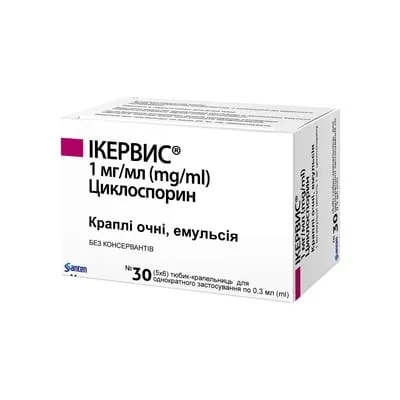
IKEERVIS®
UkraineThe drug is prescribed for adults for the treatment of severe keratitis associated with dry eye syndrome, if previous treatment with artificial tears has not yielded results.
Frequently asked questions
How should Ikeervis® be taken correctly?
One drop should be instilled into the affected eye (or both eyes) once daily before bedtime. After instillation, it is recommended to close your eyes for 2 minutes while applying pressure with a finger to the area near the nasolacrimal duct to reduce systemic absorption of the drug.
What are the possible side effects of Ikeervis®?
The most common side effects are eye pain and eye irritation. Eye redness, increased tearing, eyelid swelling, blurred vision, itching, or a foreign body sensation in the eye may also occur. Some patients may experience headaches.
Who should not use this drug?
Contraindications include hypersensitivity to the components of the drug, malignant or pre-malignant neoplasms of the eye or adjacent tissues, as well as existing or suspected eye infections.
Can contact lenses be worn during treatment?
Contact lenses must be removed before bedtime when you are about to instill the drug. They may be worn again after waking up.
Does the drug affect the ability to drive?
The drug may cause temporary double vision or other visual disturbances. It is not recommended to drive vehicles or operate machinery until vision has returned to normal.
Can the drug be used during pregnancy or breastfeeding?
Use is not recommended for pregnant women unless the potential benefit outweighs the risk to the fetus. When breastfeeding, the benefits of breastfeeding versus the benefits of therapy for the mother should be weighed.
How does the drug interact with other agents?
If you are using other eye drops, particularly corticosteroids, this may enhance the effect of cyclosporine. There should be an interval of at least 15 minutes between the application of different ophthalmic products, and Ikeervis® should be used last.
Instructions for use
INSTRUCTIONS FOR MEDICAL USE OF THE MEDICINAL PRODUCT IKEVRIS®
Composition:
Active substance: cyclosporine;
1 ml of emulsion contains 1 mg of cyclosporine;
Excipients: cetalkonium chloride, medium-chain triglycerides, tyloxapol, glycerin, poloxamer 188, 0.1 N sodium hydroxide, water for injections.
Pharmaceutical form. Eye drops, emulsion.
Main physicochemical properties: milky-white liquid.
Pharmacotherapeutic group. Agents used in ophthalmology. Other ophthalmological agents. Cyclosporine.
ATC code S01X A18.
Pharmacological Properties
Pharmacodynamics
Mechanism of Action and Pharmacodynamic Effect
Cyclosporine (also known as cyclosporine A) is a cyclic polypeptide with immunomodulatory properties that exerts immunosuppressive effects. The drug has been shown to increase survival of allogeneic grafts in animals and significantly prolong survival of transplanted organs in humans.
Cyclosporine has also demonstrated anti-inflammatory effects.
Animal studies have shown that cyclosporine suppresses the development of cell-mediated reactions. Cyclosporine has been shown to inhibit the production and release of pro-inflammatory cytokines, including interleukin-2 (IL-2), also known as T-cell growth factor (TCGF), while increasing the release of anti-inflammatory cytokines and arresting lymphocytes in the G0 or G1 phase of the cell cycle. All available data indicate that cyclosporine exerts a specific, reversible effect on lymphocytes without suppressing hematopoiesis and without affecting phagocytes. In patients with dry eye syndrome, the disease may be considered an immune-inflammatory process. Upon topical application, cyclosporine passively penetrates into T-lymphocyte infiltrates in the cornea and conjunctiva and inactivates calcineurin phosphatase. Inactivation of calcineurin leads to inhibition of dephosphorylated transcription factors NF-AT and prevents their translocation into the nucleus, thereby blocking the release of pro-inflammatory cytokines such as IL-2.
Clinical Efficacy and Safety
The efficacy and safety of the medicinal product IKERVIS® were evaluated in two randomized, double-blind, placebo-controlled clinical trials involving adult patients with keratoconjunctivitis sicca (dry eye syndrome) who met the criteria of the International Dry Eye Workshop (DEWS).
In a 12-month, double-blind, controlled clinical trial (SANSIKA), 246 patients with dry eye disease (DED) and severe keratitis (severity assessed by corneal fluorescein staining [CFS] with a score of 4 on the modified Oxford scale [CFS]) were randomized to receive either 1 drop of IKERVIS® or vehicle once daily at bedtime for 6 months. Patients in the vehicle group were switched to IKERVIS® after 6 months. The primary endpoint was the proportion of patients achieving at least a 2-grade improvement in keratitis severity (on the CFS scale) and a 30% improvement in symptoms assessed by the Ocular Surface Disease Index (OSDI). Improvement was observed in 28.6% of patients in the IKERVIS® group compared to 23.1% in the control group. The difference was not statistically significant (p = 0.326).
The severity of keratitis, assessed using the CFS scale, showed a statistically significant reduction from baseline after 6 months of treatment with IKERVIS® compared to control (mean change from baseline was –1.764 in the IKERVIS® group versus –1.418 in the control group, p = 0.037). The proportion of patients in the IKERVIS® group who achieved a 3-grade improvement on the CFS scale after 6 months (from grade 4 to grade 1) was 28.8%, compared to 9.6% in the vehicle group; however, this result was derived from a post-hoc analysis, which limits its reliability. The beneficial effect on keratitis treatment was maintained during the open-label phase from 6 to 12 months.
The mean change from baseline on the 100-point OSDI scale was 13.6 with IKERVIS® and 14.1 with the vehicle after 6 months (p = 0.858). Furthermore, no improvements were observed with IKERVIS® compared to vehicle after 6 months for other secondary endpoints, including ocular discomfort score, Schirmer test, use of concomitant artificial tears, overall efficacy assessment by investigators, tear film break-up time (Norn test), lissamine green staining, quality of life scores, and tear osmolarity.
IKERVIS® was superior regarding reduction in ocular surface inflammation (p = 0.021), assessed after 6 months by measuring expression of human leukocyte antigen-DR (HLA-DR) (an exploratory endpoint).
In a 6-month, double-blind, placebo-controlled clinical trial (SICCANOVE) involving 492 patients with dry eye syndrome and moderate to severe keratitis (defined by CFS scores from 2 to 4), participants were randomized to receive either IKERVIS® or vehicle once daily at bedtime for 6 months. The primary endpoints were changes in CFS score and overall ocular discomfort score (not related to instillation of the study drug) assessed after 6 months. A small but statistically significant difference in CFS improvement was observed between treatment groups in favor of IKERVIS® over 6 months (mean reduction from baseline in CFS: –1.05 with IKERVIS® and –0.82 with vehicle, p = 0.009).
The mean reduction from baseline in ocular discomfort score (assessed by Visual Analog Scale) was –12.82 with IKERVIS® and –11.21 with vehicle (p = 0.808). In both studies, no significant improvement in symptoms with IKERVIS® compared to control was observed after 6 months of treatment, as assessed by Visual Analog Scale or OSDI. In both studies, approximately one-third of patients had Sjögren’s syndrome; in this subgroup, a statistically significant improvement in CFS was observed with IKERVIS® compared to control, consistent with the overall population.
Following completion of the SANSIKA study (12 months duration), patients were offered participation in the Post-SANSIKA study, an open-label, non-randomized, single-group study in which patients received IKERVIS® or no treatment depending on their CFS score (patients received IKERVIS® upon worsening of keratitis). This study was designed to monitor long-term efficacy and recurrence rates in patients previously treated with IKERVIS®.
The main objective was to evaluate the duration of improvement after discontinuation of IKERVIS®, once the patient’s condition had improved by at least 2 grades from baseline on the modified Oxford scale (as assessed in the SANSIKA study).
A total of 67 patients were included in the study (37.9% of 177 patients who completed SANSIKA). After a 24-month period, 61.3% of the 62 patients in the primary efficacy population remained free of recurrence based on CFS assessment. The proportion of patients experiencing severe recurrence of keratitis was 35% and 48% in the groups previously treated with IKERVIS® for 12 and 6 months, respectively, during the SANSIKA study.
Based on first quartile data (median could not be estimated due to low number of recurrences), time to recurrence (return to CFS grade 4) was ≤224 days and ≤175 days for patients previously treated with IKERVIS® for 12 and 6 months, respectively. Patients remained longer at CFS grade 2 (median 12.7 weeks/year) and grade 1 (median 6.6 weeks/year) than at CFS grade 3 (median 2.4 weeks/year), with CFS grades 4 and 5 showing a mean duration of 0 weeks/year.
Assessment of dry eye disease (DED) symptoms using the Visual Analog Scale (VAS) showed increased discomfort after initial discontinuation of treatment until its resumption, except for pain, which remained relatively low and stable.
The overall mean VAS score increased from the time of first discontinuation (23.3%) to the time of treatment resumption (45.1%). No significant changes were observed in other secondary endpoints (TBUT, lissamine green staining, Schirmer test, NEI-VFQ, and EQ-5D) during the extended study period.
Pharmacokinetics
Formal pharmacokinetic studies of IKERVIS® in humans have not been conducted.
Cyclosporine concentrations in blood were measured using a specific high-performance liquid chromatography/mass spectrometry method. Plasma concentrations of cyclosporine were measured in 374 patients from two efficacy studies before treatment initiation and after 6 months (SICCANOVE and SANSIKA) and 12 months (SANSIKA) of treatment. After 6 months of once-daily IKERVIS® administration, cyclosporine plasma concentrations were below the lower limit of detection (0.050 ng/mL) in 327 of 362 patients, and below the lower limit of quantification (0.100 ng/mL) in 35 patients. Measurable concentrations not exceeding 0.206 ng/mL were detected in 8 patients, which are considered acceptably low. In 3 patients, concentrations exceeded the upper limit of detection (5 ng/mL), but these patients were already receiving oral cyclosporine at a stable dose, which was permitted by the study protocols. After 12 months of treatment, concentrations were below the limit of detection in 56 patients and below the lower limit of quantification in 19 patients. Seven patients had values ranging from 0.105 to 1.27 ng/mL. In 2 patients, concentrations exceeded the upper limit of detection; however, these patients were also receiving oral cyclosporine at a stable dose since study entry.
Clinical characteristics.
Indications.
Treatment of severe keratitis in adult patients with dry eye syndrome in the absence of improvement with artificial tear therapy.
Contraindications.
Hypersensitivity to the active substance or to any other component of the medicinal product.
Malignant tumors of the eye or adjacent tissues or premalignant conditions.
Eye infections or infections of adjacent tissues or suspicion thereof.
Interaction with other medicinal products and other forms of interaction.
ICERVIS**®** has not been studied in interaction studies.
Concomitant use of ICERVIS**®** with ophthalmic drops containing corticosteroids may enhance the effect of cyclosporine on the immune system (see section "Special precautions for use").
Special precautions for use.
The use of the medicinal product IKERVIS**®** in patients with a history of herpes simplex eye infection has not been studied; therefore, it should be used with caution in such patients.
Contact lenses
The use of the product in patients wearing contact lenses has not been studied. Careful monitoring of patients with severe keratitis is required. Contact lenses should be removed before bedtime when using the product and reinserted after awakening.
Concomitant therapy
There is limited experience with the use of cyclosporine in patients with glaucoma. Regular clinical monitoring is necessary when IKERVIS**®** is used in such patients concomitantly with other medicinal products, particularly beta-adrenergic blockers, which are known to reduce tear production.
Effect on the immune system
Ophthalmic medicinal products affecting the immune system, including cyclosporine, may influence the host's defense against local infections and malignancies. Therefore, regular eye examinations—at least once every 6 months—are recommended when IKERVIS**®** is used for prolonged periods.
Content of cetalkonium chloride
IKERVIS**®** contains cetalkonium chloride. Contact lenses should be removed before instillation of the product and reinserted after awakening.
Cetalkonium chloride has been reported to cause eye irritation. Patients should be monitored during long-term treatment with the product.
Use during pregnancy or breastfeeding
IKERVIS**®** is not recommended for women of childbearing potential who are not using effective contraception.
Pregnancy
There are no data on the use of IKERVIS**®** in pregnant women.
Animal studies have shown reproductive toxicity with systemic administration of cyclosporine at doses significantly exceeding the maximum doses used in humans. However, this finding has minimal relevance to the clinical use of IKERVIS**®**.
IKERVIS**®** is not recommended during pregnancy unless the potential benefit justifies the potential risk to the fetus.
Breastfeeding
After oral administration, cyclosporine is excreted in breast milk. There is insufficient information on the effects of cyclosporine on newborns or infants. However, when cyclosporine is administered as ophthalmic drops at therapeutic doses, it is unlikely that significant amounts will be present in breast milk. A decision should be made whether to discontinue breastfeeding or to discontinue/withhold IKERVIS**®** therapy, taking into account the benefits of breastfeeding for the child and the benefits of treatment for the mother.
Fertility
There are no data on the effects of IKERVIS**®** on human fertility.
No impairment of fertility was observed in animals treated intravenously with cyclosporine.
Ability to affect reaction speed when driving or operating machinery
IKERVIS**®** has a moderate influence on the ability to drive vehicles or operate machinery.
The medicinal product may cause transient blurred vision or other visual disturbances that could affect the ability to drive or operate machinery (see section "Adverse reactions"). Patients are advised not to drive or operate machinery until normal vision is restored.
Method of Administration and Dosage
IKERVIS**®** should be prescribed by an ophthalmologist.
The medicinal product should be instilled into the conjunctival sac.
Precautions to be taken prior to administration of the medicinal product
Patients should wash their hands before administration.
The single-use dropper tube should be gently shaken before use.
For single use only. The contents of one single-use dropper tube are sufficient for instillation into both eyes. Unused emulsion should be immediately discarded.
Patients should be advised to perform nasolacrimal occlusion and keep their eyes closed for 2 minutes after administration to reduce systemic absorption. This will reduce the likelihood of systemic adverse effects and may enhance local activity of the medicinal product.
When using multiple topical ophthalmic medicinal products, at least a 15-minute interval should be maintained. IKERVIS**®** should be administered last (see section "Special instructions for use").
Dosage
The recommended dose is 1 drop of the medicinal product once daily in the affected eye(s) before bedtime.
Response to treatment should be evaluated no less than once every 6 months.
If a dose is missed, treatment should be continued the next day according to the usual schedule. Patients should be advised not to instill more than one drop into the affected eye(s).
Special patient groups
Elderly patients
Use in elderly patients was studied during clinical trials.
Dose adjustment is not required.
Patients with renal or hepatic impairment
The effect of cyclosporine has not been studied in patients with hepatic or renal dysfunction. However, no special precautions are required for these patients.
Children
There is insufficient experience with the use of cyclosporine in children (under 18 years of age) for the treatment of severe keratitis associated with dry eye disease without improvement despite artificial tear therapy.
Overdose.
Local overdose following instillation of the medicinal product into the eye is unlikely. In the event of overdose with IKERVIS**®**, symptomatic and supportive therapy should be administered.
Adverse reactions
The most frequently reported adverse reactions were eye pain (19.0%), eye irritation (17.5%), ocular hyperemia (5.5%), increased lacrimation (4.9%), and eyelid erythema (1.7%). These reactions were generally transient and occurred after instillation of the medication.
These adverse reactions are consistent with those reported during post-marketing use.
List of adverse reactions in tabular form
The adverse reactions listed below were obtained during clinical trials or during post-marketing use.
They are listed by system organ classes and classified according to frequency: very common (≥ 1/10), common (≥ 1/100 to < 1/10), uncommon (≥ 1/1000 to < 1/100), rare (≥ 1/10,000 to < 1/1000), very rare (< 1/10,000), and frequency not known (cannot be estimated based on available data).
| Organ system class |
Frequency |
Adverse reactions |
| Infections and infestations |
Uncommon |
Bacterial keratitis, herpes zoster ophthalmicus |
| Eye disorders |
Very common |
Eye irritation, eye pain |
| Common |
Blepharitis erythema, increased lacrimation, eye hyperemia, blurred vision, eyelid edema, conjunctival hyperemia, eye pruritus |
|
| Uncommon |
Conjunctival edema, lacrimation disorder, eye discharge, conjunctival irritation, conjunctivitis, foreign body sensation in eye, ocular deposits, keratitis, blepharitis, chalazion, corneal infiltrates, corneal scarring, eyelid pruritus, iridocyclitis, eye discomfort |
|
| General disorders and administration site conditions |
Uncommon |
Application site reaction |
| Nervous system disorders |
Uncommon |
Headache |
Description of individual adverse reactions
Eye pain
Clinical studies have frequently reported pain at the application site as an adverse reaction during treatment with IKERVIS®. This is likely related to the effect of cyclosporine.
Generalized and local infections
Patients receiving immunosuppressive therapy, including cyclosporine, are at increased risk of developing infections. Both generalized and local infections may occur. Exacerbation of pre-existing infections is also possible (see section "Contraindications"). Infrequent cases of infections associated with the use of IKERVIS® have been reported.
As a precautionary measure, steps should be taken to minimize systemic absorption (see section "Dosage and administration").
Reporting suspected adverse reactions
Reporting of suspected adverse reactions after authorization of the medicinal product is important. It allows continued monitoring of the benefit-risk balance of the medicinal product. Healthcare professionals and pharmacists, as well as patients or their legal representatives, should report all suspected adverse reactions and lack of efficacy through the Automated Pharmacovigilance Information System at the following link: https://aisf.dec.gov.ua.
Shelf life.
3 years.
Storage conditions.
Store at a temperature not exceeding 25 °C. Do not freeze.
After opening the aluminum pouches, store the single-dose containers in a dark place to prevent evaporation.
Any opened single-dose container with residual emulsion should be discarded immediately after use.
Keep out of reach of children.
Packaging.
No. 30 (5 × 6) single-dose dropper bottles of 0.3 mL each, in laminated aluminum pouches, 5 dropper bottles per pouch, 6 pouches per cardboard box.
Prescription status.
Prescription only.
Manufacturer.
Santen Oy, Finland.
Manufacturer's address and location of business operations.
Keltinportintie 1, Tampere, 33100, Finland.
The original data is available in the language of the country of manufacture.
Data source: State Register of Medicinal Products of Ukraine
Data last verified: August 13, 2026