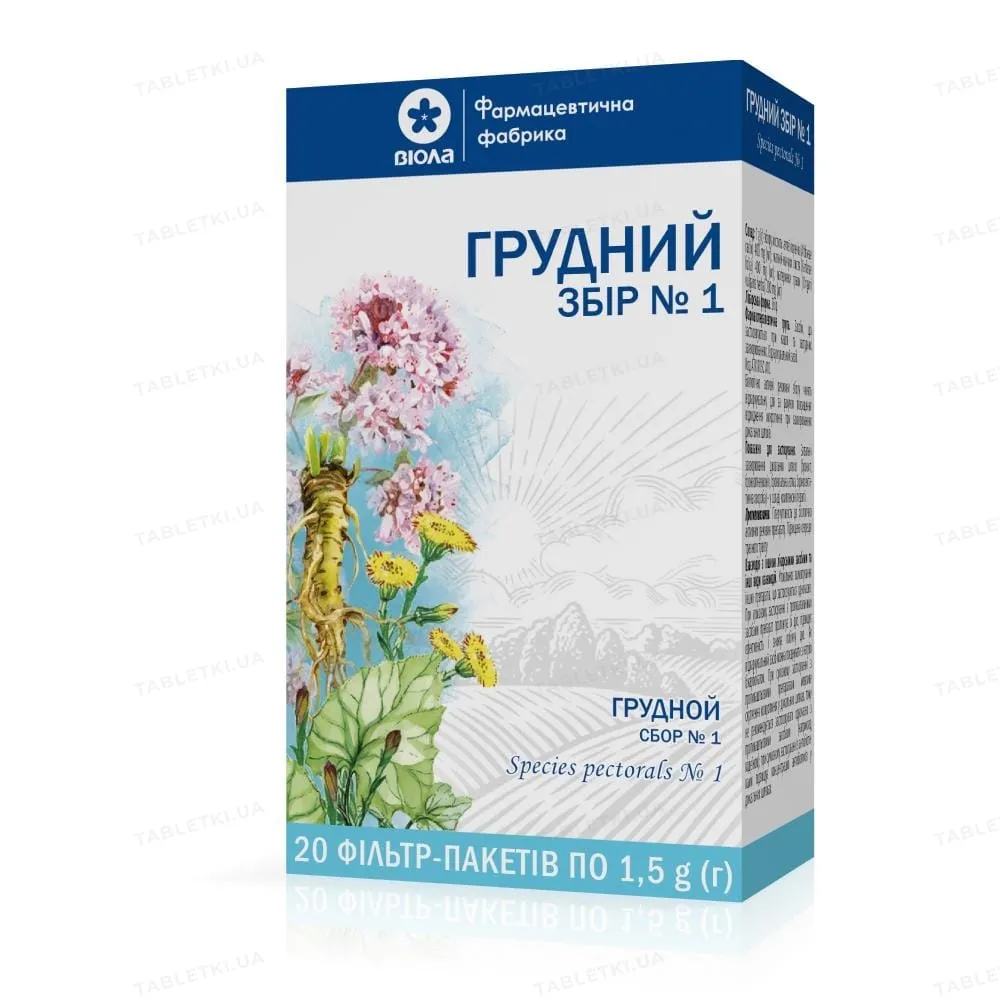
CHEST COLLECTION № 1
UkraineIt is used as an expectorant for inflammatory diseases of the respiratory tract, such as bronchitis, bronchopneumonia, bronchial asthma, and bronchiectatic disease (as part of complex therapy).
Frequently asked questions
How should the preparation be prepared and taken?
To prepare, pour 200 ml of boiled water at room temperature over 1 tablespoon of the collection and infuse in a water bath for 15 minutes. After cooling and straining, the volume of the infusion should be topped up with water to 200 ml. Take the infusion warm 2–3 times a day after meals. Dosage depends on age: adults and children over 14 years — 1/2 cup; children 12–14 years — 1/4 cup; 7–12 years — 2 tablespoons; 3–7 years — 1 tablespoon.
Who should not use Chest collection № 1?
The preparation is contraindicated in cases of increased secretion of the digestive tract and individual sensitivity to its components. It is also prohibited during pregnancy and breastfeeding.
What are the possible side effects?
Possible allergic reactions (skin rash, itching, edema, redness), increased salivation, and irritation of the gastric mucosa. Overdose may cause nausea and vomiting.
Can this product be combined with other medicines?
The preparation may slow the absorption of other drugs, but when used with anti-inflammatory agents, it enhances their effect and reduces side effects. It can be combined with sodium bicarbonate and antibiotics (the latter become more effective in the respiratory tract). However, it is not recommended to take it simultaneously with antitussive agents (e.g., codeine), as this may lead to mucus accumulation.
Are there any special precautions for use?
It is not recommended for dry cough, as it may exacerbate it. If shortness of breath, fever, or purulent sputum occurs during treatment, you must consult a physician immediately.
Instructions for use
INSTRUCTION FOR MEDICAL USE OF THE MEDICINAL PRODUCT CHEST COLLECTION № 1 (SPECIES PECTORALES № 1)
Composition:
Active ingredients: Althaea root (Althaeae radix); Coltsfoot leaves (Farfarae folia); Oregano herb (Origani vulgaris herba);
1 g of the collection contains: Althaea root (Althaeae radix) 400 mg; Coltsfoot leaves (Farfarae folia) 400 mg; Oregano herb (Origani vulgaris herba) 200 mg.
Pharmaceutical form. Herbal collection.
Main physicochemical properties:
Crushed raw material: a mixture of white fibrous fragments of marshmallow root; fragments of coltsfoot leaves, green on top and white-woolly on the underside; and oregano herb consisting of dark violet flowers, green leaf fragments with dark spots (visible under magnification), and stem fragments with a violet tint, crushed to particle size of about 5 mm. Weak, pleasant odor; taste of aqueous extract slightly mucilaginous and spicy.
Coarse powder: a mixture of white fibrous fragments of marshmallow root; fragments of coltsfoot leaves, green on top and white-woolly on the underside; and oregano herb consisting of dark violet flowers, green leaf fragments with dark spots (visible under magnification), and stem fragments with a violet tint, crushed to particle size of about 2 mm. Weak, pleasant odor; taste of aqueous extract slightly mucilaginous and spicy.
Pharmacotherapeutic group. Medicinal products used in cough and colds. Expectorant agent. ATC code R05CA10.
Pharmacological Properties.
Pharmacodynamics.
The biologically active substances of the herbal mixture exert an expectorant effect by improving the discharge of sputum in respiratory tract diseases.
Clinical characteristics.
Indications.
Inflammatory diseases of the respiratory tract (bronchitis, bronchopneumonia, bronchial asthma, bronchiectasis) – as part of complex therapy.
Contraindications.
Hypersensitivity to the biologically active substances of the drug. Increased gastrointestinal secretion.
Interaction with other medicinal products and other forms of interactions. Slows down the absorption of other concurrently administered drugs. When used concomitantly with anti-inflammatory agents, prolongs their effect, enhances efficacy, and reduces adverse effects. As an expectorant, may be combined with sodium bicarbonate. Concurrent use with antitussive agents may lead to mucus accumulation in the respiratory tract; therefore, simultaneous use with antitussives (e.g., codeine) is not recommended. When used concomitantly with antibiotics, increases antibiotic concentration in the respiratory tract.
Special precautions for use.
The drug should be used according to the physician's recommendations. It is not recommended for dry cough, as it may lead to cough intensification. If dyspnea, fever, or purulent sputum develops during treatment, immediate medical advice is required.
Use during pregnancy or breastfeeding. Contraindicated.
Ability to affect reaction rate when driving or operating machinery. Not established.
Administration and Dosage.
Place 1 tablespoon of the herbal mixture into an enameled container, pour 200 ml of boiled room-temperature water over it, cover with a lid, and steep in a water bath for 15 minutes. Cool at room temperature for 45 minutes, strain, squeeze out the residue into the strained infusion. Adjust the infusion volume to 200 ml with boiled water. Take the warm infusion 2–3 times daily after meals: for adults and children aged 14 years and older – 1/2 cup; for children aged 12–14 years – 1/4 cup; for children aged 7–12 years – 2 tablespoons; for children aged 3–7 years – 1 tablespoon.
Place 2 filter bags into a glass or enameled container, pour 200 ml of boiling water over them, cover and let steep for 15 minutes. Take the warm infusion 2–3 times daily after meals: for adults and children aged 14 years and older – 1 cup; for children aged 12–14 years – 1/2 cup; for children aged 7–12 years – 1/4 cup; for children aged 3–7 years – 2 tablespoons.
Shake the infusion before use.
The treatment duration is determined individually by a physician.
Store the prepared infusion in a cool place for no more than 2 days.
Children.
The drug may be used in children aged 3 years and older only as prescribed by a physician.
Overdose.
Nausea, vomiting. Treatment: discontinue the drug, gastric lavage.
Side effects.
Allergic reactions are possible (including hyperemia, skin rashes, itching, skin swelling). Increased salivation, irritation of gastric mucosa.
Shelf life. 2 years.
Do not use after the expiry date stated on the packaging.
Storage conditions.
Store in the original packaging at a temperature not exceeding 25 °C, in a place inaccessible to children.
Packaging.
50 g in packs with inner packet; 1.5 g in filter bags № 20 in a pack.
Prescription status. Over-the-counter.
Manufacturer: JSC Pharmaceutical Factory "Viola".
Manufacturer's address and place of business.
4 Skladska Street, Zaporizhzhia, Ukraine, 69050.
Marketing authorization holder: JSC Pharmaceutical Factory "Viola".
Address of the marketing authorization holder.
75 Amosova Akademika Street, Zaporizhzhia, Ukraine, 69063.
Similar drugs
| Brand name | Dosage form | Active substance / Dosage | Manufacturer |
|---|---|---|---|
| CHEST COLLECTION № 2 | herbal mixture | PJSC Pharmaceutical Factory "Viola" | |
| CHEST COLLECTION № 2 | herbal mixture | PJSC "Lektravy" | |
| CHEST MIXTURE № 1 | herbal mixture | PJSC "Lektravy" | |
| FITOBRONHOL | herbal mixture |
|
PJSC "Lektravy" |
The original data is available in the language of the country of manufacture.
Data source: State Register of Medicinal Products of Ukraine
Data last verified: August 13, 2026