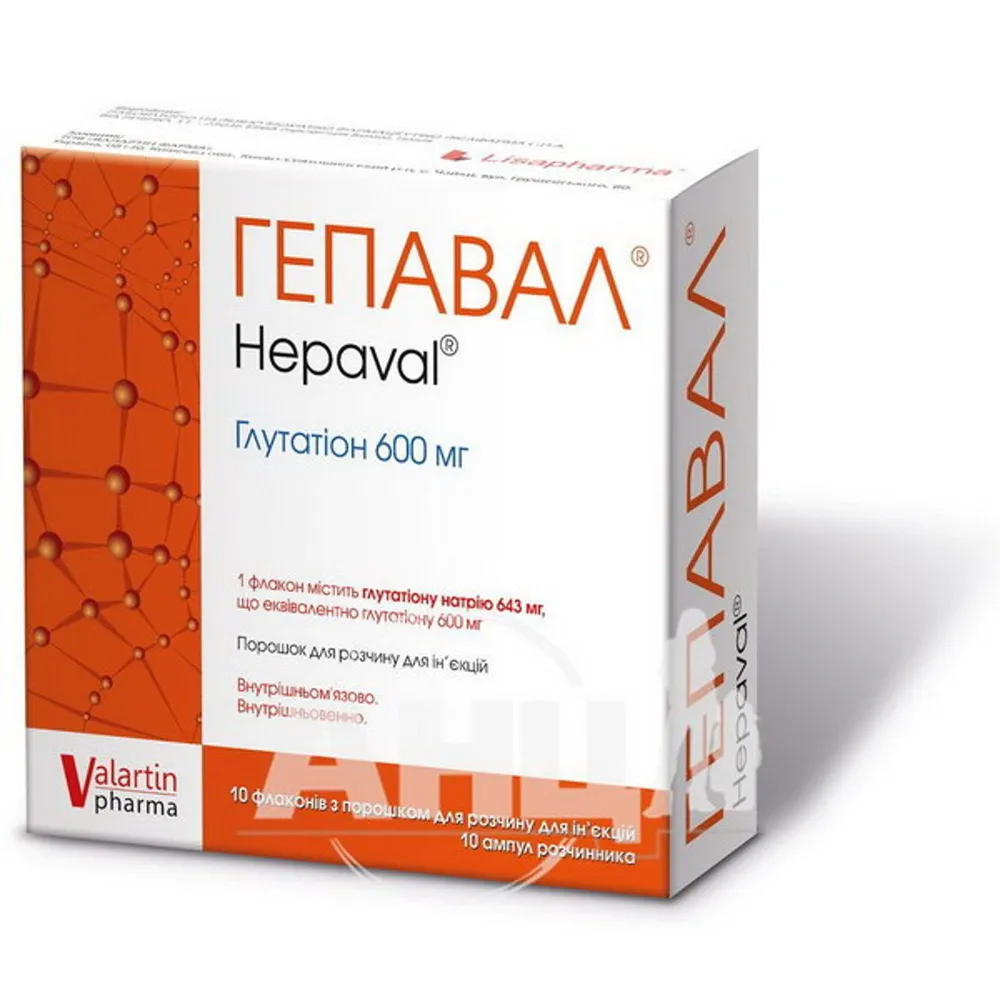
HEPAVAL®
UkraineThe drug is used for the prevention of neuropathy caused by cisplatin chemotherapy or similar substances. It is also prescribed for hepatotoxicity reactions (liver damage) caused by alcohol, medications, or impaired detoxification processes.
Frequently asked questions
How should Hepaval® be taken correctly?
In cases of severe damage, 600–1200 mg (1–2 vials) is administered daily via intramuscular injection or slow intravenous injection. For moderate damage, the dose is reduced by half. For intramuscular administration, the powder is dissolved in the included solvent directly in the vial. For intravenous administration, the solution is administered slowly or via infusion, after being added to at least 20 ml of sterile infusion solution.
What are the possible side effects of Hepaval®?
In rare cases, nausea, vomiting, headache, or skin rashes may occur. These symptoms usually disappear after discontinuing the drug.
Who should not use this drug?
The drug should not be used in case of hypersensitivity to the active substance or other components of the composition. Use is also not recommended for pregnant or breastfeeding women.
Does the drug affect the ability to drive a vehicle?
No, the drug does not affect the ability to drive motor vehicles or other mechanisms.
Can the drug be prescribed to children?
The possibility of using the drug in children has not been studied.
Instructions for use
INSTRUCTION FOR MEDICAL USE OF THE MEDICINAL PRODUCT HEPVAL® HEPAVAL®
Composition:
active substance: glutathione;
1 vial contains 643 mg of sodium glutathione, equivalent to 600 mg of glutathione;
1 ampoule of solvent contains 4 ml of water for injections.
Pharmaceutical form. Powder for solution for injection.
Main physicochemical properties: white hygroscopic powder; clear colorless odorless liquid.
Pharmacotherapeutic group. Antidotes. ATC code V03A B32.
Pharmacological properties.
Pharmacodynamics.
Glutathione is a tripeptide that is a natural component of cells in all tissues of the body. Its widespread presence is associated with a broad spectrum of biological functions and is fundamental for numerous biochemical and metabolic processes.
The sulfhydryl groups of cysteine, which are part of glutathione, act as powerful nucleophilic agents. Consequently, they become the primary target for electrophilic attack by chemical substances or their active metabolites, resulting in the inactivation of potentially toxic exogenous compounds. Thus, the drug exerts a protective effect on vital nucleophilic sites, the attack on which initiates the process of cellular damage.
Furthermore, reduced glutathione (GSH), upon interaction with a large number of oxidized organic metabolites, forms less toxic conjugated compounds, which are subsequently more easily metabolized and excreted as mercapturic acids.
Due to these properties, glutathione is indicated in cases of hepatotoxic reactions, the development mechanisms of which may include ethyl or drug-induced hepatotoxicity, or pathogenetically determined hepatotoxicity associated with impaired detoxification mechanisms.
Pharmacokinetics.
After intravenous administration, glutathione is predominantly distributed into erythrocytes, whereas in plasma it is rapidly broken down by gamma-glutamyltranspeptidase and gamma-glutamyl cyclotransferase. Thus, the plasma level of reduced glutathione (GSH), even after administration of high doses, remains low (peak plasma concentration is approximately 1 nmol/mL at 5 minutes after intravenous administration of 600 mg), while the level of the metabolite cysteine is higher (peak plasma concentration is approximately 17 nmol/mL). The blood concentration measured in whole blood reaches approximately 100 nmol/mL at 5–10 minutes after intravenous administration of 600 mg of glutathione. The drug concentration in blood gradually decreases, nearly returning to baseline levels approximately 60 minutes after administration.
Clinical characteristics.
Indications.
Prevention of neuropathy induced by chemotherapy with cisplatin or other similar substances.
Contraindications.
Hypersensitivity to the active substance or to other components of the medicinal product.
Interaction with other medicinal products and other forms of interaction.
Unknown.
Special precautions for use.
Use during pregnancy or breastfeeding.
Although glutathione showed no signs of embryotoxic or fetotoxic effects in experimental studies, its use is not recommended in pregnant women or women who are breastfeeding.
Ability to influence reaction rate when driving vehicles or operating machinery.
Glutathione does not affect the ability to drive vehicles or operate other machinery.
Method of Administration and Dosage.
In the most severe degree of involvement: 600–1200 mg (1–2 vials) daily by intramuscular or slow intravenous injection.
In moderate degree of involvement: half of the above dose should be administered.
Preparation of the drug for administration.
For intramuscular administration, the drug should be completely dissolved directly in the vial using the solvent provided in the package.
For intravenous administration, the drug should be dissolved with the solvent from the package (water for injections) and administered either by direct slow injection or by infusion after adding the prepared solution to at least 20 ml of sterile infusion solution.
Children. The possibility of use in children has not been studied.
Overdose.
No information regarding overdose is available.
Side effects.
In rare cases, nausea, vomiting, headache, and skin rashes may occur. These reactions usually disappear after discontinuation of therapy.
Shelf life. 3 years.
Storage conditions.
Store in the original packaging at a temperature not exceeding 25 °C.
The reconstituted solution is stable for approximately 2 hours when stored at room temperature and for at least 8 hours when stored at 0° to +5°C.
Keep out of the reach of children.
Packaging.
Powder for solution for injection 600 mg in vials №10, supplied with solvent (water for injection) 4 ml in ampoules №10, in a cardboard box.
Prescription status.
Prescription only.
Manufacturer.
LABORATORIO ITALIANO BIOCHIMICO FARMACEUTICO LISAPHARMA S.P.A.
Manufacturer's address.
VIA LICINIO, 11 – 22036 ERBA (Province of Como), Italy.
Marketing Authorisation Holder.
LLC "VALARTIN PHARMA".
Address of the Marketing Authorisation Holder.
60, Hrushevskoho St., village Chayky, Kyiv-Sviatoshyn district, Kyiv region, 08135, Ukraine.
Similar drugs
| Brand name | Dosage form | Active substance / Dosage | Manufacturer |
|---|---|---|---|
| HEPAVAL® | powder for injection solution |
|
VALARTIN PHARMA LLC (manufacturing in bulk form of the manufacturer LABORATORIO ITALIANO BIOCHIMICO FARMACEUTICO LISAPHARMA S.P.A., Italy, quality control, batch release of the finished medicinal product) |
The original data is available in the language of the country of manufacture.
Data source: State Register of Medicinal Products of Ukraine
Data last verified: August 13, 2026