FOSFOMYCIN
UkraineThe drug is used to treat bacterial infections such as pneumonia (respiratory tract infections), pyelonephritis (urogenital tract infections), peritonitis (digestive tract infections), endometritis (gynecological infections), as well as surgical infections and sepsis.
Frequently asked questions
What is the dosage of Fosfomycin for adults?
Adults are typically prescribed 2–4 g per day. The drug can be administered via intravenous infusion (dissolving the dose in 100–500 ml of saline over 1–2 hours twice daily) or via intravenous bolus (dissolving 2 g in 20 ml of saline over 5 minutes, more than 2–4 times daily).
Who should not take this drug?
Contraindications include hypersensitivity to the components of the drug and severe renal impairment (when creatinine clearance is less than 10 ml/min).
What are the possible side effects of Fosfomycin?
Possible reactions include the nervous system (headache, dizziness, convulsions), digestive tract (diarrhea, nausea, vomiting, abdominal pain), liver (jaundice, changes in liver function tests), heart (tachycardia), as well as allergic reactions (rash, itching, anaphylactic shock) and local reactions at the injection site (pain, phlebitis).
Can the drug be combined with other medicines?
Metoclopramide may reduce the concentration of the drug in the blood and urine. In combination with vancomycin, Fosfomycin becomes more effective against certain resistant bacterial strains. It is important not to mix the drug with other medicines in the same solution: Fosfomycin should be administered first, followed by the other antibiotic.
Can the drug be taken by pregnant or breastfeeding women?
The drug should not be used during pregnancy, as it may cross the placenta. Breastfeeding must be discontinued during treatment.
What safety precautions should be considered during administration?
It is recommended to administer the drug via intravenous infusion as slowly as possible to avoid pain and inflammation of the vein (phlebitis). During prolonged treatment, regular monitoring of liver and kidney function, as well as blood parameters, is necessary.
Instructions for use
INSTRUCTIONS FOR MEDICAL USE OF THE MEDICINAL PRODUCT FOSMICIN (FOSMICIN)
Composition:
Active substance: fosfomycin;
1 vial contains fosfomycin sodium 1 or 2 g;
Excipient: anhydrous citric acid.
Pharmaceutical form. Powder for solution for injection.
Main physicochemical properties: white crystalline powder.
Pharmacotherapeutic group. Antibacterial agents for systemic use. ATC code J01XX01.
Pharmacological properties.
Pharmacodynamics.
Fosfomycin is a broad-spectrum antibiotic. It is effective against most Gram-positive (Enterococcus spp., including Enterococcus faecalis; Staphylococcus spp., including Staphylococcus aureus, Staphylococcus saprophyticus, Staphylococcus epidermidis; Streptococcus spp., including Streptococcus faecalis) and Gram-negative pathogens (Escherichia coli, Citrobacter spp., including Citrobacter diversus, Citrobacter freundii; Enterobacter spp., including Enterobacter aerogenes; Klebsiella spp., including Klebsiella pneumoniae; Morganella morganii, Proteus mirabilis, Proteus vulgaris; Serratia spp., including Serratia marcescens; Pseudomonas spp., including Pseudomonas aeruginosa).
It has no effect on anaerobic flora.
Pharmacokinetics.
Plasma protein binding – 10%. Maximum plasma concentration after slow intravenous infusion of 0.5 g and 1 g is 28 mg/L and 46 mg/L, respectively. Steady-state concentration is 20 mg/L during infusion of 4 g every 6 hours. Accumulation may occur. Elimination half-life is 1.5–2 hours. Excreted 90–100% unchanged by the kidneys within 24 hours, with a minor portion excreted in bile.
Clinical characteristics.
Indications.
Bacterial infections of various localization caused by microorganisms sensitive to fosfomycin (in severe course of infections in combination with other antibiotics, more often with beta-lactams).
- respiratory tract infections (pneumonia);
- urinary and genital system infections (pyelonephritis);
- gastrointestinal tract and abdominal cavity infections (peritonitis);
- gynecological infections (endometritis);
- surgical infections;
- sepsis.
Contraindications.
Hypersensitivity to the components of the drug. Severe renal insufficiency (creatinine clearance less than 10 ml/min).
Interaction with other medicinal products and other types of interactions.
Metoclopramide reduces the concentration of fosfomycin in blood serum and urine. In combination with vancomycin, the drug shows high efficacy against resistant strains of St. aureus.
Special precautions for use.
Before prescribing the drug, a thorough allergic history should be obtained from the patient in order to exclude the possibility of anaphylactic shock.
Fosfomycin should be administered with caution to patients with individual or familial predisposition to allergic reactions such as bronchial asthma, rashes, or urticaria.
Since there are no adequate measures to predict potential risks of shock or anaphylactic reactions following the use of Fosfomycin, the following precautions should be taken:
- a detailed history of the above-mentioned reactions should be obtained;
- it must be confirmed that the patient has no history of allergic reactions to antibiotics or other components of the drug;
- in the event of severe allergic reactions, emergency measures for the treatment of shock should be initiated immediately and administration of the drug should be discontinued;
- the patient should be under close medical supervision at the beginning of treatment.
Patients receiving long-term Fosfomycin therapy should have periodic monitoring of liver and kidney function and hematological parameters. In patients with impaired liver function, the use of the drug may exacerbate the underlying condition.
Generally, once microbial susceptibility to the drug has been confirmed, the duration of Fosfomycin treatment should be kept to the minimum necessary and determined based on the patient's clinical condition in order to prevent the development of resistant microorganisms.
The drug should be administered with caution to patients with arterial hypertension and heart failure.
In renal impairment, reduced clearance of fosfomycin may occur, which may necessitate dose reduction.
Fosfomycin is primarily excreted by the kidneys. The risk of adverse reactions is increased, especially in elderly patients, in whom renal function is usually reduced. Caution is required when selecting doses for elderly patients, as they may require reduced sodium intake due to heart or kidney failure, or arterial hypertension. In individuals aged 75 years and older, there is an increased risk of fosfomycin hepatotoxicity.
Precautions regarding drug administration
The drug should be administered by intravenous infusion whenever possible. It is known that phlebitis and pain at the injection site may occur after administration of this medicinal product. Therefore, careful attention must be paid to the selection of the injection site and administration technique, and the infusion rate should be as slow as possible.
When administering Fosfomycin intravenously in combination with another antibiotic, both drugs must not be mixed in the same solution. Fosfomycin should be administered first, followed by the other antibiotic.
During prolonged treatment with the drug, periodic monitoring of liver and kidney function, as well as routine and biochemical blood tests, is recommended.
Any unused diluted or remaining drug solution must be destroyed.
Use during pregnancy or breastfeeding.
Adequate and well-controlled studies on the use of the drug during pregnancy have not been conducted. Therefore, considering the ability of fosfomycin to cross the placenta, the drug should not be used during this period.
Breastfeeding should be discontinued for the duration of treatment.
Ability to affect reaction speed when driving or operating machinery.
Patients should refrain from driving or operating machinery while receiving this drug.
Dosage and Administration.
Adults: the daily dose is 2–4 g.
Children aged 5 years and older: the daily dose is 100–200 mg/kg body weight.
Intravenous infusion.
Dissolve a single dose of the drug in 100–500 ml of 0.9% sodium chloride solution and administer by slow infusion over 1–2 hours, twice daily.
Intravenous bolus injection.
Dissolve 2 g of fosfomycin in 20 ml of 0.9% sodium chloride solution and administer as a bolus injection over 5 minutes or more, 2–4 times daily.
The duration of treatment is determined individually by the physician depending on the nature and course of the disease; usually the treatment course lasts 7–10 days.
Children.
Safety and efficacy of the drug in children under 5 years of age have not been established.
Overdose.
Cases of overdose have not been reported.
Treatment: discontinue the drug. Symptomatic therapy.
Adverse reactions.
Central nervous system: headache, dizziness, paresthesia, seizures (with large doses), hypesthesia, numbness.
Gastrointestinal tract: diarrhea, nausea, vomiting, heartburn, pseudomembranous colitis, stomatitis, anorexia, abdominal pain.
Hepatobiliary system: liver function disturbances, including transient increases in serum alanine aminotransferase, aspartate aminotransferase, alkaline phosphatase, lactate dehydrogenase, and bilirubin levels; jaundice.
Cardiovascular system: chest discomfort, chest tightness, tachycardia.
Blood system: pancytopenia, agranulocytosis, anemia, granulocytopenia, leukopenia, thrombocytopenia, eosinophilia.
Allergic reactions: skin rashes, erythema, urticaria, pruritus, anaphylactic shock.
Urinary system: renal function disturbances, including increased plasma urea concentration, proteinuria, decreased or increased electrolyte concentrations (sodium and potassium).
Respiratory system: cough, bronchospasm, rhinitis.
General disorders: weakness, hot flushes, malaise, thirst, fever, peripheral edema, vaginitis, dysmenorrhea, sore throat, back pain.
Local reactions: injection site changes, including pain and infiltration, phlebitis, pain along the vein.
Shelf life. 3 years.
Storage conditions.
Store in original packaging at a temperature not exceeding 25 °C.
Keep out of reach of children.
Incompatibility.
The drug should not be mixed with other medicinal products in the same container.
Packaging.
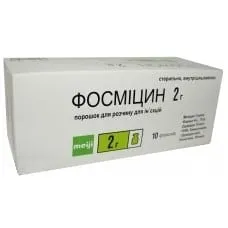
1 g in a vial; 10 vials per box.
2 g in a vial; 10 vials per box.
Prescription category. Prescription only.
Manufacturer.
Meiji Seika Pharma Co., Ltd., Odawara Plant.
Manufacturer's address.
1056, Kamonomiya, Odawara-Shi, Kanagawa, Japan.
Marketing authorization holder.
Meiji Seika Pharma Co., Ltd.
Address of marketing authorization holder and/or its representative.
4-16, Kioicho 2-chome, Chiyoda-ku, Tokyo 104-8002, Japan.
Similar drugs
| Brand name | Dosage form | Active substance / Dosage | Manufacturer |
|---|---|---|---|
| FOSFOMYCIN | powder for injection solution |
|
Meiji Seika Pharma Co., Ltd., Odawara Plant |
The original data is available in the language of the country of manufacture.
Data source: State Register of Medicinal Products of Ukraine
Data last verified: August 13, 2026