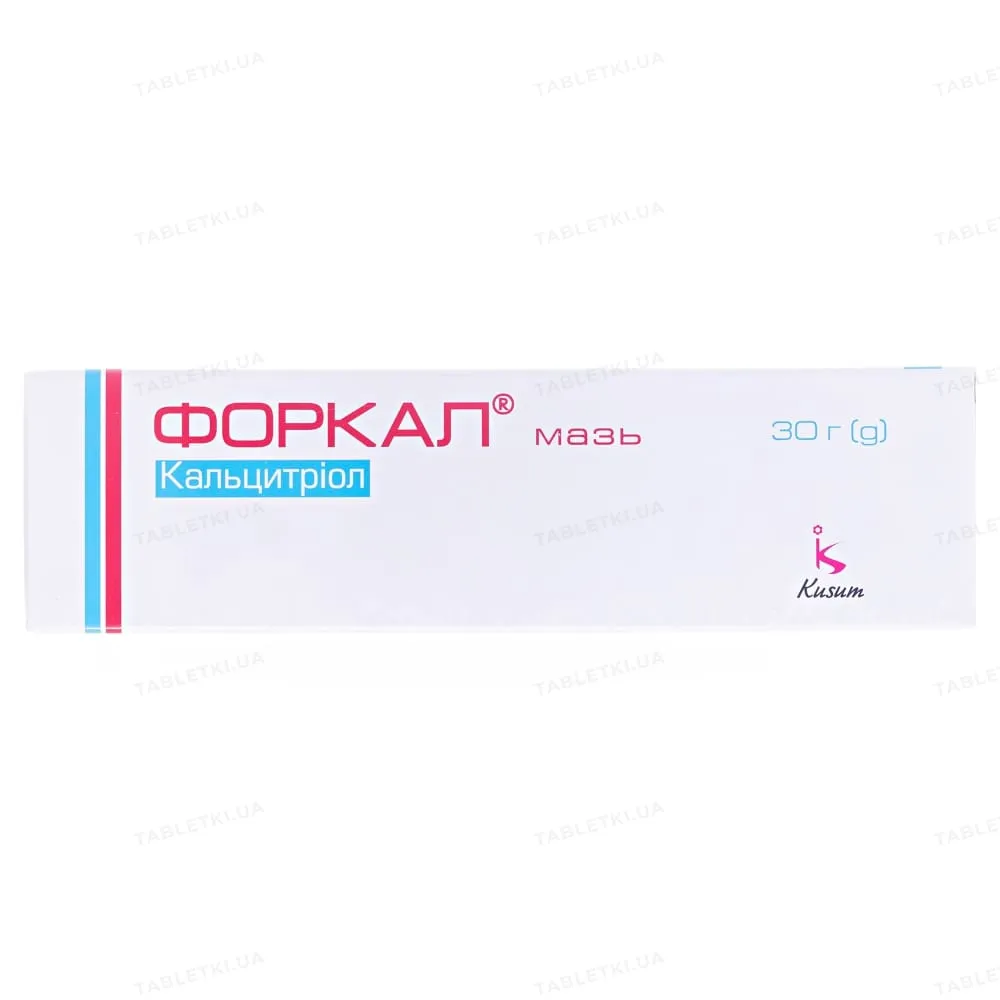
FORCAL®
UkraineThe drug is used for the topical treatment of skin manifestations of mild to moderate plaque psoriasis, if the affected area covers up to 35% of the body surface.
Frequently asked questions
How should Forcal® ointment be used correctly?
Apply the ointment to the affected areas of the skin 2 times a day (in the morning and in the evening before bedtime after washing). Do not use more than 30 g of ointment per day and do not treat more than 35% of the body surface daily. Always wash your hands after application.
Who should not use this drug?
Contraindications include hypersensitivity to the components of the ointment, high blood calcium levels (hypercalcemia) or other calcium metabolism disorders, systemic calcium homeostasis therapy, as well as liver or kidney impairment.
What side effects may occur from using Forcal®?
The most common side effects at the application site are itching, redness, irritation, or a sensation of discomfort. Skin dryness, swelling, or contact dermatitis are also possible. If severe irritation or an allergic reaction occurs, treatment should be discontinued.
Can the ointment be combined with other medicines?
Caution should be exercised if you are taking medications that increase calcium levels (e.g., thiazide diuretics or digoxin), as well as when taking calcium supplements or high doses of vitamin D. It is also not recommended to use peeling agents or other irritating products simultaneously.
Can the ointment be used by children and pregnant women?
The use of the ointment in children under 18 years of age is not recommended due to a lack of established safety. During pregnancy, use is not recommended due to a lack of data. When breastfeeding, the decision regarding the use of the drug should be made by a physician.
What safety precautions should be followed during use?
Do not cover the area treated with the ointment with a bandage and do not add substances that accelerate its absorption. Since the ointment makes fabric (clothing, bed linen) highly flammable, do not smoke or be near open flames.
Instructions for use
INSTRUCTIONS FOR MEDICAL USE OF THE MEDICINAL PRODUCT FORKAL® (PHORCAL®)
Composition:
Active substance: calcitriol;
1 g of ointment contains 3 mcg of calcitriol;
Excipients: soft white paraffin, light mineral oil, alpha-tocopherol.
Pharmaceutical form. Ointment.
Main physicochemical properties: homogeneous ointment of white or almost white color.
Pharmacotherapeutic group.
Topical antipsoriatic agents. ATC code D05AX03.
Pharmacological properties.
Pharmacodynamics.
Mechanism of action.
Calcitriol inhibits keratinocyte proliferation and stimulates keratinocyte differentiation.
Calcitriol also reduces cell adhesion and accelerates desquamation of corneocytes. Calcitriol inhibits proliferation of T-lymphocytes and normalizes production of various inflammatory mediators.
Pharmacokinetics.
Absorption.
With topical application, absorption of calcitriol is approximately 10 %.
After absorption, both unchanged calcitriol and its metabolites are detectable in blood plasma. The impact of metabolites on calcium homeostasis is negligible. In most patients, circulating levels of exogenous calcitriol are below the detection limit (2 \µg/mL).
Distribution
Clinical studies have not shown a significant increase in plasma levels of calcitriol after treatment of large body surface areas up to 6000 cm² (35 % of body surface area).
Indications.
Mild to moderate plaque psoriasis (local treatment of skin manifestations) affecting up to 35 % of body surface area.
Contraindications.
- Hypersensitivity to the active substance or to any of the excipients.
- Hypercalcemia and other pathological conditions characterized by disturbances in calcium metabolism.
- Systemic therapy affecting calcium homeostasis.
- Impaired liver or kidney function.
Interaction with other medicinal products and other forms of interaction.
Forkal® ointment should be used with caution in patients receiving medicinal products that increase blood calcium levels, such as thiazide diuretics, or drugs whose pharmacological effects depend on changes in calcium levels, for example, digoxin. Caution is also advised in patients taking calcium supplements or high doses of vitamin D.
There is no experience with concomitant use of calcitriol and other medicinal products for the treatment of psoriasis.
Information on interactions with systemically acting medicinal products following application of calcitriol ointment is limited.
Forkal® ointment has a weak irritant effect; therefore, its concomitant use with peeling agents or preparations having an irritant or astringent effect may lead to an increased risk of irritant effects.
Special precautions for use
The ointment should be used with caution on the face, as there is an increased risk of irritation in this area. Avoid contact of the ointment with the eyes. Hands should be washed after application to prevent inadvertent transfer of the ointment to unaffected skin areas. It is recommended to treat no more than 35% of the body surface area daily. Do not use more than 30 g of ointment per day.
Due to the potential effect on calcium metabolism, substances that stimulate calcium absorption should not be added to the ointment, and the treated skin area should not be covered with an occlusive dressing.
If severe irritation or allergic reactions occur at the application site, treatment should be discontinued and medical advice sought if necessary. In the case of diagnosed contact dermatitis, treatment discontinuation must be permanent.
Although clinically significant hypercalcaemia has not been observed in clinical studies using calcipotriol ointment at doses below 30 g/day, some absorption of calcipotriol through the skin does occur, and excessive use may lead to systemic adverse effects such as increased calcium levels in urine and serum, which are known effects of calcipotriol.
There is no information on the use of calcipotriol ointment in other clinical forms of psoriasis (other than plaque psoriasis), including Psoriasis guttata acuta, pustular psoriasis, Psoriasis erythrodermica, and rapidly progressive plaque psoriasis.
Patients using Forcal® ointment should not smoke or be near open flames, as there is a risk of clothing catching fire and causing severe burns. Fabrics (clothing, bed linen, dressings, etc.) that have come into contact with the ointment are more flammable and pose a serious fire hazard. Washing clothing or bed linen may reduce ointment accumulation but will not completely remove it.
There is limited clinical data on the use of calcipotriol ointment in children. Based on preclinical data showing greater sensitivity to the toxic effects of calcipotriol in newborn rodents compared to adult animals, the use of calcipotriol ointment in children should be avoided.
Use during pregnancy or breastfeeding
Pregnancy
Use during pregnancy is not recommended due to insufficient data on the use of calcipotriol ointment in pregnant women.
Breastfeeding
Calcipotriol has been detected in the milk of nursing animals. It is not known whether calcipotriol passes into human breast milk; therefore, if Forcal**®** ointment must be used, a decision should be made whether to discontinue breastfeeding.
Ability to affect reaction speed when driving or operating machinery
Forcal**®** ointment has no effect or has a negligible effect on the ability to drive or operate machinery.
Method of Administration and Dosage
For external use only. Apply the ointment to psoriatic skin lesions twice daily (in the morning and in the evening before bedtime, after washing). Daily treatment should not cover more than 35% of the body surface area. Do not apply more than 30 g of ointment per day. Clinical experience with use of the ointment for longer than 6 weeks is limited.
Paediatric Population
The safety and efficacy of calcitriol ointment in children under 18 years of age have not been established. Current available data are described in the section "Children", but dosage recommendations cannot be provided.
Special Patient Groups
Patients with impaired renal or hepatic function should not use Forcal® ointment (see section "Contraindications").
Children
The safety and efficacy of calcitriol use in children under 18 years of age have not been established.
Overdose
The most common symptoms following accidental oral ingestion of calcitriol ointment include anorexia, nausea, vomiting, constipation, hypotension, and depression. Occasionally, lethargy and coma may occur. In the event of hypercalcaemia or hypercalciuria, Forcal**®** ointment should be discontinued until serum or urinary calcium levels return to normal.
Excessive application of the ointment will not result in faster or better therapeutic effect and may lead to marked erythema, desquamation, or discomfort.
Side effects.
Side effects usually occur in 10–20% of patients at the site of ointment application on the skin and are of mild or moderate intensity.
The side effects listed below are categorized by organ systems and frequency: very common (≥ 1/10), common (≥ 1/100, < 1/10), uncommon (≥ 1/1000, < 1/100), rare (≥ 1/10000, < 1/1000), very rare (< 1/10000, including isolated cases), unknown (frequency cannot be estimated from available data).
Skin and subcutaneous tissue disorders:
common – pruritus, sensation of discomfort, skin irritation, erythema (redness);
uncommon – skin dryness, psoriasis (exacerbation);
unknown* – skin swelling, contact dermatitis.
*Side effects reported during post-marketing surveillance.
In case of severe irritation or contact allergy, application of Forcal**®** ointment should be discontinued and medical advice should be sought. If contact allergy is confirmed, the use of the medicinal product should be permanently discontinued.
Reporting of suspected adverse reactions.
Reporting of adverse reactions after medicinal product registration is important. It allows continuous monitoring of the benefit-risk balance of the medicinal product. Healthcare professionals and patients, as well as their legal representatives, are encouraged to report all suspected adverse reactions and lack of efficacy through the Automated Information System for Pharmacovigilance at the following link: https://aisf.dec.gov.ua.
Shelf life. 3 years.
Storage conditions.
Store at a temperature not exceeding 25 °C in the original packaging and protected from light.
Keep out of reach of children.
Packaging.
30 g, 100 g in tubes, 1 tube per cardboard pack.
Prescription status.
Prescription only.
Manufacturer.
Kusum Healthcare Pvt Ltd.
Address of the manufacturer and location of business operations.
SP-289 (A), RIICO Industrial area, Chopanki, Bhiwadi, Dist. Alwar (Rajasthan), India.
INSTRUCTIONS
for medical use of the medicinal product
FORCAL®
(PHORCAL®)
Composition:
Active ingredient: calcitriol;
1 g of ointment contains 3 mcg of calcitriol;
Excipients: white soft paraffin, light mineral oil, alpha-tocopherol.
Pharmaceutical form. Ointment.
Main physicochemical properties: homogeneous ointment of white or almost white color.
Pharmacotherapeutic group.
Topical antipsoriatic agents. ATC code D05AX03.
Pharmacological properties.
Pharmacodynamics.
Mechanism of action.
Calcitriol inhibits keratinocyte proliferation and stimulates keratinocyte differentiation.
Calcitri0l also reduces adhesion and accelerates desquamation of corneocytes. Calcitriol inhibits proliferation of T-lymphocytes and normalizes production of various inflammatory mediators.
Pharmacokinetics.
Absorption.
Following topical application, approximately 10 % of calcitriol is absorbed.
After absorption, both unchanged calcitriol and its metabolites are detectable in blood plasma. The effect of metabolites on calcium homeostasis is negligible. In most patients, circulating levels of exogenous calcitriol are below the detection limit (2 pg/mL).
Distributi0n.
Clinical studies have not shown a significant increase in plasma levels of calcitriol after application to large body surface areas up to 6000 cm2 (35 % of body surface area).
Indications.
Mild to moderate plaque psoriasis (local treatment of skin manifestations) affecting up to 35 % of body surface area.
Contraindications.
- Hypersensitivity to the active substance or to any of the excipients.
- Hypercalcemia and other pathological conditions characterized by disturbances in calcium metabolism.
- Systemic therapy for calcium homeostasis.
- Impaired liver or kidney function.
Interaction with other medicinal products and other forms of interaction.
Forcal® ointment should be used with caution in patients receiving medicinal products that increase blood calcium levels, such as thiazide diuretics, or medicinal products whose pharmacological effects depend on changes in calcium levels, for example digoxin. Caution should also be exercised in patients receiving calcium supplements or high doses of vitamin D.
There is no experience with concomitant use of calcitriol and other medicinal products for the treatment of psoriasis.
Information on interactions between systemically acting medicinal products following application of calcitriol ointment is limited.
Forcal® ointment has a weak irritant effect; therefore, its concomitant use with peeling agents or preparations having an irritant or astringent effect may lead to increased irritant effects.
Special precautions for use
The ointment should be used with caution on the face, as there is an increased risk of irritation in this area. Avoid contact of the ointment with the eyes. Hands should be washed after application to prevent inadvertent transfer of the ointment to unaffected areas. Daily treatment should not exceed 35% of the body surface area. Do not use more than 30 g of ointment per day.
Due to the potential effect on calcium metabolism, substances that stimulate calcium absorption should not be added to the ointment, and the treated skin area should not be covered with an occlusive dressing.
If severe irritation or allergic reactions occur at the site of application, treatment should be discontinued and medical advice sought if necessary. If contact dermatitis develops, treatment must be permanently discontinued.
Although clinically significant hypercalcemia has not been observed in clinical trials using calcipotriol ointment at doses below 30 g/day, some absorption of calcipotriol through the skin does occur, and excessive use of the ointment may lead to systemic adverse effects such as increased calcium levels in urine and serum, which are known effects of calcipotriol.
There is no information regarding the use of calcipotriol ointment in other clinical forms of psoriasis (other than plaque psoriasis), including Psoriasis guttata acuta, pustular psoriasis, Psoriasis erythrodermica, and rapidly progressive plaque psoriasis.
Patients using Forcal® ointment should not smoke or be near open flames, as there is a risk of clothing igniting and causing severe burns. Fabric (clothing, bed linen, dressings, etc.) that has come into contact with the ointment is more flammable and poses a serious fire hazard. Washing clothing or bed linen may reduce accumulation of the ointment but will not completely remove it.
There is limited clinical data on the use of calcipotriol ointment in children. Due to preclinical data showing greater sensitivity to the toxic effects of calcipotriol in newborn rodents compared to adult animals, the use of calcipotriol ointment in children should be avoided.
Use during pregnancy or breastfeeding
Pregnancy
Use during pregnancy is not recommended due to insufficient data on the use of calcipotriol ointment in pregnant women.
Breastfeeding
Calcipotriol has been detected in the milk of nursing animals. It is unknown whether calcipotriol passes into human breast milk; therefore, if Forcal**®** ointment must be used, the decision should be made whether to discontinue breastfeeding.
Ability to affect reaction speed when operating vehicles or machinery
Forcal**®** ointment has no effect or has a negligible effect on the ability to drive vehicles or operate machinery.
Method of Administration and Dosage
For external use only. Apply the ointment to psoriatic skin lesions twice daily (in the morning and evening before bedtime, after washing). Daily treatment should not exceed 35% of the body surface area. Do not use more than 30 g of the ointment per day. Clinical experience with use of the ointment for longer than 6 weeks is limited.
Paediatric population
The safety and efficacy of calcitriol ointment in children under 18 years of age have not been established. Available data are described in the section "Children", but dosage recommendations cannot be provided.
Special patient groups
Patients with impaired renal or hepatic function should not use Forcal® ointment (see section "Contraindications").
Children
The safety and efficacy of calcitriol use in children under 18 years of age have not been established.
Overdose
The most common symptoms following accidental oral ingestion of calcitriol ointment include anorexia, nausea, vomiting, constipation, hypotension, and depression. Occasionally, lethargy and coma may occur. In case of hypercalcaemia or hypercalciuria, Forcal**®** ointment should be discontinued until serum or urinary calcium levels return to normal.
Excessive application of the ointment will not result in faster or better therapeutic effect and may cause marked redness, peeling, or discomfort.
Side effects
Side effects usually occur in 10–20% of patients at the site of ointment application and are of mild or moderate intensity.
The side effects listed below are categorized by organ systems and frequency: very common (≥ 1/10), common (≥ 1/100, < 1/10), uncommon (≥ 1/1,000, < 1/100), rare (≥ 1/10,000, < 1/1,000), very rare (< 1/10,000, including isolated cases), unknown (frequency cannot be determined from available data).
Skin and subcutaneous tissue disorders:
common – pruritus, discomfort, skin irritation, erythema (redness);
uncommon – skin dryness, psoriasis (exacerbation);
unknown* – skin swelling, contact dermatitis.
*Side effects reported during post-marketing surveillance.
In case of severe irritation or contact allergy, use of Forcal**®** ointment should be discontinued and medical advice sought. If contact allergy is confirmed, the drug should be permanently discontinued.
Reporting of suspected adverse reactions.
Reporting of adverse reactions after drug registration is important. It allows continuous monitoring of the benefit-risk balance of the medicinal product. Healthcare professionals and patients, as well as their legal representatives, are encouraged to report all suspected adverse reactions and lack of efficacy via the Automated Pharmacovigilance Information System at: https://aisf.dec.gov.ua.
Shelf life. 3 years.
Storage conditions.
Store at a temperature not exceeding 25 °C in the original packaging and protected from light.
Keep out of reach of children.
Packaging.
30 g in tubes, 1 tube per cardboard pack.
Prescription status.
Prescription only.
Manufacturer.
GLF PHARM LTD LLC.
Manufacturer's location and address of business activity.
54 Davydovskoho Hryhorii Street, Sumy, Sumy region, 40020, Ukraine.
The original data is available in the language of the country of manufacture.
Data source: State Register of Medicinal Products of Ukraine
Data last verified: August 13, 2026