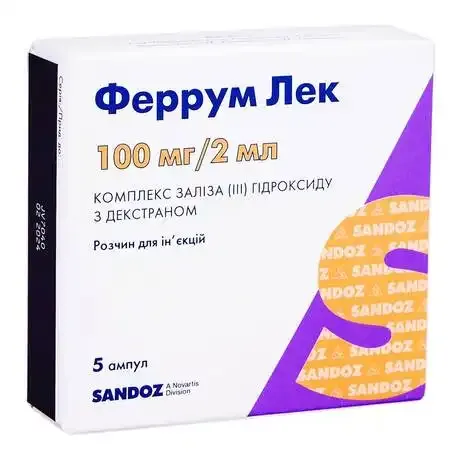
FERRUM LEK
UkraineThe drug is used to treat conditions related to iron deficiency if tablet treatment is ineffective or impossible.
Frequently asked questions
How should Ferrum lek be taken correctly?
The drug should be administered only intramuscularly. The dosage is determined by a physician depending on the patient's weight and hemoglobin levels. Adults are usually prescribed 1–2 ampoules per day; for children, the dose is calculated by a physician (not recommended for children under 4 months of age).
Who should not use this drug?
Contraindications include hypersensitivity to the components, anemia not related to iron deficiency, iron overload in the body (e.g., hemochromatosis), severe blood clotting disorders, and the first trimester of pregnancy.
What are the possible side effects of Ferrum lek?
Possible allergic reactions (itching, rash, swelling), nausea, headache, dizziness, taste changes (metallic taste), as well as pain or inflammation at the injection site. In rare cases, serious reactions such as difficulty breathing or palpitations may occur.
Can this drug be combined with other remedies?
The drug should not be used simultaneously with iron tablets, as this may reduce their effectiveness. Iron tablet intake can be started no earlier than 5 days after the last injection.
What should be done if an allergic reaction occurs?
If signs of a severe allergic reaction (e.g., difficulty breathing) appear after administration, the administration of the drug must be discontinued immediately. The patient must remain under medical supervision for at least 30 minutes after the injection.
Instructions for use
INSTRUCTIONS FOR MEDICAL USE OF THE MEDICINAL PRODUCT FERRUM LEK (FERRUM LEK®)
Composition:
Active substance: iron (III) in the form of iron (III) hydroxide complex with dextran;
1 ampoule (2 ml of solution) contains 100 mg of iron (III) in the form of iron (III) hydroxide complex with dextran;
Excipients: sodium hydroxide, concentrated hydrochloric acid, water for injections.
Pharmaceutical form. Injection solution.
Main physicochemical properties: opaque brown solution.
Pharmacotherapeutic group. Antianaemic agents. Parenteral trivalent iron preparations. ATC code B03AC06.
Pharmacological Properties.
Pharmacodynamics.
Ferum Lek injection solution contains iron in the form of an iron (III) hydroxide dextran complex, which is analogous to the physiological form of iron in the body—ferritin (a protein-bound hydroxy-iron-phosphate complex). Serum ferritin concentration reaches its peak approximately 7–9 days after intravenous administration of Ferum Lek and slowly returns to baseline levels after approximately 3 weeks. Bone marrow studies regarding iron stores following prolonged therapy with iron (III) hydroxide dextran complex may be inaccurate, as residual dextran-iron complex can accumulate in reticuloendothelial cells.
Pharmacokinetics.
After intramuscular injection, the iron (III) hydroxide dextran complex is primarily absorbed via the lymphatic system and diffuses into the bloodstream after approximately 3 days. Data on bioavailability are lacking, but it is known that a considerable portion of the complex is not absorbed from the muscle tissue over a prolonged period. The elimination half-life of the iron (III) hydroxide dextran complex is 3–4 days.
The macromolecular dextran complex enters the reticuloendothelial system, where it dissociates into an iron-containing component and dextran. Iron is then bound to ferritin or hemosiderin and, to a lesser extent, to transferrin, and participates in hemoglobin synthesis. Dextran is either metabolized or excreted. The amount of iron excreted is negligible. Iron is not readily eliminated from the body, and its accumulation can be toxic. Due to its molecular size, the iron (III) hydroxide dextran complex is not excreted by the kidneys. A small amount of iron is excreted in urine and feces.
Clinical characteristics.
Indications.
Treatment of iron deficiency conditions when treatment with oral iron preparations is ineffective or not possible.
Contraindications.
- Hypersensitivity to the active substance or to any of the excipients;
- anemia not related to iron deficiency;
- iron overload (e.g., hemochromatosis, hemosiderosis);
- disorders of iron incorporation into hemoglobin (e.g., anemia due to lead poisoning, sideroblastic anemia);
- severe coagulation disorders (e.g., hemophilia) due to the risk of hematoma formation;
- known serious hypersensitivity to other parenteral iron preparations;
- first trimester of pregnancy (see section "Use during pregnancy or breastfeeding").
Interaction with other medicinal products and other forms of interaction.
As with other parenteral iron preparations, Ferum Lek should not be used concomitantly with oral iron preparations, as this may lead to reduced absorption of orally administered iron. Therefore, treatment with oral iron preparations should not be initiated earlier than 5 days after the last injection of the iron preparation.
The efficacy of parenteral iron preparations may be increased when used concomitantly with angiotensin-converting enzyme (ACE) inhibitors.
Special precautions for use.
Ferrum Lek should be administered only to patients with clearly established indications and after confirmation of the patient's condition by laboratory test results (e.g., serum ferritin, hemoglobin (Hb), hematocrit (Ht), transferrin iron saturation, red blood cell count, or determination of their parameters: mean corpuscular volume, mean corpuscular Hb content, or mean corpuscular Hb concentration). If intestinal iron malabsorption is suspected, this should be additionally confirmed by an iron absorption test.
Hypersensitivity reactions, including severe allergic or anaphylactic/anaphylactoid reactions, which may potentially be fatal, may occur with parenteral administration. Therefore, cardiopulmonary resuscitation equipment and injectable adrenaline solution (1:1000) must be readily available for anti-allergic therapy. In case of a mild allergic reaction, antihistamines should be administered; in case of a severe anaphylactic reaction, adrenaline should be administered and symptomatic treatment initiated. Such reactions have been reported even in cases where previous administration of parenteral iron preparations was uneventful.
Hypersensitivity reactions progressing to Kounis syndrome (acute allergic coronary artery spasm, which may lead to myocardial infarction — see section "Adverse reactions") have been reported.
After administration of the medicinal product, the patient must remain under medical supervision for at least 30 minutes due to the risk of adverse effects.
Patients with asthma, eczema, other atopic allergies, or allergic reactions to other parenteral iron preparations represent a high-risk group for allergic or anaphylactic reactions.
The risk of hypersensitivity reactions with parenteral iron preparations is increased in patients with immune or inflammatory conditions (e.g., systemic lupus erythematosus, rheumatoid arthritis), Crohn's disease, progressive chronic polyarthritis, and in patients with low serum iron-binding capacity and/or folic acid deficiency.
Extreme caution is required when administering the product to patients with hepatic or renal impairment. Iron preparations should be avoided in patients with liver dysfunction caused by iron overload. Careful monitoring of iron levels is recommended to prevent iron overload.
Cardiovascular complications may occur during iron therapy in patients with heart failure or circulatory disorders.
Adverse effects occurring in patients with cardiovascular diseases may worsen the course of the underlying disease.
In patients with elevated ferritin levels, parenteral iron preparations may negatively affect the course of bacterial or viral infections.
Parenteral iron preparations should be used with caution in cases of acute or chronic infection. In patients with chronic infection, a benefit-risk assessment should be performed. It is recommended to discontinue the use of Ferrum Lek in patients with bacteremia.
If anemia is caused by infection or malignancy, administered iron accumulates in the reticuloendothelial system and is utilized by the body only after recovery from the underlying disease.
Particular caution is required when administering Ferrum Lek to patients who are taking any dietary supplements or other products containing iron salts, in order to avoid potential risks associated with iron overdose.
Sediment may form in ampoules if storage instructions are not followed; therefore, ampoules must be carefully inspected before use. Only ampoules containing a homogeneous solution without sediment should be used. The solution should be used immediately after opening the ampoule.
When administering the medicinal product, extravasation should be avoided, as the presence of iron (III) hydroxide complex with dextran at the injection site may cause pain, inflammation, and brown discoloration of the skin.
Use during pregnancy or breastfeeding.
Pregnancy.
Due to the lack of controlled clinical data on intramuscular administration of Ferrum Lek in pregnant women, it should be prescribed only when absolutely necessary and after careful evaluation of the benefit-risk ratio. In most cases, oral iron preparations are used to treat iron-deficiency anemia during the first trimester of pregnancy. Ferrum Lek injection solution may be used during the second and third trimesters only when the expected benefit to the mother and fetus outweighs the potential risks.
Fetal bradycardia may occur with parenteral iron administration, which is usually transient and results from maternal hypersensitivity. Close monitoring of the unborn child is required during intravenous administration of parenteral iron to a pregnant woman.
Breastfeeding.
It is unknown whether iron (III) hydroxide-dextran complex is excreted in breast milk. The use of this medicinal product is not recommended in women who are breastfeeding.
Ability to influence reaction speed when driving or operating machinery.
Data are lacking. Influence on reaction speed when driving or operating machinery is unlikely.
Dosage and Administration
Ferum Lek solution should be administered intramuscularly only! It must not be administered by intravenous injection or infusion.
Patients should be observed for signs of hypersensitivity reactions during and after administration of Ferum Lek. Intramuscular injections may be given only by qualified personnel who can assess the patient's condition and immediately initiate appropriate treatment for anaphylactic reactions and perform resuscitation measures if necessary. After each administration, the patient must remain under medical supervision for at least 30 minutes due to the risk of adverse effects.
The dose of the medicinal product is determined individually depending on the total iron deficit; the calculation is performed using the following formula:
| total iron deficit, mg |
= |
body weight (kg) × [target hemoglobin value (g/L) – actual hemoglobin level (g/L)] × 0.24 + stored iron (mg); |
| for body weight up to 35 kg |
|
target hemoglobin value = 130 g/L, stored iron = 15 mg/kg body weight; |
| for body weight over 35 kg |
|
target hemoglobin value = 150 g/L, stored iron = 500 mg; |
| correction factor 0.24 |
= |
0.0034 × 0.07 × 1000, where: 0.34% — iron content in hemoglobin; 7% — total blood volume as a percentage of body weight; 1000 — conversion factor from grams to milligrams. |
Example calculation:
| body weight |
= 70 kg |
| actual hemoglobin concentration |
= 80 g/l |
| iron incorporated into hemoglobin |
= 70 × 0.24 × (150 – 80) = 1200 mg |
| stored iron |
= 500 mg |
| total iron deficit |
= 1700 mg |
| Total number of ampoules for the course = |
total iron deficit, mg |
100 mg
Table for calculating the total number of vials of the drug per patient depending on body weight and hemoglobin level
| Body weight (kg) |
Total number of ampoules per treatment course |
|||
| hemoglobin 60 g/L |
hemoglobin 75 g/L |
hemoglobin 90 g/L |
hemoglobin 105 g/L |
|
| 5 |
1.5 |
1.5 |
1.5 |
1.0 |
| 10 |
3.0 |
3.0 |
2.5 |
2.0 |
| 15 |
5.0 |
4.5 |
3.5 |
3.0 |
| 20 |
6.5 |
5.5 |
5.0 |
4.0 |
| 25 |
8.0 |
7.0 |
6.0 |
5.5 |
| 30 |
9.5 |
8.5 |
7.5 |
6.5 |
| 35 |
12.5 |
11.5 |
10.0 |
9.0 |
| 40 |
13.5 |
12.0 |
11.0 |
9.5 |
| 45 |
15.0 |
13.0 |
11.5 |
10.0 |
| 50 |
16.0 |
14.0 |
12.0 |
10.5 |
| 55 |
17.0 |
15.0 |
13.0 |
11.0 |
| 60 |
18.0 |
16.0 |
13.5 |
11.5 |
| 65 |
19.0 |
16.5 |
14.5 |
12.0 |
| 70 |
20.0 |
17.5 |
15.0 |
12.5 |
| 75 |
21.0 |
18.5 |
16.0 |
13.0 |
| 80 |
22.5 |
19.5 |
16.5 |
13.5 |
| 85 |
23.5 |
20.5 |
17.0 |
14.0 |
| 90 |
24.5 |
21.5 |
18.0 |
14.5 |
If the total number of ampoules required for the treatment course exceeds the maximum daily dose, administration of the drug should be divided into several doses. If hematological parameters do not normalize after 1–2 weeks of therapy, the established diagnosis and treatment regimen should be re-evaluated.
Calculation of total iron dose required to replenish iron losses due to blood loss.
- When the volume of blood lost is known: administration of 200 mg of iron intramuscularly (2 ampoules) increases hemoglobin level by 1 unit of blood (400 mL of blood containing hemoglobin at 150 g/L).
Total iron dose (mg)
the patient should receive = number of units of blood lost × 200
Total number of ampoules of Ferum Lek
the patient should receive = number of units of blood lost × 2.
- When the reduced hemoglobin level is known: the following formula should be used for calculation, assuming there is no need to replenish stored iron.
Total iron dose (mg) = body weight (kg) × [target hemoglobin level (g/L) –
the patient should receive actual hemoglobin level (g/L)] × 0.24
A patient weighing 60 kg with a hemoglobin deficit of 10 g/L requires administration of 150 mg iron (1½ ampoules of Ferum Lek).
Typically, Ferum Lek solution is administered every other day, deeply into the upper outer quadrant of the gluteal muscle — alternating between left and right.
To avoid pain and skin discoloration, intramuscular injection must be performed properly using a 50–60 mm needle for adults (80–100 mm needle should be used for obese patients) and a 32 mm needle for children. Prior to injection, the skin should be disinfected, and the subcutaneous tissue should be pulled downward by 2 cm to minimize dispersion of the injected solution. After injection, pressure should be applied to the injection site for 1 minute.
Children: administer 0.06 mL of the drug per 1 kg body weight per day (3 mg iron/kg/day).
Adults and elderly patients: 1–2 ampoules of the drug (100–200 mg iron) per day.
Maximum daily doses:
for children: 0.14 mL of the drug per 1 kg body weight (7 mg iron/kg),
for adults: 4 mL (200 mg iron or 2 ampoules) of the drug.
Children.
Due to lack of experience, the use of Ferum Lek injection solution is not recommended in children under 4 months of age (see section "Dosage and administration").
Overdose.
Overdose may lead to acute iron overload, potentially manifesting as hemosiderosis.
No cases of poisoning or iron overload have been reported with overdose of this drug, due to the absence of free iron in the gastrointestinal tract and because iron in the form of a dextran complex is not transported in the body via passive diffusion.
Treatment. Symptomatic therapy. A specific antidote for iron is the chelating agent deferoxamine (an iron-chelating agent) — 1 g intravenously (maximum 15 mg/kg/hour).
Side effects.
Adverse reactions may occur in approximately 5% of patients. Side effects are mainly dose-dependent. Allergic reactions are rare and include urticaria, skin rashes, pruritus, nausea, and drowsiness.
Acute severe anaphylactoid reactions are rare. They usually occur within the first few minutes after administration of the drug and are generally characterized by respiratory distress and/or cardiovascular collapse. Fatal cases have been reported.
If signs of an anaphylactoid reaction occur, administration of the medicinal product must be stopped immediately.
Delayed-type reactions to the drug (occurring from several hours to 4 days after administration) are possible and may be severe. Symptoms may last 2–4 days and resolve spontaneously or after administration of conventional analgesics.
In patients with rheumatoid arthritis, joint pain may be exacerbated.
Local adverse reactions include pain and inflammation at the injection site.
With intramuscular administration, local reactions at the injection site may include skin discoloration, bleeding, subcutaneous inflammation, tissue necrosis or atrophy, and pain.
Adverse effects are classified by frequency of occurrence as follows: very common (≥ 1/10); common (≥ 1/100, < 1/10); uncommon (≥ 1/1,000, < 1/100); rare (≥ 1/10,000, < 1/1,000); very rare (< 1/10,000); frequency not known (cannot be estimated based on available data).
Adverse reactions associated with the use of Ferum Lek solution for injection:
Cardiovascular system.
Rare: arrhythmia, tachycardia, chest pain and tightness.
Very rare: fetal bradycardia, palpitations.
Frequency not known: Kounis syndrome.
Blood and lymphatic system disorders.
Very rare: hemolysis, lymphadenopathy.
Frequency not known: leukocytosis.
Nervous system disorders.
Uncommon: blurred vision, loss of sensation.
Rare: convulsions, dizziness, anxiety, tremor.
Very rare: headache, paresthesia.
Frequency not known: transient disturbance in taste perception (especially metallic taste).
Ear and labyrinth disorders.
Very rare: transient deafness.
Respiratory, thoracic and mediastinal disorders.
Uncommon: dyspnea, bronchospasm.
Frequency not known: respiratory arrest.
Gastrointestinal disorders.
Uncommon: nausea, vomiting, abdominal pain.
Rare: diarrhea.
Musculoskeletal and connective tissue disorders.
Uncommon: muscle spasms and cramps.
Rare: myalgia.
Frequency not known: arthralgia, arthritis, back pain.
Vascular disorders.
Uncommon: hot flushes.
Rare: hypotension, collapse.
Very rare: hypertension.
General disorders and administration site conditions.
Uncommon: feeling of warmth.
Rare: anaphylactic reactions (arthralgia included in rare cases), asthenia, malaise.
Frequency not known: fever, flu-like syndrome which may occur several hours or days after administration, chills.
Immune system disorders.
Uncommon: anaphylactoid reactions, including dyspnea, urticaria, rash, pruritus, nausea, and tremor.
Very rare: acute severe anaphylactoid reactions (sudden respiratory distress and/or cardiovascular failure); fatal outcomes have been reported.
Psychiatric disorders.
Rare: changes in mental status.
Frequency not known: confusion.
Skin and subcutaneous tissue disorders.
Uncommon: pruritus, rash, urticaria, exanthema, erythema.
Rare: Quincke's edema (angioedema), sweating, pain and brownish discoloration at the injection site.
Frequency not known: purpura.
Laboratory findings.
Elevated levels of alanine aminotransferase, aspartate aminotransferase, gamma-glutamyl transferase, serum ferritin, and lactate dehydrogenase; decreased serum phosphorus levels; increased alkaline phosphatase concentration.
With intramuscular administration, local reactions at the injection site may include skin discoloration, bleeding, subcutaneous inflammation, tissue necrosis or atrophy, and pain.
Adverse reactions reported during clinical trials and post-marketing surveillance with parenteral iron preparations*:
Immune system disorders.
Hypersensitivity, anaphylactoid reactions*, angioedema*.
Nervous system disorders.
Altered taste sensation, headache, dizziness, paresthesia, hypoesthesia, syncope, somnolence, distress*, confusion*, loss of consciousness*, anxiety, tremor.
Cardiovascular disorders.
Palpitations, bradycardia*, tachycardia*.
Vascular disorders.
Arterial hypotension, arterial hypertension, hot flushes, phlebitis, circulatory collapse*, thrombophlebitis*.
Respiratory, thoracic and mediastinal disorders.
Dyspnea, bronchospasm*.
Gastrointestinal disorders.
Nausea, vomiting, abdominal pain, diarrhea, constipation.
Skin and subcutaneous tissue disorders.
Pruritus, rash, urticaria*, erythema*.
Musculoskeletal and connective tissue disorders.
Muscle cramps and spasms, myalgia, limb pain, back pain.
Renal and urinary disorders.
Chromaturia*.
General disorders and administration site conditions.
Injection site reactions**, chills, asthenia, weakness, peripheral edema, pain, chest pain, hyperhidrosis, fever, cold sweat*, fatigue*, pallor*.
** The most frequently reported injection site reactions include: pain, bleeding, inflammation, skin discoloration, hematoma formation, and pruritus.
The most common adverse reaction during clinical trials was altered taste sensation, occurring at a frequency of 4.5 cases per 100 patients. The most significant serious adverse reactions were hypersensitivity reactions, occurring at a frequency of 0.25 cases per 100 patients during clinical studies.
Reporting suspected adverse reactions after drug authorization is important. It allows continuous monitoring of the benefit-risk balance of the medicinal product. Healthcare professionals, pharmacists, patients, and their legal representatives are encouraged to report any suspected adverse reactions and lack of efficacy via the Automated Pharmacovigilance Information System at: https://aisf.dec.gov.ua/.
Shelf life. 5 years.
Storage conditions.
Store at temperatures not exceeding 25 °C. Do not freeze.
Keep out of reach and sight of children.
Incompatibilities.
Ferum Lek solution must not be mixed with other medicinal products.
Packaging.
2 ml of solution in an ampoule; 5 or 10 ampoules in a blister pack; 1 (5 × 1) or 5 (10 × 5) blister packs in a cardboard box.
Prescription status. Prescription only.
Manufacturer.
Lek Pharmaceuticals d. d., Slovenia.
Manufacturer's address and place of business.
Verovskova 57, 1526 Ljubljana, Slovenia.
Date of last review.
The original data is available in the language of the country of manufacture.
Data source: State Register of Medicinal Products of Ukraine
Data last verified: August 13, 2026