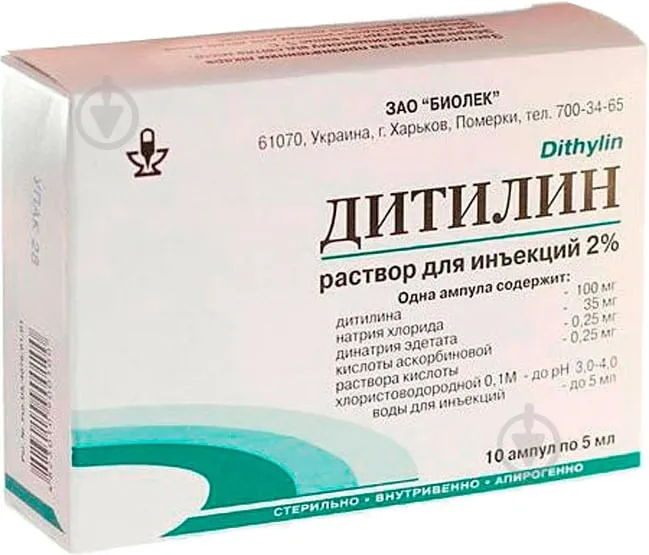
DITILIN-BIOLIC
UkraineThe drug is used for skeletal muscle relaxation (myorelaxation) during tracheal intubation, endoscopic procedures, short-term surgeries, or to eliminate convulsions during tetanus.
Frequently asked questions
How should Ditilin-biolic be taken correctly?
The drug is administered intravenously (as a bolus or infusion) or intramuscularly. The dosage is determined by a physician individually, depending on the patient's body weight, their reaction, and the purpose of the intervention. For adults during intubation, the standard dose is 1 mg/kg of body weight.
Who should not use this drug?
Contraindications include hypersensitivity to the components, glaucoma, myasthenia, acute hepatic failure, severe anemia, impaired cholinesterase activity, high potassium levels (hyperkalemia), muscle diseases (myopathy, rhabdomyolysis), and open eye injuries.
What are the possible side effects of Ditilin-biolic?
Possible side effects include: increased intraocular pressure, respiratory disturbances (apnea, bronchospasm), changes in heart rhythm (arrhythmia, bradycardia, cardiac arrest), increased or decreased blood pressure, muscle pain, skin rash, as well as increased levels of potassium and blood sugar.
Can this drug be combined with other medicines?
Some medicines may enhance or alter the effect of the drug. In particular, it interacts with antibiotics, antiarrhythmics, anesthetics, and certain psychotropic drugs. It is important to consider compatibility with cardiac glycosides and medications used to treat myasthenia.
What are the specific features of using the drug in hospital settings?
The drug should only be used in a hospital setting under the supervision of an anesthesiologist, with the availability of equipment for mechanical ventilation and tracheal intubation.
Instructions for use
INSTRUCTIONS FOR MEDICAL USE OF THE MEDICINAL PRODUCT DITILINE-BIOLIK
Composition:
Active substance: ditiline;
1 ml of solution contains 20 mg of ditiline;
Excipients: sodium chloride, edetate disodium, ascorbic acid, diluted hydrochloric acid, water for injections.
Pharmaceutical form. Injection solution.
Main physicochemical properties: clear, colorless liquid.
Pharmacotherapeutic group.
Muscle relaxants. Choline derivatives. ATC code M03AB01.
Pharmacological properties.
Pharmacodynamics.
Suxamethonium (suxamethonium iodide) is a short-acting depolarizing muscle relaxant. Chemically, suxamethonium (suxamethonium iodide) can be regarded as a doubled acetylcholine molecule. It has high affinity for the postsynaptic neuromuscular receptor, competitively blocks neuromuscular transmission, induces depolarization of the postsynaptic membrane, and causes short-term relaxation of skeletal muscles. It is rapidly hydrolyzed by pseudocholinesterase into choline and succinic acid, which is why the effect of suxamethonium (suxamethonium iodide) is short-lived.
After intravenous administration, the drug's effect appears within 2–3 minutes and persists at full strength for up to 3 minutes. Approximately 5 minutes after completion of administration, the effect ceases completely.
The rapid onset of action followed by quick recovery of muscle tone allows for controlled and manageable relaxation of skeletal muscles.
Pharmacokinetics.
Data on the pharmacokinetics of suxamethonium (suxamethonium iodide) are significantly limited due to the drug's short duration of action. Immediately after intravenous administration, the drug is metabolized by blood pseudocholinesterase. It is broken down into choline, which is subsequently used for acetylcholine synthesis, and succinic acid, which participates in tissue respiration processes. The drug crosses the blood-brain and placental barriers.
Clinical characteristics.
Indications.
Use for muscle relaxation during tracheal intubation, endoscopic procedures (broncho-, esophago-, laryngo-, cystoscopy), short-term surgeries requiring muscle relaxation (reduction of dislocations, bone fragment repositioning), maintenance of myoplegia during surgical interventions (gynecological, thoracic, abdominal), and suppression of seizures in tetanus.
Contraindications.
Hypersensitivity to the components of the drug, glaucoma, myasthenia gravis, acute hepatic failure, severe anemia, history of malignant hyperthermia, atypical plasma cholinesterase activity; hyperkalemia associated with major trauma or burns, prolonged patient immobilization, skeletal muscle paralysis; hyperkalemia related to renal insufficiency; open eye injury and conditions where increased intraocular pressure is undesirable; skeletal muscle myopathy, rhabdomyolysis.
Concomitant use of drugs that increase sensitivity to succinylcholine.
Interaction with other medicinal products and other forms of interactions.
The medicinal substances and chemical compounds listed below reduce plasma cholinesterase activity, thereby increasing the intensity and duration of the myorelaxant effect of succinylcholine (suxamethonium iodide). These include organophosphorus insecticides and metrifonate; eye drops containing echothiophate; trimethaphan; specific anticholinesterase agents: neostigmine, pyridostigmine, physostigmine, edrophonium; tacrine hydrochloride; cytotoxic medicinal agents: cyclophosphamide, mechlorethamine, triethylene melamine, thiotepa; drugs used in psychiatric practice: phenelzine, prozapine, chlorpromazine; anesthetic agents: ketamine, morphine, morphine antagonists, pethidine, pancuronium, propanidid.
Other medicinal products that may negatively affect plasma cholinesterase activity include aprotinin, diphenhydramine, promethazine, estrogens, oxytocin, glucocorticosteroids (at high doses), oral contraceptives, terbutaline, metoclopramide.
The following medicinal substances and chemical compounds enhance the intensity and prolong the duration of the myorelaxant effect of succinylcholine (suxamethonium iodide) through mechanisms unrelated to changes in plasma cholinesterase activity. These include magnesium salts; lithium carbonate; azathioprine; quinine and chloroquine; aminoglycoside antibiotics, clindamycin, polymyxins; antiarrhythmic agents: quinidine, procainamide, verapamil, β-adrenergic blockers, lidocaine, procaine; volatile and inhalational anesthetic agents: halothane, enflurane, desflurane, isoflurane, diethyl ether, and methoxyflurane, which have a negligible effect on the Phase I neuromuscular blockade induced by succinylcholine (suxamethonium iodide), but accelerate the onset and increase the intensity of Phase II neuromuscular blockade.
Concomitant use with cardiac glycosides increases the effect of the latter.
Concomitant use with drugs for the treatment of myasthenia reduces the efficacy of the latter.
Halogenated agents for general anesthesia enhance the adverse effects of succinylcholine (suxamethonium iodide) on the cardiovascular system.
Sodium thiopental and atropine reduce the adverse effects of succinylcholine (suxamethonium iodide) on the cardiovascular system.
Special precautions for use
Administer only in specialized inpatient units under the decision and close supervision of an experienced anesthesiologist, with equipment available for immediate tracheal intubation, oxygen inhalation, and artificial ventilation of the lungs.
There have been reports of irreversible cardiac arrest following succinylcholine administration in children and adolescents who previously had undiagnosed neuromuscular disorders. Due to the risk of adverse effects, the use of succinylcholine should be restricted, except in cases where immediate intubation or airway clearance is required in critical situations.
It should be noted that in high doses, dithyline (succinylcholine iodide) may cause a "dual block," where, after the initial depolarizing effect, a subsequent antidepolarizing effect develops. As a result, after the last injection of dithyline (succinylcholine iodide), the effect persists for a prolonged period (up to 25–30 minutes), and spontaneous respiration does not return.
To counteract the "dual block," administer proserin (neostigmine) or galantamine after prior administration of atropine. It should be remembered that proserin and other anticholinesterase agents, by inhibiting cholinesterase activity, prolong the action of dithyline (succinylcholine iodide).
Use with caution in patients with known hypersensitivity to other muscle relaxants or to any component of general anesthesia.
Approximately 0.05% of the population has inherited reduced plasma cholinesterase activity. The effect of succinylcholine may be prolonged in these patients, as well as in conditions associated with decreased cholinesterase activity: pregnancy and the postpartum period; severe course of tetanus, tuberculosis, and other severe and/or chronic infectious diseases; extensive burns; malignant neoplasms; chronic anemia, malnutrition; terminal stages of liver failure; acute or chronic renal failure; autoimmune diseases: myxedema, collagen diseases; after massive plasma transfusion; after plasmapheresis; and due to certain concomitant therapies (see section "Interaction with other medicinal products and other forms of interaction").
Repeated administration of succinylcholine may lead to tachyphylaxis (tolerance) to the drug.
Administration of succinylcholine may be followed by muscle pain, the intensity of which correlates poorly with visible muscle fasciculations during drug administration. Injection of non-depolarizing neuromuscular blockers a few minutes before administration of Dithyline-Biolik may help reduce muscle pain. This method may require administration of a succinylcholine dose exceeding 1 mg/kg body weight to achieve satisfactory conditions for endotracheal intubation.
Patients with severe sepsis are prone to hyperkalemia, which must be considered when using Dithyline-Biolik.
Dithyline-Biolik is not recommended for patients with myasthenia gravis due to the high risk of developing a "dual block." Patients with Eaton-Lambert myasthenic syndrome are more sensitive to the effects of succinylcholine, which may require dose reduction.
In healthy patients (adults and children), succinylcholine may occasionally cause bradycardia, which can be prevented by prior intravenous administration of atropine.
In the absence of hyperkalemia, ventricular arrhythmias related to succinylcholine administration may rarely occur. Patients receiving digitalis preparations are more prone to such arrhythmias. The effect of succinylcholine on the heart may lead to changes in cardiac rhythm, including cardiac arrest.
It should be noted that in patients with genetically determined cholinesterase deficiency, as well as in patients with hypokalemia, Dithyline-Biolik may cause prolonged respiratory depression.
The drug should be used with caution in patients with liver disease, anemia, and cachexia.
One ampoule of the solution contains less than 1 mmol of sodium, i.e., the medicinal product is practically sodium-free.
Use during pregnancy or breastfeeding
Succinylcholine does not exert a direct effect on the uterus or other smooth muscles. The drug crosses the placental barrier. At therapeutic doses, Dithyline-Biolik does not affect newborn respiration.
The drug should be used during pregnancy only if the benefit to the mother outweighs the potential risk to the fetus.
Breastfeeding: There are no data regarding the ability of the drug to pass into breast milk.
Ability to affect reaction speed when driving or operating machinery
The medicinal product should always be administered in a healthcare setting in combination with general anesthetic agents; therefore, all warnings regarding the use of such anesthetics must be taken into account.
Method of Administration and Dosage
Administer as bolus intravenous injections, as well as intravenously by infusion or intramuscularly.
Administration of the medicinal product Ditilin-Biolik is permitted only when all conditions for artificial ventilation of the lungs are available.
Adults. The dose should be individualized based on body weight, patient response, degree of required muscle relaxation, and route of administration.
For endotracheal intubation, administer intravenously at a dose of 1 mg/kg body weight. This dose usually produces muscle relaxation within 30–60 seconds, lasting from 2 to 6 minutes. Higher doses produce longer-lasting muscle relaxation, but doubling the dose does not necessarily double the duration of relaxation. Additional doses of Ditilin-Biolik, ranging from 50% to 100% of the initial dose and administered at intervals of 5 to 10 minutes, will maintain muscle relaxation during short surgical procedures under general anesthesia.
For prolonged muscle relaxation throughout surgery, Ditilin-Biolik may be administered by infusion of a 0.1–0.2% solution diluted in 5% glucose solution or 0.9% sodium chloride solution for injection or infusion, at a rate of 2.5–4 mg/min. The infusion rate should be adjusted according to the individual patient's response.
The total dose of Ditilin-Biolik during repeated intravenous injections or continuous infusion must not exceed 500 mg/hour.
Ditilin-Biolik is compatible with 0.9% sodium chloride solution for injection or infusion, Ringer's solution, 5% fructose solution, and 6% dextran solution.
Ditilin-Biolik is compatible with other muscle relaxants and opioid analgesics.
Children aged 1 year and older. Patients in this age group are more resistant to the effects of ditilin (succinylcholine iodide) compared to adults. The recommended intravenous dose is 1 mg/kg body weight.
When administering Ditilin-Biolik to children by intravenous infusion, the dose should be determined as in adults, but the initial infusion rate should be reduced proportionally to body weight.
The recommended dose for intramuscular administration is up to 4 mg/kg body weight. This dose produces muscle relaxation for approximately 3 minutes. The total dose must not exceed 150 mg.
Elderly patients. The doses of Ditilin-Biolik for elderly patients are similar to those for adults. Elderly individuals are more prone to cardiac arrhythmias, especially if they are taking cardiac glycosides.
Children.
The medicinal product is indicated for children aged 1 year and older. Use with caution in children, as they are more frequently diagnosed with myopathies, are more susceptible to developing malignant hyperthermia and rhabdomyolysis, and have an increased risk of serious adverse reactions following succinylcholine administration.
Overdose.
Overdose of Ditilin-Biolik manifests as prolonged respiratory arrest and muscle paralysis.
Treatment. Artificial ventilation of the lungs; if necessary, transfusion of fresh frozen plasma containing pseudocholinesterase in its composition.
In case of a "dual block," administer proserin and atropine (see section "Special Instructions").
Adverse reactions.
Eye disorders: increased intraocular pressure.
Respiratory, thoracic and mediastinal disorders: apnoea, bronchospasm, prolonged paralysis of respiratory muscles (associated with genetically determined deficiency of pseudocholinesterase production).
Gastrointestinal disorders: increased salivation, increased intragastric pressure (and consequently increased risk of regurgitation and aspiration of gastric contents into the airways).
Hepatobiliary disorders: liver function abnormalities.
Metabolism and nutritional disorders: hyperglycaemia, transient increase in potassium levels.
Cardiovascular disorders: arterial hypertension or hypotension, flushing, transient bradycardia, asystole, tachycardia, arrhythmia (including ventricular arrhythmias), conduction disorders, cardiogenic shock, cardiac arrest, collapse.
Immune system disorders: hypersensitivity reactions, including urticaria, anaphylactic shock.
Skin and subcutaneous tissue disorders: skin erythema, rash.
Musculoskeletal and connective tissue disorders: muscle pain occurring 10–12 hours after succinylcholine administration, muscle fasciculations, trismus, rhabdomyolysis followed by myoglobinaemia and myoglobinuria.
General disorders and administration site conditions: hyperthermia, local site reactions.
Reporting of suspected adverse reactions.
Reporting of suspected adverse reactions after marketing authorization is an important procedure. It allows continuous monitoring of the benefit-risk balance of the medicinal product. Healthcare professionals are required to report any suspected adverse reactions through the national pharmacovigilance system.
Shelf life. 2 years.
Storage conditions.
Store in the original packaging at 2 °C to 8 °C. Do not freeze!
Keep out of reach of children.
Incompatibilities.
Suxamethonium chloride solution (Ditilin-Biolik) is pharmaceutically incompatible with donor blood (hydrolysis occurs), blood preservatives, serum preservatives, blood products, barbiturate solutions (especially thiopental, with which it forms a precipitate), and alkaline solutions.
Ditilin-Biolik is compatible with 0.9% sodium chloride solution, Ringer's solution, 5% fructose solution, and 6% dextran solution.
Ditilin-Biolik is compatible with other muscle relaxants and opioid analgesics.
Packaging.
5 ml in a vial; 5 or 10 vials per pack, or 5 vials in a blister, 1 or 2 blisters per pack.
Prescription status. Prescription only.
Manufacturer.
LLC "BIOLIK PHARMA".
Manufacturer's address and place of business.
Legal entity address:
70 Pomirky, Kharkiv, Kharkiv Oblast, 61070, Ukraine.
Place of business address:
Pomirky-70, building without number, Kharkiv, Kharkiv Oblast, 61070, Ukraine.
Similar drugs
| Brand name | Dosage form | Active substance / Dosage | Manufacturer |
|---|---|---|---|
| DITILIN-DARNITSA | solution for injection |
|
PJSC «Pharmaceutical Company «Darnitsa» |
The original data is available in the language of the country of manufacture.
Data source: State Register of Medicinal Products of Ukraine
Data last verified: August 13, 2026