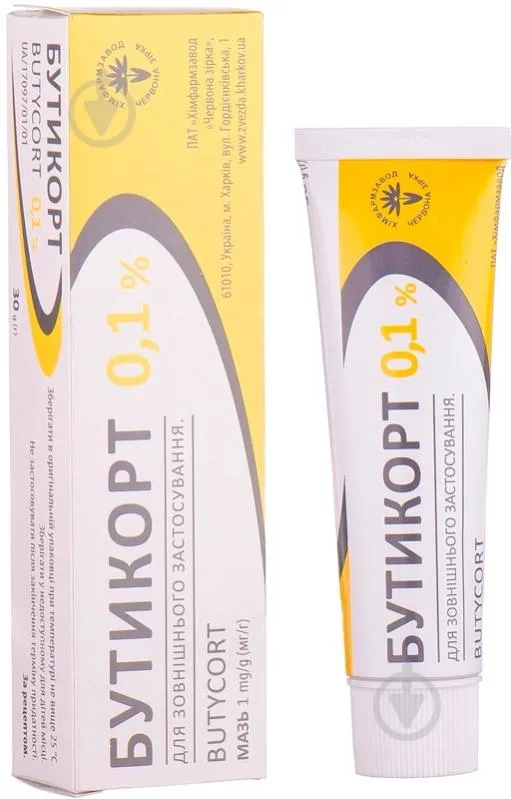
BUDICORT
UkraineThe drug is used to treat superficial non-infectious skin diseases, such as eczema, allergic and contact dermatitis, neurodermatitis, and psoriasis. It may also be prescribed to support the treatment of dermatoses that were previously treated with stronger hormonal agents.
Frequently asked questions
How should Budicort ointment be used correctly?
Apply the ointment in a thin, even layer to the affected areas of the skin 1–3 times daily. As the condition improves, it is often sufficient to apply the product once a day or 2–3 times a week. The total amount of ointment per week should not exceed 30–60 grams.
Who should not use this drug?
The product must not be used in case of bacterial, viral, fungal, or parasitic skin infections, or in the presence of open wounds or ulcers. Skin disorders caused by the corticosteroid itself (e.g., thinning or perioral dermatitis) are also contraindicated, as is individual hypersensitivity to the components of the ointment.
What are the possible side effects of Budicort?
Possible local reactions include: skin atrophy (thinning), the appearance of striae (stretch marks), changes in pigmentation, acne, or allergy. With prolonged or excessive use, systemic effects are possible, specifically an impact on the hormonal balance (suppression of adrenal gland function). Visual disturbances such as blurred vision, increased intraocular pressure, or the risk of developing cataracts are also possible.
Can the ointment be applied to the face and eyelids?
The ointment should not be applied to the eyelids, as this may lead to the development of glaucoma or cataracts. The skin of the face, genitals, and head is very sensitive; therefore, increased absorption of the drug and a risk of skin atrophy are possible in these areas.
Can the drug be used by children and pregnant women?
The drug can be used in children aged 3 months and older; however, during prolonged treatment, it is necessary to monitor their growth, body weight, and cortisol levels. For pregnant women, use is only possible under special indications, for a short period, and on small areas of the skin. For breastfeeding women, the ointment should only be used for a short time and on a limited area of the skin.
Instructions for use
INSTRUCTIONS FOR MEDICAL USE OF THE MEDICINAL PRODUCT BUDICORT (BUTYCORT)
Composition:
Active substance: hydrocortisone butyrate;
1 g of ointment contains hydrocortisone butyrate 1 mg;
Excipients: white soft paraffin, mineral oil, benzyl alcohol.
Pharmaceutical form. Ointment.
Main physicochemical characteristics: greasy, soft, homogeneous ointment of greyish-white color.
Pharmacotherapeutic group.
Corticosteroids for dermatological use.
ATC code D07AB02.
Pharmacological properties.
Pharmacodynamics.
Hydrocortisone butyrate is an active synthetic non-halogenated corticosteroid for topical use. It exerts anti-inflammatory, anti-edematous, and antipruritic effects rapidly. Its efficacy is comparable to that of halogenated steroids. Use at recommended doses does not cause suppression of the hypothalamic-pituitary-adrenal (HPA) axis. Although prolonged application of high doses, particularly under occlusive dressings, may lead to increased plasma cortisol levels, this is not associated with reduced responsiveness of the pituitary-adrenal system, and discontinuation of the drug results in rapid normalization of cortisol production.
Pharmacokinetics.
Absorption. After topical application, the active substance accumulates in the epidermis, predominantly in the stratum granulosum.
Metabolism. Hydrocortisone butyrate, absorbed through the skin, is metabolized to hydrocortisone and other metabolites directly in the epidermis and subsequently in the liver.
Excretion. Metabolites and a minor portion of unchanged hydrocortisone butyrate are excreted in urine and feces.
Clinical characteristics.
Indications.
Superficial non-infected dermatoses treatable with topical corticosteroids (eczema, allergic and contact dermatitis, neurodermatitis, psoriasis), the occurrence of which is not associated with microorganisms and which are expected to show incomplete response to treatment with weak-activity agents.
Continuation of treatment or maintenance therapy of dermatoses previously treated with more potent corticosteroids.
Contraindications.
- Skin lesions caused by bacterial infections (e.g., pyoderma, syphilitic or tuberculous lesions), viral infections (e.g., varicella, herpes simplex, herpes zoster, common warts, flat warts, condyloma, molluscum contagiosum); infections caused by fungi and yeasts; parasitic infections (e.g., scabies);
- ulcerative skin lesions, wounds;
- adverse reactions caused by corticosteroids (e.g., perioral dermatitis, striae);
- ichthyosis, juvenile plantar dermatosis, vulgaris acne, rosacea, skin vessel fragility, skin atrophy;
- hypersensitivity allergic reactions to components of the drug or to corticosteroids (the latter are rare).
Interaction with other medicinal products and other forms of interactions.
Interaction studies have not been conducted.
Special precautions for use.
Do not apply the ointment to the eyelids due to the risk of contact with the conjunctiva and increased risk of developing open-angle glaucoma or subcapsular cataract.
The skin of the face, genital area, and scalp is particularly sensitive to corticosteroids. Therefore, only low-potency corticosteroids should be used for treating lesions in these areas.
It may sometimes be appropriate to apply an occlusive or non-occlusive dressing to the affected area.
The effect of corticosteroids may be enhanced by using an occlusive dressing, which increases drug penetration (approximately by a factor of 10) through the stratum corneum of the epidermis.
However, this also increases the risk of adverse effects.
It should be noted that when corticosteroids are applied over large skin areas, especially under (cellophane) dressings or in skin fold areas, increased systemic absorption may occur, potentially leading to adrenal cortical suppression.
Adrenal suppression may develop rapidly in children. Suppression of growth hormone production may also occur. If long-term treatment is required, it is advisable to regularly monitor the child's height and body weight, as well as plasma cortisol levels.
In comparative studies, no significant differences in adrenal cortical function were observed in children treated with 30–60 grams per week of Buticort ointment for 4 weeks.
Use of the drug on the face, skin folds, and other areas of thin skin may lead to skin atrophy and increased drug absorption.
Topically applied corticosteroids may be hazardous in patients with psoriasis for several reasons, including the "rebound syndrome" due to development of tolerance, risk of generalized pustular psoriasis, or local systemic toxicity due to impaired skin barrier function. Steroids may be used in scalp psoriasis or chronic plaque psoriasis of hands and feet. Close monitoring of patients is essential.
Visual disturbances.
Visual disturbances may occur with both systemic and topical use of corticosteroids. If a patient experiences symptoms such as blurred vision or other visual disturbances, ophthalmological consultation is recommended to evaluate possible causes, including cataract, glaucoma, or rare conditions such as central serous chorioretinopathy (CSC), which has been reported following systemic or topical corticosteroid use.
Use during pregnancy or breastfeeding.
Pregnancy.
Corticosteroids cross the placenta. There is currently no clear evidence of teratogenic effects in humans similar to those observed in animal studies. When corticosteroids are administered to pregnant animals at high doses, fetal developmental abnormalities such as cleft palate and intrauterine growth retardation may occur. Furthermore, preclinical data do not provide additional information beyond the existing clinical experience with the drug.
Systemic administration of high doses of corticosteroids has been associated with effects on the fetus or newborn (fetal growth retardation, adrenal cortical suppression).
Despite limited data on topical corticosteroid use during pregnancy, due to their limited systemic absorption, weak and moderate potency corticosteroids (class 1 and class 2), such as hydrocortisone, may be used for short periods and over limited skin areas. The aforementioned effects cannot be excluded with prolonged use or application over large skin areas. Such use should only occur if specifically indicated.
Breastfeeding.
Buticort ointment may be used in breastfeeding women only for short-term treatment and on small skin areas. For long-term treatment or when applied over large areas or on damaged skin, breastfeeding should be discontinued.
Ability to influence reaction speed when driving or operating machinery.
There are no data on the effects of Buticort ointment on the ability to drive or operate machinery. Adverse effects on these functions are not expected.
Method of Administration and Dosage.
Apply a small amount of the medication to the skin 1–3 times daily. As the condition improves, usually once-daily application or 2–3 applications per week are sufficient.
The total weekly dose should not exceed 30–60 g.
BuTicoRT should be applied evenly in a thin layer to affected skin areas. The medication may be gently rubbed into the skin to enhance penetration.
For improved therapeutic effect, an occlusive dressing may be used.
Children.
Can be used in children aged 3 months and older.
Overdose.
With prolonged overdose or inappropriate use, adverse effects described in the section "Adverse Reactions" may occur.
If symptoms of hypercorticism are observed, treatment should be discontinued.
Adverse reactions.
| System Organ Class |
Uncommon (>1/10000, <1/1000) |
Very rare (<1/10000, including individual case reports) |
| Immune system disorders |
Hypersensitivity |
|
| Endocrine system disorders |
Adrenocortical suppression |
|
| Eye disorders |
Increased intraocular pressure, increased risk of cataract development (with local application). |
|
| Skin and subcutaneous tissue disorders |
Contact allergy; pustular acne; skin atrophy, often irreversible, accompanied by epidermal thinning, telangiectasia, purpura and striae; depigmentation; rosacea-like and perioral dermatitis, with or without skin atrophy; "rebound effect" which may lead to steroid dependence; dermatitis and eczema, including contact dermatitis; delayed wound healing; hypertrichosis. |
Systemic adverse reactions with topical application of corticosteroids in adults are rare but can be serious. This is particularly true for adrenocortical suppression during prolonged use of the drug.
The risk of systemic effects increases under the following conditions: use with occlusive dressing (plastic wrap or application to skin folds); application over large areas of skin; long-term treatment; use in children (children are especially sensitive due to their thin skin and relatively large body surface area); presence of components or excipients that enhance penetration through the stratum corneum and/or potentiate the effect of the active substance.
The risk of developing local adverse reactions increases with the potency of the drug and duration of treatment. Use with occlusive dressing (plastic wrap or application within skin folds) increases this risk. Facial skin, scalp, and genital areas are particularly susceptible to adverse reactions. Inappropriate use, as well as the presence of bacterial, parasitic, fungal, or viral infections, may mask and/or exacerbate the manifestations of these diseases.
Reporting of suspected adverse reactions.
Reporting suspected adverse reactions after drug registration is important. It enables ongoing monitoring of the benefit-risk balance of the medicinal product. Healthcare and pharmaceutical professionals, as well as patients or their legal representatives, should report all cases of suspected adverse reactions and lack of efficacy via the automated pharmacovigilance information system at: https://aisf.dec.gov.ua
Shelf life. 2 years.
Do not use after the expiry date stated on the packaging.
Storage conditions.
Store in the original packaging at a temperature not exceeding 25 °C.
Keep out of reach of children.
Packaging.
10 g in a tube or 30 g in a tube. 1 tube per cardboard carton.
Prescription status.
Prescription only.
Manufacturer.
JSC "CHEMICAL PHARMACEUTICAL PLANT "CHERVONA ZIRKA".
Manufacturer's address and place of business.
Ukraine, 61010, Kharkiv region, city of Kharkiv, Gordeyevskaya Street, building 1.
Similar drugs
| Brand name | Dosage form | Active substance / Dosage | Manufacturer |
|---|---|---|---|
| LOCOID | ointment |
|
Temmler Italia S.r.l. |
The original data is available in the language of the country of manufacture.
Data source: State Register of Medicinal Products of Ukraine
Data last verified: August 13, 2026