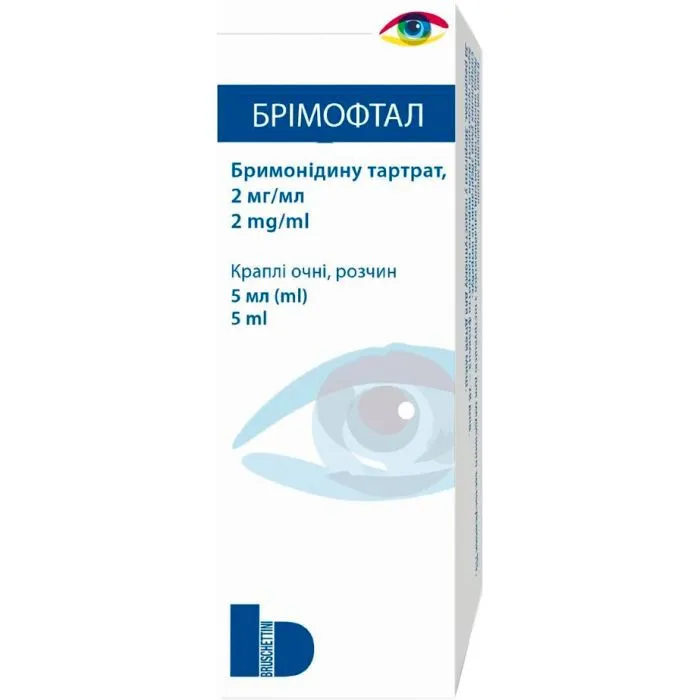
BRIMOFTAL
UkraineThe drug is used to reduce elevated intraocular pressure in patients with open-angle glaucoma or simply elevated ocular pressure.
Frequently asked questions
How should Brimoftal be taken correctly?
Instill 1 drop into the affected eye 2 times a day at regular intervals (approximately every 12 hours). Immediately after instillation, it is recommended to press on the lacrimal sac in the inner corner of the eye for 1 minute to reduce the entry of the medication into the bloodstream. If you are using other eye drops, allow a 5–15 minute interval between them.
Who should not use this drug?
Use is contraindicated in case of hypersensitivity to the components, during pregnancy or breastfeeding, as well as for newborns and infants. The drug should not be taken if you are already taking monoamine oxidase (MAO) inhibitors or certain antidepressants.
What are the possible side effects of Brimoftal?
The most common side effects are headache, drowsiness, dry mouth, irritation, redness or burning of the eyes, as well as blurred vision. Changes in taste and fatigue are also possible.
Can you drive a car during treatment?
The drug may cause drowsiness, fatigue, or blurred vision (especially at night). You should only drive vehicles or operate machinery after these symptoms have completely disappeared.
How should contact lenses be handled?
Soft contact lenses must be removed before using the drops. They may be worn no earlier than 15 minutes after instillation.
Are there any specific instructions for children?
The drug is not recommended for children under 12 years of age and is contraindicated for children under 2 years of age. For children aged 2 to 7 years, treatment must be conducted under strict medical supervision due to the high risk of drowsiness.
Instructions for use
INSTRUCTIONS FOR MEDICAL USE OF THE MEDICINAL PRODUCT BRIMOFTAL (BRIMOFTAL)
Composition:
Active substance: brimonidine;
1 ml of solution contains 2 mg brimonidine tartrate, equivalent to 1.3 mg brimonidine;
Excipients: benzalkonium chloride; polyvinyl alcohol; sodium chloride; sodium citrate; citric acid, monohydrate; hydrochloric acid 1 M; sodium hydroxide 1 M; purified water.
Pharmaceutical form. Eye drops, solution.
Main physicochemical properties: clear, water-like, free from visible particles, slightly greenish-yellow solution.
Pharmacotherapeutic group. Sympathomimetics for the treatment of glaucoma.
ATC code S01EA05.
Pharmacological properties.
Pharmacodynamics.
Brimonidine is an alpha-2 adrenergic receptor agonist that is one thousand times more selective for alpha-2 adrenergic receptors than for alpha-1 adrenergic receptors. This selectivity results in the absence of mydriasis and microvascular vasoconstriction associated with retinal xenografts in humans.
Topical application of brimonidine tartrate leads to a reduction in intraocular pressure (IOP) in humans with minimal effects on the cardiovascular and respiratory systems.
Clinical data regarding the safety of the drug in bronchial asthma are limited.
Intraocular pressure (IOP) begins to decrease rapidly after administration, with maximum reduction observed within 2 hours. Brimonidine reduces IOP by decreasing aqueous humor production and slightly increasing uveoscleral outflow.
Brimonidine has a rapid onset of action, with peak ocular hypotensive effect observed 2 hours after administration. In two one-year studies, brimonidine reduced intraocular pressure (IOP) with a mean reduction of approximately 4–6 mm Hg.
Fluorophotometric studies in animals and humans indicate that brimonidine tartrate has a dual mechanism of action. It is believed that brimonidine may reduce intraocular pressure (IOP) by decreasing the production of intraocular fluid and enhancing uveoscleral outflow.
Studies show that brimonidine is effective when used in combination with topical beta-blockers. Short-term studies also indicate that brimonidine has a clinically significant additive effect when combined with travoprost (6 weeks) and latanoprost (3 months).
Pharmacokinetics.
General characteristics.
After instillation of a 0.2% solution of the drug twice daily for 10 days, its plasma concentration was low (mean Cmax was 0.06 ng/mL). After repeated administration (twice daily for 10 days), a slight accumulation of the drug in the blood was observed. The area under the pharmacokinetic curve over 12 hours at steady state (AUC-0–12 hours) was 0.31 ng·h/mL compared to 0.23 ng·h/mL after the first dose. After topical administration, the mean elimination half-life from systemic circulation was approximately 3 hours.
Plasma protein binding of brimonidine after topical administration is approximately 29%.
Brimonidine reversibly binds to melanin in ocular tissues, both in vitro and in vivo. After 2 weeks of ocular instillation, brimonidine concentrations in the iris, ciliary body, and choroid-retina were 3–17 times higher than after a single dose. Accumulation does not occur in the absence of melanin. The significance of melanin binding is not fully understood.
However, slit-lamp examination of patients who received brimonidine for one year revealed no significant adverse reactions, and no significant toxicity was observed during a one-year visual safety study in monkeys receiving approximately four times the recommended dose of brimonidine tartrate.
After oral administration, brimonidine is well absorbed and rapidly eliminated. The majority of the dose (approximately 75%) is excreted as metabolites in urine within 5 days. No unchanged brimonidine is found in urine.
In vitro studies using liver tissue from animals and humans indicate that metabolism is primarily mediated by aldehyde oxidase and cytochrome P450. Therefore, systemic elimination occurs primarily via hepatic metabolism.
The drug is metabolized mainly by aldehyde oxidase and cytochrome P450. Thus, systemic elimination occurs primarily through first-pass metabolism in the liver.
After single administration of doses of 0.08%, 0.2%, and 0.5%, no significant deviation in plasma Cmax and AUC proportional to dose was observed.
Use in specific patient populations.
Elderly patients.
After single-dose administration, plasma Cmax, AUC, and elimination half-life of brimonidine in elderly patients (aged 65 years and older) did not differ from those in younger patients. This indicates that age does not affect systemic absorption or elimination of the drug.
Based on data from studies including elderly patients, systemic exposure to brimonidine was very low.
Clinical characteristics.
Indications.
To be used for reduction of elevated intraocular pressure in patients with open-angle glaucoma or ocular hypertension:
- as monotherapy, when topical beta-blockers are contraindicated;
- in combination with other medicinal products that reduce intraocular pressure, when pressure reduction with these agents is insufficient.
Contraindications.
Hypersensitivity to the active substance or to any of the excipients of the medicinal product.
Concomitant use with monoamine oxidase inhibitors (MAOIs) and antidepressants affecting noradrenergic transmission (e.g., tricyclic antidepressants and mianserin).
Pregnancy or lactation period.
Neonates and infants (see section "Adverse reactions").
Interaction with other medicinal products and other forms of interaction.
Brimonidine is contraindicated in patients receiving monoamine oxidase inhibitors (MAOIs) and in patients taking antidepressants that affect noradrenergic transmission (e.g., tricyclic antidepressants and mianserin) (see section "Contraindications").
Although specific drug interactions of brimonidine have not been studied, the possibility of additive or enhanced effects should be considered when using central nervous system (CNS) depressants (alcohol, barbiturates, opioids, sedatives, and anesthetics).
Data on plasma catecholamine levels after administration of brimonidine are lacking. However, brimonidine should be administered with caution in patients receiving drugs that affect metabolism and increase amine concentrations in plasma (e.g., chlorpromazine, methylphenidate, reserpine).
Clinically insignificant lowering of arterial blood pressure has been observed in some patients after brimonidine administration. Brimonidine should be used with caution when administered concomitantly with antihypertensive agents and/or cardiac glycosides.
Recommended monitoring at the beginning of treatment (or upon dose increase) during combination therapy with systemic agents (regardless of dosage form) that may interact with alpha-adrenergic receptor agonists or affect their efficacy (e.g., adrenergic receptor agonists or antagonists — isoprenaline, prazosin).
Special precautions for use
Children aged 2 years, especially those aged 2 to 7 years and/or with body weight less than 20 kg, should be treated with particular caution and under constant supervision due to the high frequency and degree of somnolence observed.
The drug should be used with caution in patients with severe, unstable, and uncontrolled cardiovascular disorders.
Ocular allergic-type reactions have been reported in some patients during studies following brimonidine administration (see section "Adverse reactions").
If allergic reactions occur, treatment with brimonidine should be discontinued.
Delayed hypersensitivity reactions of the eye have been reported with brimonidine use, which were associated with increased intraocular pressure (IOP).
The drug should be used with caution in patients with depression, cerebral circulatory insufficiency, coronary insufficiency, Raynaud's syndrome, orthostatic hypotension, or thromboangiitis obliterans.
Since the effect of brimonidine in patients with hepatic or renal insufficiency has not been studied, the drug should be administered with caution in such patients.
Brimoftal contains benzalkonium chloride as a preservative, which may cause local ocular irritation. Contact with soft contact lenses should be avoided. Contact lenses must be removed prior to instillation and may be reinserted 15 minutes after administration. Cases of discoloration of soft contact lenses have been reported.
Benzalkonium chloride may also cause ocular irritation, especially in the presence of dry eye or corneal pathology (the anterior transparent part of the eye). If discomfort, burning, or eye pain occurs after using this medicinal product, the patient should consult a physician.
Use during pregnancy or breastfeeding
Studies on the safety of the drug in pregnant women have not been conducted; therefore, Brimoftal should not be used during pregnancy. It is unknown whether brimonidine is excreted in human breast milk; therefore, the drug should not be used during breastfeeding.
Ability to affect reaction speed when driving or operating machinery
Use of Brimoftal may cause fatigue and/or somnolence, which could impair the ability to drive or operate machinery. Brimoftal may cause blurred vision and/or visual disturbances, which could impair the ability to drive or operate machinery, particularly at night or under low lighting conditions. Patients should wait until these symptoms resolve before driving or operating machinery.
Method of Administration and Dosage
Instill 1 drop of brimonidine into the affected eye twice daily at regular intervals (approximately 12 hours apart). Dose adjustment in elderly patients is not required.
As with any ophthalmic drops, to reduce potential systemic absorption, it is recommended to apply pressure to the lacrimal sac in the medial canthus of the eye (punctal occlusion) for 1 minute immediately after instillation of each drop. If more than one type of ophthalmic drop is prescribed, they should be administered with an interval of 5–15 minutes between applications.
Use in Renal and Hepatic Impairment
The use of brimonidine in patients with hepatic or renal dysfunction has not been studied (see section "Special Warnings and Precautions for Use").
Children
Clinical studies on the use of the medicinal product in adolescents (aged 12 to 17 years) have not been conducted.
Brimonidine is not recommended for use in children under 12 years of age and is contraindicated in newborns and infants (under 2 years of age) (see section "Contraindications", section "Special Warnings and Precautions for Use", and section "Overdose"). Serious adverse reactions have been reported in newborns following administration of the drug.
Overdose
Overdose in ophthalmic use (adults)
All known cases of overdose have already been reported as adverse reactions.
Cases of serious adverse effects in children following accidental oral ingestion of brimonidine have been reported. Symptoms observed included central nervous system (CNS) depression, typical transient coma or near-comatose state; lethargy, somnolence, arterial hypotension, bradycardia, hypothermia, pallor, respiratory depression, and apnea requiring intensive therapy including intubation if necessary. Within 6–24 hours, the condition of all patients returned to normal.
Systemic overdose due to accidental oral ingestion (adults)
The only adverse event reported to date has been hypotension. There have also been reports of rebound hypertension following a hypotensive episode.
Management of oral overdose includes supportive and symptomatic therapy; respiratory function should be maintained.
Following oral overdose of other alpha-2 agonists, cases of the following symptoms have been reported: arterial hypotension, asthenia, vomiting, lethargy, sedation, bradycardia, arrhythmia, miosis, apnea, hypothermia, cyanosis, respiratory depression, and seizures. Treatment is symptomatic.
Adverse Reactions
The most commonly reported adverse reactions were dry mouth, eye hyperemia, and inflammation/burning, occurring in 22–25% of patients. These reactions are usually temporary and rarely severe enough to require discontinuation of treatment.
Symptoms of ocular allergic reactions were observed in 12.7% of patients (leading to discontinuation in 11.5% of patients) in studies where onset occurred between 3 and 9 months in most patients.
Within each frequency group, adverse reactions are listed in order of decreasing incidence. The following terminology is used to classify the frequency of adverse reactions: very common (≥1/10); common (≥1/100 to <1/10); uncommon (≥1/1,000 to <1/100); rare (≥1/10,000 to <1/1,000); very rare (<1/10,000); frequency not known (cannot be estimated from available data).
Cardiac disorders:
- Uncommon: Palpitations/arrhythmias (including bradycardia and tachycardia)
Nervous system disorders:
- Very common: Headache, somnolence
- Common: Dysgeusia, taste alteration
- Very rare: Syncope
Eye disorders:
- Very common: Eye irritation, including allergic reactions (hyperemia, inflammation and burning, itching, foreign body sensation, follicular conjunctivitis), blurred vision, allergic blepharitis, allergic blepharoconjunctivitis, allergic conjunctivitis, ocular allergic reaction, and follicular conjunctivitis
- Common: Local irritation (hyperemia and eyelid edema, blepharitis, conjunctival edema and eye discharge, eye pain, and lacrimation), photophobia, corneal erosion and keratopathy, dry eyes, conjunctival pallor, visual disturbances, conjunctivitis
- Very rare: Iritis, miosis
Respiratory system disorders:
- Common: Upper respiratory tract symptoms
- Uncommon: Nasal mucosal dryness
- Rare: Dyspnea
Gastrointestinal disorders:
- Very common: Dry mouth
- Common: Gastrointestinal symptoms
Vascular disorders:
- Very rare: Hypertension, hypotension
General disorders:
- Very common: Increased fatigue
- Common: Asthenia
Immune system disorders:
- Uncommon: Systemic allergic reactions (hypersensitivity)
Psychiatric disorders:
- Uncommon: Depression
- Very rare: Insomnia
The following adverse reactions have been identified during post-marketing use of brimonidine in clinical practice. Because these reports are from a population of unknown size and are reported voluntarily, it is not possible to reliably estimate their frequency or establish a causal relationship to drug exposure.
Eye disorders:
- Frequency not known: Iridocyclitis (anterior uveitis), eyelid pruritus
Skin and subcutaneous tissue disorders:
- Frequency not known: Skin reactions, including erythema, facial edema, pruritus, rash, vasodilation
When brimonidine was used as part of medical treatment for congenital glaucoma, symptoms of brimonidine overdose such as loss of consciousness, lethargy, somnolence, hypotension, bradycardia, hypothermia, cyanosis, pallor, and respiratory depression have been reported in neonates and infants receiving brimonidine.
In studies involving children aged 2 to 7 years with glaucoma inadequately controlled by beta-blockers, a high incidence of somnolence (55%) was reported when brimonidine was used as adjunctive therapy. Severe somnolence occurred in 8% of children, and treatment was discontinued in 13% of cases.
The frequency of somnolence decreased with increasing age, with the lowest incidence observed in the 7-year-old age group (25%). However, the reduction was more strongly influenced by body weight, occurring more frequently in children with body weight <20 kg (63%) compared to those with body weight >20 kg (25%).
Reporting of suspected adverse reactions
It is important to report suspected adverse reactions after marketing authorization. This allows continued monitoring of the benefit-risk balance of the medicinal product. Healthcare professionals are encouraged to report any suspected adverse reactions.
Shelf life: 4 years. After first opening – 28 days.
Storage conditions:
No special storage conditions required.
Keep out of reach of children.
Packaging:
5 ml of solution in a low-density polyethylene bottle with a dropper and a white high-density polyethylene cap; 1 bottle per cardboard box.
Prescription status: Prescription only.
Manufacturer:
Famar Anonymous Industrial Single Member Company of Pharmaceuticals and Cosmetics.
Manufacturer's address:
63 Agiou Dimitriou Street, Alimos, 174 56, Greece
Similar drugs
| Brand name | Dosage form | Active substance / Dosage | Manufacturer |
|---|---|---|---|
| ALPHA-BRYON® | drops, ophthalmic solution |
|
Farmak JSC |
| BGLAU | drops, ophthalmic solution |
|
Laboratorio Edol - Produtos Farmaceuticos, S.A. (full-cycle manufacturing) |
| BIMANOXX® | drops, ophthalmic solution |
|
Jadran-Galenski Laboratorij d.d. |
| BRIGLAU ECO | drops, ophthalmic solution |
|
Rafarm S.A. |
| BRIMOGEN | drops, ophthalmic solution |
|
Farmaselect International Betriebs GmbH (manufacturer responsible for batch release) |
| BRIMONAL 0.2 % | drops, ophthalmic solution |
|
UNIMED PHARMA LLC |
| RIMONID | drops, ophthalmic solution |
|
Micro Labs Limited |
The original data is available in the language of the country of manufacture.
Data source: State Register of Medicinal Products of Ukraine
Data last verified: August 13, 2026