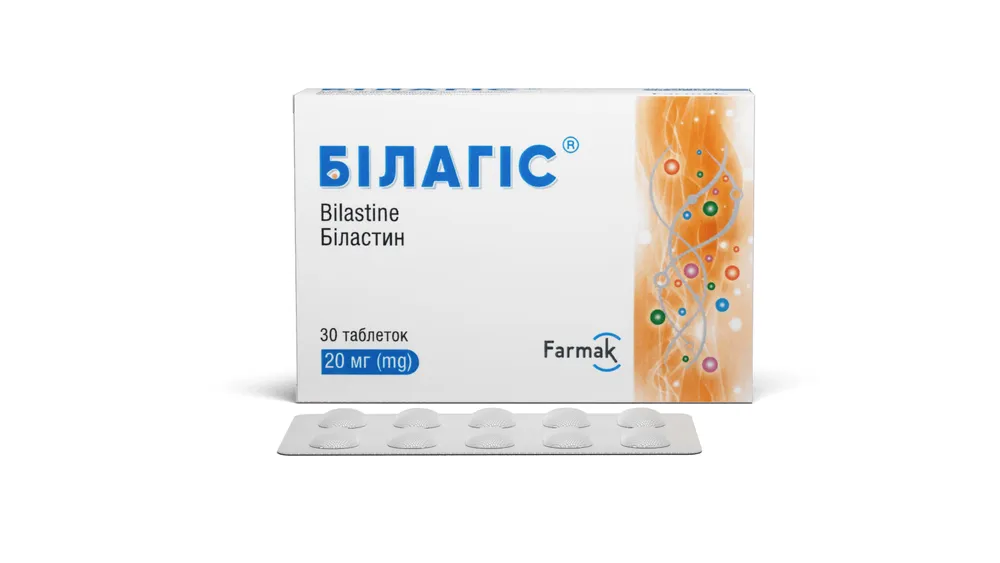
BILAGIS®
UkraineThe drug is used for the symptomatic treatment of urticaria, as well as allergic rhinoconjunctivitis (both seasonal and perennial).
Frequently asked questions
How should Bilagis® be taken correctly?
Adults and adolescents aged 12 years and older should take 1 tablet (20 mg) once daily. The tablet should be swallowed with water. It is important to take the drug either 1 hour before a meal or 2 hours after it. It is also not recommended to consume grapefruit or other fruit juices during treatment.
Are there any contraindications for Bilagis®?
The drug must not be taken in case of hypersensitivity to the active substance or to any other components of the composition.
What are the possible side effects of Bilagis®?
Patients most frequently reported headache and drowsiness. Dizziness and fatigue may also occur. Other possible reactions include nausea, abdominal pain, dry mouth, or changes in appetite.
How do food and drinks affect the drug's action?
Food and fruit juices reduce the efficacy of bilastine by 30%. Therefore, the tablet should be taken on an empty stomach (one hour before or two hours after a meal).
Can I drive a vehicle during treatment?
In some cases, the drug may cause drowsiness, so caution should be exercised when driving vehicles or operating machinery.
Can the drug be taken with other medicines?
Caution should be exercised when used concurrently with P-glycoprotein inhibitors (e.g., ketoconazole, erythromycin, cyclosporine, diltiazem), as this may increase bilastine levels in the blood. Patients with moderate or severe renal impairment should avoid combining it with these agents.
Instructions for use
INSTRUCTION for medical use of the medicinal product BILAGIS® (BILAGIS)
Composition:
Active substance: bilastine;
1 tablet contains 20 mg of bilastine;
Excipients: microcrystalline cellulose, sodium starch glycolate (type A), colloidal anhydrous silicon dioxide, magnesium stearate.
Pharmaceutical form. Tablets.
Main physicochemical properties: white or almost white tablets, double convex, elongated in shape, with embossing B20 and a score line on one side.
Pharmacotherapeutic group.
Antihistamines for systemic use. Other antihistamines for systemic use. Bilastine. ATC code R06AX29.
Pharmacological properties.
Pharmacodynamics.
Bilastine is a non-sedating, long-acting antihistamine and a highly selective blocker of peripheral H1-receptors, which does not bind to muscarinic receptors.
After single administration, bilastine suppresses histamine-induced skin reactions for up to 24 hours, manifested as wheals and erythema.
In clinical studies involving adults and adolescents with allergic rhinoconjunctivitis (seasonal and perennial), administration of 20 mg bilastine once daily for 14–28 days was effective in alleviating symptoms such as sneezing, rhinorrhea, nasal pruritus, nasal congestion, ocular pruritus, tearing, and eye redness. Symptoms were effectively controlled by bilastine over 24 hours.
In two clinical studies involving patients with chronic idiopathic urticaria, administration of 20 mg bilastine once daily for 28 days was effective in reducing the intensity of pruritus and decreasing the number and size of wheals, as well as discomfort caused by urticaria. Patients showed improvement in sleep and quality of life.
In clinical studies with bilastine, no clinically significant QTc interval prolongation or other cardiovascular effects were observed, even when administered at a dose of 200 mg daily (10 times the clinical dose) for 7 days in 9 participants or when co-administered with P-glycoprotein (P-gp) inhibitors such as ketoconazole (24 participants) and erythromycin (24 participants). Additionally, a thorough QT study was conducted involving 30 volunteers.
In controlled clinical trials, the central nervous system (CNS) safety profile of bilastine at the recommended dose of 20 mg once daily was similar to that of placebo, and the incidence of somnolence with bilastine was not statistically different from that with placebo. Bilastine at doses up to 40 mg daily did not affect psychomotor performance in clinical studies or the ability to drive in a standardized driving test.
In elderly patients (≥65 years of age) participating in Phase II and III studies, efficacy and safety of the drug did not differ from those in younger patients.
In a post-marketing study involving 146 elderly patients, no differences in safety profile were observed compared to other adult participants.
Children. Adolescents (aged 12–17 years) were included in the clinical development program. Of these, 128 received bilastine during clinical trials (81 in double-blind allergic rhinoconjunctivitis studies), while the remaining 116 were randomized to receive active comparator drugs or placebo. No differences in efficacy or safety were observed between adults and adolescents.
Pharmacokinetics.
Absorption. After oral administration, bilastine is rapidly absorbed, with peak plasma concentration reached approximately 1.3 hours post-dose. Accumulation does not occur. The mean bioavailability of bilastine after oral administration is 61%.
Distribution. In vitro and in vivo studies have shown that bilastine is a substrate of P-gp (see section "Interaction with ketoconazole, erythromycin, and diltiazem") and OATP (see section "Interaction with grapefruit juice"). Bilastine does not appear to be a substrate of the BCRP transporter or renal transporters OST2, OAT1, and OAT3. In vitro data do not suggest that bilastine inhibits the activity of transporter proteins such as P-gp, MRP2, BCRP, BSEP, OATP1B1, OATP1B3, OATP2B1, OAT1, OAT3, OCT1, OCT2, and NTCP in systemic circulation, as its inhibitory capacity for P-gp, OATP2B1, and OCT1 is negligible, with IC50 values ≥ 300 µM, significantly exceeding the predicted maximum plasma concentration (Cmax) during clinical use of bilastine. Thus, such interactions are not expected to be clinically relevant. However, results from similar studies indicate that inhibition of transporters located in the intestinal mucosa (e.g., P-gp) by bilastine cannot be ruled out. At therapeutic doses, 84–90% of bilastine is bound to plasma proteins.
Biotransformation. In vitro studies have shown that bilastine does not induce or inhibit the activity of CYP450 isoenzymes.
Elimination. In a mass balance study conducted in healthy volunteers, after a single 20 mg dose of 14C-bilastine, nearly 95% of the administered dose was recovered in urine (28.3%) and feces (66.5%) as unchanged bilastine, indicating that bilastine undergoes minimal metabolism in humans. The mean elimination half-life of bilastine in healthy volunteers is 14.5 hours.
Linearity. Over the studied dose range (5 to 220 mg), bilastine exhibits linear pharmacokinetics with low inter-subject variability.
Renal impairment. Studies in patients with varying degrees of renal function showed that in patients with normal renal function (glomerular filtration rate [GFR] > 80 mL/min/1.73 m²), the mean AUC0–∞ (± standard deviation) was 737.4 (±260.8) ng·h/mL; in those with mild renal impairment (GFR = 50–80 mL/min/1.73 m²), it was 967.4 (±140.2) ng·h/mL; in moderate impairment (GFR = 30–<50 mL/min/1.73 m²), 1384.2 (±263.23) ng·h/mL; and in severe impairment (GFR <30 mL/min/1.73 m²), 1708.5 (±699.0) ng·h/mL.
The mean (± SD) elimination half-life of bilastine was 9.3 (±2.8) hours in patients with normal renal function, 15.1 (±7.7) hours in mild impairment, 10.5 (±2.3) hours in moderate impairment, and 18.4 (±11.4) hours in severe impairment. Bilastine was no longer detectable in urine in almost all patients within 48–72 hours after administration. These pharmacokinetic changes are not expected to be clinically significant or affect the safety of bilastine, as plasma concentrations in patients with renal impairment remain within safe limits.
Hepatic impairment. Pharmacokinetic data in patients with hepatic impairment are lacking. Bilastine undergoes minimal metabolism in humans. Data from studies in patients with renal impairment indicate that bilastine is primarily eliminated via the kidneys, with only a negligible amount likely excreted in bile. Changes in liver function are not expected to have a clinically significant impact on the pharmacokinetics of bilastine.
Elderly patients. Pharmacokinetic data in patients over 65 years of age are limited. Pharmacokinetic parameters of bilastine in patients over 65 years of age do not differ significantly from those in patients aged 18–35 years.
Children. Pharmacokinetic data in adolescents (12–17 years) are not available, as extrapolation of data obtained in adults is considered appropriate for this medicinal product.
Clinical characteristics.
Indications.
Symptomatic treatment of allergic rhinoconjunctivitis (seasonal and perennial) and urticaria.
Contraindications.
Hypersensitivity to the active substance or to any of the excipients.
Interaction with other medicinal products and other forms of interaction.
Interaction with food. Food decreases the oral bioavailability of bilastine by 30%.
Interaction with grapefruit juice. When bilastine 20 mg was administered concomitantly with grapefruit juice, the bioavailability of bilastine decreased by 30%. A similar effect may also occur with other fruit juices. The extent of reduced bioavailability may vary depending on the juice manufacturer and fruit type. The mechanism of this interaction involves inhibition of the OATP1A2 transporter protein, for which bilastine is a substrate (see section "Pharmacokinetics"). Medicinal products that are substrates or inhibitors of OATP1A2, such as ritonavir or rifampicin, may also reduce bilastine plasma concentrations.
Interaction with ketoconazole or erythromycin. When bilastine was administered concomitantly with ketoconazole or erythromycin, the AUC of bilastine increased twofold and Cmax increased 2–3 times. These changes can be explained by interactions at the level of transporter proteins responsible for drug efflux from intestinal cells, since bilastine is a substrate for P-glycoprotein and is not metabolized (see section "Pharmacokinetics"). These changes are unlikely to affect the safety profile of bilastine on one hand, and ketoconazole or erythromycin on the other. Other medicinal products that are substrates or inhibitors of P-gp, such as cyclosporine, may also increase bilastine plasma concentrations.
Interaction with diltiazem. When 20 mg bilastine and 60 mg diltiazem were administered concomitantly, the Cmax of bilastine increased by 50%. This effect can be explained by interaction at the level of transporter proteins responsible for drug efflux from intestinal cells (see section "Pharmacokinetics"); this effect is unlikely to affect the safety profile of bilastine.
Interaction with ethanol. After concomitant administration of alcohol and bilastine 20 mg, psychomotor functions remained at the same level as after concomitant administration of alcohol and placebo.
Interaction with lorazepam. When bilastine 20 mg was administered concomitantly with lorazepam 3 mg for 8 days, no enhancement of the CNS depressant effect of lorazepam was observed.
Children. Interaction studies with other medicinal products have been conducted only in adults. The extent of interaction with other medicinal products and other forms of interaction are expected to be similar in children aged 12 to 17 years.
Special precautions for use
In patients with moderate or severe renal impairment, concomitant use of bilastine with P-glycoprotein inhibitors (e.g., ketoconazole, erythromycin, cyclosporine, ritonavir, diltiazem, etc.) may lead to increased plasma levels of bilastine, thereby increasing the risk of its adverse reactions. Therefore, patients with moderate or severe renal impairment should avoid concomitant use of bilastine and P-glycoprotein inhibitors.
Cases of QT interval prolongation on electrocardiogram have been reported in patients treated with bilastine (see sections "Adverse reactions", "Overdose", and "Pharmacological properties"). Medicinal products known to cause QT/QTc prolongation may potentially increase the risk of torsades de pointes.
Therefore, bilastine should be prescribed with caution in patients who have an increased risk of QT/QTc interval prolongation. This includes patients with a history of cardiac arrhythmias; patients with hypokalemia, hypomagnesemia, or hypocalcemia; patients with confirmed QT prolongation or significant bradycardia; and patients receiving concomitant treatment with other medicinal products associated with QT/QTc prolongation.
Use during pregnancy or breastfeeding.
Pregnancy. Data on the use of bilastine in pregnant women are lacking or limited.
Animal studies have not shown any direct or indirect harmful effects on reproductive function, parturition, or postnatal development. As a precautionary measure, it is advisable to avoid use of the medicinal product Bilagis® during pregnancy.
Breastfeeding. Studies on the excretion of bilastine into human breast milk have not been conducted. Available pharmacokinetic data in animals have shown that bilastine is excreted into breast milk. A decision on whether to continue/stop breastfeeding or to discontinue/abstain from treatment with Bilagis® should be made, taking into account the benefit of breastfeeding for the child and the benefit of bilastine therapy for the mother.
Fertility. Clinical data are limited or lacking. Studies in rats have shown no negative effect on fertility.
Ability to influence the ability to drive and use machines.
Studies evaluating the effect of bilastine on the ability to drive have demonstrated that treatment with bilastine at a dose of 20 mg does not affect driving ability in adults. However, patients should be informed that the medicinal product may cause somnolence in individual cases and thus may affect the ability to drive or operate machinery.
Method of Administration and Dosage.
Dosage.
Adults and children (aged 12 years and older). 20 mg of bilastine (1 tablet) once daily for relief of symptoms of allergic rhinoconjunctivitis (seasonal and perennial) and urticaria.
The tablet should be taken 1 hour before or 2 hours after food or fruit juice intake (see section "Interaction with other medicinal products and other forms of interaction").
Special patient groups.
Elderly patients. Dose adjustment is not required in elderly patients (see sections "Pharmacodynamics" and "Pharmacokinetics").
Renal impairment. Dose adjustment is not required in patients with renal impairment (see section "Pharmacokinetics").
Hepatic impairment. Clinical experience with the use of bilastine in patients with hepatic impairment is lacking. Since bilastine is not metabolized and is primarily excreted by the kidneys, hepatic impairment is not expected to lead to an increase in systemic exposure to a dangerous level. Therefore, dose adjustment is not required in patients with hepatic impairment (see section "Pharmacokinetics").
Children. The use of bilastine in children aged 0 to 2 years for allergic rhinoconjunctivitis and urticaria is not recommended. Safety and efficacy of bilastine in children under 12 years of age have not been established.
Duration of treatment. Patients with allergic rhinitis should take the medicinal product only during periods of allergen exposure. For patients with seasonal allergic rhinitis, treatment may be discontinued after symptom relief and restarted upon symptom recurrence. For patients with perennial allergic rhinitis, the drug may be administered continuously throughout the period of allergen exposure. In patients with urticaria, the duration of treatment depends on the nature and duration of symptoms as well as their clinical course.
Method of administration.
For oral use.
Tablets should be taken with water. The daily dose should be taken as a single dose.
Children.
Safety and efficacy of bilastine in children under 12 years of age have not been confirmed.
Overdose.
Information regarding acute overdose of bilastine was obtained from clinical trials conducted during drug development and from post-marketing surveillance. In clinical studies, after administration of bilastine to healthy adult volunteers at doses 10–11 times higher than the therapeutic dose (220 mg as a single dose or 200 mg daily for 7 days), the incidence of adverse reactions was twice as high compared to placebo. The most commonly reported adverse reactions included dizziness, headache, and nausea. No reports of serious adverse reactions or significant QTc interval prolongation were observed. Information collected during post-marketing surveillance is consistent with data obtained from clinical trials.
In a thorough cross-study evaluation of QT/QTc intervals involving 30 healthy adult volunteers, a critical assessment of the effect of multiple doses of bilastine (100 mg × 4 days) on ventricular repolarization did not reveal significant QTc interval prolongation.
In case of overdose, symptomatic and supportive treatment is recommended.
There is no known specific antidote for bilastine.
Adverse Reactions
During clinical studies in patients suffering from allergic rhinoconjunctivitis or chronic idiopathic urticaria, adverse reactions with bilastine 20 mg occurred at approximately the same frequency as with placebo (12.7% and 2.8%, respectively). Phase II and III clinical trials conducted during clinical development included 2525 patients treated with various doses of bilastine, of whom 1697 received bilastine 20 mg. In these studies, 1362 patients received placebo. Patients receiving bilastine 20 mg for allergic rhinoconjunctivitis or chronic idiopathic urticaria most commonly reported the following adverse reactions: headache, somnolence, dizziness, and fatigue. These adverse reactions occurred at frequencies comparable to those observed in patients receiving placebo.
The table below lists adverse reactions likely related to bilastine and reported in more than 0.1% of patients who received bilastine 20 mg during clinical development (N = 1697).
The frequency of adverse reactions is defined as follows: very common (≥ 1/10); common (≥ 1/100 to < 1/10); uncommon (≥ 1/1000 to < 1/100); rare (≥ 1/10,000 to < 1/1000); very rare (< 1/10,000); not known (cannot be estimated from available data).
Reactions occurring rarely and very rarely, as well as those for which frequency is not known, were not included in the table.
| Organs and organ systems |
Bilastine, 20 mg N = 1697 |
All bilastine doses N = 2525 |
|
| Frequency |
Adverse reaction |
||
| Infections and parasitic disorders |
|||
| Uncommon |
Oral herpes |
2 (0.12%) |
2 (0.08%) |
| Metabolism and nutrition disorders |
|||
| Uncommon |
Increased appetite |
10 (0.59%) |
11 (0.44%) |
| Psychiatric disorders |
|||
| Uncommon |
Anxiety |
6 (0.35%) |
8 (0.32%) |
| Insomnia |
2 (0.12%) |
4 (0.16%) |
|
| Nervous system disorders |
|||
| Common |
Somnolence |
52 (3.06%) |
82 (3.25%) |
| Headache |
68 (4.01%) |
90 (3.56%) |
|
| Uncommon |
Dizziness |
14 (0.83%) |
23 (0.91%) |
| Ear and labyrinth disorders |
|||
| Uncommon |
Tinnitus |
2 (0.12%) |
2 (0.08%) |
| Vertigo |
3 (0.18%) |
3 (0.12%) |
|
| Cardiac disorders |
|||
| Uncommon |
Right bundle branch block |
4 (0.24%) |
5 (0.20%) |
| Sinus arrhythmia |
5 (0.30%) |
5 (0.20%) |
|
| QT interval prolongation on electrocardiogram* |
9 (0.53%) |
10 (0.40%) |
|
| Other ECG abnormalities |
7 (0.41%) |
11 (0.44%) |
|
| Respiratory, thoracic and mediastinal disorders |
|||
| Uncommon |
Dyspnea |
2 (0.12%) |
2 (0.08%) |
| Nasal discomfort |
2 (0.12%) |
2 (0.08%) |
|
| Dry nose |
3 (0.18%) |
6 (0.24%) |
|
| Gastrointestinal disorders |
|||
| Uncommon |
Upper abdominal pain |
11 (0.65%) |
14 (0.55%) |
| Abdominal pain |
5 (0.30%) |
5 (0.20%) |
|
| Nausea |
7 (0.41%) |
10 (0.40%) |
|
| Abdominal discomfort |
3 (0.18%) |
4 (0.16%) |
|
| Diarrhea |
4 (0.24%) |
6 (0.24%) |
|
| Dry mouth |
2 (0.12%) |
6 (0.24%) |
|
| Dyspepsia |
2 (0.12%) |
4 (0.16%) |
|
| Gastritis |
4 (0.24%) |
4 (0.16%) |
|
| Skin and subcutaneous tissue disorders |
|||
| Uncommon |
Pruritus |
2 (0.12%) |
4 (0.16%) |
| General disorders and administration site conditions |
|||
| Uncommon |
Fatigue |
14 (0.83%) |
19 (0.75%) |
| Thirst |
3 (0.18%) |
4 (0.16%) |
|
| Exacerbation of pre-existing illness |
2 (0.12%) |
2 (0.08%) |
|
| Pyrexia |
2 (0.12%) |
3 (0.12%) |
|
| Asthenia |
3 (0.18%) |
4 (0.16%) |
|
| Investigations |
|||
| Uncommon |
Increased gamma-glutamyltransferase levels |
7 (0.41%) |
8 (0.32%) |
| Increased alanine aminotransferase levels |
5 (0.30%) |
5 (0.20%) |
|
| Increased aspartate aminotransferase levels |
3 (0.18%) |
3 (0.12%) |
|
| Increased blood creatinine levels |
2 (0.12%) |
2 (0.08%) |
|
| Increased blood triglyceride levels |
2 (0.12%) |
2 (0.08%) |
|
| Weight increased |
8 (0.47%) |
12 (0.48%) |
|
*During the post-marketing period, cases of QT interval prolongation on electrocardiogram have also been reported.
Frequency unknown (cannot be estimated based on available data): during the post-marketing period, increased heart rate, tachycardia, hypersensitivity reactions (such as anaphylaxis, angioedema, dyspnea, rash, localized/local swelling, erythema), and vomiting have been observed.
Description of selected adverse reactions. The most frequently reported adverse reactions were two that occurred commonly (somnolence and headache) and two that occurred uncommonly (dizziness and fatigue). These were observed both in patients receiving bilastine and in patients receiving placebo. The frequency of somnolence was 3.06% versus 2.86%, headache was 4.01% and 3.38%, dizziness was 0.83% and 0.59%, and fatigue was 0.83% and 1.32%, respectively.
Almost all of the adverse reactions described above occurred with similar frequency in patients receiving bilastine 20 mg and in those receiving placebo.
Data collected during post-marketing surveillance confirmed the safety profile observed during clinical development.
Pediatric population. During clinical development, the frequency, type, and severity of adverse reactions in adolescents (12–17 years) were the same as in adults. Data collected in this population (adolescents) during post-marketing surveillance were consistent with the results of clinical trials.
Reporting of suspected adverse reactions. Reporting suspected adverse reactions after medicinal product authorization is important. It allows continued monitoring of the benefit-risk balance of the medicinal product. Healthcare professionals are required to report any suspected adverse reactions.
Shelf life. 3 years from the date of manufacture of the bulk product.
Do not use the medicinal product after the expiry date stated on the packaging.
Storage conditions. Store in the original packaging.
No special storage conditions required. Keep out of reach of children.
Packaging. 10 tablets per blister. 1 or 3 blisters per carton.
Prescription status. Prescription only.
Manufacturer. JSC "Farmak", Ukraine
(manufactured from bulk product supplied by Laboratorios Normon, S.A., Spain).
Manufacturer's address and location of manufacturing site.
74, Kyrylivska Street, Kyiv, 04080, Ukraine.
Similar drugs
| Brand name | Dosage form | Active substance / Dosage | Manufacturer |
|---|---|---|---|
| AFETTO | tablets |
|
PJSC "Kyivmedpreparat" |
| BILASTINE | tablets |
|
Vivimed Labs Ltd |
| BILASTINE-TEVA | tablets |
|
AET Laboratories Private Ltd. (manufacturing of unpackaged products, primary and secondary packaging) |
| FLUSTIN | tablets |
|
Vivimed Labs Ltd |
| NIKSAR | tablets |
|
FAES Pharma, S.A. (bulk manufacturing, packaging, batch control) |
The original data is available in the language of the country of manufacture.
Data source: State Register of Medicinal Products of Ukraine
Data last verified: August 13, 2026