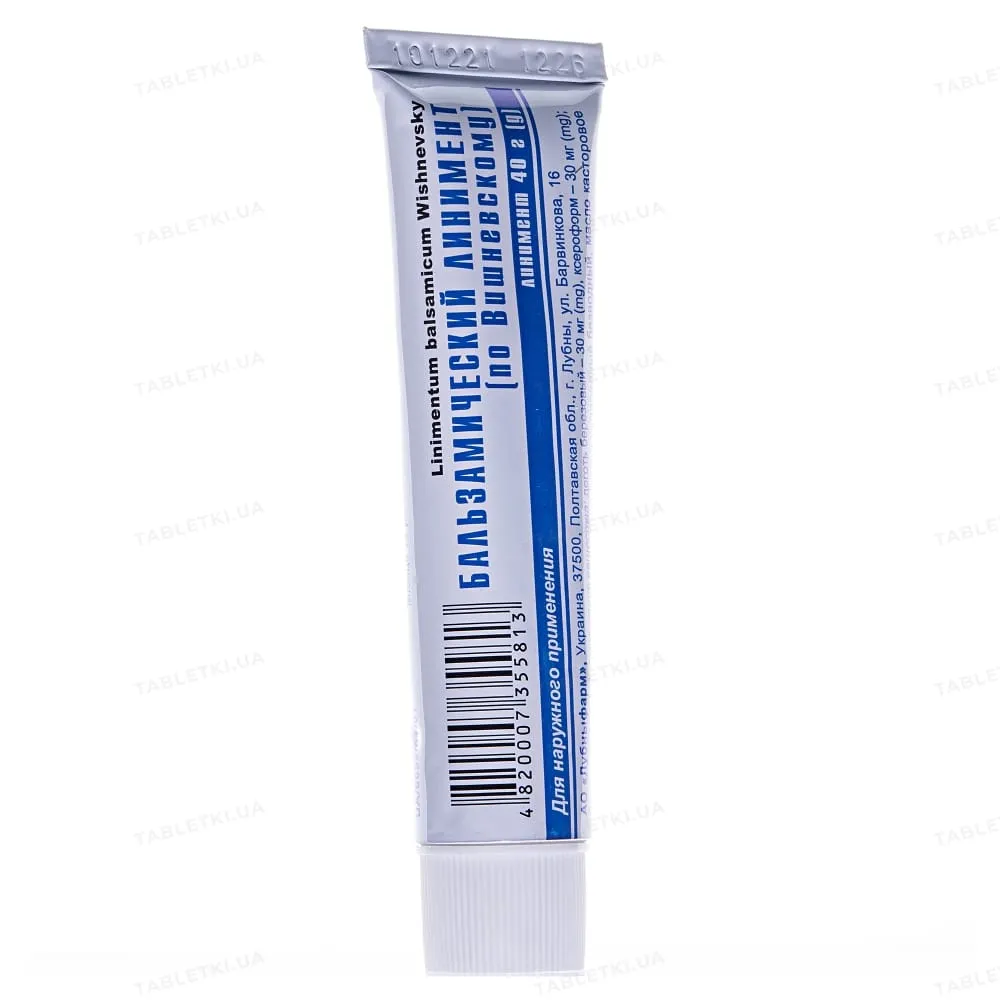
BALSAMIC LINIMENT (BY VISHNEVSKY)
UkraineIt is used for abscesses, boils, pressure sores, lymphadenitis, lymphangitis, burns, frostbite, and trophic ulcers.
Frequently asked questions
How should Balsamic liniment (by vishnevsky) be used correctly?
The agent is applied in a thin layer to the affected skin 2–3 times a day, or a dressing is made using 5–6 layers of gauze soaked in the liniment. The dressing must be secured and changed once every 2–3 days. The course of treatment usually lasts from 6 to 20 days.
What are the possible side effects of Balsamic liniment (by vishnevsky)?
Allergic reactions are possible: redness, itching, skin rash, urticaria, or edema. Increased skin sensitivity to sunlight is also possible.
Who should not use this product?
The preparation must not be used in case of hypersensitivity to its components or to phenol and its derivatives.
Can this product be mixed with other medicines?
Other topical preparations should not be applied to the same areas of the skin, as this may lead to the formation of new compounds with unpredictable effects.
What should be done if the product gets into the eyes or onto mucous membranes?
The affected area must be rinsed immediately with a large amount of water.
What safety precautions should be followed during treatment?
After applying the liniment, hands must be washed thoroughly to prevent the product from getting into the eyes, nose, or mouth. Since the tar in the composition increases sun sensitivity, exposure to sunlight should be avoided during treatment in summer.
Instructions for use
INSTRUCTIONS FOR MEDICAL USE OF THE MEDICINAL PRODUCT BALSAMIC LINIMENT (BY VISHNEVSKY) (LINIMENTUM BALSAMICUM WISHNEVSKY)
Composition:
Active substances: birch tar, ichthammol (xeroform);
1 g of the liniment contains 30 mg of birch tar, 30 mg of xeroform;
Excipients: silicon dioxide, castor oil or edible fish fat.
Pharmaceutical form. Liniment.
Main physicochemical properties: liniment ranging in color from light yellow to brown with a characteristic odor.
Pharmacotherapeutic group.
Antiseptics and disinfectants. ATC Code D08A X.
Pharmacological properties.
Pharmacodynamics.
The drug exerts a disinfectant, anti-inflammatory, and mild irritant effect on tissue receptors. It promotes accelerated wound healing by normalizing tissue blood supply.
Clinical characteristics.
Indications.
Abscesses, furuncles, pressure sores, lymphadenitis, lymphangitis, burns, frostbite, trophic ulcers.
Contraindications.
Hypersensitivity to the components of the drug, to phenol and its derivatives.
Safety precautions.
Avoid contact of the drug with mucous membranes, especially eyes. In case of contact, rinse thoroughly with large amounts of water.
Before applying a dressing, the wound should be debrided of necrotic tissue, blisters opened, and irrigated with an antiseptic solution.
Hands should be thoroughly washed after application of the liniment to prevent accidental transfer of residual product into eyes, nose, or mouth.
Birch tar contained in the drug may increase sensitivity to sunlight; therefore, during summer, exposure to direct sunlight should be avoided while undergoing treatment with this product.
Interaction with other medicinal products and other forms of interaction.
When used simultaneously on the same skin areas with other topical medicinal products, new compounds with unpredictable effects may form.
Special precautions.
Use during pregnancy or breastfeeding.
Since the safety of using the drug during pregnancy or breastfeeding has not been studied, it should be prescribed only after careful consideration of the benefit to the woman versus the risk to the fetus (child).
Ability to affect reaction rate when driving vehicles or operating machinery.
There is no information available regarding the potential effect of the drug on reaction speed when driving vehicles or operating machinery.
Method of Administration and Dosage.
Apply externally.
Apply the liniment in a thin layer to the affected skin areas 2–3 times daily, or apply a dressing consisting of 5–6 layers of gauze soaked with the liniment.
The dressing should be well secured with adhesive tape or bandage and changed every 2–3 days.
Continue dressings until complete cleansing of the infected skin area.
The treatment course lasts from 6 to 20 days.
Children. Safety and efficacy of the drug in this age group have not been studied.
Overdose. Possible manifestations of local allergic reactions (including rash, itching), requiring desensitizing therapy.
Treatment: in case of accidental ingestion of a large amount of liniment, induce vomiting and seek medical advice immediately. Symptomatic therapy.
Side effects.
Allergic reactions (including hyperemia, itching, skin rashes, urticaria, swelling). Possible photosensitization reactions.
Shelf life. 5 years.
Storage conditions. Store at a temperature not exceeding 25 °C in a place inaccessible to children.
Packaging.
25 g in tubes;
40 g in a tube; 1 tube per pack.
Availability. Over-the-counter.
Manufacturer.
LLC "DKP "Pharmaceutical Factory".
Manufacturer's address and location of business activity.
4, Korolyova St., Stanishivka, Zhytomyr district, Zhytomyr region, 12430, Ukraine.
Similar drugs
The original data is available in the language of the country of manufacture.
Data source: State Register of Medicinal Products of Ukraine
Data last verified: August 13, 2026