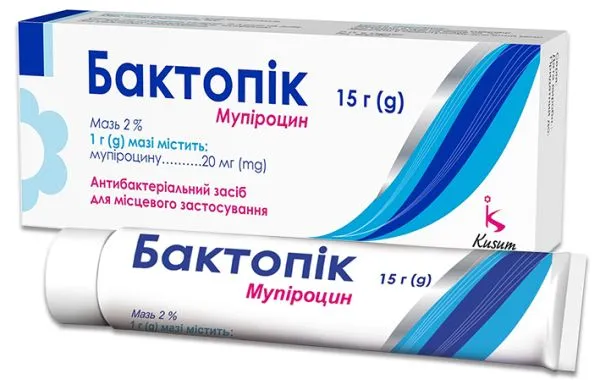
BACTOPICK
UkraineThe drug is used for the topical treatment of nasal cavity infections caused by Staphylococcus aureus, including its resistant strains.
Frequently asked questions
How should Bactopick be used correctly?
A small amount of ointment (approximately the size of a match head) should be applied to the mucous membrane of each nostril 2-3 times a day using the pinky finger or a cotton swab. After application, the nose should be squeezed several times to distribute the ointment evenly. It is important to wash hands thoroughly after use.
What is the duration of the treatment course?
Relief usually occurs within 3-5 days, but treatment should not last longer than 10 days.
Who should not use this drug?
The ointment must not be used in case of hypersensitivity to mupirocin or to any other components of the composition.
Can Bactopick be used by children?
The drug is intended for the treatment of children aged 12 years and older. The safety of use in children under 12 years has not been established.
What are the possible side effects of Bactopick?
Possible reactions of the nasal mucosa include itching, burning, redness, rhinorrhea, sneezing, nasal congestion, cough, and pharyngitis. Very rarely, allergic reactions (rash, urticaria, edema) may occur. Headaches and changes in taste sensations have also been reported.
What should be done if the ointment gets into the eyes?
The ointment is not intended for use in the eyes. If this occurs, the eyes should be thoroughly rinsed with water until all traces of the product are completely removed.
Does the drug affect interactions with other medicines?
No interactions with other medicinal products have been identified; however, it is not recommended to mix the ointment with other drugs, as this may reduce its efficacy.
Can the drug be used during pregnancy?
Bactopick ointment should be used during pregnancy only when the potential benefit to the mother outweighs the possible risk to the fetus.
Instructions for use
INSTRUCTIONS FOR MEDICAL USE OF THE MEDICINAL PRODUCT BACTOPIC (BACTOPIC®)
Composition:
Active substance: mupirocin calcium;
1 g of ointment contains mupirocin calcium, calculated as mupirocin – 20 mg;
Excipients: white soft paraffin, Softisan 649.
Pharmaceutical form. Nasal ointment.
Main physicochemical properties: homogeneous ointment from white to almost white in color.
Pharmacotherapeutic group. Antibiotics and chemotherapeutic agents for dermatological use. ATC code D06AX09.
Pharmacodynamics.
Mupirocin is the principal antibacterial component of a group of structurally related metabolites produced by fermentation of Pseudomonas fluorescens. The mechanism of action of mupirocin involves inhibition of bacterial isoleucyl-tRNA synthetase, thus cross-resistance with other antibiotics is not expected.
Mupirocin has bacteriostatic properties at minimum inhibitory concentrations, and exhibits bactericidal properties at higher concentrations, such as those achieved with topical application.
| Usually susceptible microorganisms: |
| Staphylococcus aureus* |
| Streptococcus spp. |
| Microorganisms with potential acquired resistance: |
| Methicillin-resistant Staphylococcus aureus (MRSA) |
| Methicillin-resistant coagulase-negative Staphylococci (MRCoNS) |
| Resistant microorganisms: |
| Corynebacterium spp. |
| Micrococcus spp. |
*Clinical efficacy has been demonstrated for susceptible isolates in approved clinical indications.
Breakpoints for mupirocin susceptibility (MIC) for Staphylococcus aureus:
Susceptible: ≤ 1 mg/L.
Resistant: > 256 mg/L.
Pharmacokinetics.
Studies have shown that systemic absorption of mupirocin following topical application is minimal. To evaluate potential increased systemic penetration of mupirocin when applied to damaged skin areas or vascular sites such as mucous membranes, studies with intravenous administration of mupirocin were conducted. Mupirocin was rapidly eliminated from plasma by metabolism into monic acid, which in turn was excreted predominantly in urine.
Clinical characteristics.
Indications.
Local treatment of nasal cavity infections caused by Staphylococcus aureus, including methicillin-resistant strains.
Contraindications.
Hypersensitivity to mupirocin or to any of the other components of the medicinal product.
Interaction with other medicinal products and other forms of interaction.
No interactions with other medicinal products have been observed.
Usage characteristics.
Hypersensitivity reactions
If hypersensitivity reactions or severe local skin reactions occur during application of the ointment, treatment should be discontinued, any residual ointment should be removed, and appropriate therapy should be initiated.
Pseudomembranous colitis
As with other antibacterial agents, prolonged use of mupirocin may lead to overgrowth of resistant microorganisms.
The use of antibiotics may result in the development of pseudomembranous colitis, the severity of which may range from mild to life-threatening. Therefore, it is important to consider this diagnosis in patients who develop diarrhea during or after antibiotic therapy. Although the likelihood of this occurring with topical application of mupirocin is lower, treatment should be discontinued immediately and further diagnostic evaluation initiated if prolonged or severe diarrhea or abdominal cramps occur.
Accidental exposure to eyes
Mupirocin nasal ointment is not intended for ophthalmic use.
Contact with the eyes should be avoided. If accidental exposure occurs, the eyes should be thoroughly rinsed with water until all traces of the ointment are removed.
Use during pregnancy or breastfeeding.
Pregnancy.
Animal studies with mupirocin have not shown evidence of harmful effects on the fetus. However, there are no clinical data on the use of mupirocin ointment during pregnancy. Bactopik ointment should be used during pregnancy only if the potential benefit to the mother outweighs the potential risk to the fetus.
Breastfeeding period.
There are no data on the excretion of mupirocin into breast milk following topical administration.
Fertility. There are no data on the effect of mupirocin on human fertility. Animal studies have not shown any effect on fertility.
Ability to affect reaction speed when driving or operating machinery.
No adverse reactions affecting the ability to drive or operate machinery have been reported.
Method of Administration and Dosage
Adults, children and elderly patients
A small amount of ointment (approximately the size of a match head) should be applied to the nasal mucosa in each nostril 2–3 times daily using the little finger or a cotton swab. After application, the nose should be gently squeezed several times from both sides to ensure even distribution of the ointment over the mucosal surface. Eradication of pathogens from the nasal cavity usually occurs within 3–5 days after initiation of treatment. Treatment should not last longer than
10 days.
The medication is intended for topical use only.
Hands should be thoroughly washed after applying the medication.
Do not mix the ointment with other medicinal products, as dilution of the ointment may reduce its antibacterial activity and compromise the stability of the active ingredient.
Dosage adjustment is not required in patients with hepatic or renal impairment.
Children
The medication can be used for treatment of children aged 12 years and older. The safety of use in children under 12 years of age has not been established.
Overdose
Symptoms: Experience regarding symptoms of mupirocin overdose is limited.
Treatment: There is no specific antidote. Symptomatic treatment and appropriate patient monitoring are recommended.
Adverse reactions.
The adverse reactions listed below are those reported during clinical trials and in the post-marketing period. Frequency of adverse reactions: very common (≥1/10), common (≥1/100 to <1/10), uncommon (≥1/1,000 to <1/100), rare (≥1/10,000 to <1/1,000), very rare (<1/10,000), including isolated cases, and not known (cannot be estimated from available data).
Immune system disorders: very rare – skin hypersensitivity reactions, systemic allergic reactions, including anaphylaxis, generalized rash, urticaria, and angioedema.
Respiratory, thoracic and mediastinal disorders: uncommon – reactions of the nasal mucosa: itching, burning sensation, redness, as well as rhinitis, sneezing, nasal congestion, cough, pharyngitis.
Nervous system disorders: not known – headache, taste disturbances.
Reporting of adverse reactions
Healthcare professionals may report suspected adverse reactions through the national reporting system, as well as to the marketing authorization holder via the feedback form on the website: https://kusum.ua/pharmacovigilance/.
Shelf life.
2 years.
Storage conditions.
Store in the original packaging at a temperature not exceeding 25 °C.
Keep out of reach and sight of children.
Packaging.
3 g in an aluminum tube with a nozzle and a screw-on cap. One tube per cardboard box with the instruction for medical use.
Prescription status.
Prescription only.
Manufacturer.
Kusum Healthcare Pvt Ltd.
Manufacturer's address and location of operations.
SP-289 (A), RIICO Industrial Area, Chopanki, Bhiwadi, Dist. Alwar (Rajasthan), India.
Similar drugs
| Brand name | Dosage form | Active substance / Dosage | Manufacturer |
|---|---|---|---|
| BACTROBAN | ointment, nasal |
|
Glaxo Operations UK Limited |
The original data is available in the language of the country of manufacture.
Data source: State Register of Medicinal Products of Ukraine
Data last verified: August 13, 2026