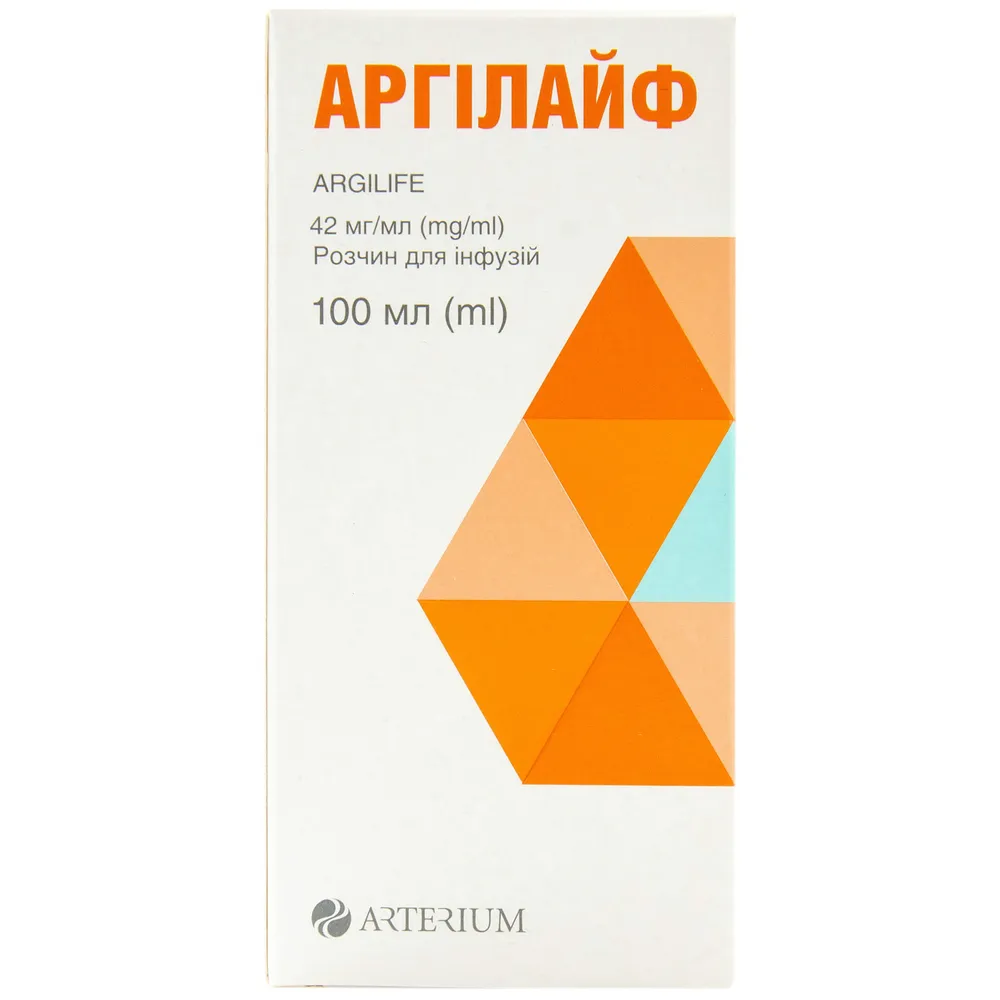
ARGILIFE
UkraineThe drug is used to treat atherosclerosis of the heart vessels, the brain, and peripheral vessels, arterial hypertension, chronic heart failure, high cholesterol levels, chronic lung diseases (obstructive and pulmonary hypertension), as well as asthenic states.
Frequently asked questions
How should Argilife be taken correctly?
The solution should be taken orally during meals. The dosage depends on the condition: for atherosclerosis — 5 ml 3–8 times a day; for high cholesterol and hypertension — 5 ml 3–6 times a day; for lung diseases — 5 ml 3–6 times a day; for weakness (asthenia) — 5 ml 4–8 times a day. The maximum daily dose is 8 g. The course of treatment usually lasts 8–15 days.
What side effects may Argilife cause?
Possible side effects include joint pain, mild stomach or intestinal discomfort, or nausea after administration. Allergic reactions (including bronchospasm) and increased blood potassium levels may also occur.
Who should not take this drug?
The drug is contraindicated in cases of hypersensitivity to its components, severe renal impairment, and myocardial infarction (including a history of myocardial infarction).
Can the drug be combined with other medicines?
When taking arginine aspartate, it should be noted that its compatibility with aminophylline may increase insulin levels, and with spironolactone — increase potassium levels. The drug is incompatible with thiopental.
Can the drug be taken by pregnant women or children?
The drug is not used in children under 18 years of age. Pregnant women may take it only if the expected benefit to the mother outweighs the potential risk to the child. Data regarding use during breastfeeding are unavailable.
What should be done in case of overdose?
If you experience symptoms of an overdose (for example, allergic reactions or a sudden drop in blood sugar levels), you must stop taking the drug immediately. Gastric lavage and the administration of sorbents may be required.
Instructions for use
INSTRUCTIONS FOR MEDICAL USE OF THE MEDICINAL PRODUCT ARGYLIFE (ARGILIFE)
Composition:
Active substance: L-arginine L-aspartate;
1 ml of solution contains L-arginine L-aspartate – 200 mg;
Excipients: sorbitol (E 420), sodium saccharin (E 954), methylparahydroxybenzoate (E 218), propylparahydroxybenzoate (E 216), food flavoring "Caramel", purified water.
Pharmaceutical form. Oral solution.
Main physicochemical properties: slightly yellowish liquid with a caramel odor.
Pharmacotherapeutic group. Other cardiac preparations. Amino acids.
ATC code C01E.
Pharmacological Properties
Pharmacodynamics
The medicinal product Argilife exerts anti-hypoxic, cytoprotective, antioxidant, detoxifying, and membrane-stabilizing effects. It plays an important role in ammonia neutralization and stimulates its excretion from the body, enhancing the liver's detoxification function. It exerts hepatoprotective action and positively influences energy supply processes in hepatocytes.
As a nitric oxide donor, Argilife participates in the body's energy supply processes, reduces activation and adhesion of leukocytes and platelets to the vascular endothelium, thus preventing the formation and progression of atherosclerotic plaques, and is involved in fibrinogenolysis and spermatogenesis processes.
The medicinal product exerts a moderate anabolic effect, stimulates thymus gland activity, promotes insulin synthesis, regulates blood glucose levels during physical exertion, and contributes to correction of acid-base balance.
Pharmacokinetics
Not studied.
Clinical characteristics.
Indications.
Used in the complex therapy of atherosclerosis of the heart and cerebral vessels, arterial hypertension, peripheral vascular atherosclerosis; chronic heart failure; hypercholesterolemia; chronic obstructive pulmonary diseases, pulmonary hypertension; asthenic conditions.
Contraindications.
Hypersensitivity, severe renal function impairment. Myocardial infarction (including history of).
Interaction with other medicinal products and other forms of interaction.
When using arginine aspartate, it should be taken into account that concomitant use of aminophylline with arginine may be accompanied by an increase in blood insulin levels, and concomitant use of spironolactone with arginine may lead to increased blood potassium levels.
Arginine is incompatible with thiopental.
Special precautions for use
The medicinal product should be used with caution in patients with electrolyte imbalance and kidney diseases. During treatment, a balanced regimen of sleep and rest should be maintained, and consumption of alcohol, nicotine, and psychostimulants should be avoided. If symptoms of asthenia worsen during administration of the drug, treatment should be discontinued.
The drug should be used with caution in patients with angina pectoris.
The medicinal product contains sorbitol (E 420); therefore, if intolerance to certain sugars is known, consult a physician before taking this medicinal product.
The product contains auxiliary substances such as methylparahydroxybenzoate (E 218) and propylparahydroxybenzoate (E 216), which may cause allergic reactions (possibly delayed).
This medicinal product contains less than 0.015 mmol (0.34 mg) of sodium per dose (5 ml), i.e., it is practically sodium-free.
Use during pregnancy or breastfeeding
The drug crosses the placental barrier; therefore, during pregnancy it should be used only when the expected benefit to the mother outweighs the potential risk to the fetus.
There are no data available on the use of the drug during breastfeeding.
Ability to influence reaction rate when driving or operating machinery
No effect.
Method of Administration and Dosage
Administer orally, take during meals.
For adults:
- In case of atherosclerosis of cardiac and cerebral vessels, peripheral vascular atherosclerosis – 5 ml (1 measuring spoon (5 ml) – 1 g of arginine aspartate) 3–8 times daily.
- In hypercholesterolemia, arterial hypertension – 5 ml 3–6 times daily.
- In chronic obstructive pulmonary diseases, pulmonary hypertension – 5 ml 3–6 times daily.
- In asthenic conditions – 5 ml 4–8 times daily.
Maximum daily dose – 8 g.
Duration of treatment course – 8–15 days; if necessary, the course may be repeated.
Children
Not recommended for patients under 18 years of age.
Overdose
Symptoms: hypersensitivity reactions, hypoglycemic conditions.
Treatment: If these symptoms occur, discontinue the drug immediately. Gastric lavage and administration of sorbents are indicated. No antidote is available. Symptomatic therapy should be provided.
Side effects.
Musculoskeletal system: joint pain.
Gastrointestinal tract: rarely – mild discomfort in the stomach and intestine, nausea immediately after administration of the medicinal product, which resolve spontaneously.
Immune system: hypersensitivity reactions, including bronchospasm.
Laboratory findings: hyperkalemia.
Shelf life. 1 year.
Shelf life after opening the bottle – 14 days.
Storage conditions.
Store in the original packaging at a temperature not exceeding 25 °C. Keep out of reach of children. Do not freeze.
Packaging.
200 ml in a bottle; 1 bottle with a measuring spoon in a carton.
Availability.
Over-the-counter.
Manufacturer.
JSC "Halychpharm".
Manufacturer's address and place of business.
6/8 Opryshkivska Street, Lviv, 79024, Ukraine.
Similar drugs
| Brand name | Dosage form | Active substance / Dosage | Manufacturer |
|---|---|---|---|
| LARGINUS | solution, oral |
|
PJSC "Tekhnolog" |
| SARGIN | solution, oral |
|
Farmak JSC |
| TIVOMAX® A | solution, oral |
|
PJSC «Pharmaceutical Company «Darnitsa» |
| TIVORTIN® ASPARTATE | solution, oral |
|
Yuria-Pharm LLC |
The original data is available in the language of the country of manufacture.
Data source: State Register of Medicinal Products of Ukraine
Data last verified: August 13, 2026