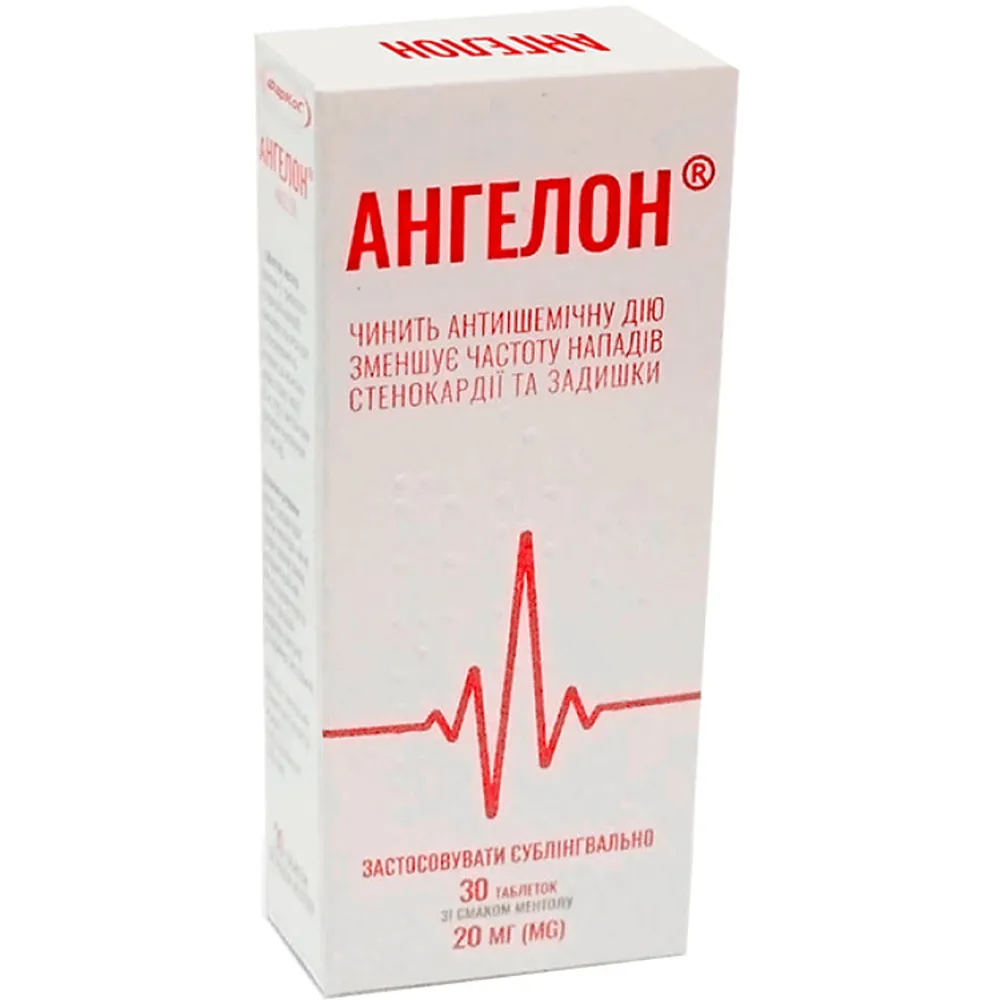
ANGELON
UkraineThe drug is used as part of a complex treatment for ischemic heart disease, angina pectoris, cardiac rhythm disorders, consequences of myocardial infarction, as well as for myocarditis, cardiomyopathies, and fatigue syndrome.
Frequently asked questions
How should Angelon be taken correctly?
Tablets should be held under the tongue until completely dissolved. Usually, 10–40 mg is taken 3–4 times a day, regardless of food intake. In acute conditions (an angina attack or arrhythmia), 10–80 mg may be taken until the condition improves, but no more than 160 mg per day.
What side effects can Angelon cause?
Possible reactions include: headache, dizziness, nausea, abdominal discomfort, decreased blood pressure, tachycardia, skin rashes, itching or Quincke's edema (angioedema), as well as bronchospasm.
Who should not take this drug?
Contraindications include hypersensitivity to the components, acute myocardial infarction, shock states, severe asthma or obstructive bronchial diseases, certain types of heart block, high levels of potassium or magnesium in the blood, as well as hemorrhagic stroke. The drug is prohibited for use in children and pregnant women.
Can the drug be combined with other medicines?
It must not be taken simultaneously with cardiac glycosides due to the risk of cardiac rhythm disturbances. When combined with potassium or magnesium preparations, or certain diuretics, the levels of these elements in the blood may increase. Caffeine and certain other substances may reduce the effect of the drug.
What should be noted during treatment?
During long-term use, it is necessary to monitor potassium and magnesium levels in the blood. Patients with diabetes mellitus should be cautious due to the presence of sugar and lactose in the composition. If you experience dizziness or a drop in blood pressure, driving a vehicle is not recommended.
Instructions for use
INSTRUCTIONS FOR MEDICAL USE OF THE MEDICINAL PRODUCT ANGELON® ANGELON
Composition:
Active substance:
1 tablet contains adenosine-5'-triphosphate-histidine-magnesium(II) tri-potassium salt octahydrate, calculated as 100 % substance with a content of total adenine nucleotides 6.3 mg — 10 mg;
Excipients: sugar powder; lactose monohydrate; magnesium stearate; silicon dioxide, colloidal anhydrous.
Pharmaceutical form. Tablets.
Main physical and chemical properties: white, round-shaped tablets with flat surface and bevelled edges, with a bevel and a score line on one side.
Pharmacotherapeutic group. Cardiological preparations. ATC code C01EB10.
Pharmacological Properties
Pharmacodynamics
ANGELON**®** is a medicinal agent of a new class of compounds — multiligand coordination complexes with macroergic phosphates. Its molecule consists of adenosine-5'-triphosphate (ATP), the amino acid histidine, and magnesium and potassium salts, producing a characteristic pharmacological effect that cannot be attributed to any individual chemical component (ATP, histidine, K+, Mg++) alone.
ANGELON**®** affects metabolic processes in the myocardium, normalizes energy metabolism, influences the activity of cellular membrane ion-transport systems, improves membrane lipid composition, enhances the activity of membrane-bound enzymes, strengthens the myocardial antioxidant defense system, and exerts anti-ischemic, membrane-stabilizing, and antiarrhythmic effects in supraventricular tachycardia.
The medicinal agent provides an energy-sparing effect by inhibiting the activity of the enzyme 5'-nucleotidase, which regulates the rate of hydrolysis of energy substrates. ANGELON**®** prevents structural and functional damage to cardiomyocyte plasma membranes by maintaining the quantitative and qualitative composition of membrane lipids, suppressing the activity of membrane-bound phospholipases. ANGELON**®** reduces the intensity of lipid peroxidation (LPO) processes, thereby decreasing the accumulation in membranes of hydrolysis and peroxidation products of phospholipid fatty acids — lysophospholipids — which have pronounced detergent properties and can disrupt the contractile and rhythmic functions of the heart during ischemia.
In experimental myocardial ischemia, the drug enhances the activity of Na+-K+-ATPase and Ca2+, Mg2+-ATPase, as well as the calcium-binding capacity of membranes. ANGELON**®** improves central and peripheral hemodynamic parameters and coronary circulation, normalizes myocardial contractility, thereby increasing physical performance. Under ischemic conditions, the drug reduces myocardial oxygen consumption, activates cardiac functional status, increases cardiac output, and consequently reduces the frequency of angina attacks and dyspnea during physical exertion.
ANGELON**®** restores normal sinus rhythm in patients with paroxysmal supraventricular tachycardia associated with atrial fibrillation and flutter, and also reduces the activity of ectopic rhythm foci (atrial and ventricular extrasystoles).
ANGELON**®** normalizes tissue concentrations of potassium and magnesium and reduces uric acid concentration.
Pharmacokinetics
After administration into the body, the medicinal agent ANGELON**®** slowly degrades, forming adenosine.
Clinical characteristics.
Indications.
To be used in complex therapy for:
- ischemic heart disease, stable and unstable angina, exertional angina, and angina with documented vasospasm;
- previous myocardial infarction, post-infarction myocardial syndrome (diffuse and focal cardiac sclerosis), ischemic cardiomyopathy;
- cardiac rhythm disorders;
- neurocirculatory asthenia, cardiogenic neurosis;
- cardiomyopathies;
- myocarditis;
- fatigue syndrome.
Contraindications.
- Hypersensitivity to the components of the medicinal product;
- acute myocardial infarction;
- cardiogenic shock and other types of shock;
- obstructive diseases of the bronchopulmonary system;
- severe forms of bronchial asthma;
- sinoatrial block;
- second- and third-degree atrioventricular block;
- hyperkalemia, hypermagnesemia;
- hemorrhagic stroke.
Interaction with other medicinal products and other forms of interaction.
ANGELON® must not be used concomitantly with cardiac glycosides due to increased risk of developing atrioventricular block.
Concomitant use with potassium-sparing diuretics, potassium-containing preparations, and angiotensin-converting enzyme (ACE) inhibitors increases the risk of hyperkalemia; with magnirone (magnesium oxide) and other magnesium-containing preparations — hypermagnesemia.
Dipyridamole enhances the therapeutic effect of ANGELON®; whereas xanthinol nicotinate, caffeine, theophylline, and aminophylline reduce it.
ANGELON® may enhance the antianginal effect of alpha- and beta-adrenergic blockers, calcium channel blockers, and nitrates.
Special precautions for use.
Use with caution in pronounced arterial hypotension, concomitant use with cardiac glycosides (due to increased risk of atrioventricular block), and in patients predisposed to bronchospasm.
During prolonged use, serum potassium and magnesium levels should be monitored.
The medicinal product contains powdered sugar and lactose; therefore, it should be used with caution in patients with diabetes mellitus. The drug is contraindicated in patients with hereditary glucose-galactose malabsorption or hereditary sucrase-isomaltase deficiency. Consumption of products containing caffeine (coffee, tea, cola drinks) should be limited.
Use during pregnancy or breastfeeding.
There are no clinical data on the safety and efficacy of the drug during pregnancy; therefore, its use in pregnant women is contraindicated.
Breastfeeding should be discontinued during the treatment period.
Ability to influence reaction speed while driving or operating machinery.
If dizziness or decreased arterial pressure occurs during treatment, patients should refrain from driving or operating machinery.
Method of administration and dosage.
ANGELON® tablets should be taken sublingually and held under the tongue until completely dissolved. The single dose is 10−40 mg, taken 3−4 times daily, independently of food intake.
In acute cardiac conditions (angina attack, arrhythmia), ANGELON® tablets should be administered at a dose of 10–80 mg until improvement of the condition. The maximum daily dose is 160 mg.
The duration of treatment is determined by a physician; on average, it lasts 20−30 days. If necessary, the course may be repeated after 10−15 days.
Children.
Do not use in children.
Overdose.
Symptoms: possible development of bradycardia, atrioventricular block, arterial hypotension, and syncope associated with a sudden drop in arterial pressure.
Treatment: discontinue the drug and initiate symptomatic therapy. In case of bradycardia, administer atropine sulfate.
Adverse reactions.
Skin and subcutaneous tissue disorders: skin rashes, pruritus, facial hyperemia, Quincke's edema.
Respiratory system: bronchospasm.
Cardiovascular system: decreased arterial pressure, tachycardia, atrioventricular block.
Gastrointestinal tract: nausea, epigastric discomfort, increased gastrointestinal motility.
Urinary system: increased diuresis.
Nervous system: headache, dizziness.
Vascular disorders: sensation of warmth.
Immune system: allergic reactions, including skin rashes, pruritus, Quincke's edema.
Shelf life. 3 years.
The medicinal product should not be used after the expiry date stated on the packaging.
Storage conditions.
Store in the original packaging at a temperature not exceeding +25 °C.
Keep out of reach of children.
Packaging.
10 tablets in a blister; 3 or 4 blisters per carton.
Availability category. Over-the-counter.
Manufacturer.
Pharmaceutical Company "Farcos" LLC.
Manufacturer's address and location of business activity.
360, Sviato-Pokrovska St., Gorodnytsia settlement, Irpin, Kyiv region, 08290, Ukraine.
Marketing Authorization Holder.
Pharmaceutical Company "Farcos" LLC.
Address of the Marketing Authorization Holder.
50-A, Zodchykh St., Kyiv, 03162, Ukraine.
Similar drugs
| Brand name | Dosage form | Active substance / Dosage | Manufacturer |
|---|---|---|---|
| ANGELON | tablets | Farmaceutical Company "Farkos" LLC | |
| ANGELON® | tablets | Farmaceutical Company "Farkos" LLC | |
| ANGELON® | tablets | Farmaceutical Company "Farkos" LLC | |
| ATF-CARDIO | tablets | PJSC "Scientific and Production Center "Borshchahivskyy Chemical and Pharmaceutical Plant" | |
| ATF-LONG® | tablets |
|
Farmaceutical Company "Farkos" LLC |
| ATF-LONG® | tablets |
|
Farmaceutical Company "Farkos" LLC |
| ATP-CARDIO | tablets | PJSC "Scientific and Production Center "Borshchahivskyy Chemical and Pharmaceutical Plant" | |
| ATP-LONG® | tablets |
|
Farmaceutical Company "Farkos" LLC |
| ATP-LONG® | tablets |
|
Farmaceutical Company "Farkos" LLC |
The original data is available in the language of the country of manufacture.
Data source: State Register of Medicinal Products of Ukraine
Data last verified: August 13, 2026