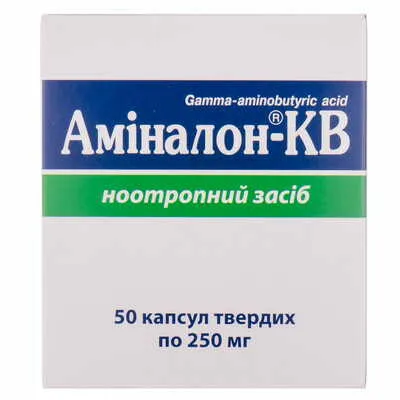
AMINOLON®-KV
UkraineThe drug is used for the complex treatment of central nervous system diseases, such as cerebrovascular diseases, encephalopathy, cerebral palsy, mental retardation in children (from 5 years old), and senile dementia. It also helps with motion sickness (sea and air sickness).
Frequently asked questions
How should Aminolon®-kv be taken correctly?
The capsules should be taken orally before meals. For adults, the usual dosage is 2–5 capsules at a time, with a total daily dose of 6–12 capsules divided into 3 doses. For children from 5 years of age, the dosage is 2 to 12 capsules per day, also divided into 3 doses. The duration of the course is determined by a physician.
Who should not take this drug?
The drug is contraindicated in cases of acute renal failure and hypersensitivity to any of its components. It is also not recommended for women during pregnancy and breastfeeding, or for children under 5 years of age.
What are the possible side effects of Aminolon®-kv?
In some cases, nausea, vomiting, intestinal disorders, sleep disturbances or insomnia, fluctuations in arterial blood pressure (especially at the start of treatment), allergic reactions (rash, itching), sensations of heat, and increased body temperature may occur.
Can the drug be combined with other medicines?
When taken simultaneously with tranquilizers, anticonvulsants, or sedative drugs (barbiturates), the effect may be enhanced. Vitamin B6 may also enhance the effect of the product. Consult a physician before combining it with any other medications.
Does the drug affect the ability to drive a vehicle?
During the first days of use, you should refrain from driving vehicles. With long-term use, individuals whose activities require high concentration and rapid reaction should exercise caution.
What rules should be followed during treatment?
It is not recommended to take the drug in the evening or immediately before bedtime, as this may disrupt sleep. Additionally, alcohol should not be consumed during treatment.
Instructions for use
INSTRUCTIONS FOR MEDICAL USE OF THE MEDICINAL PRODUCT AMINALON®-KV (AMINALON-KV)
Composition:
Active substance: γ-aminobutyric acid;
1 capsule contains γ-aminobutyric acid equivalent to 100% substance 250 mg;
Excipients: methylcellulose, calcium stearate.
Pharmaceutical form. Hard capsules.
Main physicochemical properties: hard gelatin capsules with a white body and a blue cap. The capsule contents are a white powder or compressed mass.
Pharmacotherapeutic group. Other psychostimulants and nootropics. ATC code N06B X.
Pharmacological properties.
Pharmacodynamics.
γ-Aminobutyric acid (GABA) is the main mediator of inhibitory processes in the central nervous system (CNS). The neurometabolic effect of the drug is primarily due to its stimulating influence on the GABAergic system, which helps normalize the dynamics of neural processes.
Under the influence of GABA, energy processes in brain tissues are also activated, their respiratory activity increases, and cerebral blood flow improves.
The drug promotes restoration of motor activity, speech, and other cortical functions following cerebrovascular disorders. It exerts a psychostimulant effect: improves cognitive function, memory, attention concentration, and also reduces vestibular disorders and sleep disturbances.
Pharmacokinetics.
The drug is rapidly absorbed from the gastrointestinal tract and undergoes biotransformation in the liver. Metabolites are primarily excreted from the body via urine; partially – as carbon dioxide in exhaled air.
Clinical characteristics.
Indications.
As part of complex treatment of central nervous system disorders:
- cerebral vascular diseases (atherosclerosis, cerebrovascular lesions in arterial hypertension);
- chronic cerebral circulation insufficiency with impaired memory, concentration, speech, dizziness, headache;
- encephalopathy (alcoholic, post-stroke, post-traumatic);
- cerebral palsy in children;
- intellectual developmental delay in children (from 5 years of age);
- senile dementia (early stages of dementia);
- motion sickness (for prevention and treatment of symptoms related to motion sickness).
Contraindications.
Hypersensitivity to any component of the medicinal product; acute renal failure.
Interaction with other medicinal products and other forms of interaction.
When used concomitantly with benzodiazepine agents (tranquilizers, anticonvulsants) as well as with sedative agents (barbiturates), mutual enhancement of effect is observed.
Pyridoxine hydrochloride (vitamin B6) may also enhance the effect of the medicinal product.
When used in combination with benzodiazepine agents, each drug should be administered at the lowest or at moderate effective doses.
If simultaneous use of any medicinal products is necessary, consult a physician.
Special precautions for use.
At the beginning of treatment, monitoring of blood pressure is required due to the possibility of fluctuations.
The drug should not be administered in the evening or before bedtime due to a potential sleep disturbance.
Alcohol consumption is not recommended during treatment with this medicinal product.
Use during pregnancy or breastfeeding.
The drug is not recommended for administration to women during pregnancy or breastfeeding.
Ability to affect reaction rate when driving or operating machinery.
Caution is required in individuals who engage in potentially hazardous activities requiring heightened attention and rapid psychomotor reactions, such as driving vehicles or operating machinery, especially during prolonged treatment. During the first days of treatment, patients should refrain from driving or operating potentially dangerous machinery.
Dosage and Administration
The medicinal product should be taken orally before meals.
For adults, the recommended dose is 2–5 capsules (500–1250 mg) per administration, depending on the course and severity of the disease. The daily dose usually ranges from 6–12 capsules (1500–3000 mg), divided into 3 doses.
For children, the medicinal product may be administered starting from the age of 5 years, depending on the course and severity of the disease, at a dose of 2–12 capsules (500–3000 mg) per day. The daily dose should be divided into 3 administrations. Treatment duration ranges from 2 weeks to 6 months. If necessary, repeated courses may be conducted (after consultation with a physician).
For the treatment of motion sickness symptoms, administer to adults 2 capsules (500 mg) and to children aged 5 years and older 1 capsule (250 mg), 3 times daily for 3–4 days. For prophylactic purposes, administer to adults 2 capsules (500 mg) 3 times daily for 3 days prior to travel or anticipated motion exposure.
The duration of treatment course is determined individually by a physician.
Children. The medicinal product is not recommended for children under 5 years of age.
Overdose.
Significant exceeding of therapeutic doses or failure to follow recommended treatment regimens may lead to nausea, vomiting, gastrointestinal disturbances, headache, fever, fluctuations in arterial blood pressure, and sleep disturbances. In such cases, the drug should be discontinued immediately. Treatment is symptomatic.
Adverse reactions.
In individual cases, the following may occur:
- Gastrointestinal tract: dyspeptic symptoms, nausea, vomiting;
- Nervous system: sleep disturbances, insomnia;
- Cardiovascular system: fluctuations in arterial pressure (more often during the first days of treatment);
- Immune system: allergic reactions, including skin rashes, itching;
- General: sensation of heat, increased body temperature.
These symptoms usually resolve upon dose reduction.
If any adverse reactions occur, discontinue use of the drug and consult a physician immediately.
Shelf life. 3 years.
Storage conditions.
Store in the original packaging at a temperature not exceeding 25 °C.
Keep out of reach of children.
Packaging.
10 capsules in blisters.
10 capsules in a blister; 5 blisters per pack.
Dispensing category. Over-the-counter.
Manufacturer. JSC "KYIV VITAMIN PLANT".
Manufacturer's address and location of business activities.
38 Kopilivska Street, Kyiv, 04073, Ukraine.
Web-site: www.vitamin.com.ua.
INSTRUCTION
for medical use of the medicinal product
| AMINALON-KV® |
| (AMINALON-KV) |
Composition:
Active ingredient: γ-aminobutyric acid;
1 capsule contains γ-aminobutyric acid equivalent to 100 % substance 250 mg;
Excipients: methylcellulose, calcium stearate.
Pharmaceutical form. Hard capsules.
Main physicochemical properties: hard gelatin capsules with a white body and a blue cap. The capsule contents are white powder or compressed mass.
Pharmacotherapeutic group. Other psychostimulants and nootropic agents. ATC code N06B X.
Pharmacological properties.
Pharmacodynamics.
γ-aminobutyric acid (GABA) is the main mediator of inhibitory processes in the central nervous system (CNS). The neurometabolic effect of the drug is mainly due to its stimulating influence on the GABA-ergic system, which ensures normalization of nervous processes dynamics.
Under the influence of GABA, energy processes in brain tissues are also activated, their respiratory activity increases, and blood supply improves.
The drug promotes restoration of motor activity, speech, and other cortical functions after cerebral circulation disorders. It exerts psychostimulant action: improves mental performance, memory, attention concentration, and also reduces vestibular disorders and sleep disturbances.
Pharmacokinetics.
The drug is rapidly absorbed from the gastrointestinal tract and undergoes biotransformation in the liver. Metabolites are excreted from the body mainly in urine; partially – as carbon dioxide in exhaled air.
Clinical characteristics.
Indications.
As part of complex treatment of central nervous system disorders:
- cerebrovascular diseases (atherosclerosis, cerebral vessel lesions in arterial hypertension);
- chronic cerebral circulation insufficiency with memory impairment, attention concentration difficulties, speech disorders, dizziness, headache;
- encephalopathy (alcoholic, post-stroke, post-traumatic);
- cerebral palsy in children;
- intellectual developmental delay in children (from 5 years of age);
- senile dementia (early stages of dementia);
- motion sickness (for prevention and treatment of motion sickness symptoms).
Contraindications.
Hypersensitivity to any component of the drug; acute renal failure.
Interaction with other medicinal products and other types of interactions.
When used concomitantly with benzodiazepine drugs (tranquilizers, anticonvulsants) as well as with sedatives (barbiturates), mutual enhancement of effects may occur.
Pyridoxine hydrochloride (vitamin B6) may also enhance the effect of the drug.
When used in combination with benzodiazepine drugs, each medicinal substance should be administered at minimal or medium effective doses.
If simultaneous use of any medicinal products is necessary, consult a physician.
Special precautions.
At the beginning of treatment, blood pressure should be monitored due to possible fluctuations.
The drug is not recommended in the evening or before bedtime due to possible sleep disturbances.
Alcohol consumption during treatment with the drug is not recommended.
Use during pregnancy or breastfeeding.
The drug is not recommended for women during pregnancy or breastfeeding.
Ability to affect reaction speed when driving or operating machinery.
During prolonged use of the drug, caution should be exercised by individuals engaged in potentially hazardous activities requiring high attention and rapid psychomotor reactions, such as driving or operating machinery. During the first days of treatment, driving or operating potentially hazardous machinery should be avoided.
Dosage and administration.
The drug should be taken orally before meals.
For adults: 2–5 capsules (500–1250 mg) per dose, depending on the course and severity of the disease. Daily dose usually ranges from 6 to 12 capsules (1500–3000 mg) divided into 3 doses.
For children: the drug may be prescribed from the age of 5 years, depending on the course and severity of the disease, at 2–12 capsules (500–3000 mg) per day. The daily dose should be divided into 3 doses. Treatment duration ranges from 2 weeks to 6 months. Repeat courses may be conducted if necessary (after consultation with a physician).
For treatment of motion sickness symptoms: adults should take 2 capsules (500 mg) and children from 5 years of age should take 1 capsule (250 mg) 3 times daily for 3–4 days. For prophylaxis, adults should take 2 capsules (500 mg) 3 times daily for 3 days preceding travel or possible motion sickness.
The duration of treatment is determined individually by a physician.
Children. The drug is not recommended for children under 5 years of age.
Overdose.
Significant exceeding of therapeutic doses or failure to follow recommended treatment regimens may lead to nausea, vomiting, intestinal disturbances, headache, increased temperature, blood pressure fluctuations, and sleep disturbances. In such cases, drug administration should be discontinued. Treatment: symptomatic.
Adverse reactions.
In individual cases, the following may occur:
- Gastrointestinal system: dyspeptic symptoms, nausea, vomiting;
- Nervous system: sleep disturbances, insomnia;
- Cardiovascular system: blood pressure fluctuations (more common during the first days of treatment);
- Immune system: allergic reactions, including skin rashes, itching;
- General: sensation of warmth, increased temperature.
These symptoms usually resolve after dose reduction.
If any adverse reactions occur, drug administration should be discontinued and medical advice should be sought immediately.
Shelf life. 3 years.
Storage conditions.
Store in original packaging at a temperature not exceeding 25 °C.
Keep out of reach of children.
Packaging.
10 capsules in blisters.
10 capsules per blister; 5 blisters per carton.
Prescription status. Over-the-counter.
Manufacturer. JSC "KYIV VITAMIN PLANT".
Manufacturer's address and location of operations.
38 Kopylovska Street, Kyiv, 04073, Ukraine.
Web-site: www.vitamin.com.ua.
Similar drugs
| Brand name | Dosage form | Active substance / Dosage | Manufacturer |
|---|---|---|---|
| CINATROPIL®-ZDOROVYA | capsules, hard |
|
LLC "Corporation "Zdorovya" |
| COGNIFEN® | capsules, hard |
|
JSC "Olyinpharm" |
| FEZAM | capsules, hard |
|
Balkanpharma-Dupnitsa JSC |
The original data is available in the language of the country of manufacture.
Data source: State Register of Medicinal Products of Ukraine
Data last verified: August 13, 2026