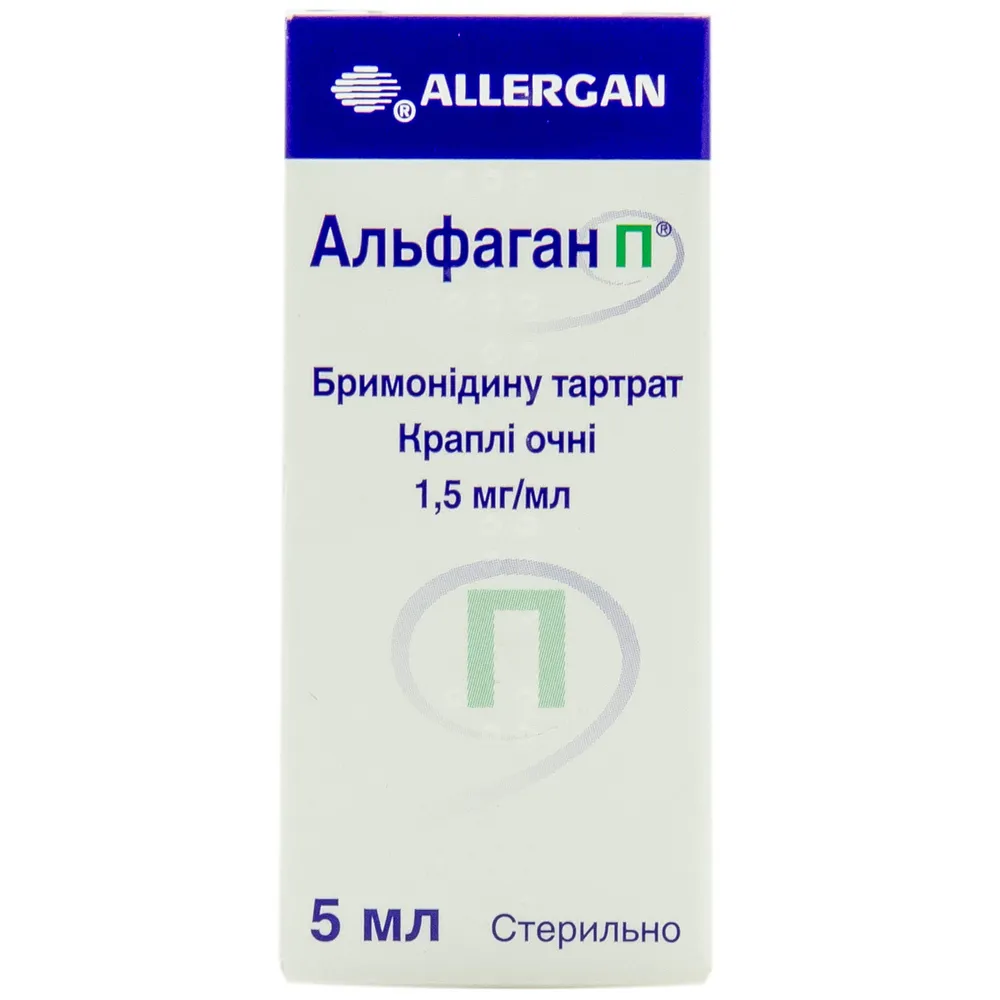
ALPHAGAN P®
UkraineThe drug is used to reduce elevated intraocular pressure in patients with open-angle glaucoma or simply in cases of increased ocular pressure.
Frequently asked questions
How should Alphagan p® be used correctly?
Instill 1 drop into the affected eye 3 times a day at intervals of approximately 8 hours. If you are using other eye drops, wait at least 5 minutes between them.
Can contact lenses be worn while using the drug?
Soft contact lenses must be removed before instillation. They can be reinserted 15 minutes after using the drops.
Who should not use this drug?
Use is contraindicated in cases of hypersensitivity to the components of the drug, during pregnancy and breastfeeding, as well as in children under 2 years of age or children with low body weight (up to 20 kg). It should also not be used in conjunction with MAO inhibitors and certain antidepressants.
What are the possible side effects of Alphagan p®?
The most common side effects may include allergic conjunctivitis, itching, eye redness, a burning sensation, visual disturbances, eye pain, or dryness. Headache, dizziness, drowsiness, insomnia, cough, or taste changes are also possible.
How does Alphagan p® interact with other medicines?
The drug may enhance the effects of agents that depress the central nervous system (e.g., alcohol, sedatives, opioids). Caution should be exercised when taken concurrently with antihypertensive agents and cardiac glycosides. Reduced efficacy is also possible during concomitant treatment with tricyclic antidepressants.
Does the drug affect the ability to drive a vehicle?
Use may lead to visual disturbances, weakness, or drowsiness. It is not recommended to drive vehicles or operate machinery requiring high concentration until visual clarity is restored.
Instructions for use
INSTRUCTIONS FOR MEDICAL USE OF THE MEDICINAL PRODUCT ALPHAGAN P® (ALPHAGAN P®)
Composition:
Active substance: brimonidine tartrate;
1 ml of solution contains brimonidine tartrate 1.5 mg;
Excipients: oxy-chloro complex stabilized [sodium chlorite, sodium chlorate, chlorine dioxide]; sodium carmellose; sodium chloride; potassium chloride; calcium chloride, dihydrate; magnesium chloride, hexahydrate; boric acid; sodium tetraborate, decahydrate; hydrochloric acid or sodium hydroxide; purified water.
Pharmaceutical form. Eye drops.
Main physicochemical properties: clear yellow-green solution.
Pharmacotherapeutic group. Antiglaucoma and miotic agents.
ATC code S01E A05.
Pharmacological properties.
Pharmacodynamics.
Brimonidine is a relatively selective alpha-2-adrenergic receptor agonist. (It is a locally acting agent used to reduce elevated intraocular pressure.) When administered as eye drops 1.5 mg/mL, the maximum intraocular pressure-lowering effect is achieved within 2 hours. The hypotensive effect of brimonidine is due to reduction in aqueous humor production and increased uveoscleral outflow.
Pharmacokinetics.
After instillation of the eye drops, maximum plasma concentration (Cmax) of the drug is reached within 0.5–2.5 hours; elimination half-life (T1/2) is approximately 2 hours.
Protein binding of brimonidine has not been studied. Brimonidine is predominantly metabolized in the liver. Brimonidine and its metabolites are excreted via the kidneys.
Clinical characteristics.
Indications.
Reduction of elevated intraocular pressure in patients with open-angle glaucoma or ocular hypertension (either as monotherapy or in combination with other intraocular pressure-lowering agents).
Contraindications.
Hypersensitivity to brimonidine tartrate or any other component of the drug.
Concomitant use of monoamine oxidase inhibitors (MAOIs) and antidepressants affecting noradrenergic transmission (e.g., tricyclic antidepressants and mianserin).
Pregnancy and breastfeeding.
Children under 2 years of age and patients with low body weight (less than 20 kg), as the safety and efficacy of the drug have not been established in these patient groups.
Interaction with other medicinal products and other forms of interaction.
When using more than one topical ophthalmic agent, administer the products at least 5 minutes apart.
Although specific drug interaction studies with Alphagan P**®** have not been conducted, potential additive effects should be considered when using drugs that depress the central nervous system (e.g., alcohol, barbiturates, opioids, sedatives, general anesthetics). Since Alphagan P**®** may reduce arterial blood pressure (BP), antihypertensive agents and cardiac glycosides should be used with caution.
Due to the known attenuation of the hypotensive effect of clonidine (an alpha-adrenergic agonist) when used concomitantly with tricyclic antidepressants, a reduced efficacy of Alphagan P**®** cannot be ruled out during concomitant therapy with tricyclic antidepressants.
Monoamine oxidase inhibitors (MAOIs) may theoretically affect brimonidine metabolism and potentially increase the incidence of systemic adverse reactions, such as arterial hypotension.
The drug should be administered with caution to patients receiving medicinal products that may influence amine metabolism and their distribution in the vascular bed, e.g., chlorpromazine, methylphenidate, reserpine.
Special precautions for use.
Alphagan P® should be prescribed with caution to patients with depression, cerebral or coronary insufficiency, Raynaud's syndrome, orthostatic hypotension, and thromboangiitis obliterans.
Although clinical studies of brimonidine tartrate ophthalmic solution demonstrated minimal effect on patient blood pressure, the drug should be used cautiously in patients with severe, unstable, or uncontrolled cardiovascular disorders.
Cases of bacterial keratitis associated with the use of multidose containers for topical ophthalmic products have been reported. This occurred primarily in patients who had concomitant corneal disease or compromised ocular surface integrity and inadvertently contaminated the containers during use.
Improper use of eye drops or contact of the dropper tip with the eye or surrounding surfaces may contaminate the eye drops with common bacteria, which can lead to ocular infections. Severe eye damage and subsequent vision loss may result from the use of contaminated eye drops.
Close the dropper bottle with the cap immediately after use. If the solution changes color or becomes cloudy, use of the eye drops should be discontinued.
Patients with the aforementioned conditions must be closely monitored. If the patient's condition worsens, Alphagan P**®** should be discontinued.
In the event of ocular surgery or the development of an intercurrent disease (e.g., trauma or infection), patients should immediately consult their physician regarding the continued use of the multidose dropper bottle.
Alphagan P® has not been studied in patients with hepatic or renal insufficiency; therefore, the drug should be used with caution in such patients.
The effect of dialysis on the pharmacokinetics of brimonidine in patients with renal insufficiency is unknown.
Patients wearing soft contact lenses must remove them before instilling Alphagan P**®**. Contact lenses may be reinserted 15 minutes after administration.
Allergic reactions affecting the eye have been observed in some patients receiving 0.2% brimonidine tartrate. If allergic reactions occur, use of Alphagan P**®** should be discontinued.
Use during pregnancy or breastfeeding.
Controlled studies in pregnant women have not been conducted. Alphagan P**®** should be used during pregnancy or breastfeeding only if the potential benefit to the mother clearly outweighs the potential risk to the fetus or infant. If use of the drug is necessary, breastfeeding should be discontinued.
Effect on ability to drive or operate machinery.
Use of Alphagan P**®** may be accompanied by visual disturbances; therefore, patients should refrain from driving or operating machinery until visual acuity is restored. The drug may cause episodes of weakness and/or drowsiness in some patients. If a patient's occupation involves potentially hazardous activities, they should be warned in advance about possible reductions in attention and psychomotor reaction speed, and it is recommended to avoid such activities.
Dosage and Administration.
Apply locally. Instill 1 drop into the conjunctival sac of the affected eye 3 times daily, with approximately 8-hour intervals between doses.
Alphagan P**®** may be used concomitantly with other ophthalmic agents intended to reduce intraocular pressure. If a patient is using other ophthalmic drops, an interval of at least 5 minutes should be maintained between instillations.
Children. The efficacy and safety of Alphagan P**®** in children under 2 years of age and in children with low body weight (less than 20 kg) have not been established.
Overdose.
Overdose with topical administration (in adults).
Cases of overdose have been reported and are included in the list of adverse reactions.
Systemic overdose following accidental oral intake (in adults).
Information regarding accidental ingestion of brimonidine by adults is very limited. The only adverse reaction reported to date has been arterial hypotension. Arterial hypotension has been reported to be followed by reactive hypertension.
Management of overdose includes supportive and symptomatic therapy, with monitoring and maintenance of airway patency.
Cases of overdose with other alpha-2 agonists have been reported, causing symptoms such as arterial hypotension, asthenia, vomiting, lethargy, sedation, bradycardia, arrhythmias, miosis, apnea, hypotonia, hypothermia, respiratory depression, and seizures.
Overdose with topical administration and systemic overdose following accidental oral intake (in children).
Symptoms of brimonidine overdose, such as apnea, bradycardia, coma, arterial hypotension, hypothermia, hypotonia, lethargy, pallor, respiratory depression, and somnolence, have been observed in neonates, infants, and children who received brimonidine ophthalmic solution (0.1–0.2%) as part of treatment for congenital glaucoma or following accidental ingestion of brimonidine.
Some of these symptoms required intensive therapy including intubation. All patients fully recovered within 6–24 hours.
Adverse Reactions
Adverse reactions observed in patients receiving brimonidine tartrate ophthalmic solution (0.1–0.2%) are listed according to the MedDRA classification system and grouped by system organ class as follows:
Very common (≥1/10); common (≥1/100 to <1/10); uncommon (≥1/1000 to <1/100); rare (≥1/10,000 to <1/1000); very rare (<1/10,000).
Within each group, adverse reactions are listed in order of decreasing severity.
Clinical Trial Experience
Because clinical trials are conducted under widely varying conditions, adverse reaction rates observed in clinical trials of a particular drug cannot be directly compared to those of another drug and may not reflect the rates observed in clinical practice.
Infections and parasitic diseases
Common: bronchitis, influenza-like syndrome, infections (mainly colds and respiratory tract infections), pharyngitis, rhinitis, infectious sinusitis, sinusitis.
Blood and lymphatic system disorders
Common: hypercholesterolemia.
Eye disorders
Very common: allergic conjunctivitis, conjunctival hyperemia, eye pruritus.
Common: burning sensation, conjunctival folliculosis, eye allergic reactions, visual disturbance, blepharitis, blepharoconjunctivitis, blurred vision, cataract, conjunctival edema, conjunctival hemorrhage, conjunctivitis, lacrimation, eye discharge, dry eye, eye irritation, eye pain, eyelid edema, eyelid erythema, follicular conjunctivitis, foreign body sensation in the eye, keratitis, eyelid disorders, photophobia, acute pain, superficial punctate keratopathy, epiphora, visual field defect, vitreous detachment, vitreous body disorders, floaters in the vitreous body, decreased visual acuity.
Uncommon: corneal erosion, hordeolum.
Vascular disorders
Common: hypertension, hypotension.
Respiratory, thoracic and mediastinal disorders
Common: dry mouth mucosa, cough, dyspnea.
Uncommon: dry nasal mucosa, bronchitis.
Gastrointestinal disorders
Common: taste perversion, dyspepsia, digestive disorder.
Uncommon: taste disturbance.
General disorders and administration site conditions
Common: asthenia, fatigue.
Immune system disorders
Common: allergic reactions.
Nervous system disorders
Common: dizziness, headache, somnolence.
Uncommon: weakness.
Psychiatric disorders
Common: insomnia.
Skin and subcutaneous tissue disorders
Common: rash.
Post-marketing Experience
The following adverse reactions have been reported during post-marketing use of brimonidine tartrate ophthalmic solution. Because these reactions are reported voluntarily from a population of unknown size, it is not always possible to reliably estimate their frequency or establish a causal relationship to drug exposure. The reactions listed below have been selected based on their severity, frequency of reporting, potential relationship to brimonidine tartrate ophthalmic solution, or a combination of these factors.
Cardiac disorders
Unknown frequency: bradycardia, tachycardia.
Psychiatric disorders
Unknown frequency: depression.
Immune system disorders
Unknown frequency: hypersensitivity, skin reactions (including erythema, eyelid pruritus, skin rash, vasodilation).
Eye disorders
Unknown frequency: iritis, dry keratoconjunctivitis, miosis.
Nervous system disorders
Unknown frequency: dizziness, syncope, coma.
Gastrointestinal disorders
Unknown frequency: nausea.
In children treated with brimonidine tartrate ophthalmic solution, the following adverse reactions have been reported:
Respiratory, thoracic and mediastinal disorders
Unknown frequency: apnea.
Cardiac disorders
Unknown frequency: bradycardia.
Vascular disorders
Unknown frequency: hypotension.
Nervous system disorders
Unknown frequency: coma, hypotonia, lethargy, somnolence.
General disorders and administration site conditions
Unknown frequency: hypothermia, pallor.
Respiratory, thoracic and mediastinal disorders
Unknown frequency: respiratory failure.
Shelf life. 2 years.
Do not use after the expiry date stated on the packaging.
The shelf life of the medicinal product after first opening the dropper bottle is 28 days.
Storage conditions.
Store at a temperature not exceeding 25 °C. Keep out of the reach of children.
Packaging.
5 ml, 10 ml, or 15 ml in a dropper bottle made of opaque low-density polyethylene with a capacity of 10 ml (for 5 ml and 10 ml) or 15 ml (for 15 ml), closed with a polystyrene cap and sealed with a PVC film. One dropper bottle per cardboard box.
Prescription status.
Prescription only.
Manufacturer.
Allergan Sales LLC.
Manufacturer's address.
8301 Mars Drive,
Waco, Texas 76712-6578, USA.
Similar drugs
| Brand name | Dosage form | Active substance / Dosage | Manufacturer |
|---|---|---|---|
| BRIMONIDINE-PHARMEX | drops, ophthalmic |
|
Farmex Group LLC |
The original data is available in the language of the country of manufacture.
Data source: State Register of Medicinal Products of Ukraine
Data last verified: August 13, 2026