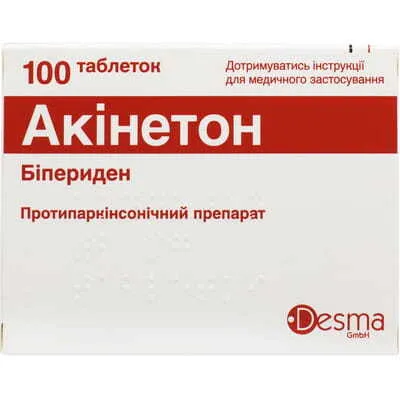
AKINETON
UkraineThe drug is used to treat symptoms of Parkinson's disease (such as tremor and muscle rigidity), as well as to eliminate side effects from the intake of neuroleptics and other medications (for example, in cases of akathisia, early dyskinesia, or parkinsonism).
Frequently asked questions
How should Akineton be taken correctly?
The dosage is selected individually. Treatment usually begins with the lowest dose, which is gradually increased. Tablets should be taken during or after meals, with liquid. The total daily dose should be distributed evenly over several doses throughout the day. You must not stop taking the medication abruptly — the dose should be reduced gradually.
Who should not take this medication?
Contraindications include hypersensitivity to the components of the drug, untreated angle-closure glaucoma, mechanical narrowing or obstruction of the gastrointestinal tract, and megacolon. Since the drug contains lactose, it should not be used in certain forms of galactose or fructose intolerance.
What are the possible side effects of Akineton?
The most common side effects may include dry mouth, nausea, gastrointestinal disturbances, fatigue, dizziness, or muscle spasms. Less frequently, memory impairment, insomnia, agitation, rapid heartbeat, urinary retention, or visual disturbances (e.g., pupil dilation) may be observed.
Can the drug be combined with other medicines or alcohol?
Alcohol consumption should be avoided, as it enhances the effect of the drug. Akineton may enhance the effects of other anticholinergic agents, psychotropic drugs, antihistamines, and antispasmodics. Interaction is also possible with levodopa (which may increase dyskinesia) and quinidine.
Can the drug be taken during pregnancy or breastfeeding?
Experience regarding use during pregnancy is lacking; therefore, a decision is made only after assessing the risks and benefits. Breastfeeding is not recommended while taking the drug, as it may suppress lactation and be excreted in breast milk.
Instructions for use
I N S T R U C T I O N for medical use of the medicinal product A K I N E T O N (AKINETON®)
Composition:
Active substance: biperiden hydrochloride;
1 tablet contains biperidene hydrochloride 2 mg;
Excipients: maize starch; lactose monohydrate; microcrystalline cellulose; calcium hydrogen phosphate; potato starch; copovidone; talc; magnesium stearate.
Pharmaceutical form. Tablets.
Main physicochemical properties: almost white, flat cylindrical tablets with bevelled edges, marked with a cross-shaped groove on one side.
Pharmacotherapeutic group. Anti-Parkinson drugs. Anticholinergic agents. Tertiary amines. Biperiden. ATC code N04A A02.
Pharmacological properties.
Pharmacodynamics.
The Akineton preparation is an anticholinergic agent with predominantly central action. Peripheral anticholinergic activity is less pronounced compared to that of atropine. Biperiden competitively binds to peripheral and central muscarinic receptors (mainly M1).
In animal studies, biperiden influenced parkinsonism-like conditions (tremor, rigidity) induced by centrally acting cholinergic agents.
Thus, biperiden affects conditions associated with cholinergic hyperactivity in the CNS, e.g., Parkinson's syndrome as an extrapyramidal symptom of dopamine deficiency due to neuronal degeneration, as well as other symptoms caused by neuroleptics, which also can be attributed to disturbances in dopaminergic neurotransmission in the basal ganglia. Therefore, the balance between dopaminergic and cholinergic functions is disrupted. Relatively increased cholinergic activity can be pharmacologically suppressed by anticholinergic agents such as Akineton.
Pharmacokinetics.
Absorption
Biperiden hydrochloride is rapidly absorbed after oral administration of 4 mg and is detectable in blood plasma within 27 minutes. Maximum plasma concentration of 4–7 ng/mL is reached within 1–2 hours.
Bioavailability
The bioavailability of biperiden hydrochloride after oral administration is approximately 30%.
Distribution
Protein binding of biperiden to plasma proteins is approximately 95%. The apparent volume of distribution of biperiden has been determined to be 24 ± 4.1 L/kg. Biperiden readily penetrates tissues and has a tissue distribution half-life of 0.6 hours; the ratio of total volume of distribution to central volume of distribution is 9.6.
Information regarding placental transfer of biperiden is lacking.
Biotransformation
Biperiden is almost completely metabolized. Unchanged biperiden is not detected in urine. The main metabolite of biperiden is formed via hydroxylation of the bicycloheptane ring (60%); additionally, partial hydroxylation of the piperidine ring occurs (40%). Numerous metabolites (as hydroxylated products and their conjugates) are excreted in a 50:50 ratio in urine and feces.
Elimination
The terminal elimination half-life in plasma after single oral administration of biperiden hydrochloride in young healthy volunteers is 11–24 hours, and plasma clearance is approximately 146 L/h. At steady state, the elimination half-life in plasma was 25 ± 9 hours.
Elderly patients
Bioavailability
Since liver mass, blood flow, and hepatic enzyme activity may decrease with age, a reduced rate of hepatic metabolism of biperiden may occur in elderly patients, resulting in increased bioavailability and reduced elimination rate compared to younger patients. In a comparative study, elderly patients showed AUC values 3–5 times higher and elimination half-lives twice as long as those observed in younger volunteers.
Elimination
The terminal elimination half-life after single oral administration in elderly patients was 30 ± 6 hours. The elimination half-life at steady state was 39 ± 12 hours.
Pharmacokinetic data in patients with hepatic or renal impairment are lacking.
Preclinical safety data.
Chronic toxicity
Chronic toxicity studies in rats and dogs did not reveal signs of organ toxicity.
Mutagenic and carcinogenic potential
In vivo and in vitro studies with biperiden did not show mutagenic or clastogenic effects. Long-term animal studies on the carcinogenic potential of biperiden are lacking.
Reproductive toxicity
Biperiden has not been sufficiently studied regarding reproductive toxicity in animals.
Studies on the effects on fertility, fetal and postnatal development are lacking. Embryotoxicity studies did not reveal signs of teratogenic potential or other embryotoxic characteristics when the drug was administered within the therapeutic dose range.
There is no experience with the use of the medicinal product in pregnant or breastfeeding women.
Clinical characteristics.
Indications.
Parkinson's syndrome: treatment of symptoms of Parkinson's disease such as rigidity and tremor.
Extrapyramidal side effects of neuroleptics and other medicinal products: early dyskinesia, akathisia, and parkinsonism.
Contraindications.
Hypersensitivity to biperiden hydrochloride or to any of the excipients, untreated closed-angle glaucoma, mechanical narrowing (stenosis) of the gastrointestinal tract, megacolon, gastrointestinal obstruction.
Interaction with other medicinal products and other forms of interaction.
Concomitant use of Akineton with other anticholinergic agents, such as psychotropic drugs, antihistamines, antiparkinsonian and spasmolytic medicinal products, may lead to an increased risk of central and peripheral adverse effects.
Concomitant administration of quinidine may enhance anticholinergic cardiovascular effects (particularly disturbances in atrioventricular conduction).
Concomitant use of Akineton with levodopa may enhance dyskinesia. When biperiden is used concomitantly with levodopa/carbidopa preparations in patients with Parkinson's disease, generalized choreiform movements have been observed.
Tardive dyskinesia caused by neuroleptics may be exacerbated by Akineton. Sometimes, parkinsonism symptoms associated with tardive dyskinesia may be so severe that treatment with anticholinergic agents becomes necessary.
Anticholinergic agents may enhance central nervous system-related side effects of pethidine.
Effects of alcohol may be enhanced during treatment with the drug (alcohol consumption should therefore be avoided).
Anticholinergic agents such as Akineton reduce the effects of metoclopramide and other substances acting similarly on the gastrointestinal tract.
Special precautions for use.
Central-acting anticholinergic drugs, such as biperiden, may increase susceptibility to epileptic seizures. Akineton should be used with caution in patients with increased seizure predisposition (see section "Adverse reactions").
In cases of urinary retention, patients should empty the bladder before taking the appropriate dose of biperiden.
In individual cases, biperiden may cause difficulty in urination, particularly in patients with prostatic hyperplasia, and less frequently, urinary retention.
During treatment with Akineton, intraocular pressure should be monitored regularly (see section "Adverse reactions"). The drug should also be used cautiously in patients with glaucoma.
Akineton may be administered to patients with myasthenia gravis only with extreme caution.
Akineton should be used with caution in patients with conditions that may lead to tachycardia.
If pronounced dry mouth occurs, it can be alleviated by frequently drinking small amounts of fluid or chewing sugar-free gum.
Warnings for special patient groups
The drug should be used with caution in elderly patients, particularly those with symptoms of organic brain damage. Elderly patients, especially those with cerebrovascular or degenerative cerebral disorders, often exhibit increased sensitivity to the active substance when the drug is used at therapeutic doses.
Impairment of memory may occur during treatment with biperiden (see section "Adverse reactions").
Isolated cases of misuse and dependence on biperiden have been reported, possibly related to mood improvement and euphoric effects induced by the drug, which are rarely observed.
Except in life-threatening complications, abrupt discontinuation of the drug should be avoided due to the risk of excessive rebound effects.
Special notes
The product contains lactose and therefore should not be administered to patients with rare hereditary forms of fructose intolerance, galactose intolerance, lactase deficiency, glucose-galactose malabsorption, or sucrase-isomaltase deficiency.
Use during pregnancy or breastfeeding.
Pregnancy
Since there is no experience with the use of Akineton during pregnancy, the drug should be prescribed only after careful assessment of the risk-benefit ratio.
Breastfeeding
Anticholinergic drugs may suppress lactation. Due to the chemical structure of the active substance, biperiden is likely excreted in breast milk; therefore, breastfeeding should be discontinued.
Reproductive function
Data on the effect of Akineton on reproductive function are lacking.
Ability to affect reaction speed when driving or operating machinery.
Due to adverse effects on the central and peripheral nervous systems, such as fatigue, dizziness, and somnolence, even when used correctly, this drug may impair reaction speed to such an extent that, regardless of limitations imposed by the underlying disease being treated, the ability to actively participate in road traffic or to work with electrical tools, engine-powered tools, or other machinery is further compromised. This is particularly evident when the drug is used concomitantly with other centrally acting agents, anticholinergic drugs, and especially with alcohol.
Patients taking this medication should refrain from potentially hazardous activities requiring rapid mental and motor responses.
Dosage and Administration
The dosage of biperiden should be individually adjusted.
Treatment with Akineton is usually initiated at the lowest dose, gradually increasing it depending on the therapeutic effect and adverse reactions.
Dosage
Adults
Parkinsonism syndrome
Initial dose: ½ tablet orally twice daily (2 mg biperiden hydrochloride/day). The dose may be increased by 2 mg (1 tablet) daily. Maintenance dose: ½–2 tablets 3–4 times daily (corresponding to 3–16 mg/day). The maximum daily dose is 16 mg biperiden hydrochloride (equivalent to 8 tablets/day).
Extrapyramidal symptoms induced by medicinal products
For treatment of drug-induced extrapyramidal symptoms, depending on the severity of symptoms, ½–1 tablet 2–3 times daily (corresponding to 2–6 mg biperiden hydrochloride/day) is administered concomitantly with a neuroleptic.
Children and adolescents (under 18 years of age)
For treatment of drug-induced extrapyramidal symptoms in children aged 3–15 years, ½–1 tablet once to three times daily (corresponding to 1–6 mg biperiden hydrochloride/day) is administered.
Elderly patients
The drug must be used with caution. The lowest possible initial dose should be used, followed by gradual dose escalation depending on patient response.
Patients with hepatic or renal impairment
Pharmacokinetic data in patients with hepatic or renal impairment are lacking. Therefore, the drug should be used with caution. The lowest possible dose should be used, and the dose should be gradually increased depending on patient response.
Note
If a rapid onset of action is required, the drug should be administered in the form of an injection solution.
Administration
The total daily dose should be evenly divided into several doses taken throughout the day.
The tablet may be divided into two equal doses and should be taken during or after meals, with liquid. Gastrointestinal adverse effects may be reduced by taking the drug immediately after meals.
Duration of treatment
The duration of treatment depends on the nature and course of the disease and may vary from short-term to long-term therapy. Treatment with this medicinal product should not be abruptly discontinued. When discontinuing Akineton, the dose should be gradually tapered.
Children. The drug is not administered to children under 3 years of age.
Experience with the use of biperiden in children and adolescents (under 18 years of age) is limited and primarily relates to short-term use in drug-induced dystonia (e.g., caused by neuroleptics or metoclopramide and similar agents), which may occur as a side effect or symptom of intoxication.
Overdose
Symptoms of overdose are similar to those of atropine toxicity, with peripheral anticholinergic signs: dilated pupils with slow reaction to light (mydriasis); dry mucous membranes, facial flushing, increased heart rate, atony of the urinary bladder and intestines, elevated body temperature, and central nervous system disturbances (such as agitation, delirium, disorientation, confusion, and/or hallucinations). In severe intoxications, there is a risk of circulatory collapse and central paralysis of respiratory muscles.
Treatment: Acetylcholinesterase inhibitors, particularly physostigmine (which penetrates into the cerebrospinal fluid and may also affect centrally mediated symptoms), are recommended as antidotes (and/or physostigmine salicylate if the physostigmine test is positive). Supportive measures include maintenance of cardiovascular and respiratory function (mechanical ventilation with oxygen), measures to enhance heat dissipation in case of hyperthermia, and urinary catheterization—depending on the type of symptoms.
Additionally, if necessary, gastric lavage or other measures to reduce gastrointestinal absorption may be performed.
Side effects
Side effects occur particularly at the beginning of treatment and in case of very rapid dose escalation.
Central nervous system stimulation is often observed in patients with symptoms of cerebral dysfunction and may require dose reduction.
The frequency of side effects is defined as follows: very common (≥ 1/10), common (≥ 1/100, < 1/10), uncommon (≥ 1/1,000, < 1/100), rare (≥ 1/10,000, < 1/1,000), very rare (< 1/10,000), frequency not known (cannot be estimated based on available data).
Infections and infestations
Frequency not known: mumps.
Immune system disorders
Very rare: hypersensitivity.
Psychiatric disorders
Rare: at high doses – agitation, restlessness, fear, confusion, delirium, hallucinations, insomnia.
Very rare: nervousness, euphoria.
Nervous system disorders
Rare: fatigue, dizziness, memory impairment.
Very rare: headache, dyskinesia, ataxia, speech disorders, increased susceptibility to epileptic seizures and convulsions.
Eye disorders
Very rare: accommodation disorders, mydriasis, photophobia. Angle-closure glaucoma may occur (intraocular pressure should be monitored).
Cardiac disorders
Rare: tachycardia.
Very rare: bradycardia.
Gastrointestinal disorders
Rare: dry mouth, nausea, gastric discomfort.
Very rare: constipation.
Skin and subcutaneous tissue disorders
Very rare: decreased sweating, allergic rash.
Musculoskeletal and connective tissue disorders
Rare: muscle spasms.
Renal and urinary disorders
Very rare: dysuria, particularly in patients with prostate adenoma (dose reduction required), urinary retention.
General disorders and administration site conditions
Rare: fatigue.
Description of selected side effects
There have been reports of a temporary shortening of the rapid eye movement (REM) sleep phase, characterized by an increased latency to reach this phase and a reduced duration of REM sleep as a percentage of total sleep time.
Children
The safety profile in children is similar to that in adults.
Reporting of suspected adverse reactions
Reporting suspected adverse reactions after authorization of the medicinal product is important. It allows continued monitoring of the benefit-risk balance of the medicinal product. Healthcare professionals and patients, as well as their legal representatives, should report any suspected adverse reactions and lack of efficacy via the Automated Pharmacovigilance Information System at the following link: https://aisf.dec.gov.ua.
Shelf life. 5 years.
Storage conditions.
Store in a place inaccessible to children, at a temperature not exceeding 25 °C, in the original packaging.
Packaging.
20 tablets in a blister; 5 blisters in a cardboard box.
Prescription status.
Prescription only.
Manufacturer.
"Laboratorio Farmaceutico C.I.T. s.r.l." (therapeutic-hygienic specialization)
Manufacturer's address and place of business.
Via Cavour, 70, 27035 Mede (PV), Italy
The original data is available in the language of the country of manufacture.
Data source: State Register of Medicinal Products of Ukraine
Data last verified: August 13, 2026