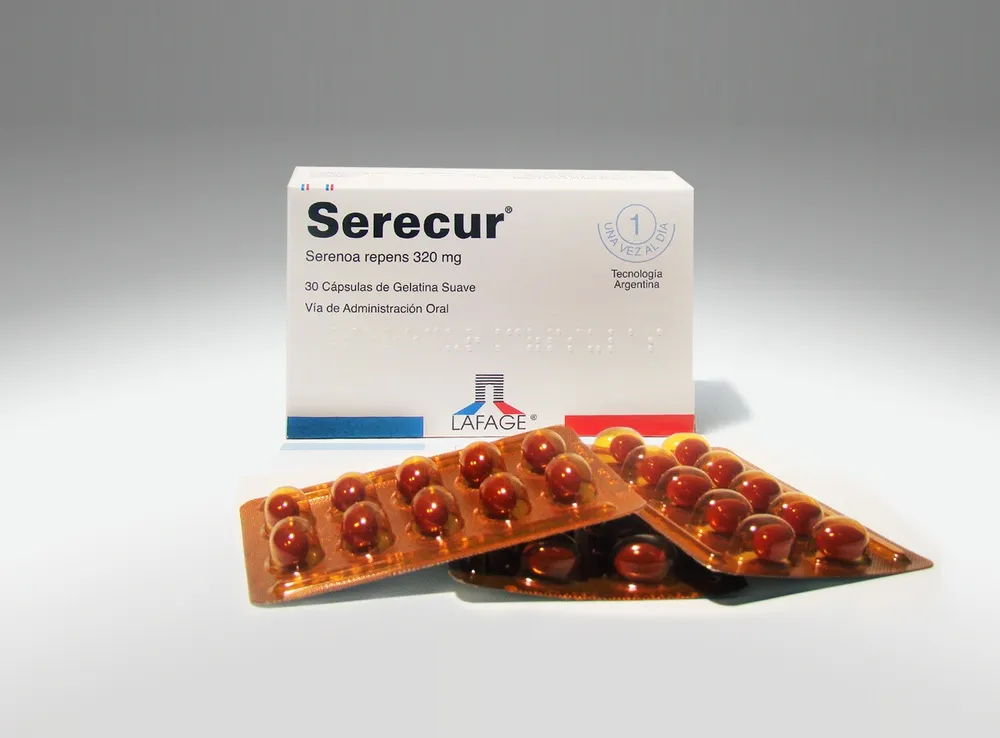
SEREQUR 320 MG SOFT CAPSULES
SpainIt is used in adult men to treat moderate urinary disorders caused by benign prostatic hyperplasia.
Frequently asked questions
How should I take Serequr?
One 320 mg capsule should be taken once daily, during dinner, with a glass of water and without chewing it.
When should I not take this medication?
Do not take it if you are allergic to its components or if you suffer from hepatic impairment. It should also not be used by women, children, or adolescents.
What side effects can Serequr cause?
Common effects include abdominal pain and headache. Other effects may include nausea, increased blood pressure, skin flushing, heartburn, or diarrhea, among others.
Can I take other medications along with this treatment?
No interference with urinary antibiotics, antiseptics, or anti-inflammatories has been described, but suspected interactions with warfarin have been reported. You should consult your doctor regarding any other treatment you are undergoing.
What should I do if I miss a dose?
You should not take a double dose to make up for the missed one; simply continue the treatment following the usual dosage.
When should I consult a doctor during treatment?
You should consult a doctor if symptoms worsen, or if fever, spasms, blood in the urine, pain during urination, or urinary retention occur.
Instructions for use
Package leaflet: Information for the user
Introduction
Package leaflet: information for the user
Serequr 320 mg soft capsules
Lipidosterolic extract of Serenoa repens
Read the entire leaflet carefully before you start taking this medicine, because it contains important information for you.
- Keep this leaflet, as you may need to read it again.
- If you have any questions, ask your doctor or pharmacist.
- This medicine has been prescribed for you only, and you should not give it to others, even if they have the same symptoms as you, because it could harm them.
- If you experience any adverse effects, consult your doctor or pharmacist, even if they are adverse effects not listed in this leaflet. See section 4.
Leaflet contents
- What Serequr is and what it is used for
- What you need to know before taking Serequr
- How to take Serequr
- Possible side effects
- How to store Serequr
- Contents of the pack and other information
1. What Serequr is and what it is used for
Serequr contains as its active ingredient lipidosterolic extract of Serenoa repens.
It belongs to the group of medications used for benign prostatic hyperplasia and acts at the prostatic level, improving the symptoms associated with this condition thanks to its inhibitory effect on 5-alpha reductase (reduces the formation of the hormone responsible for increasing prostate volume), as well as its local anti-inflammatory and antiproliferative actions (reduces proliferation of prostate cells).
Serequr is used in adult men for the treatment of mild to moderate urinary disorders associated with benign prostatic hyperplasia.
2. What you need to know before starting to take Serequr
Do not take Serequr
- if you are allergic to the active substance, lipidosterolic extract of Serenoa repens, or to any of the other ingredients of this medicine (listed in section 6).
- if you have hepatic insufficiency.
Serequr should be discontinued at least two weeks prior to undergoing surgery.
Warnings and precautions
Consult your doctor or pharmacist before starting to take Serequr.
During treatment, as routine monitoring of benign prostatic hyperplasia, the patient must remain under continuous medical supervision.
Given its indications, this product is intended for use only in male patients.
If symptoms worsen or if symptoms such as fever, spasms, blood in the urine, pain during urination, or urinary retention occur during treatment, you must consult a doctor or pharmacist.
Taking Serequr on an empty stomach may cause gastrointestinal discomfort such as acid reflux and abdominal pain.
It is not indicated for use in women, children, or adolescents.
Other medicines and Serequr
Inform your doctor or pharmacist if you are currently using, have recently used, or may need to use any other medicines.
No interactions have been reported with other drugs commonly used to treat this condition (urinary antibiotics, antiseptics, and anti-inflammatory agents). However, to avoid potential interactions between multiple medications, you should consult your doctor or pharmacist about any other treatments you are receiving.
There have been some reported cases of suspected interactions with warfarin.
Pregnancy, breastfeeding and fertility
Serequr is not indicated for use in women.
Driving and using machines
No effects on the ability to drive or operate machinery have been observed.
Allergic reactions (possibly delayed) may occur because it contains ethyl parahydroxybenzoate, sodium salt (E-215) and propyl parahydroxybenzoate, sodium salt (E-217).
3. How to take Serequr
Follow exactly the instructions for using this medicine as given by your doctor. If you are unsure, consult your doctor or pharmacist again.
The recommended dose is one 320 mg capsule taken orally once daily (during dinner).
Elderly patients
Dosage adjustment is not necessary in elderly individuals.
Patients with renal impairment
Dosage adjustment is not necessary in patients with renal impairment.
If you take more Serequr than you should
In case of overdose or accidental ingestion, consult your doctor or pharmacist or call the Toxicology Information Service at telephone number: 91 562 04 20, indicating the medicine and the amount ingested.
If you forget to take Serequr
Do not take a double dose to make up for missed doses.
Continue treatment without changing the dosage regimen.
If you stop taking Serequr
If you have any further questions about the use of this medicine, ask your doctor or pharmacist.
Method of administration
Oral use
Take with a glass of water
Do not chew.
4. Possible adverse effects
Like all medicines, Serequr may cause adverse effects, although not everyone experiences them.
The possible adverse effects are:
Frequent (may affect up to 1 in 10 patients)
- Abdominal pain
- Headache.
Uncommon (may affect up to 1 in 100 patients)
- Increased blood pressure.
- Gynaecomastia (enlargement of breast gland tissue in men). Reversible upon discontinuation of treatment.
- Nausea
- Mild increase in transaminases or gamma-glutamyl transferase (liver enzymes).
- Skin redness (rash).
Rare (may affect up to 1 in 1,000 patients)
- Aerophagia, diarrhoea, pyrosis (acid reflux).
Very rare (may affect up to 1 in 10,000 patients)
- Oedema
Frequency not known (frequency cannot be estimated from the available data)
- Floppy iris syndrome during cataract extraction
- Allergic reactions
Reporting of adverse effects
If you experience any type of adverse effect, consult your doctor or pharmacist, even if it is a possible adverse effect not listed in this leaflet. You may also report them directly via the Spanish Pharmacovigilance System for Human Medicinal Products: https://www.notificaram.es. By reporting adverse effects, you can help provide more information on the safety of this medicine.
5. Storage of Serequr
Do not store above 30°C.
Keep in the original packaging.
Keep this medicine out of the sight and reach of children.
Do not use this medicine after the expiry date stated on the container. The expiry date is the last day of the month indicated after EXP.
Medicines should not be disposed of via wastewater or household waste. Dispose of unused medicines and their containers at the SIGRE collection point at your pharmacy. If you have any doubts, ask your pharmacist how to dispose of unused medicines and their containers. This will help protect the environment.
6. Contents of the pack and other information
Composition of Serequr
- Each soft gelatin capsule contains 320 mg of lipidosterolic extract from the fruit of Serenoa repens (Bartram) Small (DER 9-11:1). Solvent: ethanol 96% V/V.
- Other components (excipients): Gelatin, Glycerol (E-422), Titanium dioxide (E-171), Ethyl parahydroxybenzoate, sodium salt (E-215), Propyl parahydroxybenzoate, sodium salt (E-217), Red iron oxide (E 172), Brown iron oxide (E 172), Yellow iron oxide (E172).
Appearance of the product and contents of the pack
Each box contains 30 soft capsules, in 2 blisters of PVC/PVDC - AL/PVDC with 15 soft capsules each.
The soft capsules are oval and brown.
Marketing Authorization Holder
Laboratorios Q Pharma, S.L.
C/ Moratín 15 Entlo, Oficinas 6-7
03008 Alicante
Spain
Manufacturer
Catalent Italy S.p.A.
Via Nettunense Km 20+100,
04011 Aprilia (LT)
Italy
Laboratorios BOHM S.A.
C/ Molinaseca 23, Polígono Industrial Cobo Calleja,
Fuenlabrada, 28947 Madrid (Spain)
Date of the most recent revision of this leaflet: October 2019
“Detailed and up-to-date information on this medicinal product is available on the website of the Spanish Agency for Medicines and Health Products (AEMPS) http://www.aemps.gob.es/”
Similar drugs
| Brand name | Dosage form | Active substance / Dosage | Manufacturer |
|---|---|---|---|
| PROSTAMED CAPSULES | capsules, soft gelatin |
|
Bioforce Espana A Vogel S.A. |
The original data is available in the language of the country of manufacture.
Data source: Online Medicines Information Centre (CIMA) — AEMPS
Data last verified: September 21, 2026