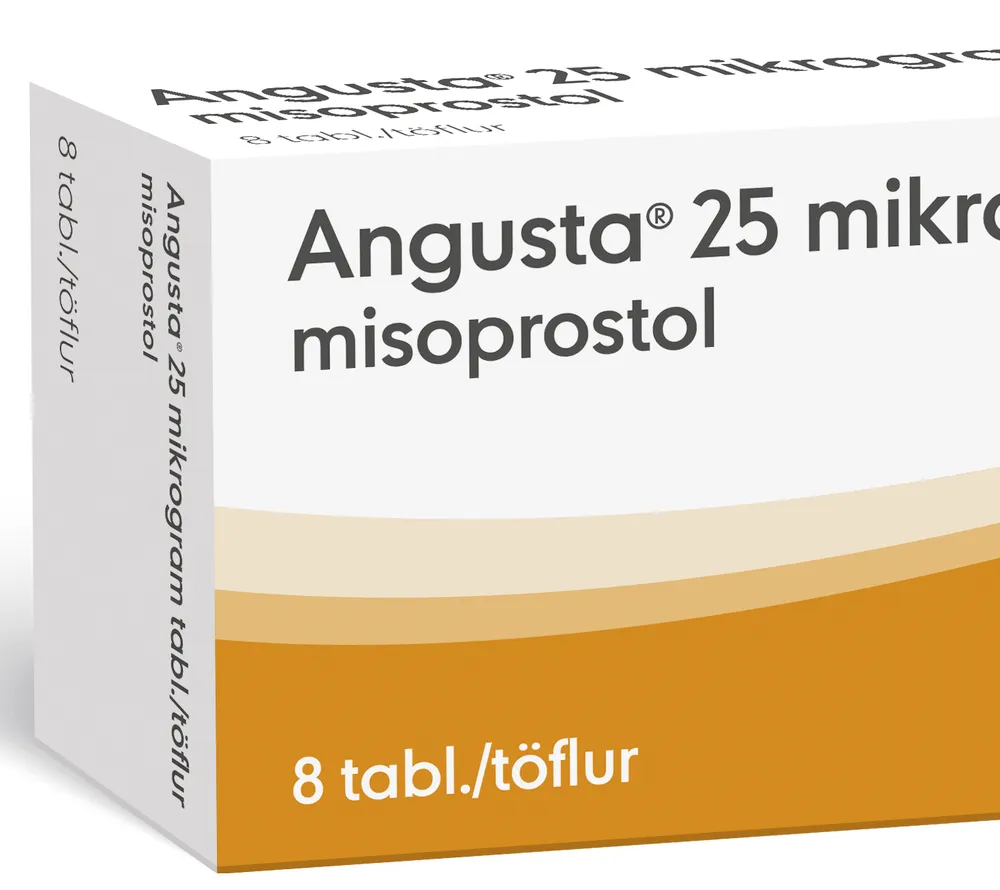
ANGUSTA 25 MICROGRAMS TABLETS
SpainIt is used to help initiate the labor process by helping to soften the cervix and inducing the contractions necessary for birth.
Frequently asked questions
How should I take Angusta?
It should be taken orally with a glass of water, following your healthcare professional's instructions exactly. The dose may be 25 micrograms every two hours or 50 micrograms every four hours, without breaking the tablet.
When should this medication not be used?
Do not take it if labor has already begun, if you are allergic to misoprostol, if you have had any previous surgery on the uterus or cervix, if you have uterine abnormalities, if the placenta blocks the birth canal, or if your baby is not in good health.
What side effects can Angusta cause?
The most common effects include nausea, vomiting, diarrhea, chills, increased body temperature, and postpartum hemorrhage. Contractions that are too strong or frequent may also occur.
Can I take other medications with Angusta?
You should not take it at the same time as other medications used to facilitate labor. If you need to receive oxytocin, it is recommended to wait 4 hours after the last dose of Angusta.
What happens if I take more than the recommended dose?
It could cause contractions to be too strong or long, or cause the baby to experience distress. In that case, treatment must be discontinued and a doctor will decide on the next steps.
Are there risks to the baby with Angusta?
The medication should only be used from the 37th week of pregnancy to avoid the risk of birth defects. During the process, effects such as changes in fetal heart rate or a low Apgar score may occur.
Instructions for use
Patient Information Leaflet
Introduction
Patient Information Leaflet
ANGUSTA 25 micrograms tablets
misoprostol
Read the entire leaflet carefully before you start taking this medicine, as it contains important information for you.
-
Keep this leaflet, as you may need to read it again.
-
If you have any questions, consult your midwife, doctor, or nurse.
-
This medicine has been prescribed for you only. Do not give it to other people, even if they have the same symptoms as you, because it could harm them.
- If you experience any adverse effects, consult your midwife, doctor, or nurse, even if these effects are not listed in this leaflet. See section 4.
Leaflet Contents
-
What Angusta is and what it is used for
-
What you need to know before taking Angusta
-
How to take Angusta
-
Possible side effects
-
How to store Angusta
-
Contents of the pack and other information
1. What Angusta is and what it is used for
Angusta contains the active substance misoprostol.
Angusta is used to help initiate the process of labour.
Misoprostol belongs to a group of medicines called prostaglandins. Prostaglandins have two actions during labour. One action is to soften the cervix to facilitate vaginal birth of the baby. The second action is to induce contractions, which helps push the baby out of the uterus. There may be various reasons why you may need help to start this process. Ask your midwife or doctor if you require further information.
2. What you need to know before taking Angusta
Do not take Angusta
- if you are allergic to misoprostol or to any of the other ingredients of this medicine (listed in section 6)
- if labour has already started
- if your midwife or doctor considers that your baby is not in good health and/or is in distress
- if you are being given oxytocic medicines (medicines used to assist childbirth) and/or other medicines that help initiate the birthing process (see "Warnings and precautions", "Other medicines and Angusta", and "How to take Angusta" below)
- if you have previously undergone surgery on the uterus or cervix, including a prior caesarean section
- if you have any uterine abnormality such as a "heart-shaped" uterus (bicornuate uterus) that prevents vaginal delivery
- if your midwife or doctor believes your placenta is blocking the birth canal (placenta praevia) or you have experienced unexplained vaginal bleeding after week 24 of pregnancy
- if your baby is in a position that does not allow for natural childbirth (fetal malposition)
- if you have impaired kidney function (glomerular filtration rate < 15 ml/min/1.73 m²)
Warnings and precautions
Talk to your midwife, doctor, or nurse before starting to take Angusta.
Angusta should only be administered by a trained professional in a hospital setting where monitoring facilities for you and your baby are available. Your cervix will be carefully assessed before you take Angusta.
Angusta may cause strong stimulation of your uterus.
If uterine contractions are prolonged or too intense, or if your doctor or nurse are concerned about you or your baby, no further tablets will be given, and your midwife or doctor will decide whether to administer medications to reduce the strength or frequency of contractions.
The effect of Angusta in women with severe pre-eclampsia (a condition causing high blood pressure in pregnant women, protein in the urine, and possibly other complications) has not been studied.
Infections of the membranes surrounding the baby (chorioamnionitis) may require rapid delivery. The doctor will make necessary decisions regarding treatment with antibiotics, induction of labour, or caesarean section.
Experience with the use of Angusta in women whose membranes have ruptured more than 48 hours before administration of Angusta is limited or non-existent.
Your doctor will carefully assess the need to start treatment with oxytocin (a medicine used to assist childbirth), as oxytocin treatment may affect the action of Angusta. It is recommended to wait 4 hours after the last dose of Angusta before receiving oxytocin (see "Do not take Angusta", "Other medicines and Angusta", and "How to take Angusta" below).
You should only take Angusta if your midwife or doctor considers that you require medical assistance to initiate labour.
Information on the use of Angusta in pregnant women with a Bishop score > 6 (the Bishop score is the most commonly used method to assess cervical ripeness) is very limited or absent.
An increased risk of blood clot formation in small blood vessels (disseminated intravascular coagulation) after childbirth has been reported in patients whose labour has been induced by any method.
Pregnant women with reduced kidney or liver function may require dose adjustment (see "How to take Angusta" below).
Angusta contains sodium
This medicine contains less than 1 mmol of sodium (23 mg) per tablet; hence, it is essentially "sodium-free".
Other medicines and Angusta
Inform your midwife or doctor if you are taking, have recently taken, or might need to take any other medicines.
You must not take Angusta at the same time as other medicines used to assist childbirth and/or initiate labour (see "Do not take Angusta"). It is recommended to wait 4 hours after the last dose of Angusta before receiving oxytocin (see "Warnings and precautions" and "How to take Angusta" below).
Pregnancy, breastfeeding and fertility
Pregnancy
Angusta is used to help initiate labour from week 37 of pregnancy. When used at this stage of pregnancy, there is no risk of birth defects for your baby. However, you must not use Angusta at any other time during pregnancy, as misoprostol may cause birth defects.
Breastfeeding
Misoprostol may be excreted in breast milk, but the levels and duration are expected to be very limited and should not interfere with breastfeeding. Breastfeeding may be started 4 hours after the last dose of Angusta.
Fertility
There is no impact on fertility with the use of Angusta to assist initiation of labour from week 37 of pregnancy.
3. How to take Angusta
Follow exactly the administration instructions for this medicine given by your midwife, doctor, or nurse. If in doubt, consult your doctor again. Angusta will be administered by a trained professional in a hospital setting where monitoring facilities for you and your baby are available. Your cervix will be carefully assessed before taking Angusta.
The recommended dose is 25 micrograms every two hours or 50 micrograms every four hours. Angusta must be taken orally with a glass of water. Do not break the tablet.
Your midwife or doctor will decide when administration of Angusta should be stopped. Your midbye or doctor will discontinue treatment with Angusta:
- if you have taken 200 micrograms within a 24-hour period
- when labour has started
- if you experience contractions that are too strong or last too long
- if your baby begins to suffer
- if you require treatment with oxytocin or other medications used to assist delivery (see "Do not take Angusta", "Warnings and precautions", and "Other medicines and Angusta" above).
Use in patients with reduced kidney or liver function
Dosage adjustments may be required in pregnant women with reduced kidney or liver function (dose reduction and/or prolonged dosing intervals).
Use in girls and adolescents
The use of Angusta has not been studied in pregnant women under 18 years of age.
If you take more Angusta than you should
If you take more Angusta than you should, it may cause contractions that are too strong or last too long, or cause your baby to suffer. Administration of Angusta must then be stopped. Your midwife or doctor will decide whether you should be given medications to reduce the strength or frequency of your contractions, or whether your baby should be delivered by caesarean section.
4. Possible adverse effects
Like all medicines, this medicine can cause adverse effects, although not everyone experiences them. The following adverse effects may occur with the use of Angusta.
Very common: may affect more than 1 in 10 people
- Nausea1
- Vomiting1
- Meconium in amniotic fluid (early passage of fetal stools into the amniotic fluid)
- Postpartum haemorrhage2 (loss of more than 500 ml of blood after childbirth)
- Reported as very common with Angusta 50 micrograms every 4 hours.
- Reported as very common with Angusta 25 micrograms every 2 hours.
Common: may affect up to 1 in 10 people
- Low Apgar score*1 (test performed at 1 minute and 5 minutes after birth, in which the test score determines the newborn's condition)
- Fetal heart rate abnormalities*1
- Uterine hyperstimulation2 (uterine contractions that are too strong, too frequent, or too prolonged)
- Diarrhoea
- Nausea3
- Vomiting3
- Postpartum haemorrhage1 (loss of more than 500 ml of blood after childbirth)
- Chills
- Increase in body temperature
*Adverse effect in the baby
- Reported as common with Angusta 50 micrograms every 4 hours.
- Uterine hyperstimulation was reported with and without fetal heart rate abnormalities.
- Reported as common with Angusta 25 micrograms every 2 hours.
Uncommon: may affect up to 1 in 100 people
- Low Apgar score*1 (test performed on the baby at 1 minute and 5 minutes after birth, in which the test score determines the newborn's condition)
- Fetal heart rate abnormalities*1
*Adverse effect in the baby
- Reported as uncommon with Angusta 25 micrograms every 2 hours.
Unknown: frequency cannot be estimated from available data
- Dizziness
- Neonatal convulsions* (seizures in the newborn)
- Neonatal asphyxia* (lack of oxygen to the baby's brain and organs during birth)
- Neonatal cyanosis* (also known as "blue baby syndrome", characterized by a bluish discoloration of the skin and mucous membranes of the newborn)
- Pruritic rash (itchy rash)
- Fetal acidosis* (elevated levels of acid in the fetal blood)
- Premature placental separation (separation of the placenta from the uterine wall before birth)
- Uterine rupture
*Adverse effect in the baby
Reporting of adverse effects
If you experience any type of adverse effect, consult your midwife, doctor, or nurse, even if it is a possible adverse effect not listed in this leaflet. You may also report them directly via the Spanish System of Pharmacovigilance for Human Medicines: www.notificaram.es. By reporting adverse effects, you can help provide more information on the safety of this medicine.
5. Storage of Angusta
Keep this medicine out of the sight and reach of children.
Store in the original packaging to protect it from moisture.
Do not use this medicine after the expiry date stated on the blister and on the outer packaging after EXP. The expiry date refers to the last day of the month indicated.
Medicines should not be disposed of via wastewater drains. Ask your midwife, doctor or pharmacist how to dispose of medicines and packaging that you no longer need. This will help protect the environment.
6. Contents of the pack and other information
Composition of Angusta
- The active substance is misoprostol. Each tablet contains 25 micrograms of misoprostol.
- The other components are: hypromellose, microcrystalline cellulose, corn starch, crospovidone, sodium croscarmellose, colloidal anhydrous silica.
Appearance of Angusta and contents of the pack
Angusta tablets are white, oval, uncoated, measuring 7.5 x 4.5 mm, with a single-scored surface on one side and smooth on the other. The tablet should not be divided along the score line.
Angusta tablets are supplied in blister packs containing 8 tablets.
Marketing Authorisation Holder and Manufacturer
Marketing Authorisation Holder
Norgine B.V.
Antonio Vivaldistraat 150
1083 HP Amsterdam
The Netherlands
Manufacturer
Norgine B.V.
Antonio Vivaldistraat 150
1083 HP Amsterdam
The Netherlands
For further information about this medicinal product, please contact the local representative of the Marketing Authorisation Holder:
Norgine de España, S.L.U.
Paseo de la Castellana, 91, 2nd Floor
28046, Madrid
Spain
This medicinal product is authorised in the European Economic Area member states under the following names:
Germany, Austria, Belgium, Bulgaria, Croatia, Cyprus, Denmark, Slovakia, Slovenia, Spain, Estonia, Finland, France, Greece, Hungary, Ireland, Iceland, Italy, Latvia, Luxembourg, Malta, Norway, The Netherlands, Poland, Portugal, Czech Republic, Romania, Sweden: ANGUSTA
Date of the most recent revision of this leaflet: September 2025
Detailed information on this medicinal product is available on the website of the Spanish Agency of Medicines and Health Products (AEMPS) http://www.aemps.gob.es/
Similar drugs
| Brand name | Dosage form | Active substance / Dosage | Manufacturer |
|---|---|---|---|
| MISOPROSTOL 400 MICROGRAMS TABLETS | tablets |
|
Exelgyn |
The original data is available in the language of the country of manufacture.
Data source: Online Medicines Information Centre (CIMA) — AEMPS
Data last verified: September 21, 2026