VIVOTIF
PolandThe vaccine is used to protect adults and children over 5 years of age against typhoid fever.
Frequently asked questions
How should the Vivotif vaccine be administered?
Three capsules should be taken, one every other day (on the 1st, 3rd, and 5th day). The capsules should be swallowed whole, without chewing or crushing, and taken with cold or lukewarm water. It is important to take them on an empty stomach, at least one hour before a meal.
When should this medicine not be taken?
The vaccine should not be used if you are allergic to its ingredients, have a weakened immune system, or have a high fever (above 38.5°C) or an intestinal disease (e.g., diarrhea). It should also not be administered to children under 5 years of age.
Does the Vivotif vaccine interact with other medicines?
Yes. The vaccine should not be taken while using antibiotics (you should wait 3 days after the last dose). Malaria treatment can only be started 3 days after taking the last dose of the vaccine.
What side effects may occur?
Abdominal pain, nausea, vomiting, diarrhea, fever, headache, or skin redness may occur frequently. Other symptoms may include weakness, chills, dizziness, or muscle and joint pain. You must contact a doctor immediately if facial or throat swelling, shortness of breath, or fainting occurs.
Should special precautions be taken regarding food and drink?
Yes, despite vaccination, hygiene rules should always be followed, and caution should be exercised when consuming food and water in areas where typhoid fever is present.
Instructions for use
Package leaflet: Information for the user
Vivotif
Salmonella Typhi Ty21a
Please read all of this leaflet carefully before taking this vaccine, as it contains
important information for you.
- Keep this leaflet, as you may need to read it again.
- If you have any further questions, ask your doctor, pharmacist or nurse.
- This vaccine has been prescribed for a specific individual. Do not pass it on to others.
- If you experience any side effects, including any not listed in this leaflet, inform your doctor, pharmacist or nurse. See section 4.
Contents of the leaflet
- What Vivotif vaccine is and what it is used for
- Important information before taking Vivotif vaccine
- How to take Vivotif vaccine
- Possible side effects
- How to store Vivotif vaccine
- Contents of the pack and other information
1. What Vivotif vaccine is and what it is used for
Vivotif is an oral vaccine that stimulates an immune response against the bacterium called
Salmonella Typhi, which causes typhoid fever. It is used to provide protection against typhoid
fever in adults and children aged 5 years and older.
How Vivotif vaccine works
The bacterium contained in Vivotif vaccine has been modified so that it cannot cause typhoid
fever, but can still stimulate the body's natural defence system (immune system) to fight the bacterium that causes typhoid fever.
Other diseases caused by Salmonella bacteria
There are many other types of Salmonella bacteria. Most of them cause diarrhoeal diseases, which differ significantly from typhoid fever. These are less serious illnesses. Vivotif vaccine does not provide protection against infections caused by other types of Salmonella bacteria.
2. Important information before taking Vivotif vaccine
When not to take Vivotif vaccine:
- if the patient is allergic (hypersensitive) to Salmonella Typhi Ty21a or to any of the other components of this vaccine (listed in section 6);
- if the patient has previously experienced an allergic reaction after taking the Vivotif vaccine;
- if the patient has a weakened immune system for any reason, e.g., if the patient has been born with low resistance to infections. The patient may also have a weakened immune system due to certain infections or treatments that suppress immune function, such as high-dose corticosteroids, anticancer drugs, or radiotherapy;
- if the patient currently has a high fever (above 38.5°C) or an illness affecting the intestines (e.g. diarrhoea), the Vivotif vaccine should not be taken until symptoms have resolved.
Warnings and precautions
Not every person receiving a complete vaccination course with Vivotif will be fully protected against typhoid fever. It is important to continuously follow hygiene recommendations and take precautions regarding food and water consumption in areas where typhoid fever occurs.
Children
Do not administer this vaccine to children under 5 years of age, as the capsule formulation is not suitable for this age group.
Vivotif vaccine and other medicines
Tell your doctor, pharmacist, or nurse about all medicines or vaccines the patient is currently taking or has recently taken, as well as any medicines or vaccines the patient plans to take, including over-the-counter and herbal medicines. This is because the Vivotif vaccine may affect the action of certain medicines and vaccines. In particular, inform your doctor, pharmacist, or nurse if the patient is taking:
- antibiotics – Vivotif may not work properly if taken during antibiotic treatment. The Vivotif vaccine should be taken no earlier than 3 days after the last dose of antibiotic;
- antimalarial medicines – treatment with these medicines may be started 3 days after the last dose of Vivotif vaccine, unless otherwise advised by your doctor, pharmacist, or nurse.
If the patient is taking any of the medicines listed above, inform your doctor, pharmacist, or nurse before taking the Vivotif vaccine.
Taking Vivotif vaccine with food and drink
The Vivotif vaccine should be taken on an empty stomach and at least one hour before the next meal.
Pregnancy, breastfeeding, and fertility
If the patient is pregnant or breastfeeding, suspects she may be pregnant, or is planning to have a child, she should consult her doctor or pharmacist before using this medicine.
Driving and using machines
The Vivotif vaccine is not expected to affect the ability to drive or operate machinery. However, if the patient feels unwell, driving and operating machinery should be avoided.
Vivotif vaccine contains lactose and sucrose
If the patient has been previously diagnosed by a doctor as having an intolerance to certain sugars, consult a doctor before taking this vaccine.
3. How to take the Vivotif vaccine
This vaccine should always be taken in accordance with the recommendations of your doctor, pharmacist, or nurse. If in doubt, consult your doctor, pharmacist, or nurse.
Check the blister pack containing the vaccine capsules to ensure that the protective foil and the capsules are not damaged.
Number of capsules to take and timing of doses
The recommended dose consists of three capsules. One capsule should be taken every other day.
- Take the first capsule on your chosen day. This will be Day 1.
- Take the second capsule on Day 3.
- Take the third capsule on Day 5.
How to take the capsules
- Take the capsules on an empty stomach, at least one hour before your next meal.
- Do not crush or chew the capsules.
- Swallow the capsules with cold or lukewarm water (temperature not exceeding 37°C).
- Swallow the capsules as quickly as possible after placing them in your mouth.
Protection against typhoid fever begins approximately seven to ten days after completing the three-dose course. Your doctor, pharmacist, or nurse will advise you on when it is safe to travel after completing the Vivotif vaccination course.
After three years, you may need to receive the Vivotif vaccine again if you continue to travel to areas where typhoid fever occurs. In such a case, contact your doctor, pharmacist, or nurse.
Taking more Vivotif vaccine than recommended
If you accidentally take all three doses at the same time, contact your doctor, pharmacist, or nurse. It is unlikely to cause illness, but you may not be adequately protected against typhoid fever.
Missing a dose of Vivotif vaccine
If you miss a dose, take the vaccine as soon as possible. Take the next dose after approximately 48 hours.
If you have any further questions about the use of this vaccine, consult your doctor, pharmacist, or nurse.
4. Possible adverse reactions
Like any vaccine, this vaccine may cause adverse reactions, although they do not occur
in everyone.
You should contact a doctor immediately if the patient experiences any of the following severe
adverse reactions:
- severe allergic reactions causing facial or throat swelling and shortness of breath and (or) low blood pressure and fainting.
Other adverse reactions:
Frequently occurring adverse reactions (may affect up to 1 in 10 people):
- abdominal pain;
- nausea or vomiting;
- diarrhoea;
- fever;
- headache;
- skin redness.
Other adverse reactions (frequency cannot be estimated from available data):
- skin irritation, rash, red rash or raised rash, and itching;
- weakness;
- general malaise;
- chills;
- feeling of fatigue;
- tingling;
- dizziness;
- joint or muscle pain;
- back pain;
- decreased appetite, flatulence, bloating;
- influenza-like illness.
Reporting of adverse reactions
If any adverse symptoms occur, including any adverse symptoms not listed
in this leaflet, tell a doctor, pharmacist, or nurse. Adverse reactions
can be reported directly to
Department for Monitoring Adverse Drug Reactions, Office for Registration of Medicinal Products, Medical Devices and Biocidal Products
Al. Jerozolimskie 181C
PL-02 222 Warsaw
Phone: + 48 22 49 21 301
Fax: + 48 22 49 21 309
Website: https://smz.ezdrowie.gov.pl
Adverse reactions can also be reported to the marketing authorization holder.
Reporting adverse reactions helps to provide more information on the safety of the medicine.
5. How to store the Vivotif vaccine
Keep the vaccine out of sight and reach of children.
Do not use the Vivotif vaccine after the expiry date stated on the label. The expiry date refers to the last day of the stated month.
Store in a refrigerator (2 °C – 8 °C).
Keep the blister in the outer packaging to protect from light.
Do not use this vaccine if the blister or capsules are damaged.
Medicines should not be disposed of via wastewater. Ask your pharmacist how to dispose of medicines no longer in use. This will help protect the environment.
EXP means expiry date
Lot means batch number
6. Contents of the pack and other information
What Vivotif vaccine contains
- Each capsule contains not less than 2x10* viable cells of Salmonella Typhi Ty21a.
- Other ingredients: anhydrous lactose, sucrose, casein hydrolysate, ascorbic acid (E300), magnesium stearate (E470b), inactivated cells of Salmonella Typhi Ty21a. Capsule shell: gelatin, titanium dioxide (E171), erythrosine (E127), yellow iron oxide (E172), red iron oxide (E172). Enteric coating: hydroxypropyl methylcellulose phthalate, ethylene glycol, diethyl phthalate.
What Vivotif vaccine looks like and contents of the pack
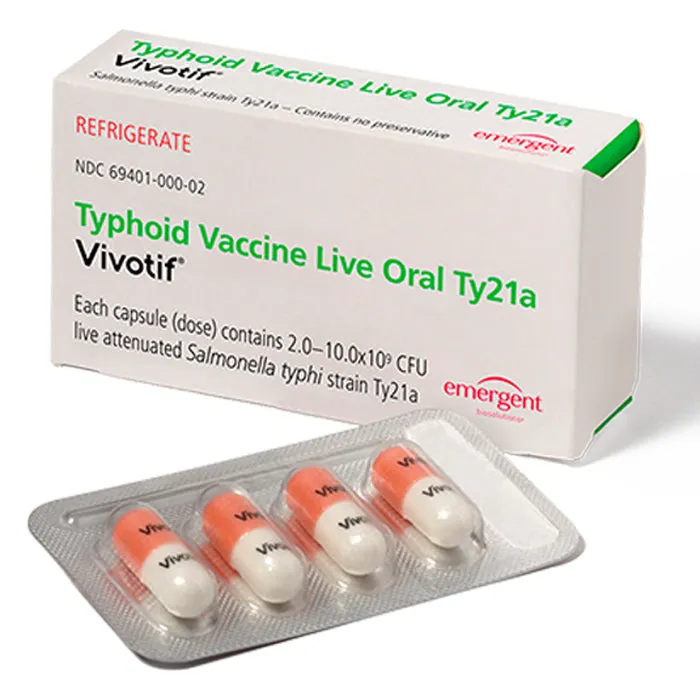
The pack contains a blister with three enteric-coated capsules of Vivotif vaccine. The capsules are two-coloured: white and salmon-pink.
Marketing Authorisation Holder
Emergent Netherlands B.V., Strawinskylaan 411, 1077XX Amsterdam, the Netherlands
Importer
IL-CSM GmbH
Marie-Curie-Strasse 8
79539 Lörrach
Germany
For information about this medicine, contact the local representative of the Marketing Authorisation Holder:
This medicinal product is authorised in the European Economic Area countries and in the United Kingdom (Northern Ireland) under the following names:
Austria, Belgium, Czech Republic, Denmark, Finland, France, Italy, Luxembourg, the Netherlands, Norway, Portugal, Slovakia, Spain, Sweden, United Kingdom (Northern Ireland): Vivotif
Germany: Typhoral L
04/2022
Other sources of information
The original data is available in the language of the country of manufacture.
Data source: Register of Medicinal Products of Poland (URPL)
Data last verified: September 01, 2026