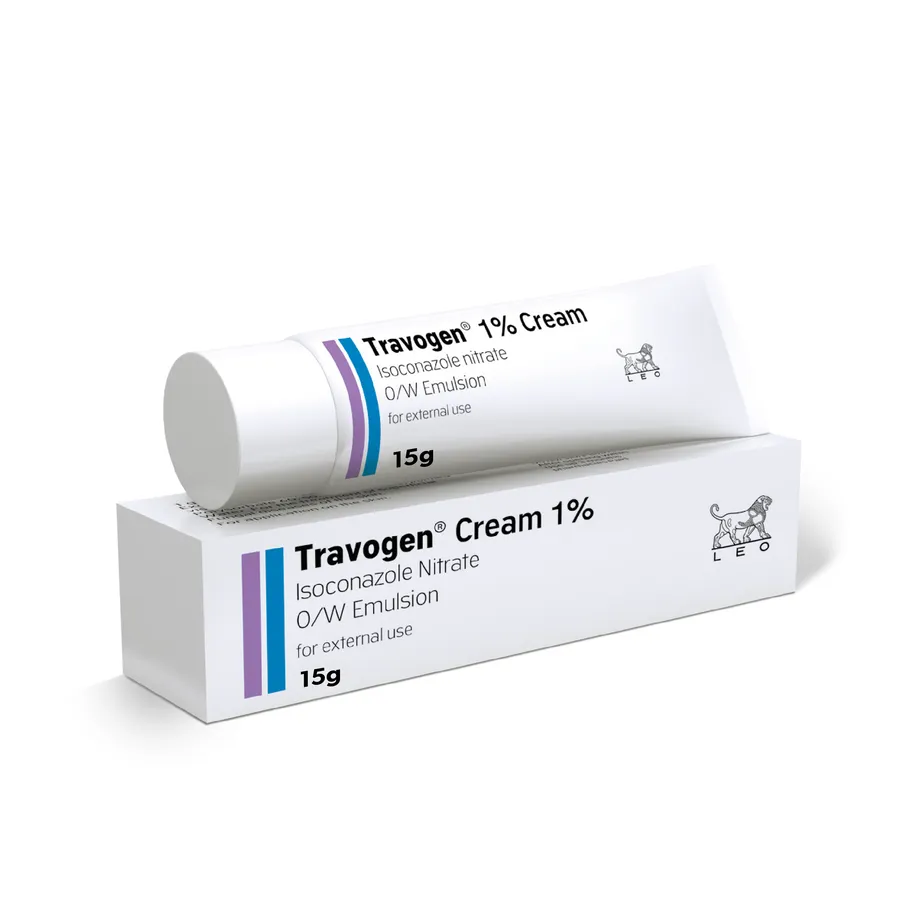
TRAVOGEN
PolandThis is an antifungal medicine for topical use on the skin. It helps in the treatment of superficial fungal infections, such as ringworm of the hands, feet, groin, or genital area, as well as in cases of pityriasis versicolor and seborrheic dermatitis.
Frequently asked questions
How to use Travogen?
The cream should usually be applied once daily to the affected skin. The treatment duration is typically two to three weeks, and in more difficult cases, it may be extended by a doctor to four weeks. To prevent recurrence, it is recommended to continue application for at least two weeks after the symptoms have subsided.
When should you not use the medicine?
Do not use the medicine if you are allergic to isoconazole nitrate or any of the other ingredients of the product.
What are the possible side effects of Travogen?
Skin irritation or burning may occur most frequently. Less commonly, itching, excessive skin dryness, weeping changes, small blisters, dermatitis, swelling, or skin cracks may occur. Redness or allergic reactions may also occur.
Does the medicine interact with other medicines?
No studies have been conducted on interactions with other medicines; however, before starting treatment, you should inform your doctor or pharmacist about all medicines you are currently taking or have previously taken.
Should special precautions be taken during use?
Avoid contact of the medicine with the eyes. If the medicine gets into the eyes, they must be rinsed immediately with plenty of water. When used in the genital area, the medicine may weaken the effectiveness of condoms and intrauterine devices. It is also important to maintain hygiene, e.g., changing underwear daily and thoroughly drying the spaces between the toes.
Can the medicine be used during pregnancy or breastfeeding?
Pregnant women should consult a doctor, who will exercise caution when prescribing the medicine. Breastfeeding women may use it only if the doctor deems that the benefits to the mother outweigh the risks to the child. In such cases, the area around the nipples must not be applied with the medicine to prevent the child from ingesting it.
Instructions for use
Package leaflet: Information for the patient
Warning! Keep this leaflet. Information on the immediate packaging in a foreign language.
Travogen, 10 mg/g (1%), cream
Isoconazoli nitras
Please read carefully all the information in this leaflet before using the medicine, as it contains
important information for the patient.
- Keep this leaflet so that you can read it again if necessary.
- If you have any further questions, please consult your doctor or pharmacist.
- This medicine has been prescribed for a specific individual. Do not pass it on to others. The medicine may harm another person, even if their symptoms are the same.
- If the patient experiences any adverse reactions, including any adverse reactions not listed in this leaflet, inform a doctor, pharmacist, or nurse. See section 4.
Table of contents of the leaflet:
- What Travogen is and what it is used for
- Important information before using Travogen
- How to use Travogen
- Possible side effects
- How to store Travogen
- Contents of the pack and other information
1. What Travogen is and what it is used for
Travogen cream is an antifungal medicine for topical application to the skin.
The active substance of the medicine – isoconazole nitrate – exerts antifungal activity against various species of fungi causing skin infections in humans, such as dermatophytes, yeasts, yeast-like fungi (including those causing pityriasis versicolor), moulds, and fungi causing erythrasma.
Indications
Superficial fungal skin infections, e.g. tinea of hands, feet, groin, genital area; pityriasis versicolor; erythrasma.
2. Information before using Travogen
When not to use Travogen
- if the patient is allergic to isoconazole nitrate or to any of the other components of this medicine (listed in section 6).
Warnings and precautions
- Before starting to use Travogen, discuss this with your doctor or pharmacist.
- Avoid contact of the medicine with the eyes. If the medicine gets into the eyes, rinse them immediately with plenty of water.
- To avoid re-infection, personal clothing (including body and face towels) should be changed daily and boiled. Cotton products are recommended.
- Effective treatment with Travogen depends on maintaining proper personal hygiene. In fungal infections of the feet, the space between the toes should be carefully dried after each washing. Socks and stockings should be changed daily.
- If Travogen is used in the genital area, some of the excipients contained in this medicine may damage condoms and diaphragms. Therefore, they may become ineffective as contraceptive methods or for protection against
sexually transmitted diseases, such as HIV infection. For further
information, consult your doctor or pharmacist.
Travogen and other medicines
Inform your doctor or pharmacist about all medicines currently used, recently used, or planned to be used.
There are no studies on interactions between Travogen and other medicines.
Pregnancy, breastfeeding and fertility
During pregnancy and breastfeeding, or if pregnancy is suspected or planned, consult your doctor or pharmacist before using this medicine.
Pregnancy
Your doctor will exercise caution when prescribing this medicine to pregnant women.
Breastfeeding
Women who are breastfeeding may use Travogen only if, in the opinion of the doctor, the benefits to the mother outweigh the potential risks to the infant.
If the doctor decides that Travogen should be used during breastfeeding, it should not be applied to the area of the nipples to prevent the infant from ingesting the medicine.
Fertility
There are no data indicating that the use of Travogen affects fertility.
Driving and operating machinery
Travogen has no influence on the ability to drive or operate machinery.
Travogen contains cetostearyl alcohol
This ingredient may cause skin reactions (e.g. contact dermatitis).
3. How to use Travogen
This medicine should always be used according to the doctor's instructions. If in doubt, consult your
doctor or pharmacist.
Travogen is intended for topical application on the skin only.
Travogen is usually applied once daily to the affected skin area.
In fungal infections, topical treatment is typically administered for two to three weeks. In infections
that are difficult to treat (especially interdigital infections), the treatment duration may be extended
by the doctor to four weeks. Longer treatment periods are also possible.
In fungal infections of the interdigital spaces of hands and feet, it is recommended to place a gauze
strip impregnated with Travogen between the fingers or toes.
To prevent recurrence of fungal infection, treatment should be continued for at least two weeks
after symptoms have resolved.
For optimal treatment outcome with Travogen, it is very important to follow hygiene measures daily
(see section "Warnings and precautions").
Children and adolescents
Dose adjustment is not necessary when administering Travogen to infants, children, and adolescents.
Use of a higher than recommended dose of Travogen
Single use of the medicine on a large skin surface area or accidental ingestion does not pose a risk
of acute poisoning. If in doubt, contact your doctor or pharmacist.
Missed dose of Travogen
Do not use a double dose to make up for a missed dose. If a dose is missed, apply the next dose as
soon as possible, then continue treatment according to instructions.
If you have any further questions about the use of this medicine, consult your doctor or pharmacist.
4. Possible adverse reactions
Like all medicines, this medicine can cause adverse reactions, although not everybody will get them.
The adverse reactions are listed below by their frequency of occurrence:
Common: may affect 1 in 10 people
- Skin irritation or burning sensation at the application site.
Uncommon: may affect 1 in 100 people
- Itching or excessive dryness of the skin at the application site, weeping lesions, small fluid-filled blisters (miliaria), skin inflammation (contact dermatitis).
Rare: may affect 1 in 1000 people
- Swelling at the application site, skin fissures.
Frequency not known:
- Redness (erythema) or blisters at the application site, allergic skin reactions.
Reporting of adverse reactions
If any adverse reactions occur, including any adverse reactions not listed in this leaflet, inform your doctor, pharmacist or nurse. Adverse reactions can also be reported directly to the Department for Monitoring Adverse Drug Reactions of the Office for Registration of Medicinal Products, Medical Devices and Biocidal Products
Al. Jerozolimskie 181C
02-222 Warsaw
Phone: +48 (22) 49 21 301
Fax: +48 (22) 49 21 309
Website: https://smz.ezdrowie.gov.pl
Reporting adverse reactions helps provide more information on the safety of the medicine.
5. How to store Travogen
Do not store above 30°C.
Keep the medicine in a place invisible and inaccessible to children.
Do not use this medicine after the expiry date stated on the packaging. The expiry date refers to the last day of the stated month.
Shelf-life after first opening the tube: 3 months.
Medicines must not be disposed of via wastewater or household waste. Ask your pharmacist what to do with unused medicines. This will help protect the environment.
6. Contents of the package and other information
What Travogen contains
- The active substance is isiconazole nitrate. 1 g of cream contains 10 mg of isiconazole nitrate.
- The other ingredients are: polysorbate 60, sorbitan stearate, cetostearyl alcohol, liquid paraffin, white soft paraffin, purified water.
What Travogen looks like and contents of the pack
Travogen is a white to slightly yellowish, opaque cream.
The packaging is an aluminium tube internally coated with epoxy resin, closed with a cap made of high-density polyethylene (HDPE), containing 30 g of cream, placed in a cardboard box.
For more detailed information, please contact the marketing authorisation holder or the parallel importer.
Marketing authorisation holder in Austria, the country of export:
LEO Pharma A/S
Industriparken 55
2750 Ballerup
Denmark
Manufacturer:
LEO Pharma Manufacturing Italy S.r.l.
Via E. Schering 21, 20090 Segrate (Milan), Italy
Parallel importer:
Delfarma Sp. z o.o.
ul. Św. Teresy od Dzieciątka Jezus 111, 91-222 Łódź
Repackaged in:
Delfarma Sp. z o.o.
ul. Św. Teresy od Dzieciątka Jezus 111, 91-222 Łódź
Marketing authorisation number in Austria, the country of export: 1-16910
Parallel import authorisation number: 439/24
Similar drugs
| Brand name | Dosage form | Active substance / Dosage | Manufacturer |
|---|---|---|---|
| TRAVOGEN | cream |
|
LEO Pharma Manufacturing Italy S.r.l. |
| TRAVOGEN | cream |
|
LEO Pharma A/S |
| TRAVOGEN | cream |
|
LEO Pharma A/S |
| TRAVOGEN | cream |
|
LEO Pharma A/S |
| TRAVOGEN | cream |
|
LEO Pharma A/S |
| TRAVOGEN | cream |
|
LEO Pharma A/S |
The original data is available in the language of the country of manufacture.
Data source: Register of Medicinal Products of Poland (URPL)
Data last verified: September 01, 2026