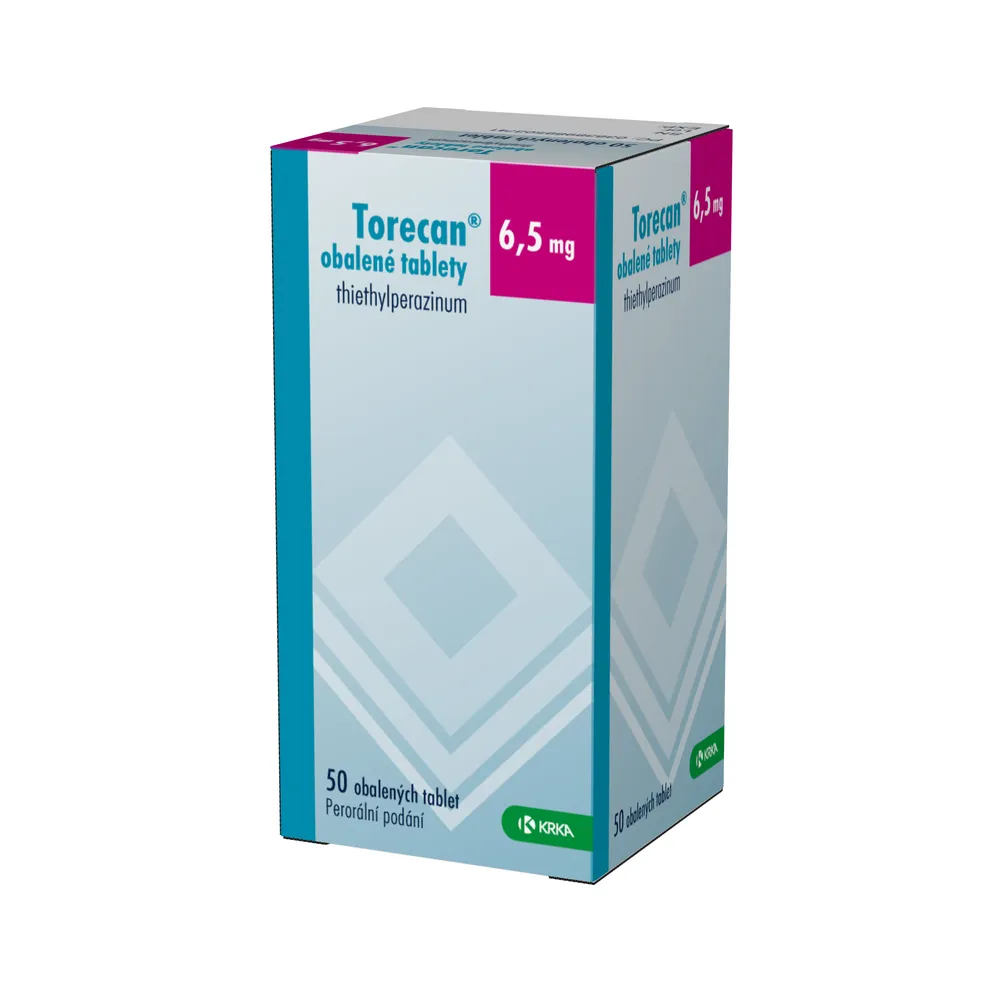
TORECAN
PolandIt is intended for the treatment of nausea and vomiting occurring after anticancer chemotherapy, radiotherapy, surgical procedures, and after the administration of emetogenic drugs.
Frequently asked questions
How to use Torecan?
Usually, 1 tablet is taken per day, although the doctor may increase the dose to two or three tablets. The tablet should be swallowed with water or another appropriate liquid.
When should you not take this medicine?
It must not be used if you are allergic to any of the ingredients of the medicine, have severe disturbances of consciousness or neurological disorders, very low blood pressure, are pregnant, or are breastfeeding. The medicine should not be used in children under 15 years of age.
Does Torecan interact with other medicines?
Yes, the effect of the medicine may change when used simultaneously with drugs acting on the central nervous system (e.g., hypnotics, sedatives, antidepressants, opioid analgesics), bromocriptine, and procarbazine.
What are the possible side effects?
Side effects may include, among others, drowsiness, dizziness, headache, restlessness, dry mouth, loss of appetite, blurred vision, edema, and less commonly, tachycardia or jaundice. In the event of high fever, muscle stiffness, and changes in mental state, treatment must be discontinued immediately.
Can you drive while using the medicine?
The medicine may significantly reduce the ability to drive vehicles and operate machinery; therefore, special caution should be exercised.
Instructions for use
Package leaflet: Information for the patient
Torecan, 6.5 mg, coated tablets
Thiethylperazinum
Please read the entire leaflet carefully before using this medicine, as it contains important information for the patient.
- Keep this leaflet so that you can read it again if necessary.
- If you have any further questions, please consult your doctor or pharmacist.
- This medicine has been prescribed for a specific individual. Do not pass it on to others. The medicine may harm someone else, even if their symptoms are the same.
- If the patient experiences any adverse reactions, including any not listed in this leaflet, inform your doctor or pharmacist. See section 4.
Table of contents of the leaflet
- What Torecan is and what it is used for
- Important information before taking Torecan
- How to take Torecan
- Possible side effects
- How to store Torecan
- Contents of the pack and other information
1. What Torecan is and what it is used for
Torecan belongs to a group of medicines known as phenothiazine derivatives. The drug acts on structures in the medulla oblongata that regulate physiological processes related to vomiting. In this way, it suppresses the body's response to stimuli that trigger nausea and vomiting.
The medicine is intended for the treatment of nausea and vomiting in the following conditions:
- after cytotoxic chemotherapy,
- after radiotherapy,
- after administration of emetogenic drugs,
- after surgical procedures.
2. Important information before using Torecan
When Torecan must not be used
- if the patient is allergic to tiethylperazine, phenothiazines, or any of the other ingredients of this medicine (listed in section 6);
- in severe disturbances of consciousness or other symptoms of impaired central nervous system function;
- if the patient has very low blood pressure;
- if the patient is pregnant or breastfeeding.
Torecan must not be used in children under 15 years of age, and in children and adolescents with symptoms resembling acute severe brain disease associated with concurrent liver function disorders (Reye's syndrome).
Warnings and precautions
Before starting treatment with Torecan, consult a doctor if the patient has:
- conditions related to low blood pressure;
- pregnancy, particularly with a specific form of high blood pressure accompanied by limb swelling (pre-eclampsia);
- impaired liver function;
- a history of any disease-related involuntary body movements;
- is taking the medicine bromocriptine.
Like other antiemetic medicines, Torecan may mask symptoms of certain gastrointestinal and central nervous system disorders, as well as adverse effects of other medicines.
As a member of the phenothiazine group, Torecan may cause a group of symptoms known as neuroleptic malignant syndrome, characterized by high fever, muscle rigidity, altered mental status, and fluctuating blood pressure. In such a case, treatment must be stopped immediately and a doctor should be contacted or visited as soon as possible.
In elderly patients, involuntary movements may occur during treatment; therefore, treatment should not last longer than 2 months.
Torecan with other medicines
Inform your doctor or pharmacist about all medicines currently used, recently used, or planned to be used.
Concurrent administration of Torecan and certain other medicines may lead to drug interactions, which could reduce or increase the effect of either medicine.
Particular attention should be paid when using the following medicines:
- medicines acting on the central nervous system (sedatives, opioid analgesics, tranquilizers, antidepressants);
- a medicine that inhibits the secretion of certain hormones (bromocriptine);
- a medicine used in the treatment of cancer (procarbazine).
Pregnancy, breastfeeding and fertility
If the patient is pregnant or breastfeeding, suspects she may be pregnant, or is planning to have a child, she should consult a doctor or pharmacist before using this medicine.
Pregnancy
There are only limited data on the use of tiethylperazine in pregnant women. Animal studies are insufficient to exclude teratogenic effects of tiethylperazine, especially since a possible association was observed in two observational studies. As a precautionary measure, Torecan should not be used during pregnancy.
Breastfeeding
Phenothiazines pass into breast milk; therefore, Torecan should not be used during breastfeeding.
Effect on fertility
Tiethylperazine had no effect on male fertility in rats. An effect on pregnancy rate in female rats was observed only at doses higher than recommended, indicating minimal relevance in clinical practice.
Driving and operating machinery
Torecan may significantly impair the ability to drive and operate machinery, especially when used concomitantly with sedatives, hypnotics, or alcohol. Therefore, caution is advised when driving vehicles or operating machinery.
Torecan contains lactose and sucrose.
If the patient has been previously diagnosed with intolerance to certain sugars, the patient should consult a doctor before taking this medicine.
3. How to use Torecan
This medicine should always be taken as directed by a doctor or pharmacist. If in doubt,
consult a doctor or pharmacist.
The usual dose is 1 tablet per day. The doctor may increase the dose to two or three
tablets.
The tablet should be swallowed with water or another suitable liquid. The duration of treatment depends on
the course of the underlying disease. The doctor will determine the duration of treatment.
If you feel the effect of the medicine is too strong or too weak, consult your doctor or
pharmacist.
Special populations
Renal function impairment
Studies have not been conducted in patients with renal function impairment.
Hepatic function impairment
In patients with hepatic function impairment, liver function should be monitored during treatment with Torecan,
especially when used in high doses or for prolonged periods.
Children and adolescents
Dosage in children has not been established; therefore, the use of this product is not recommended in children under
15 years of age.
Elderly patients
Particular caution should be exercised when treating elderly patients (75 years of age
and older).
Overdose of Torecan
Excessive doses of the medicine may cause dry mouth, dizziness, confusion, involuntary
movements, and fainting due to low blood pressure. After ingesting more tablets than recommended,
severe disturbances of consciousness, seizures, and other symptoms of central nervous system dysfunction may additionally occur.
A doctor or medical personnel should be contacted immediately if any of these symptoms occur.
Missed dose of Torecan
Do not take a double dose to make up for a missed dose. If a patient forgets to take the medicine,
the next dose should be taken at the scheduled time.
If in doubt about the use of this medicine, consult a doctor or pharmacist.
4. Possible adverse reactions
Like all medicines, this medicine can cause adverse reactions, although not everyone experiences them.
Uncommon adverse reactions (may occur in no more than 1 in 100 patients):
- headache, dizziness, drowsiness, motor restlessness.
Rare adverse reactions (may occur in no more than 1 in 1000 patients):
- breast enlargement in men (after long-term treatment);
- severe spasms and other symptoms of central nervous system disorders (torticollis, opisthotonus, oculogyric crisis, muscle rigidity, and facial grimacing). In elderly patients, prolonged use of the medicine may lead to tardive dyskinesia (involuntary movements). These symptoms usually resolve after discontinuation of the medicine or dose reduction;
- lens opacities and blurred vision (after long-term treatment);
- fluid retention with swelling of limbs and face, decreased blood pressure;
- dry mouth and loss of appetite.
Very rare adverse reactions (may occur in no more than 1 in 10,000 patients):
- facial pain (trigeminal neuralgia);
- tachycardia (increased heart rate);
- jaundice.
Reporting of adverse reactions
If any adverse reactions occur, including any adverse reactions not listed in this leaflet, inform your doctor or pharmacist. Adverse reactions can be reported directly to the Department of Monitoring of Adverse Drug Reactions, Office for Registration of Medicinal Products, Medical Devices and Biocidal Products,
Al. Jerozolimskie 181C, 02-222 Warsaw, Poland,
Tel.: +48 22 49 21 301, Fax: +48 22 49 21 309
e-mail: [email protected]
Adverse reactions can also be reported to the marketing authorization holder.
Reporting adverse reactions contributes to enhancing knowledge about the safety of the medicine.
5. How to store Torecan
Keep this medicine out of sight and reach of children.
Do not use Torecan after the expiry date stated on the cardboard box after EXP. The expiry date refers to the last day of the stated month.
Store below 25°C.
Medicines must not be disposed of via wastewater or household waste. Ask your pharmacist how to dispose of medicines no longer required. This will help protect the environment.
6. Contents of the pack and other information
What Torecan contains
- The active substance is tiethylperazine. Each coated tablet contains 6.5 mg of tiethylperazine in the form of tiethylperazine dimaleate.
- Other ingredients are: tablet core – lactose monohydrate, maize starch, talc, stearic acid, gelatin. Coating – sucrose, acacia gum, talc, titanium dioxide (E 171). See section 2.
What Torecan looks like and contents of the pack
White, round, biconvex coated tablets.
The pack contains 50 coated tablets of 6.5 mg in a bottle, placed in a cardboard box.
Marketing Authorisation Holder and Manufacturer
KRKA, d.d., Novo mesto
Šmarješka cesta 6
8501 Novo mesto
Slovenia
The original data is available in the language of the country of manufacture.
Data source: Register of Medicinal Products of Poland (URPL)
Data last verified: September 01, 2026