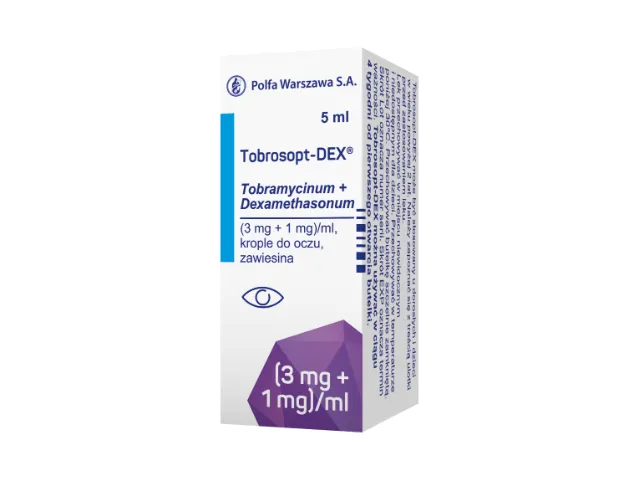
TOBROSOPT-DEX
PolandIt is used for the prevention and treatment of inflammation and for the prevention of eye infections following cataract surgery. It can be used in adults and children over 2 years of age.
Frequently asked questions
How to use Tobrosopt-DEX correctly?
Shake the bottle before use. Instill one or two drops into the conjunctival sac of the affected eye every 4-6 hours (unless otherwise directed by a physician). Immediately after instillation, it is advisable to gently press the inner corner of the eye for approximately 1 minute. The dosage regimen prescribed by the doctor must be strictly followed.
When should you not use this medicine?
Do not use it if you are allergic to any of the ingredients of the medicine, have viral keratitis (e.g., herpes, varicella), fungal infection, or untreated parasitic or bacterial eye infections, ocular tuberculosis, or if a foreign body has been removed from the cornea and there are no complications.
What are the possible side effects of Tobrosopt-DEX?
Mild stinging or stinging sensation in the eye may occur frequently. Other possible symptoms include, among others, eye pain, itching, redness, blurred vision, eyelid swelling, as well as hormonal changes (e.g., increased hair growth, changes in body weight) or allergic reactions. In case of facial or lip swelling or difficulty breathing, contact a doctor immediately.
Can contact lenses be worn during treatment?
Contact lenses should be removed before instilling the medicine, and you should wait at least 15 minutes before putting them back in. Contact lenses should not be worn in the event of an eye infection.
What are important notes regarding other medicines?
Inform your doctor if you are using other antibiotics or non-steroidal anti-inflammatory drugs (NSAIDs). If you are using other eye drops, maintain an interval of at least 5 minutes between them. Eye ointments should be applied last.
How long can the opened bottle be stored?
The medicine can be used within 4 weeks of opening the bottle for the first time.
Instructions for use
Table of contents
Patient Information Leaflet
Tobrosopt-DEX, (3 mg + 1 mg)/ml, eye drops, suspension
Tobramycin + Dexamethasone
Please read this leaflet carefully before using the medicine, as it contains important information for the patient.
- Keep this leaflet, as you may need to read it again.
- If you have any questions, please consult your doctor or pharmacist.
- This medicine has been prescribed for a specific individual. Do not pass it on to others. The medicine may harm another person, even if their symptoms are the same.
- If you experience any adverse effects, including any not listed in this leaflet, tell your doctor or pharmacist. See section 4.
Table of contents
- What Tobrosopt-DEX is and what it is used for
- Important information before using Tobrosopt-DEX
- How to use Tobrosopt-DEX
- Possible side effects
- How to store Tobrosopt-DEX
- Contents of the pack and other information
1. What Tobrosopt-DEX is and what it is used for
Tobrosopt-DEX is a combination medicine containing two active substances:
tobramycin (an antibiotic) and dexamethasone (an anti-inflammatory, anti-allergic, and anti-pruritic agent).
Tobrosopt-DEX is used to prevent and treat inflammatory conditions and to prevent eye infections after cataract surgery.
Tobrosopt-DEX may be used in adults and children over 2 years of age.
2. Important information before using Tobrosopt-DEX
When not to use Tobrosopt-DEX
- if you are allergic to tobramycin, dexamethasone, or any of the other ingredients of this medicine (listed in section 6);
- if you have corneal inflammation caused by herpes simplex virus;
- if you have corneal inflammation caused by varicella-zoster virus (chickenpox/shingles) or other viral diseases of the cornea or conjunctiva;
- if you have fungal eye infection or untreated parasitic eye infections;
- if you have tuberculosis of the eye;
- if you have untreated purulent (bacterial) eye infections;
- if a foreign body has been removed from the cornea (part of the eye) and there are no signs of complications.
Warnings and precautions
Before starting treatment with Tobrosopt-DEX, discuss it with your doctor or pharmacist.
- If you experience an allergic reaction (hypersensitivity) such as eyelid itching, swelling, or redness of the eye, stop treatment and consult your doctor. Such hypersensitivity reactions may occur when using other locally or systemically administered aminoglycoside antibiotics.
- If your symptoms worsen or suddenly recur, consult your doctor. During treatment, you may be more susceptible to eye infections.
- If you are using other antibiotics, including those taken orally, while using Tobrosopt-DEX, consult your doctor.
- If you use Tobrosopt-DEX for a prolonged period, you may:
- become more susceptible to eye infections,
- develop increased intraocular pressure (glaucoma),
- develop cataracts.
- If persistent corneal ulceration occurs during treatment, seek medical advice promptly, as this may indicate a fungal eye infection.
- Prolonged use increases the risk of secondary infections caused by fungi, bacteria, and viruses. It may also delay healing of eye injuries.
- During long-term treatment, your doctor may recommend ophthalmological examinations (measurement of intraocular pressure). Regular eye pressure checks are recommended, especially in children.
- The risk of corticosteroid-induced ocular hypertension and cataract formation is higher in children and in patients with concomitant diseases (e.g., diabetic patients).
- Corticosteroid eye medications may delay healing of eye injuries. Topically applied non-steroidal anti-inflammatory drugs (NSAIDs) may slow and delay the healing process. Concurrent topical use of non-steroidal anti-inflammatory drugs and corticosteroids may increase the risk of eye healing problems.
- If you have a condition causing thinning of eye tissues, consult your doctor or pharmacist.
- If you experience blurred vision or other visual disturbances, contact your doctor.
Seek medical advice if you develop swelling and weight gain, particularly noticeable in the trunk and face, as these are usually the first signs of a condition called Cushing's syndrome. Adrenal suppression may occur following discontinuation of prolonged or intensive treatment with Tobrosopt-DEX. Consult your doctor before deciding to stop treatment. This risk is particularly significant in children and in patients treated with ritonavir or cobicistat.
Tobrosopt-DEX and other medicines
Tell your doctor or pharmacist about all medicines you are currently using, have recently used, or plan to use.
In particular, inform your doctor if you are using non-steroidal anti-inflammatory drugs (NSAIDs).
Concurrent topical use of a corticosteroid and a non-steroidal anti-inflammatory drug (NSAID) may lead to problems with healing of eye injuries.
If you are using other eye drops or ointments simultaneously, wait at least 5 minutes between applications. Eye ointments should be applied last.
Inform your doctor if you are taking ritonavir or cobicistat, as these drugs may increase blood levels of dexamethasone.
Pregnancy and breastfeeding
If you are pregnant, breastfeeding, think you may be pregnant, or are planning to have a baby, consult your doctor or pharmacist before using this medicine.
Use of Tobrosopt-DEX is not recommended during pregnancy and breastfeeding.
Driving and operating machinery
Tobrosopt-DEX has no effect or a negligible effect on the ability to drive and operate machinery.
For a short time after instillation, vision may be blurred. Do not drive or operate machinery until this symptom resolves.
Tobrosopt-DEX contains benzalkonium chloride
The medicine contains 0.1 mg of benzalkonium chloride per ml. Benzalkonium chloride may be absorbed by soft contact lenses and may alter their color. Remove contact lenses before instillation and wait at least 15 minutes before reinserting them. Benzalkonium chloride may also cause eye irritation, especially in individuals with dry eye syndrome or corneal disorders (the transparent layer at the front of the eye). If you experience abnormal sensations in the eye, stinging, or pain after using the medicine, contact your doctor.
Contact lenses should not be worn when there is an eye infection.
3. How to use Tobrosopt-DEX
Always use this medicine exactly as prescribed by your doctor. If in doubt, consult your doctor or pharmacist.
Use in adults
Strictly follow the dosing regimen prescribed by your doctor.
If your doctor has not advised otherwise, the usual regimen is:
one to two drops into the conjunctival sac (sacs) of the affected eye(s) every 4–6 hours. During the first 24–48 hours, your doctor may increase the dose to 1–2 drops every two hours, then gradually reduce the frequency as symptoms improve. Be careful not to stop treatment prematurely.
In severe cases, one to two drops into the conjunctival sac (sacs) of the affected eye(s) every hour should be used until improvement occurs. Then gradually reduce the frequency—1–2 drops every two hours for three days, followed by 1–2 drops every 4 hours for 5–8 days, and finally 1–2 drops daily for 5 to 8 days, if deemed necessary by your doctor.
After cataract surgery, one drop four times daily should be used, starting the day after surgery, for up to 24 days. Your doctor may decide to start treatment one day before surgery, with a dose of one drop four times daily, followed by one drop after surgery and then one drop four times daily for the next 23 days. If necessary, your doctor may prescribe more frequent dosing: up to one drop every two hours during the first two days of treatment.
Use in children over 2 years of age
The medicine may be used in children aged 2 years and older at the same doses as in adults.
Safety and efficacy in children under 2 years of age have not been established, and no data are available for use in this age group.
Use in patients with liver or kidney impairment
The effects of the medicinal product in the form of eye drops containing tobramycin and dexamethasone have not been studied in these patient populations. However, due to the low systemic absorption of these substances following local administration, dose adjustment is considered unnecessary.
Instructions for use
Tobrosopt-DEX is for external use only—topical application into the conjunctival sac.
Do not touch the dropper tip, as this may contaminate the contents of the bottle.
- Wash your hands thoroughly before instillation.
- Shake the bottle before use.
- Unscrew the cap on the bottle.
- Tilt your head backward and pull the lower eyelid downward to create a pocket between the eyelid and the eyeball.
- Invert the bottle and gently press with your thumb or index finger on the side until one drop of the medicine is dispensed into the eye. Do not touch the dropper tip to the eye, eyelids, or any other surface. If the drop missed the eye, instill another drop.
- Immediately after instillation of Tobrosopt-DEX, gently press the inner corner of the eye for about 1 minute. This helps reduce the risk of systemic adverse effects.
- If your doctor has instructed you to instill the medicine into the other eye, repeat steps 4, 5, and 6.
- The dropper is designed to deliver drops accurately; do not enlarge the dropper opening.
- After instillation, replace the cap on the bottle. Do not overtighten.
Regular instillation of the medicine throughout the entire treatment period prescribed by your doctor is recommended, even if symptoms of eye infection (eye[s]) resolve earlier.
Use of a higher than recommended dose of Tobrosopt-DEX
Do not use higher doses or more frequently than prescribed by your doctor. In case of overdose, excess medicine can be rinsed from the eye with lukewarm water.
Missed dose of Tobrosopt-DEX
If you miss a dose, take it as soon as possible. If it is almost time for the next dose, skip the missed dose and continue with your regular dosing schedule. Do not use a double dose to make up for a missed dose.
Stopping treatment with Tobrosopt-DEX
If you have any further doubts regarding the use of this medicine, consult your doctor, pharmacist, or nurse.
4. Possible side effects
Like all medicines, this medicine may cause side effects, although not everybody gets them.
If you experience allergic reactions, including rash, swelling of the face, lips, tongue and/or throat, which may cause difficulty breathing or swallowing, or other serious adverse effects, stop using Tobrosopt-DEX and contact your doctor or the nearest hospital Emergency Department immediately.
Shortly after instillation, mild burning or stinging of the eyes may occur frequently (in 1 to 10 patients out of 100). These symptoms resolve within about 5–15 seconds and do not require discontinuation of the medicine.
Uncommon (occur in 1 to 10 patients out of 1,000):
Eye-related: elevated intraocular pressure, eye pain, eye itching, eye discomfort, eye irritation.
Rare (occur in 1 to 10 patients out of 10,000):
Eye-related: eye allergy, blurred vision, dry eye syndrome, eye surface inflammation, redness.
General: taste disturbances.
Unknown frequency (cannot be estimated from available data):
Eye-related: eyelid swelling, eyelid redness, pupil dilation, excessive tearing, blurred vision.
General: severe allergic reactions (hypersensitivity), dizziness, headache, nausea, abdominal discomfort, severe skin reactions (erythema multiforme), rash, facial swelling, itching.
Hormonal disorders: increased body hair growth (especially in women), muscle weakness and loss of muscle mass, purple skin striae, increased blood pressure, irregular or absent menstruation, changes in protein and calcium levels in the body, growth suppression in children and adolescents, and swelling and weight gain, particularly noticeable in the trunk and face (a condition called Cushing's syndrome) (see section 2 "Warnings and precautions").
Reporting of adverse effects
If any adverse effects occur, including any not listed in this leaflet, inform your doctor or pharmacist. Adverse effects can be reported directly to the Department of Monitoring Adverse Drug Reactions of the Office for Registration of Medicinal Products, Medical Devices and Biocidal Products
Al. Jerozolimskie 181C
02-222 Warsaw
Tel.: + 48 22 49 21 301
Fax: + 48 22 49 21 309
Website: https://smz.ezdrowie.gov.pl
Adverse effects can also be reported to the responsible entity.
Reporting adverse effects helps gather more information on the safety of the medicine.
5. How to store Tobrosopt-DEX
Store below 30°C.
Keep the bottle tightly closed in the outer packaging.
Store out of sight and reach of children.
Shake before use.
Do not use this medicine after the expiry date stated on the carton and bottle.
The expiry date refers to the last day of the stated month.
The label marked EXP indicates the expiry date, and LOT indicates the batch number.
Tobrosopt-DEX may be used for 4 weeks after first opening the bottle.
Do not dispose of medicines via wastewater or household waste. Ask your pharmacist how to dispose of medicines no longer in use. This will help protect the environment.
6. Contents of the package and other information
What Tobrosopt-DEX contains
- The active substances are tobramycin and dexamethasone. Each ml of eye drops contains 3 mg of tobramycin and 1 mg of dexamethasone. Each drop contains 120 micrograms of tobramycin and 40 micrograms of dexamethasone.
- The other ingredients are: hydroxyethylcellulose; benzalkonium chloride solution; sodium chloride; anhydrous sodium sulfate (E 514); disodium edetate; tyloxapol; sulfuric acid and (or) sodium hydroxide (for pH adjustment); purified water.
What Tobrosopt-DEX looks like and contents of the pack
Tobrosopt-DEX is a sterile eye drop suspension, white in appearance.
The medicine is available in LDPE bottles containing 5 ml of solution with an LDPE dropper and HDPE screw cap with a tamper-evident seal, packed in a cardboard box.
Marketing Authorisation Holder
Zakłady Farmaceutyczne POLPHARMA S.A.
ul. Pelplińska 19, 83-200 Starogard Gdański
tel. + 48 22 364 61 01
Manufacturer
Warszawskie Zakłady Farmaceutyczne Polfa S.A.
ul. Karolkowa 22/24, 01-207 Warszawa
Similar drugs
| Brand name | Dosage form | Active substance / Dosage | Manufacturer |
|---|---|---|---|
| BRAZOFLAMIN | drops, ophthalmic suspension |
|
Rafarm S.A. |
| MAXITROL | drops, ophthalmic suspension | Novartis Europharm Limited | |
| MAXITROL | drops, ophthalmic suspension | Novartis Pharma NV | |
| MAXITROL | drops, ophthalmic suspension | Novartis s.r.o. | |
| MAXITROL | drops, ophthalmic suspension | Novartis s.r.o. | |
| MAXITROL | drops, ophthalmic suspension | Novartis Pharma GmbH | |
| MAXITROL | drops, ophthalmic suspension | Novartis Pharma GmbH | |
| MAXITROL | drops, ophthalmic suspension | Novartis Croatia d.o.o. | |
| MAXITROL | drops, ophthalmic suspension | Novartis Pharma NV | |
| MAXITROL | drops, ophthalmic suspension | Novartis Pharma GmbH | |
| MAXITROL | drops, ophthalmic suspension | Novartis Ireland Ltd | |
| MAXITROL | drops, ophthalmic suspension | Novartis Europharm Limited |
The original data is available in the language of the country of manufacture.
Data source: Register of Medicinal Products of Poland (URPL)
Data last verified: September 01, 2026