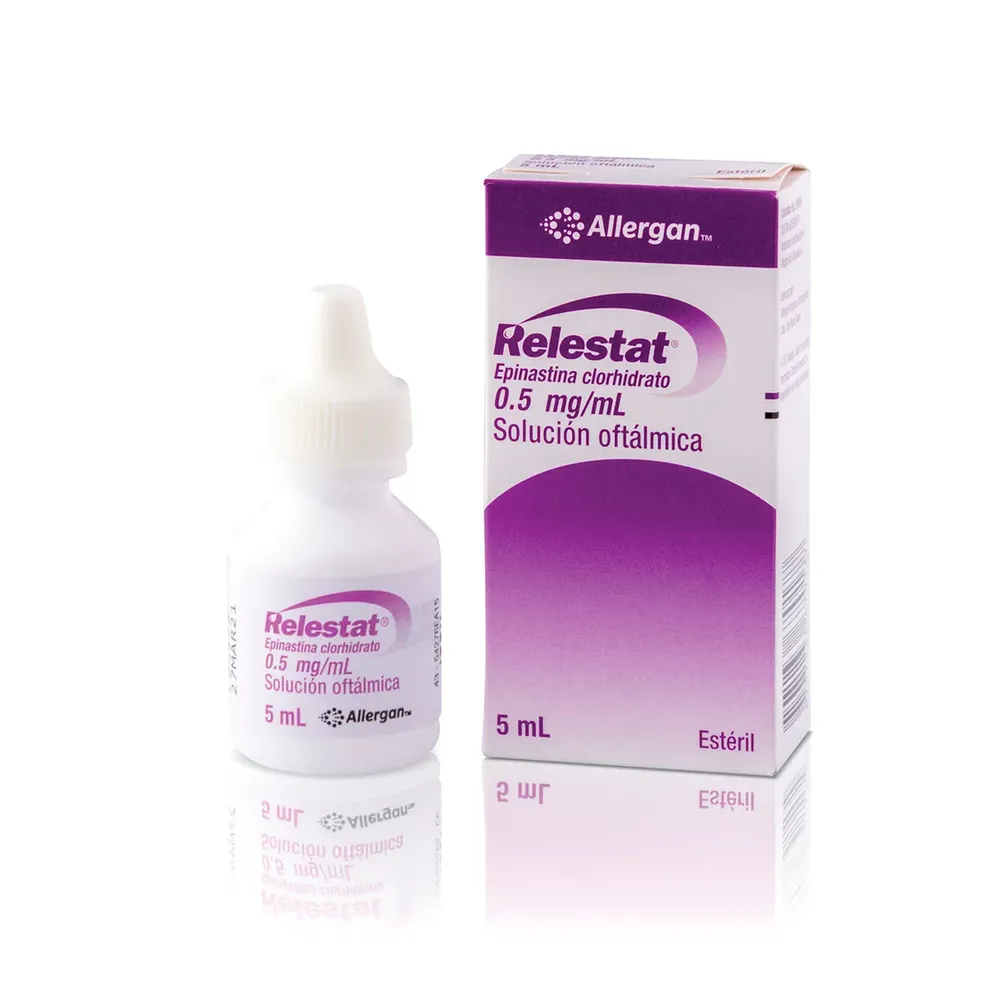
RELESTAT
PolandThe medicine is used to treat the symptoms of seasonal allergic conjunctivitis, such as tearing, itching, redness, or swelling of the eyes or eyelids.
Frequently asked questions
How to use Relestat?
Adults and adolescents over 12 years of age should instill one drop into each affected eye twice daily (e.g., morning and evening). The medicine may be used daily for a period not exceeding 8 weeks.
When should you not use the medicine?
Do not use the medicine if you are allergic to epinastine hydrochloride or any of the other ingredients of the product.
Can I wear contact lenses during treatment?
Soft contact lenses should be removed before instilling the drops. Lenses may be reinserted only after at least 15 minutes have passed since the administration of the medicine.
What side effects may Relestat cause?
A burning sensation or eye irritation may occur frequently. Headache, runny nose, sneezing, dryness, itching, or blurred vision may occur uncommonly. Contact a doctor immediately if breathing problems (asthma) or swelling of the face, tongue, or throat occur.
What should I remember when using other eye drops?
If you need to use other eye drops, maintain an interval of at least 10 minutes between the administration of consecutive preparations.
How long can the opened bottle be stored?
The bottle should be discarded 28 days after the first opening, even if the medicine has not been completely used.
Does the medicine affect the ability to drive vehicles?
Vision may be blurred immediately after applying the medicine. Do not drive or operate machinery until your vision has returned to normal.
Instructions for use
Package leaflet: Information for the user
Relestat, 0.5 mg/ml, eye drops, solution
Epinastini hydrochloridum
Please read all of this leaflet carefully before using this medicine because it contains important information for you.
- Keep this leaflet, as you may need to read it again.
- If you have any further questions, please ask your doctor or pharmacist.
- This medicine has been prescribed for a specific individual. Do not pass it on to others. It may harm them even if their symptoms are the same.
- If you experience any adverse reactions, including those not listed in this leaflet, inform your doctor or pharmacist. See section 4.
Table of contents
- What Relestat is and what it is used for
- What you need to know before using Relestat
- How to use Relestat
- Possible side effects
- How to store Relestat
- Contents of the pack and other information
1. What Relestat is and what it is used for
Relestat eye drops solution is an antiallergic (anti-allergic) medicine used in the treatment of symptoms of seasonal allergic conjunctivitis. Relestat is used to treat the following symptoms: watery eyes, itching, redness or swelling of the eyes or eyelids.
2. Important information before using Relestat
When not to use Relestat
- If the patient is allergic to epinastine hydrochloride or any of the other ingredients of this medicine (listed in section 6).
Warnings and precautions
Before starting treatment with Relestat, discuss this with your doctor or pharmacist.
- If the patient wears soft contact lenses; lenses must be removed before applying Relestat eye drops. After applying the medicine, wait at least 15 minutes before reinserting the lenses. See also section 2: "Relestat contains benzalkonium chloride".
- If it is necessary to use other eye drops during treatment with Relestat, an interval of at least 10 minutes should be maintained between the administration of Relestat and the other medicines.
Relestat and other medicines
Tell your doctor or pharmacist about all medicines the patient is currently taking or has recently taken, as well as any medicines the patient plans to use.
If it is necessary to use other eye drops during treatment with Relestat, see the paragraph: "Warnings and precautions" in this section.
Pregnancy and breastfeeding
Pregnancy
If the patient is pregnant or breastfeeding, suspects she may be pregnant, or is planning to become pregnant, she should consult her doctor or pharmacist before using this medicine.
Breastfeeding
It is not known whether Relestat passes into human breast milk. The patient should consult her doctor or pharmacist before using this medicine during breastfeeding.
Driving and using machines
Vision may be blurred for a short time after applying Relestat.
Do not drive or operate machinery until vision returns to normal.
Relestat contains benzalkonium chloride and phosphates
This medicine contains 0.5 mg of benzalkonium chloride in each 5 ml of solution, equivalent to 0.1 mg/ml.
Relestat contains a preservative called benzalkonium chloride, which may be absorbed by soft contact lenses and may change the colour of soft contact lenses.
Before applying Relestat eye drops, remove soft contact lenses (also known as hydrophilic lenses).
After applying the medicine, wait at least 15 minutes before reinserting the lenses.
Benzalkonium chloride may also cause eye irritation, especially if dry eye or corneal disorders (the transparent layer at the front of the eye) are present. If any abnormal sensations occur in the eye, such as stinging or eye pain after using this medicine, contact a doctor.
This medicine contains 23.75 mg of phosphates in each 5 ml, equivalent to 4.75 mg/ml.
In very rare cases, during treatment in some patients with severe damage to the transparent front layer of the eye (cornea), phosphates may cause corneal clouding due to calcium accumulation (see section 4).
3. How to use Relestat
This medicine should always be used exactly as directed by a doctor. If in doubt, consult a doctor or pharmacist.
Use in children
Relestat must not be used in children under 12 years of age.
Use in adults and adolescents (aged 12 years and older)
The recommended dose of Relestat is one drop into each affected eye twice daily, for example in the morning and evening.
Relestat should be used every day in the eye(s) with symptoms during the allergy season, but for no longer than 8 weeks.
Method of administration
Do not use the medicine if the tamper-evident seal on the bottle neck is damaged before first opening. The drops should be administered as follows:
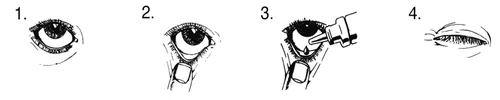
- Wash hands before opening the bottle. Tilt the head backwards and look upwards at the ceiling.
- Gently pull down the lower eyelid of the affected eye to form a small pocket.
- Turn the bottle upside down and squeeze it gently to instill one drop into the pocket formed in the eye to be treated.
- Release the lower eyelid and close the eye for 30 seconds. If the drop misses the eye, repeat the procedure.
To avoid contamination of the solution in the bottle, do not touch the eye or any other surface with the dropper tip. Immediately after use, replace and firmly tighten the cap to close the bottle. Wipe off any excess solution from the cheek with a clean tissue.
It is very important to correctly administer the drop into the affected eye. If you have any questions, consult your doctor or pharmacist.
Use of more Relestat than recommended
It is unlikely that using more Relestat than recommended will harm the patient. The next dose should be administered at the usual time. If in doubt, consult a doctor or pharmacist.
Missed dose of Relestat
If a dose is missed, instill one drop into each affected eye as soon as remembered, unless it is almost time for the next dose. In that case, do not administer the missed dose. Apply the next dose at the usual time and continue with the regular dosing schedule.
Do not use a double dose to make up for a missed dose.
Stopping Relestat
Relestat should be used exactly as directed by a doctor. If you have any further questions about the use of this medicine, consult your doctor or pharmacist.
4. Possible adverse effects
Like all medicines, this medicine may cause adverse effects, although not everyone experiences them.
Severe adverse symptoms are not expected. Most of the symptoms are mild in intensity and affect only the eyes.
If any of the following symptoms occur, stop using Relestat and immediately contact a doctor or go to the nearest hospital:
- asthma (an allergic reaction affecting the lungs which may cause difficulty in breathing);
- symptoms of angioedema (swelling of the face, tongue or throat, difficulty in swallowing, urticaria and breathing difficulties).
The following adverse effects may also occur:
Common (occur in not more than 1 in 10 patients):
sensation of burning or eye irritation (in most cases mild).
Uncommon (occur in not more than 1 in 100 patients):
General disorders:
- headache;
- nasal swelling and irritation which may cause runny nose, nasal congestion and sneezing;
- unusual taste in the mouth.
Eye disorders:
- eye redness;
- dry eyes;
- itchy eyes;
- blurred vision;
- eye discharge.
Frequency not known (frequency cannot be estimated from available data):
- excessive tearing;
- eye pain;
- allergic reaction affecting the eyes;
- eye swelling;
- eyelid swelling;
- skin rash and redness.
Other adverse effects reported after use of eye drops containing phosphates
This medicine contains 23.75 mg of phosphates in each 5 ml of solution, equivalent to 4.75 mg/ml.
In very rare cases, during treatment, phosphates may cause corneal clouding due to calcium accumulation in some patients with severe damage to the transparent outer layer of the front of the eye (cornea) (see section 2).
Reporting of adverse effects
If any adverse effects occur, including any adverse effects not listed in this leaflet, inform your doctor or pharmacist. Adverse effects can be reported directly to the Department of Monitoring Adverse Drug Reactions of the Office for Registration of Medicinal Products, Medical Devices and Biocidal Products
Al. Jerozolimskie 181C
PL-02 222 Warsaw
Tel.: + 48 22 49 21 301
Fax: + 48 22 49 21 309
Website: https://smz.ezdrowie.gov.pl
Adverse effects can also be reported to the responsible entity.
Reporting adverse effects helps to provide more information on the safety of the medicine.
5. How to store Relestat
Keep the medicine out of sight and reach of children.
Do not use this medicine after the expiry date stated on the bottle and carton,
following the EXP.
Do not use this medicine if there are signs of deterioration of the eye drops, for example a change in colour;
in such a case, return the medicine to the pharmacist.
Do not store above 25°C.
Keep the bottle in the outer packaging to protect from light.
To prevent contamination, discard the bottle 28 days after first opening, even
if the medicine has not been completely used. To help remember the expiry date, write the date of first opening of the bottle on the carton in the space provided for this purpose.
Medicines must not be disposed of via the sewage system or household waste. Ask
your pharmacist how to dispose of medicines no longer required. This will help
protect the environment.
6. Contents of the package and other information
What Relestat contains
- The active substance is epinastine hydrochloride. 1 ml of solution contains 0.5 mg of epinastine hydrochloride.
- The other ingredients are: benzalkonium chloride (a preservative), disodium edetate, sodium chloride, sodium dihydrogen phosphate dihydrate, sodium hydroxide/hydrochloric acid (to adjust pH), purified water.
What Relestat looks like and contents of the pack
Relestat is a clear, colourless solution for ophthalmic use in the form of eye drops in a plastic bottle with a screw cap. Each bottle is filled halfway and contains 5 ml of solution.
Each pack contains one bottle.
Marketing Authorisation Holder
AbbVie Sp. z o.o.
ul. Postępu 21B
02-676 Warszawa
tel. 22 372 78 00
Manufacturer
Allergan Pharmaceuticals Ireland
Castlebar Road
Westport
County Mayo
Ireland
This medicinal product is authorised in the Member States of the European Economic Area under the following names:
| Country name | Medicinal product name |
| Austria, Germany | RELESTAT 0.5 mg/ml eye drops solution |
| Belgium | RELESTAT, 0.5 mg/ml, oogdruppels, oplossing |
| Czech Republic | PURIVIST 0.5 mg/ml ophthalmic solution |
| Denmark, Greece, Luxembourg, Sweden | RELESTAT |
| France | PURIVIST (0.5 mg/ml, eye drops solution) |
| Hungary | RELESTAT 0.5 mg/ml oldatos szemcsepp |
| Ireland, United Kingdom | RELESTAT, 0.5 mg/ml, eye drops solution |
| Italy | RELESTAT, 0.5 mg/ml, eye drops, solution |
| Netherlands | RELESTAT, oogdruppels, oplossing, 0.5 mg/ml |
| Portugal | RELESTAT, 0.5 mg/ml, colírio, solução |
| Slovakia | PURIVIST |
| Spain | RELESTAT 0.5 mg/ml eye drops solution |
The original data is available in the language of the country of manufacture.
Data source: Register of Medicinal Products of Poland (URPL)
Data last verified: September 01, 2026