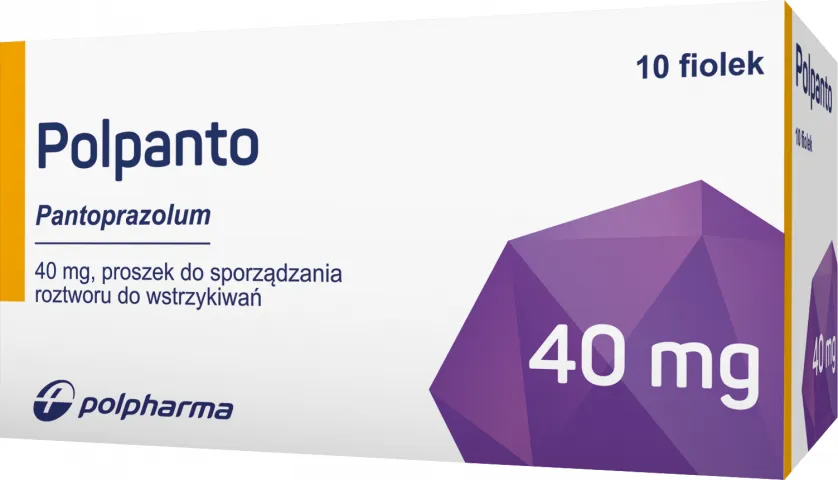
POLPANTO
PolandThe medicine is used in adults for the treatment of, among others, reflux esophagitis, gastric and duodenal ulcer disease, Zollinger-Ellison syndrome, and other conditions related to excessive hydrochloric acid secretion in the stomach.
Frequently asked questions
How should Polpanto be administered?
The medicine is administered intravenously by a doctor or nurse. The dosage depends on the type of condition: in the case of ulcers and reflux, one vial per day is usually used, whereas in the treatment of Zollinger-Ellison syndrome, two vials per day are used (the dose may be adjusted by a doctor).
When should this medicine not be used?
The medicine must not be used if there is an allergy to pantoprazole, to other ingredients of the medicine, or to other medicines from the proton pump inhibitor group.
What are the possible side effects of Polpanto?
It may cause, among others, headache, dizziness, diarrhea, nausea, constipation, dry mouth, as well as less commonly allergic reactions, joint pain, or changes in body weight. In rare cases, serious skin reactions or liver problems may occur.
Can Polpanto be combined with other medicines?
The doctor must be informed about all medicines being taken, as Polpanto may affect their action, e.g., antifungal medicines (ketoconazole, itraconazole), blood-thinning medicines (warfarin), HIV medicines (atazanavir), or methotrexate.
What precautions should be taken when using the medicine?
Caution should be exercised in cases of severe liver disease and during long-term use (exceeding 3 months), which may lead to decreased magnesium levels in the blood. The doctor should also be informed about bone problems (osteoporosis) or the use of corticosteroids.
Is the medicine safe for children?
The use of the medicine is not recommended in children and adolescents under 18 years of age.
Instructions for use
Package leaflet: Information for the user
Polpanto, 40 mg, powder for solution for injection
Pantoprazole
Please read all of this leaflet carefully before use, as it contains
important information for the patient.
- Keep this leaflet, as you may need to read it again.
- If you have any further questions, please consult your doctor, pharmacist or nurse.
- If you experience any adverse reactions, including any not listed in this leaflet, inform your doctor, pharmacist or nurse. See section 4.
Leaflet contents
- What Polpanto is and what it is used for
- Important information before using Polpanto
- How to use Polpanto
- Possible side effects
- How to store Polpanto
- Contents of the pack and other information
1. What Polpanto is and what it is used for
Polpanto contains the active substance pantoprazole. Polpanto is a selective "proton pump inhibitor", a medicine which reduces the secretion of hydrochloric acid in the stomach. It is used in the treatment of stomach and intestinal disorders associated with hydrochloric acid secretion.
This medicine is administered intravenously and is used only when, in the opinion of the physician, this route of administration is more beneficial for the patient than oral pantoprazole tablets. Intravenous administration will be switched to tablet form as soon as the physician considers it appropriate.
Polpanto is indicated in adults for the treatment of:
- Gastro-oesophageal reflux disease. Inflammation of the oesophagus (the tube connecting the throat to the stomach), associated with backflow of hydrochloric acid from the stomach.
- Gastric and duodenal ulcer disease.
- Zollinger-Ellison syndrome and other conditions associated with excessive hydrochloric acid secretion in the stomach.
2. Important information before using Polpanto
When not to use Polpanto
- If the patient is allergic to pantoprazole or to any of the other ingredients of this medicine (listed in section 6).
- If the patient is allergic to medicines containing other proton pump inhibitors. Warnings and precautions Before starting treatment with Polpanto, discuss with your doctor, pharmacist or nurse:
- If the patient has severe liver function impairment. Inform the doctor if there has ever been any liver dysfunction. The doctor may recommend more frequent monitoring of liver enzyme activity. If liver enzyme activity increases, treatment should be discontinued.
- If the patient is taking HIV protease inhibitors such as atazanavir (used in the treatment of HIV infection) concomitantly with pantoprazole, the patient should seek detailed advice from the doctor.
- Use of a proton pump inhibitor such as pantoprazole, especially for periods longer than one year, may slightly increase the risk of fractures of the hip, wrist or spine.
- Inform the doctor if the patient has osteoporosis or if they are taking corticosteroids (which may increase the risk of osteoporosis).
- If the patient uses Polpanto for longer than three months, they may develop low blood magnesium levels. Symptoms of low magnesium levels may include: fatigue, involuntary muscle spasms, disorientation, seizures, dizziness and rapid heartbeat. If any of these symptoms occur, inform the doctor. Low blood magnesium levels may also lead to reduced potassium and calcium levels in the blood. The doctor may decide that periodic blood magnesium level testing is necessary.
- If the patient has ever experienced a skin reaction due to taking a medicine similar to Polpanto that reduces hydrochloric acid secretion in the stomach.
- In case of skin rash, especially in sun-exposed areas, inform the doctor as soon as possible, as treatment with Polpanto may need to be discontinued. Also inform the doctor of other adverse effects such as joint pain.
- Regarding a planned specific blood test (chromogranin A level). Immediately inform the doctor before starting or during treatment if any of the following symptoms occur, as they may indicate another, more serious condition:
- Unintentional weight loss,
- Vomiting, particularly recurrent,
- Bloody vomiting, which may look like dark coffee grounds,
- Blood in stool, black or tarry stools,
- Difficulty swallowing or pain during swallowing,
- Pallor and weakness (anaemia),
- Chest pain,
- Abdominal pain,
- Severe and (or) persistent diarrhoea, as use of this medicine is associated with a small increased risk of infectious diarrhoea.
The doctor may decide that tests are necessary to exclude an underlying tumour, as treatment with pantoprazole may alleviate symptoms of tumour disease and delay diagnosis. If symptoms persist despite treatment, further investigations should be considered.
Children and adolescents
Polpanto is not recommended for use in children, as its efficacy has not been demonstrated in children and adolescents under 18 years of age.
Polpanto with other medicines
Inform your doctor or pharmacist about all medicines currently used, recently used, or planned for use, including over-the-counter medicines.
Since Polpanto may affect the efficacy of other medicines, inform the doctor if the patient is taking:
- Medicines such as ketoconazole, itraconazole and posaconazole (used to treat fungal infections) or erlotinib (used in certain types of cancer), because Polpanto may inhibit the proper action of these and other medicines,
- Warfarin and phenprocoumon, which affect blood viscosity or thinning; further testing may be required,
- Medicines used in the treatment of HIV infection, such as atazanavir,
- Methotrexate (used in the treatment of rheumatoid arthritis, psoriasis and cancer diseases) – in case of methotrexate use, the doctor may temporarily discontinue Polpanto, as pantoprazole may increase methotrexate blood levels,
- Fluvoxamine (used in the treatment of depression and other psychiatric disorders) – if the patient is taking fluvoxamine, the doctor may recommend reducing the dose,
- Rifampicin (used to treat infections),
- St John's wort ( Hypericum perforatum ) (used in the treatment of mild depression). Pregnancy and breastfeeding If the patient is pregnant or breastfeeding, suspects she may be pregnant, or plans to become pregnant, she should consult her doctor or pharmacist before using this medicine. Experience with use in pregnant women is limited. It has been shown that the active substance passes into human milk.
The medicine may be used in women only if the doctor considers that the benefit to the woman outweighs the risk to the unborn child or infant.
Driving and operating machinery
Polpanto has no effect or negligible effect on the ability to drive and operate machinery.
Do not drive or operate machinery if the patient experiences adverse effects such as dizziness or visual disturbances.
Polpanto contains sodium
The medicine contains less than 1 mmol (23 mg) of sodium per vial, meaning the medicine is considered "sodium-free".
The entire contents of each vial must be dissolved and diluted. The sodium content of the solvent must be taken into account when calculating the total sodium content of the prepared dilution.
Detailed information on the sodium content of the solvent is provided in the Product Information supplied by the manufacturer.
3. How to use Polpanto
The medicinal product is administered intravenously as a daily dose over a period of 2 to 15 minutes by a nurse or doctor.
The recommended dose is:
Adults
- For the treatment of gastric ulcer, duodenal ulcer, and reflux oesophagitis
One vial (40 mg of pantoprazole) per day. - For long-term treatment of Zollinger-Ellison syndrome and other conditions associated with excessive hydrochloric acid secretion in the stomach
Two vials (80 mg of pantoprazole) per day. The dosage may be appropriately adjusted by the physician depending on the amount of acid secreted. Daily doses exceeding two vials (80 mg) should be administered in two equal doses. It is possible to periodically increase the pantoprazole dose to more than four vials (160 mg) per day. To achieve rapid control of acid secretion, an initial dose of 160 mg (4 vials) should be sufficient to reduce acid secretion.
Patients with impaired liver function
In severe liver disease, the daily dose should be only 20 mg (half a vial).
Use in children and adolescents
Polpanto is not recommended for use in children and adolescents under 18 years of age.
Use of a higher than recommended dose of Polpanto
The physician or nurse carefully checks the dosage; therefore, overdose is unlikely. Symptoms of overdose are not known.
If you have any further questions regarding the use of this medicinal product, consult your doctor, pharmacist, or nurse.
4. Possible adverse reactions
Like all medicines, this medicine can cause adverse reactions, although not everyone will experience them.
If any of the following adverse reactions occur, you should
immediately contact your doctor or go to the emergency department
of your nearest hospital:
- Severe allergic reactions ( rare: occur in less than 1 in 1,000 patients ): swelling of the tongue and/or throat, difficulty swallowing, hives (rash resembling nettle burn), difficulty breathing, allergic swelling of the face (Quincke's oedema/angioedema), severe dizziness with rapid heartbeat and excessive sweating
- Severe skin reactions ( frequency unknown: cannot be estimated from available data ): formation of skin blisters and sudden deterioration in general condition, erosions (with slight bleeding) of the eyes, nose, oral cavity and/or lips or genital organs (Stevens-Johnson syndrome, Lyell's syndrome, erythema multiforme), drug reaction with eosinophilia and systemic symptoms (DRESS), and photosensitivity
- Other severe reactions ( frequency unknown: cannot be estimated from available data ): yellowing of the skin or whites of the eyes (severe liver cell damage, jaundice), or fever, rash, and kidney enlargement, sometimes with pain during urination and lower back pain (severe kidney inflammation), which may lead to kidney failure. Other adverse reactions:
- Common (occur in less than 1 in 10 patients ) Inflammation of blood vessel walls and blood clots (thrombophlebitis) at the injection site; benign gastric polyps
- Uncommon (occur in less than 1 in 100 patients ) Headache; dizziness; diarrhoea; nausea, vomiting; bloating and flatulence; constipation; dryness of the mouth; abdominal pain and discomfort; skin rash, urticaria, skin eruptions; itching of the skin; weakness, fatigue or general malaise; sleep disturbances; fractures of the hip, wrist or spine
- Rare (occur in less than 1 in 1,000 patients )
Disturbances or complete loss of taste sensation; visual disturbances such as blurred
vision; urticaria; joint pain; muscle pain; changes in body weight; elevated body
temperature; high fever; swelling of limbs (peripheral oedema); allergic reactions;
depression; breast enlargement in men
- Very rare (occur in less than 1 in 10,000 patients ) Disorientation.
- Frequency unknown ( cannot be estimated from available data ) Hallucinations, disorientation (especially in patients who have previously experienced such symptoms); decreased sodium levels in blood, decreased magnesium levels in blood (see section 2), sensations of tingling, pricking, burning or numbness, rash possibly accompanied by joint pain, inflammation of the large intestine causing persistent watery diarrhoea.
Adverse reactions detected by blood tests:
- Uncommon (occur in less than 1 in 100 patients ) Increased liver enzyme activity.
- Rare (occur in less than 1 in 1,000 patients ) Increased bilirubin levels; increased blood lipid levels; sudden decrease in circulating granulocytes – white blood cells – associated with high fever.
- Very rare (occur in less than 1 in 10,000 patients ) Decreased platelet count, which may lead to more frequent bleeding and bruising; decreased white blood cell count, which may increase susceptibility to infections; concurrent abnormal decrease in red blood cells, white blood cells, and platelets.
- Frequency unknown ( cannot be estimated from available data ) Decreased potassium, sodium, magnesium, and calcium levels in blood.
Reporting of adverse reactions
If any adverse reactions occur, including any adverse reactions not listed
in this leaflet, you should inform your doctor, pharmacist, or nurse. Adverse reactions
can be reported directly to the Department of Monitoring Adverse Drug Reactions of the Office for Registration of Medicinal Products, Medical Devices and Biocidal Products:
Al. Jerozolimskie 181C
02-222 Warsaw
Phone: + 48 22 49 21 301
Fax: + 48 22 49 21 309
Website: https://smz.ezdrowie.gov.pl
Adverse reactions can also be reported to the marketing authorisation holder.
By reporting adverse reactions, more information on the safety of this medicine can be collected.
5. How to store Polpanto
Keep this medicine out of sight and reach of children.
Do not use this medicine after the expiry date stated on the carton and vial after EXP.
The expiry date refers to the last day of the stated month.
Store below 30°C.
Keep the vial in the original packaging to protect it from light.
Use the prepared solution within 12 hours.
Use the prepared and diluted solution within 12 hours.
From a microbiological point of view, the medicine should be used immediately. If not used
immediately, the responsibility for storage conditions and duration prior to use lies with the user and
should usually not exceed 12 hours at a temperature not exceeding 25°C.
Do not use this medicine if visible changes are observed (e.g. cloudiness or precipitation).
Medicines must not be disposed of via wastewater or household waste. Ask your pharmacist how to
dispose of medicines no longer in use. Such measures help protect the environment.
6. Contents of the pack and other information
What Polpanto contains
- The active substance is pantoprazole. Each vial contains 40 mg of pantoprazole (as pantoprazole sodium sesquihydrate).
- Other ingredients are: disodium edetate and sodium hydroxide (for pH adjustment).
What Polpanto looks like and contents of the pack
Polpanto is a white or almost white lyophilized powder with a porous appearance.
A 10 ml colourless glass vial (type I) with an aluminium cap and a chlorobutyl rubber stopper, containing 40 mg of powder for solution for injection.
Polpanto is available in the following pack sizes:
Pack containing 1 vial.
Pack containing 10 vials.
Pack containing 50 vials.
Marketing Authorisation Holder and Manufacturer
Marketing Authorisation Holder
Zakłady Farmaceutyczne POLPHARMA S.A.
ul. Pelplińska 19, 83-200 Starogard Gdański
tel. + 48 22 364 61 01
Manufacturer
Laboratorios Normon, S.A.
Ronda de Valdecarrizo, 6
28760 Tres Cantos, Madrid
Spain
This medicinal product is authorised in the European Economic Area member states under the following names:
Czech Republic: Pantoprazole Polpharma
Slovakia: Pantoprazole Polpharma 40 mg prášok na injekčný roztok
Bulgaria: Pantoprazole Polpharma 40 mg, powder for solution for injection
Information intended exclusively for medical professionals:
The ready-to-administer solution is prepared by injecting 10 ml of 9 mg/ml (0.9%) sodium chloride injection solution (0.9%) into a vial containing the lyophilized powder. The resulting solution may be administered directly or after dilution with 100 ml of 9 mg/ml (0.9%) sodium chloride injection solution or 55 mg/ml (5%) glucose injection solution. Glass or plastic containers should be used for dilution. Polpanto must not be prepared or mixed with solvents other than those specified above.
After preparation, the solution should be used within 12 hours. From a microbiological standpoint, the product should be used immediately. If not used immediately, the responsibility for storage conditions and duration prior to use lies with the user and should generally not exceed 12 hours at a temperature not exceeding 25°C.
The solution should be administered intravenously over 2 to 15 minutes.
The contents of the vial are intended for single intravenous administration only. Any unused solution remaining in the container, or any solution that has changed in appearance (e.g., cloudiness or precipitation), should be discarded.
Similar drugs
| Brand name | Dosage form | Active substance / Dosage | Manufacturer |
|---|---|---|---|
| CONTROLOC | powder for preparation of injection solution |
|
Takeda GmbH |
| IPP | powder for preparation of injection solution |
|
Lek Pharmaceuticals d.d. |
| NOLPAZA | powder for preparation of injection solution |
|
Krka, d.d., Novo mesto Laboratorios Alcala Farma, S.L. Laboratorios Alcala Farma, S.L. SOFARIMEX Chemical and Pharmaceutical Industry, S.A. |
| PANTOPRAZOLE ACCORD | powder for preparation of injection solution |
|
Accompagny Healthcare Polska Ltd. |
| PANTOPRAZOLE APTAPHARMA | powder for preparation of injection solution |
|
APL Swift Services (Malta) Ltd. |
| PANTOPRAZOLE EUGIA | powder for preparation of injection solution |
|
APL Swift Services (Malta) Ltd. |
| PANTOPRAZOLE GENOPTIM | powder for preparation of injection solution |
|
Laboratorios Normon, S.A. |
| PANTOPRAZOLE KALCEKS | powder for preparation of injection solution |
|
AS Kalceks |
| PANTOPRAZOLE NORIDEM | powder for preparation of injection solution |
|
DEMO S.A. Pharmaceutical Industry |
| PANTOPRAZOLE PHARMLINE | powder for preparation of injection solution |
|
Rompharm Company SRL |
| PANTOPRAZOLE REIG JOFRE | powder for preparation of injection solution |
|
Laboratorio Reig Jofre, S.A. |
| PANTOPRAZOLE SUN | powder for preparation of injection solution |
|
S.C. Terapia S.A. |
The original data is available in the language of the country of manufacture.
Data source: Register of Medicinal Products of Poland (URPL)
Data last verified: September 01, 2026