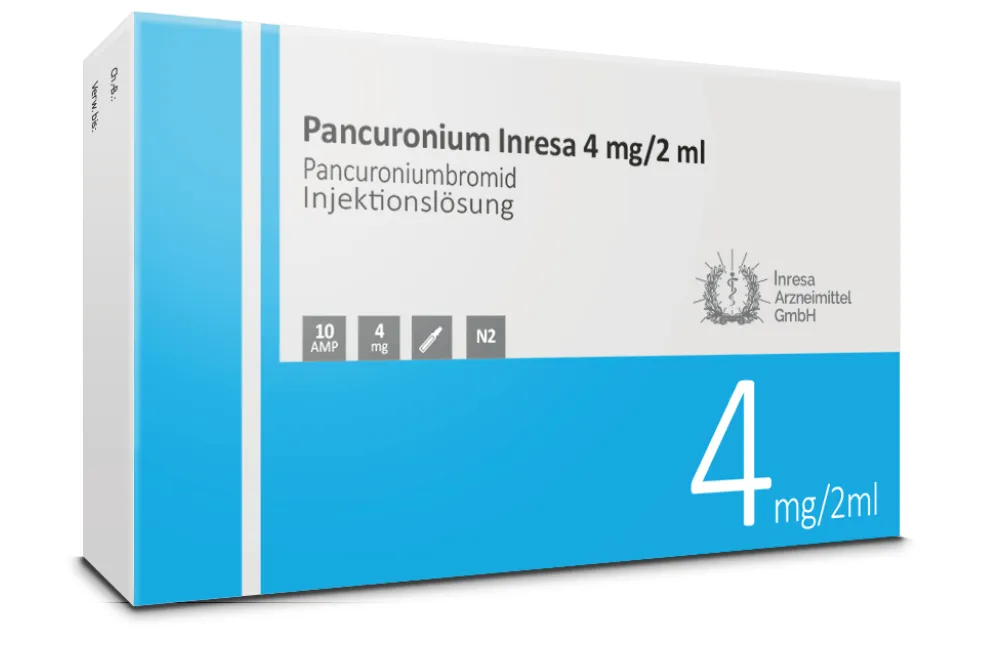
PANCURONIUM INRESA
PolandIt is an agent used in hospitals to relax muscles during general anesthesia or endotracheal intubation. It is also used in patients connected to a ventilator and to alleviate the symptoms of tetanus.
Frequently asked questions
How should Pancuronium Inresa be administered?
The medicine is administered intravenously only by qualified medical personnel. The dosage is determined individually by a physician depending on the patient's response and the purpose of the procedure.
When should you not use this medicine?
Do not use the medicine if the patient is allergic to its ingredients or if it is not possible to provide the technical conditions for performing intubation and controlled ventilation. The medicine must not be administered to premature infants and newborns.
What are the possible side effects of Pancuronium Inresa?
Possible side effects include: accelerated or irregular heart rhythm, increased blood pressure, allergic reactions (including rare anaphylactic reactions), excessive salivation, muscle weakness, and pain or skin reactions at the injection site.
Does the medicine interact with other substances?
Yes, the effect of the medicine may be enhanced or diminished by other agents, such as certain analgesics, antibiotics, lithium salts, or glucocorticosteroids. The physician should be informed about all medications being taken.
What precautions should be taken in case of pregnancy and breastfeeding?
The medicine may be used during pregnancy only if the physician deems it absolutely necessary. In the case of breastfeeding, it should be discontinued for 24 hours after administration of the medicine.
Can you drive after using the medicine?
Yes, the medicine significantly impairs psychophysical performance; therefore, there is an absolute prohibition on driving vehicles and operating machinery for at least 24 hours after administration.
Instructions for use
Table of contents
- 1. WHAT IS PANCURONIUM INRESA AND WHAT IS IT USED FOR
- 2. IMPORTANT INFORMATION BEFORE USING PANCURONIUM INRESA
- 3. HOW TO USE THE MEDICINE PANCURONIUM INRESA
- 4. POSSIBLE ADVERSE REACTIONS
- 5. HOW TO STORE PANCURONIUM INRESA
- 6. CONTENTS OF THE PACKAGE AND OTHER INFORMATION
- The following information is intended exclusively for medical personnel
Package leaflet: Information for the user
Warning! Keep the leaflet. Information on the immediate packaging in a foreign language.
Pancuronium Inresa, 2 mg/ml (4 mg/2 ml), solution for injection
Pancuronii bromidum
Please read the entire leaflet carefully before using the medicine, as it contains
important information for the patient.
- Keep this leaflet, so that you can read it again if necessary.
- Consult your doctor, pharmacist, or nurse if you have any further questions.
- If any adverse reactions occur, including any possible adverse reactions not listed in this leaflet, inform your doctor, pharmacist, or nurse.
Table of contents of the leaflet:
- What is Pancuronium Inresa and what is it used for
- Important information before using Pancuronium Inresa
- How to use Pancuronium Inresa
- Possible side effects
- How to store Pancuronium Inresa
- Contents of the pack and other information
1. WHAT IS PANCURONIUM INRESA AND WHAT IS IT USED FOR
Pancuronium is a non-depolarizing skeletal muscle relaxant.
Indications
Pancuronium Inresa is intended for use only in a hospital setting:
- to achieve skeletal muscle relaxation during endotracheal intubation (endotracheal intubation involves placement of a flexible tube through the mouth or nose into the trachea to mechanically assist breathing) and during general anesthesia;
- in patients connected to a ventilator and receiving controlled ventilation;
- for alleviating symptoms of tetanus.
2. IMPORTANT INFORMATION BEFORE USING PANCURONIUM INRESA
INRESA
When not to use Pancuronium Inresa
- if the patient is allergic to pancuronium, bromide, or any of the other ingredients of this medicine (listed in section 6);
- pancuronium must absolutely not be used if there are no technical possibilities to perform intubation and apply controlled ventilation;
- do not use in premature infants and newborns.
Warnings and precautions
Pancuronium bromide is intended for hospital use only and may be administered solely by qualified medical personnel when equipment for controlled ventilation is available.
Inform the doctor if the patient has any of the following conditions:
- myasthenia gravis (muscle weakness, fatigue);
- myasthenic syndrome (Eaton-Lambert syndrome);
- neuromuscular disorders;
- Heine-Medin disease (poliomyelitis);
- malignant hypertension, particularly hypertension associated with kidney diseases;
- adrenal chromaffin tumor (tumor causing arterial hypertension);
- coronary heart disease (ischemic heart disease);
- severe electrolyte disturbances (e.g. decreased blood potassium and calcium ion levels; increased blood magnesium ion levels).
Use in elderly patients
The dose of the medicine should be reduced in elderly patients.
Other medicines and Pancuronium Inresa
Tell the doctor about all medicines currently used or recently taken, as well as any medicines the patient plans to take.
Pregnancy and breastfeeding
During pregnancy and breastfeeding, or if pregnancy is suspected or planned, consult a doctor before using this medicine.
This medicine may be used during pregnancy only if the doctor considers it absolutely necessary.
Studies have shown that pancuronium bromide can be safely used prior to caesarean section.
It is not known whether pancuronium bromide passes into breast milk in amounts that could affect the breastfed infant. If use of the medicine is necessary, breastfeeding must be discontinued. Breastfeeding may be resumed only after elimination of the drug from the body (after 24 hours following administration).
Driving and operating machinery
Pancuronium Inresa significantly impairs psycho-physical performance. Absolute prohibition of driving vehicles and operating machinery applies for at least 24 hours after administration of the medicine.
3. HOW TO USE THE MEDICINE PANCURONIUM INRESA
Due to significant individual differences in response to the medicine, the doctor will determine the dosage individually.
The medicine may only be administered by medical personnel.
The medicine is given intravenously.
4. POSSIBLE ADVERSE REACTIONS
Like all medicines, this medicine can cause adverse reactions, although not everyone experiences them.
Heart and vascular disorders:
Increased heart rate, elevated arterial blood pressure, and increased cardiac output.
Additionally, ventricular arrhythmias and atrioventricular dissociation (conduction disturbances) may occur.
Reactions related to histamine release (sudden drop in blood pressure, bronchospasm and associated dyspnea) may occur less frequently than with other muscle relaxants.
Immune system disorders:
In rare cases, pancuronium may cause an anaphylactic reaction, manifested by sudden drop in arterial blood pressure, development of vascular leakage (edema), cardiac arrhythmias, and bronchospasm.
Skin allergic reactions may occur more frequently than with other muscle relaxants.
Gastrointestinal disorders:
Excessive salivation.
Metabolism and nutrition disorders:
In newborns treated with pancuronium bromide, the relative risk of hyperbilirubinemia (increased blood bilirubin concentration) was 1.2 compared to newborns not treated with the drug.
General disorders and administration site conditions:
Local skin reactions and pain at the injection site may occasionally be observed.
Musculoskeletal and connective tissue disorders:
Frequency not known: muscle weakness.
Reporting of adverse reactions
If any adverse reactions occur, including any adverse reactions not listed in this leaflet, inform your doctor, pharmacist, or nurse. Adverse reactions can be reported directly to the Department of Monitoring Adverse Drug Reactions of the Office for Registration of Medicinal Products, Medical Devices and Biocidal Products
Al. Jerozolimskie 181C
02-222 Warsaw
Phone: + 48 22 49 21 301
Fax: + 48 22 49 21 309
Website: https://smz.ezdrowie.gov.pl
Reporting adverse reactions helps to provide more information on the safety of the medicine.
5. HOW TO STORE PANCURONIUM INRESA
Store in a refrigerator (2°C - 8°C).
Keep the medicine out of the sight and reach of children.
Before use, check the expiry date on the packaging and do not use this medicine after the
expiry date stated on the packaging.
The expiry date refers to the last day of the stated month.
Medicines should not be disposed of via wastewater or household waste. Ask your
pharmacist how to dispose of medicines no longer required. These measures will help
protect the environment.
6. CONTENTS OF THE PACKAGE AND OTHER INFORMATION
What Pancuronium Inresa contains
The active substance is pancuronium bromide.
One 2 ml ampoule contains 4 mg of pancuronium bromide. 1 ml of injection solution contains 2 mg of pancuronium bromide.
The other ingredients are: sodium chloride, sodium acetate trihydrate, glacial acetic acid, water for injections.
What Pancuronium Inresa looks like and contents of the pack
Pancuronium Inresa is a sterile, colourless solution.
The available pack consists of 10 ampoules with a capacity of 2 ml, made of amber glass, placed in a cardboard box.
For more detailed information, please contact the Marketing Authorisation Holder or the parallel importer.
Marketing Authorisation Holder in Germany, the country of export:
Inresa Arzneimittel GmbH
Obere Hardtstraße 18
79114 Freiburg, Germany
Manufacturer:
Inresa Arzneimittel GmbH
Obere Hardtstraße 18
79114 Freiburg, Germany
Parallel Importer:
Delfarma Sp. z o.o.
ul. Św. Teresy od Dzieciątka Jezus 111
91-222 Łódź
Repackaged by:
Delfarma Sp. z o.o.
ul. Św. Teresy od Dzieciątka Jezus 111
91-222 Łódź
German Marketing Authorisation Number (country of export): 34409.00.00
Parallel Import Authorisation Number: 352/25
The following information is intended exclusively for medical personnel
Precautions
Before administering the drug, ensure the possibility of intubating the patient, oxygen therapy, and access to a ventilator. Pancuronium should not be used without prior adequate sedation of the patient. Administration of a muscle relaxant to a fully conscious individual may lead to adverse psychological consequences.
Increased sensitivity to pancuronium bromide is observed in patients with myasthenia gravis, and even a dose of 0.005 mg/kg body weight may induce muscle relaxation reaching 90% of maximal effect.
In patients with coronary artery disease, administration of pancuronium bromide may cause myocardial ischemia and provoke angina pectoris.
Generally, pancuronium bromide is not recommended for use in patients with myasthenia gravis or coronary artery disease. If used in such patients, a test dose of 0.005 mg/kg body weight should be administered intravenously (bolus), followed, if tolerated, by a slow continuous infusion to achieve the desired degree of muscle relaxation.
Dose reduction is not usually necessary in patients with mild to moderate renal impairment. However, the elimination half-life of the drug may be prolonged in these patients.
In cases of severe renal failure (GFR < 10 ml/min), administration of pancuronium bromide should be avoided.
In patients with hepatic insufficiency or biliary obstruction, a higher initial dose may be required to achieve adequate muscle relaxation. However, repeat doses should not be administered earlier than 120 minutes apart due to prolonged elimination half-life in these patients.
In patients with extensive burns, resistance to the effects of pancuronium bromide may occur, necessitating higher doses.
In patients with severe electrolyte disturbances—such as hypokalemia, hypocalcemia, hypermagnesemia, severe fluid-electrolyte imbalances, acid-base disturbances, or hypoproteinemia—the effect of pancuronium bromide may be enhanced and prolonged.
In patients with coronary artery disease, administration of pancuronium bromide may cause myocardial ischemia and provoke angina pectoris.
In patients with pheochromocytoma, administration of pancuronium bromide may cause significant hypertension.
Interactions with other drugs
Concomitant use of pancuronium bromide with inhalational anesthetics such as halothane, isoflurane, or enflurane may potentiate neuromuscular blockade, requiring adjustment of the pancuronium bromide dose.
Opioid analgesics may contribute to post-pancuronium respiratory failure by depressing the respiratory center.
The muscle-relaxing effect of pancuronium is enhanced and prolonged by: barbiturates, lithium salts, furosemide, ethacrynic acid, amphotericin, tetracyclines, polymyxin B, lincomycin, clindamycin, capreomycin, colistin, aminoglycoside antibiotics, ajmaline, propranolol, procainamide, and quinidine.
Respiratory acidosis, hypokalemia, hypermagnesemia, and hypercalcemia enhance the effects of muscle relaxants.
Beta-blockers prolong the action of pancuronium.
Glucocorticoids reduce the potency of pancuronium. However, after prolonged use, when they lead to hypokalemia, they may potentiate neuromuscular blockade.
Lithium salts enhance and prolong the effect of pancuronium.
Patients receiving lithium therapy should discontinue lithium at least 24 hours before general anesthesia involving pancuronium.
In patients on long-term carbamazepine therapy, pancuronium metabolism may be accelerated, resulting in significantly shortened duration of muscle relaxation.
Patients receiving phenytoin may be less responsive to neuromuscular blockade; the muscle-relaxing effect of pancuronium bromide appears later and lasts shorter, and standard doses may fail to produce complete relaxation.
Reduced body temperature also diminishes the effect of pancuronium bromide.
Pancuronium may enhance the effects of cardiac glycosides, potentially leading to arrhythmias.
Edrophonium, neostigmine, and other acetylcholinesterase inhibitors reverse the muscle-relaxing effect of pancuronium.
Mixing pancuronium with other solutions in the same syringe may result in precipitation.
Dosage
Pancuronium must be administered intravenously.
Adults
Depending on the desired depth of muscle relaxation and individual response, the dose for adults ranges from 0.04 to 0.1 mg/kg body weight.
To assess individual sensitivity to pancuronium bromide, it is recommended to administer an initial intravenous test dose of 1 mg. Drooping of the eyelids may indicate hypersensitivity to pancuronium bromide and the need for a reduced dose.
The optimal dose for tracheal intubation is usually 0.09 mg/kg body weight. Adequate relaxation typically occurs within 2–3 minutes. Additional doses of 0.01 to 0.06 mg/kg body weight may be administered every 30–40 minutes, or depending on recovery of neuromuscular function, if needed.
Administration of an initial bolus dose of 0.007 mg/kg body weight followed 3 minutes later by 0.063 mg/kg body weight accelerates the onset of muscle relaxation and prolongs its duration.
Children and adolescents
The dose of pancuronium bromide in children, calculated per body weight, is the same as in adults and ranges from 0.04 to 0.1 mg/kg body weight.
In children and adolescents up to 17 years of age, the maximum dose is 0.1 mg/kg body weight.
Infants
When used in infants during the first few months of life, individual sensitivity to the drug should be assessed each time.
The initial dose in infants is typically 0.02 to 0.04 mg/kg body weight of pancuronium bromide as a bolus, with maintenance doses of 0.015 to 0.02 mg/kg body weight.
Elderly patients
The effect of pancuronium bromide is prolonged in elderly patients; therefore, dose reduction may be advisable.
Obese patients
Dose calculation based on total body weight in obese patients may lead to overdosing. Therefore, individual response to the drug should be carefully monitored in these patients.
Patients with hepatic or renal impairment
Caution is required when determining dosage in patients with hepatic or renal dysfunction.
After opening the ampoule, the contents should be used immediately and any unused solution discarded.
Administration of a higher than recommended dose of Pancuronium Inresa
Pancuronium is a muscle relaxant, including of respiratory muscles. Therefore, any effective dose may be lethal if intubation and controlled ventilation are not possible.
Chronic intoxication does not occur. The main symptoms of acute overdose due to intravenous administration of excessive doses are prolonged respiratory depression and circulatory collapse.
Initially, patients may exhibit drooping eyelids, difficulty swallowing and speaking, followed within 2–3 minutes by paralysis of limb muscles, neck muscles, intercostal muscles, and the diaphragm. Tachycardia, cardiac arrhythmias, vasodilation with venous stasis, and significant drop in arterial blood pressure are frequently observed.
Management includes intubation and controlled ventilation until spontaneous respiration returns. Arterial blood pressure should also be monitored.
Specific treatment includes intravenous administration of one of the following agents:
- 10 mg edrophonium (1 ml of 1% solution). This dose may be repeated as needed up to a total of 30 mg;
- methylsulfate neostigmine (1 to 2 ml of 1:2000 solution) intravenously together with 1 mg atropine.
After each administration of the above agents, the cannula and vein should be flushed with sodium chloride solution.
Similar drugs
| Brand name | Dosage form | Active substance / Dosage | Manufacturer |
|---|---|---|---|
| PANCURONIUM JELFA | solution for injection |
|
Jelfa Pharmaceutical Enterprise S.A. |
The original data is available in the language of the country of manufacture.
Data source: Register of Medicinal Products of Poland (URPL)
Data last verified: September 01, 2026