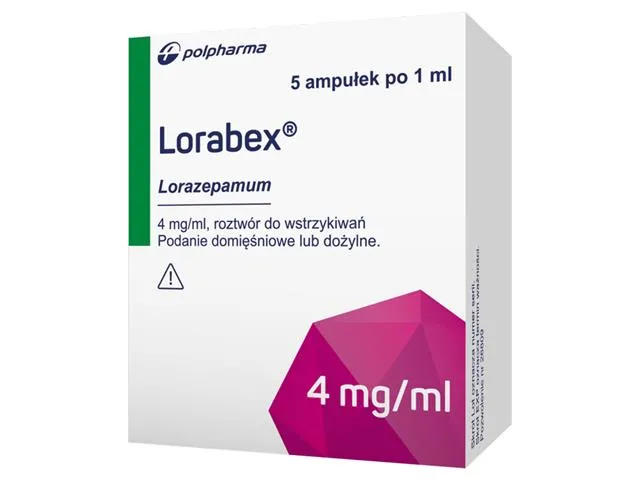
LORABEX
PolandThe medicine helps to relieve anxiety and muscle tension. It is used as premedication before surgery or diagnostic tests, as well as to relieve acute anxiety states, agitation, mania, and to control seizures.
Frequently asked questions
How should Lorabex be taken?
The medicine is administered by a doctor via intravenous or intramuscular injection. The dose is always determined individually by the doctor depending on the purpose of treatment, the patient's weight, and their health status.
When should you not use this medicine?
It must not be used if the patient has significant breathing difficulties, chest pain, liver problems, sleep apnea syndrome, or myasthenia gravis. Use is also contraindicated in individuals allergic to benzodiazepines and in children under 12 years of age (except for seizure control).
What are the possible side effects of Lorabex?
Drowsiness, fatigue, and sedation are the most common. Dizziness, muscle weakness, or depression occur more frequently. You must contact a doctor immediately if serious symptoms occur, such as breathing difficulties, allergic reactions (swelling of the throat or tongue), suicidal thoughts, or impaired consciousness.
Can the medicine be combined with other agents?
You must inform the doctor about all medications being taken. Particular caution should be exercised when combining it with sedatives, anti-anxiety drugs, antidepressants, strong painkillers (e.g., opioids), and anti-epileptic drugs. Taking the medicine with painkillers may increase the risk of drowsiness and, in rare cases, lead to breathing problems or death.
Should alcohol be avoided during treatment?
Yes, alcohol consumption should be avoided for 24 to 48 hours before administering the medicine.
Does the medicine affect driving vehicles?
Yes, the medicine may cause drowsiness or dizziness. You should not drive vehicles or operate machinery for 24 to 48 hours after taking the medicine.
Instructions for use
Package leaflet: Information for the patient
Lorabex, 2 mg/ml, solution for injection
Lorazepamum
Please read all of this leaflet carefully before using this medicine because it contains
important information for you.
- Keep this leaflet. You may need to read it again.
- If you have any questions, ask your doctor, pharmacist, or nurse.
- This medicine has been prescribed for a specific individual. Do not pass it on to others. It may harm someone else, even if their symptoms are the same.
- If you experience any adverse effects, including any not listed in this leaflet, tell your doctor, pharmacist, or nurse. See section 4.
Contents of the leaflet
- What Lorabex is and what it is used for
- Important information before using Lorabex
- How to use Lorabex
- Possible side effects
- How to store Lorabex
- Contents of the pack and other information
1. What Lorabex is and what it is used for
This medicine contains lorazepam, which belongs to a group of medicines called benzodiazepines. The medicine helps to relieve anxiety and muscle tension.
Lorabex is usually indicated for premedication before surgery or before invasive or prolonged diagnostic procedures. It may also be used to manage acute anxiety states, acute agitation or acute mania, and for controlling seizures.
If there is no improvement or if the patient feels worse after receiving Lorabex, inform the doctor.
Lorabex must not be used in children under 12 years of age, except in status epilepticus, in which case Lorabex may be used in adults, children, and infants from 1 month of age and older.
2. Important information before using Lorabex
You should inform your doctor or pharmacist if the patient has received Lorabex before
using any other medicine, if the patient becomes pregnant, or if the patient is admitted
to hospital for treatment.
When not to use Lorabex
- if the patient has significant breathing difficulties or experiences chest pain
- if in the past a doctor prescribed benzodiazepines and they proved inappropriate
- if the patient is allergic to benzodiazepines, including lorazepam, or to any of the other ingredients of this medicine (listed in section 6)
- if the patient has myasthenia gravis (excessive muscle weakness or fatigue)
- if the patient has significant liver problems
- if the patient has sleep apnoea syndrome (breathing problems during sleep)
- if the child is under 12 years of age, except for controlling status epilepticus. In case of status epilepticus, Lorabex must not be used in newborns.
Warnings and precautions
Before starting treatment with Lorabex, discuss this with your doctor, pharmacist, or
nurse:
- if the patient is pregnant, planning to become pregnant, or breastfeeding
- if the patient abuses drugs or alcohol
- if the patient has kidney or liver problems
- if the patient is elderly or frail
- if the patient has or has had depression
- if the patient has a personality disorder
- if the patient has had psychotic disorders in the past
- if the patient has had seizures/epileptic fits in the past
- if the patient has breathing difficulties
- if the patient has eye problems – glaucoma
- if the patient is taking any other medicines, as they may affect how Lorabex works.
If the patient is being treated as an outpatient, Lorabex must not be administered unless accompanied by a caregiver who will escort the patient home.
Tolerance and dependence
Tolerance to benzodiazepines may develop, so after several weeks of using Lorabex, the effect may become less noticeable.
Lorazepam may cause dependence, particularly in patients who have previously abused
drugs, narcotics, and/or alcohol.
Dependence is unlikely, but the risk increases with higher doses and prolonged use, and is further increased in patients with a history of alcohol, drug, or narcotic dependence, or in patients with marked personality disorders. Therefore, lorazepam should be avoided in individuals dependent on alcohol, drugs, or narcotics.
Dependence may lead to withdrawal symptoms, especially if treatment is stopped abruptly. Therefore, the medicine should always be discontinued gradually – if necessary, using lorazepam in oral form.
Some patients may feel drowsy after receiving Lorabex. It may be advisable to remain in hospital for at least 8 hours or overnight after receiving the injection. If the patient leaves hospital soon after receiving Lorabex, they should be under the supervision of a caregiver.
Some elderly patients may experience dizziness after receiving Lorabex, and these patients have an increased risk of falls.
Transient memory loss has been reported after administration of benzodiazepines.
Children
Lorabex must not be used in children under 12 years of age, except for controlling status
epilepticus. In case of status epilepticus, Lorabex must not be used in newborns.
Lorabex and other medicines
You should inform your doctor or pharmacist about all medicines currently or recently taken by the patient, as well as any medicines the patient plans to take.
In particular, inform the doctor if the patient is taking any other sedatives, anxiolytics, antidepressants, strong painkillers (e.g. opioids, methadone – doses should be reduced and duration of use minimized as recommended by the doctor), antiepileptics, antihistamines, or psychotropic medicines for mood or psychiatric disorders (e.g. haloperidol or chlorpromazine). Taking Lorabex with painkillers increases the risk of drowsiness; in rare cases, breathing difficulties may occur and may result in death.
Barbiturates (sedative medicines) and anaesthetics (medicines causing anaesthesia – reversible loss of sensation), clozapine (a medicine for mood or psychiatric disorders), sodium valproate (used in the treatment of epilepsy and bipolar affective disorder), probenecid (a medicine used in gout), theophylline, aminophylline (medicines used in respiratory diseases), disulfiram (a medicine used in alcoholism treatment), and metronidazole (an antibiotic): doses of these medicines may need to be reduced before administering Lorabex. You should also inform the doctor if the patient is taking a medicine called scopolamine, which may be used for intestinal problems or before surgery.
You should inform your doctor or pharmacist if the patient has received Lorabex before
using any other medicine, if the patient becomes pregnant, or if the patient is admitted
to hospital for treatment.
Lorabex with food, drink and alcohol
Alcohol consumption should be avoided for 24 to 48 hours before administration of Lorabex. See section 3.
Pregnancy and breastfeeding
If the patient is pregnant or breastfeeding, suspects she may be pregnant, or is planning to have a child, she should consult her doctor or pharmacist before using this medicine.
Pregnancy
Benzodiazepines, including Lorabex, may harm the unborn baby if administered during early pregnancy. Therefore, if the patient is pregnant or may become pregnant, she should not take this medicine without consulting her doctor. If the patient takes this medicine during late pregnancy or during labour, the newborn baby may be less active than usual, and symptoms such as: low body temperature, reduced muscle tone, breathing difficulties, or feeding problems may occur. The baby may also temporarily have impaired response to low temperature. The baby may also experience withdrawal symptoms after birth if the mother has regularly taken lorazepam for a prolonged period during late pregnancy.
Breastfeeding
Lorabex should not be given to breastfeeding mothers unless, in the opinion of the doctor, the expected benefits to the mother outweigh the risks to the baby, because the medicine may pass into breast milk.
Driving and using machines
Some patients may experience drowsiness or dizziness on the day of receiving Lorabex.
You should not drive or operate machinery for 24 to 48 hours after receiving Lorabex.
Lorabex contains benzyl alcohol, propylene glycol (E1520) and macrogol
Lorabex contains 20.9 mg of benzyl alcohol, 828.3 mg of propylene glycol, and 202.3 mg
of macrogol in each ml.
In children under 5 years of age, patients with liver or kidney disease, pregnant women, or breastfeeding women, contact your doctor or pharmacist before using Lorabex, as excipients may cause adverse effects. The doctor may adjust the dose if the patient or child is taking other medicines containing benzyl alcohol, propylene glycol, or alcohol.
Benzyl alcohol may cause allergic reactions.
Administration of benzyl alcohol to small children carries a risk of severe adverse effects including breathing disorders (so-called "gasping syndrome"), although Lorabex is not used in infants under 1 month of age.
Do not administer to young children (under 3 years of age) for longer than one week without a doctor's or pharmacist's recommendation.
3. How to take Lorabex
This medicine should always be taken according to the doctor's instructions. If in doubt, consult your doctor or pharmacist.
The doctor will administer Lorabex by injection into a vein or into a muscle.
Recommended dose:
For premedication, the usual recommended dose is 0.05 mg per kilogram of body weight (e.g. if the patient weighs 70 kg, they will likely receive 3.5 mg of lorazepam).
Lorabex must not be used for premedication in children under 12 years of age.
For acute anxiety, the usual recommended dose is 0.025 to 0.03 mg per kilogram of body weight (e.g. if the patient weighs 70 kg, they will likely receive 1.75 to 2.1 mg of lorazepam).
Lorabex must not be used for the treatment of acute anxiety in children under 12 years of age.
The doctor may prescribe a different dose or recommend a different treatment duration, especially in elderly or frail patients.
Patients with impaired kidney or liver function: lower doses may be sufficient. Use in patients with severe liver failure is contraindicated.
For controlling epileptic status in adults, lorazepam is usually administered intravenously at a dose of 4 mg. Children receive a lower intravenous dose of 0.1 mg per kilogram of body weight. The dose should not exceed 4 mg. If seizures persist within 10–15 minutes after administration, the doctor may decide to administer a second dose.
Due to the potential risk of toxicity related to accumulation of excipients, the maximum dose of Lorabex should not be repeated within 24 hours in children under 5 years of age.
Use in children
Lorabex must not be used in children under 12 years of age, except for controlling status
epilepticus (see also section 2). In case of status epilepticus, the medicine must not be used
in newborns (see also section 2).
Prolonged treatment may lead to benzodiazepine dependence. For this reason,
Lorabex is usually prescribed for one or two doses or for a short treatment period.
This reduces the risk of dependence on Lorabex or the occurrence of withdrawal symptoms after stopping treatment (see "Stopping treatment with Lorabex" below).
The doctor will prescribe the lowest effective dose for the shortest possible duration.
If Lorabex is administered at doses significantly higher than those indicated above, the risk of adverse effects increases, such as those listed in section 4 "Possible side effects". Inform the doctor if any of these symptoms occur or if other adverse effects appear.
Stopping treatment with Lorabex
After completing treatment with Lorabex, the doctor will decide whether further treatment is necessary.
After completing treatment, the dose of Lorabex should be gradually reduced. This allows the body to adapt to the absence of Lorabex and reduces the risk of adverse effects.
Withdrawal symptoms
After stopping Lorabex, withdrawal symptoms may occur, such as: headache, muscle pain, anxiety, tension, depression, restlessness, dizziness, nausea, diarrhoea, loss of appetite, insomnia, confusion, irritability, agitation, tremor, abdominal pain, changes in heart rate, short-term memory loss, dysphoria (feeling of sadness (low mood), anxiety, irritability or restlessness), high body temperature, and sweating. If these symptoms occur, they usually do not last long. If the patient experiences any of these symptoms, contact the doctor.
If the patient experiences any of the following withdrawal symptoms: loss of sense of reality, feeling of unreality or detachment from life and inability to feel emotions, tinnitus (ringing in the ears), numbness or tingling in hands or feet, vomiting, tremor, hallucinations, seizures, or disturbances in vision, hearing or touch, contact the doctor immediately.
If you have any further questions about the use of this medicine, consult your doctor or pharmacist.
4. Possible adverse effects
Like all medicines, this medicine can cause adverse effects, although they do not occur in everyone.
If any of the following serious adverse effects occur (frequency: not known
(frequency cannot be estimated from the available data)), immediately contact
a doctor or seek immediate medical help:
- severe allergic reactions may occur after administration of benzodiazepines, even after the first dose. Symptoms include: swelling of the tongue or throat, difficulty breathing, throat swelling, nausea or vomiting.
- paradoxical reactions (including anxiety, agitation, excitement, hostility, aggression, rage, sleep disturbances/insomnia, sexual excitement, hallucinations);
- disturbances in consciousness (e.g. reduced alertness, confusion, disorientation, fainting), as these may ultimately lead to coma;
- suicidal thoughts or suicide attempts;
- jaundice (e.g. yellowing of the skin and eyes);
- seizures/convulsions;
- difficulty breathing or breathing problems during sleep. Benzodiazepines, including lorazepam, may lead to potentially fatal breathing problems.
In rare cases, patients may experience pain, skin inflammation or rash at the
injection site. In such a case, inform the doctor.
During treatment with Lorabex, adverse effects may occur sporadically. They are usually
not severe and do not last long. However, you should inform your doctor if any of the following
adverse effects are severe or troublesome.
Other possible adverse effects include:
Very common (occur in more than 1 in 10 patients):
- sedation
- fatigue
- drowsiness.
Common (occur in less than 1 in 10 patients):
- muscle weakness
- asthenia (weakness)
- ataxia (impaired coordination of movement)
- confusion
- depression
- emergence of depression (unmasking of symptoms of depression previously hidden)
- dizziness.
Uncommon (occur in less than 1 in 100 patients):
- nausea
- sexual dysfunction
- impotence
- less intense orgasm.
Frequency not known (frequency cannot be estimated from the available data):
- constipation
- tremor
- visual disturbances (double vision and blurred vision)
- slurred speech
- headache
- memory disturbances
- increased emotional states, euphoria
- disinhibition (lack of psychological restraint)
- increased liver enzyme activity (bilirubin, aminotransferases, alkaline phosphatase)
- loss of balance
- worsening of lung disease
- allergic skin reactions (e.g. rash, swelling)
- alopecia (hair loss from head or body)
- angioedema (swelling of face, hands and feet)
- syndrome of inappropriate antidiuretic hormone secretion (SIADH), a condition in which the body secretes excessive antidiuretic hormone (ADH). Increased ADH may cause excessive water retention in the body.
- hyponatremia (low sodium levels in blood, which may cause fatigue and confusion, muscle twitching, convulsions and coma)
- hypothermia (lowered body temperature)
- low blood pressure
- thrombocytopenia (unexplained bruising, nosebleeds and (or) bleeding gums), agranulocytosis (severe infection), pancytopenia (bleeding, easy bruising, fatigue, shortness of breath and weakness)
- vestibular dizziness.
The following adverse effects may be more likely in children and elderly patients:
- restlessness
- excitement
- irritability
- aggression
- sudden anger
- nightmares
- hallucinations
- personality disorders
- behavioural disturbances
- delusions.
If any of the adverse effects become serious, or if any adverse effects not listed in this leaflet occur, inform your doctor.
Reporting of adverse effects
If any adverse effects occur, including any adverse effects not listed
in this leaflet, tell your doctor or pharmacist. Adverse effects can
be reported directly to the Department of Monitoring Adverse Drug Reactions of the Office for Registration of Medicinal Products, Medical Devices and Biocidal Products
Al. Jerozolimskie 181C
02-222 Warsaw
Tel.: + 48 22 49 21 301
Fax: + 48 22 49 21 309
Website: https://smz.ezdrowie.gov.pl
Adverse effects can also be reported to the marketing authorization holder.
By reporting adverse effects, additional information on the safety of the medicine can be collected.
5. How to store Lorabex
Keep this medicine out of the sight and reach of children.
Store and transport in a refrigerated condition (2°C–8°C). Store in the original
packaging to protect from light. Chemical and physical stability of the diluted product has been demonstrated
for one hour at 2°C–8°C. From a microbiological point of view, unless the method of opening/dilution excludes the risk of microbiological contamination, the medicine should be used immediately. If not used immediately, the user is responsible for the storage conditions and duration during use.
Do not use this medicine after the expiry date stated on the label and carton following: EXP.
The expiry date refers to the last day of the stated month.
The marking on the packaging following the abbreviation EXP indicates the expiry date, and following the abbreviation Lot indicates the batch number.
Medicines must not be disposed of via wastewater or household waste. Ask your pharmacist how to dispose of medicines no longer required. Such practices help protect the environment.
6. Contents of the package and other information
What Lorabex contains
- The active substance is lorazepam. Each ml of solution contains 2 mg of lorazepam.
- The other ingredients are: propylene glycol (E1520), macrogol 400, benzyl alcohol.
What Lorabex looks like and contents of the pack
A clear, colourless or almost colourless solution.
Lorabex is supplied in ampoules made of transparent, colourless type I glass with a capacity of 2 ml. Each ampoule contains 1 ml of solution.
The ampoules are placed on PVC trays, wrapped in transparent PE foil. The PVC trays are contained in a cardboard box together with the leaflet.
Lorabex is packed in packs of 5 or 10 ampoules, each containing 1 ml of solution.
Not all pack sizes may be marketed.
Marketing Authorisation Holder
Zakłady Farmaceutyczne POLPHARMA S.A.
ul. Pelplińska 19, 83-200 Starogard Gdański
tel. + 48 22 364 61 01
Manufacturer
Medochemie Ltd
48 Iapetou Street, Agios Athanassios Industrial Area
4101 Limassol
Cyprus
Information intended exclusively for medical professionals:
Dosage and administration
Dosage:
Dosage and duration of treatment should be individually determined for each patient.
The lowest effective dose for the shortest possible time should be used. The risk of withdrawal syndrome and rebound phenomena is greater after abrupt discontinuation of the drug; therefore, the drug should be tapered gradually in all patients.
Premedication:
Adults: 0.05 mg/kg body weight (3.5 mg at an average body weight of 70 kg). Administer intravenously 30–45 minutes before surgery. Anxiolytic effects occur after 5–10 minutes, and loss of consciousness occurs within a maximum of 30–45 minutes.
Alternatively, administer intramuscularly 1–1.5 hours before surgery. Anxiolytic effects occur after 30–45 minutes, and loss of consciousness occurs within a maximum of 60–90 minutes.
Children and adolescents: Lorabex must not be used in children under 12 years of age.
Acute anxiety state:
Adults: 0.025–0.03 mg/kg body weight (1.75–2.1 mg at an average body weight of 70 kg). Repeat every 6 hours.
Children and adolescents: Lorabex must not be used in children under 12 years of age.
Status epilepticus:
Adults: 4 mg administered intravenously.
Children and adolescents (aged 1 month and above): 0.1 mg/kg body weight administered intravenously.
Maximum dose: 4 mg per administration.
Due to the potential risk of toxicity related to accumulation of excipients, the maximum dose of Lorabex product should not be repeated within 24 hours in children under 5 years of age.
Lorabex must not be used in neonates for status epilepticus.
If seizures persist within the next 10–15 minutes, the dose may be repeated, but no more than 2 doses should be administered. Do not exceed 4 mg per dose.
Elderly and debilitated patients: Elderly and debilitated patients may respond to lower doses, and half the recommended adult dose may be sufficient.
Patients with renal or hepatic impairment
Lower doses may be sufficient in patients with renal impairment or mild to moderate hepatic impairment. Administration in patients with severe hepatic impairment is contraindicated.
Elderly and debilitated patients
In elderly and debilitated patients, the initial dose should be reduced by approximately 50%, and dosage should be adjusted according to individual patient needs and tolerance.
Route of administration
Lorabex can be administered intravenously or intramuscularly; however, the intravenous route is preferred.
Care should be taken during administration to avoid intra-arterial injection or injection into small veins.
Absorption from the injection site is considerably slower after intramuscular administration, and similar onset of action can be achieved with oral lorazepam tablets.
Lorabex should not be used for long-term treatment.
Preparation of injection
Intramuscular administration:
To facilitate intramuscular injection, it is recommended to dilute Lorabex 1:1 with 0.9% sodium chloride solution, 5% glucose solution, or water for injections.
Intravenous administration:
For intravenous administration, Lorabex must always be diluted 1:1 with 0.9% sodium chloride solution, 5% glucose solution, or water for injections.
Lorabex is available as a 1 mL solution in a 2 mL ampoule to facilitate dilution.
Lorabex must not be mixed with other drugs in the same syringe.
Pharmaceutical incompatibilities
Due to lack of compatibility data, this medicinal product must not be mixed with other medicinal products except those mentioned in the section "Dosage and administration".
Shelf life
Before opening: 18 months.
Stability after dilution:
The table below presents the chemical and physical stability of the drug during storage at temperatures from 2°C to 8°C (refrigerated) and at 25°C, depending on the solvent used and the concentration of lorazepam:
| Lorazepam concentration | Solvent | Stability [hours] | |
| 2°C-8°C | 25°C | ||
| 0.5 mg/ml | Water for injections | 2 | 1 |
| 0.9% sodium chloride solution | 8 | use immediately | |
| 5% glucose solution | 4 | use immediately | |
| 1.0 mg/ml | Water for injections | 4 | 3 |
| 0.9% sodium chloride solution | 8 | 3 | |
| 5% glucose solution | 4 | 3 | |
From a microbiological standpoint, the medicinal product should be used immediately, unless the method of opening/dilution excludes the risk of microbiological contamination. If the product is not used immediately, the user is responsible for the storage conditions and duration prior to use.
Special precautions for storage
Store and transport in a refrigerated state (2°C–8°C).
Keep in the original packaging to protect from light.
Special precautions regarding disposal and preparation for administration
Lorabex must not be mixed with other medicinal products in the same syringe. Do not use if the solution has changed colour or if particles are present (see "Dosage and method of administration").
No special requirements for disposal.
Any unused residues or waste material should be disposed of in accordance with local regulations.
Similar drugs
| Brand name | Dosage form | Active substance / Dosage | Manufacturer |
|---|---|---|---|
| LORABEX | solution for injection |
|
Medochemie Ltd. |
| LORAZEPAM TZF | solution for injection |
|
Tarchomin Pharmaceutical Works 'Polfa' S.A. |
| LORAZEPAM TZF | solution for injection |
|
Tarchomin Pharmaceutical Works 'Polfa' S.A. |
The original data is available in the language of the country of manufacture.
Data source: Register of Medicinal Products of Poland (URPL)
Data last verified: September 01, 2026