IVERMECTIN MEDICAL VALLEY
PolandThe medicine is used to treat infections caused by certain parasites, such as intestinal strongyloidiasis, lymphatic filariasis (microfilarial blood infection), and scabies caused by small mites.
Frequently asked questions
How should Ivermectin Medical Valley be taken?
The tablets should be taken orally, on an empty stomach, with water. All prescribed tablets should be taken at the same time as a single dose. Nothing should be eaten for two hours before and after taking the medicine. For children under 6 years of age, the tablets should be crushed.
When should you not use this medicine?
Do not take it if you are allergic to ivermectin or any other ingredients of the medicine, or if you experienced a severe rash, skin peeling, blisters, or oral ulcers after previous use of ivermectin.
What are the possible side effects?
Allergic reactions (fever, rash, difficulty breathing), liver problems, blood in the urine, or dizziness are possible. In case of serious skin changes (spots, blisters, ulcers) or severe allergic reactions, discontinue use immediately and seek medical assistance.
Can the medicine be combined with other agents or used during pregnancy?
Inform your doctor about all medications you are currently taking. If you are pregnant or planning a pregnancy, consult your doctor – during pregnancy, the medicine should only be used if absolutely necessary. In the case of breastfeeding, the doctor may recommend delaying treatment for one week after childbirth.
Can you drive after taking the medicine?
Do not drive vehicles or operate machinery if dizziness, drowsiness, tremors, or a spinning sensation occur after taking the medicine.
Instructions for use
Table of contents
Package leaflet: Information for the user
Ivermectin Medical Valley, 3 mg, tablets
Ivermectinum
Please read this leaflet carefully before taking this medicine, because it contains
important information for you.
- Keep this leaflet as you may need to read it again.
- If you have any questions, please consult your doctor or pharmacist.
- This medicine has been prescribed for a specific individual. Do not pass it on to others. This medicine may harm other people, even if their symptoms are the same.
- If you experience any adverse reactions, including any adverse reactions not listed in this leaflet, inform your doctor or pharmacist. See section 4.
Leaflet contents
- What Ivermectin Medical Valley is and what it is used for
- Important information before taking Ivermectin Medical Valley
- How to take Ivermectin Medical Valley
- Possible side effects
- How to store Ivermectin Medical Valley
- Contents of the pack and other information
1. What Ivermectin Medical Valley is and what it is used for
Ivermectin Medical Valley contains an active substance called ivermectin. This medicine is used
to treat infections caused by certain parasites.
Ivermectin Medical Valley is used to treat:
- Intestinal infection called strongyloidiasis (threadworm disease). It is caused by a type of roundworm known as the intestinal threadworm (Strongyloides stercoralis).
- Blood infection with microfilariae in patients with lymphatic filariasis. This infection is caused by the immature form of a worm called the human filarial worm (Wuchereria bancrofti). Ivermectin Medical Valley does not act against adult forms, but only against immature stages of the worms.
- Skin disease caused by tiny mites (scabies), which multiply under the skin. This may cause intense itching. Ivermectin Medical Valley should only be taken when a doctor has diagnosed scabies or suspects that the patient has scabies.
Ivermectin Medical Valley does not prevent the occurrence of any of these infections. It does not act
against adult worm forms. Ivermectin Medical Valley should only be taken when a doctor has diagnosed or suspects a parasitic infection.
2. Important information before taking Ivermectin Medical Valley
When not to take Ivermectin Medical Valley
- if the patient is allergic to ivermectin or any of the other ingredients of this medicine (listed in section 6). Symptoms of an allergic reaction may include skin rash, difficulty breathing, or fever.
- if the patient has ever experienced the following after taking ivermectin: severe skin rash, skin peeling, blisters, or mouth ulcers.
If any of the above apply to the patient, Ivermectin Medical Valley should not be taken. If in doubt, consult a doctor or pharmacist before starting treatment with Ivermectin Medical Valley.
Warnings and precautions
Before taking Ivermectin Medical Valley, discuss it with a doctor or pharmacist.
Serious skin reactions, including Stevens-Johnson syndrome and toxic epidermal necrolysis, have been reported with ivermectin treatment. If any symptoms of severe skin reactions occur (as described in section 4), ivermectin must be discontinued immediately and medical help must be sought without delay.
In particular, consult a doctor or pharmacist before taking this medicine if the patient:
- has a weakened immune system (immunodeficiency),
- lives or has traveled to regions of Africa where human infection with the parasitic worm Loa loa, also known as the eye worm, occurs,
- currently lives or has stayed in certain regions of Africa. Use of DEC (diethylcarbamazine citrate) in the treatment of Onchocerca volvulus infection may increase the risk of adverse reactions, which can sometimes be severe.
If any of the above apply to the patient (or if the patient is unsure), medical advice must be sought from a doctor or pharmacist before taking Ivermectin Medical Valley.
Children
It is not known whether Ivermectin Medical Valley can be safely used in children weighing less than 15 kg.
Ivermectin Medical Valley and other medicines
Inform the doctor or pharmacist about all medicines currently taken or recently taken, as well as any medicines the patient plans to take.
Pregnancy and breastfeeding
- If the patient is pregnant or may become pregnant, she should consult a doctor immediately before taking Ivermectin Medical Valley. This medicine should be used during pregnancy only if clearly necessary. The decision will be made by the patient and her doctor.
- Talk to a doctor if the patient is breastfeeding or planning to breastfeed. Ivermectin Medical Valley passes into human milk. The doctor may decide that treatment should begin one week after childbirth.
If the patient is pregnant or breastfeeding, suspects she may be pregnant, or is planning to have a child, she should consult a doctor or pharmacist before using this medicine.
Driving and operating machinery
Dizziness, drowsiness, tremor, or vertigo may occur after taking Ivermectin Medical Valley. If such symptoms occur, the patient should not drive or operate any vehicles or machinery.
3. How to take Ivermectin Medical Valley
This medicine should always be taken as directed by a doctor or pharmacist. If in
doubt, consult a doctor or pharmacist.
How to take this medicine:
- This medicine should be taken orally.
- When administering to children under 6 years of age, the tablets should be crushed before swallowing.
- The prescribed number of tablets should be taken at the same time as a single dose. The tablets should be taken on an empty stomach, swallowed with water. No food should be consumed within two hours before or after taking this medicine, as the effect of food on its absorption is unknown.
How many tablets to take
Treatment consists of taking a single dose.
- The prescribed number of tablets should be taken at the same time as a single dose.
- The dose depends on the type of disease and the patient's body weight or height.
- The doctor will inform the patient how many tablets should be taken.
Intestinal strongyloidiasis (strongyloidiasis)
- The usual dose is:
| BODY WEIGHT (kg) | DOSE (number of 3 mg tablets) |
| from 15 to 24 | One |
| from 25 to 35 | Two |
| from 36 to 50 | Three |
| from 51 to 65 | Four |
| from 66 to 79 | Five |
| ≥ 80 | Six |
Microfilaria, caused by lymphatic filariasis – caused by the human threadworm
(Wuchereria bancrofti)
- The usual dose is:
| BODY WEIGHT (kg) | DOSE administered every 6 months Number of 3 mg tablets | DOSE administered every 12 months Number of 3 mg tablets |
| from 15 to 25 | One | Two |
| from 26 to 44 | Two | Four |
| from 45 to 64 | Three | Six |
| from 65 to 84 | Four | Eight |
- The above dose should be repeated every 6 months or every 12 months.
- Alternatively, if the patient's body weight cannot be determined, the dose may be determined based on the patient's height as follows:
| HEIGHT (in cm) | DOSE when administered once every 6 months Number of 3 mg tablets | DOSE when administered once every 12 months Number of 3 mg tablets |
| from 90 to 119 | One | Two |
| from 120 to 140 | Two | Four |
| from 141 to 158 | Three | Six |
| > 158 | Four | Eight |
Human scabies
- A dose of 200 micrograms per kilogram of body weight should be administered.
- The effectiveness of treatment can only be assessed 4 weeks after initiation.
- The physician may decide to administer a second single dose within 8 to 15 days.
If you feel that the effect of Ivermectin Medical Valley is too strong or too weak,
you should consult your doctor or pharmacist.
Taking more than the recommended dose of Ivermectin Medical Valley
You must take exactly the dose prescribed by your doctor. In some patients, reduced level of consciousness, including coma, has been reported following ivermectin overdose.
If an excessive dose of Ivermectin Medical Valley has been taken, you should contact your doctor immediately.
If you have any further questions regarding the use of this medicine, consult your doctor or pharmacist.
Missing a dose of Ivermectin Medical Valley
You should try to take Ivermectin Medical Valley as directed by your doctor. Do not take a double dose to make up for a missed dose.
4. Possible adverse reactions
Like all medicines, this medicine can cause adverse reactions, although not everyone will experience them.
Adverse reactions are usually not severe and do not last long. They are more likely to occur in individuals infected with multiple parasites, and particularly in those infected with the Loa loa worm. The following adverse reactions may occur during treatment with this medicine:
Allergic reactions
If a patient experiences an allergic reaction, medical advice should be sought immediately. Symptoms may include:
- sudden fever
- sudden skin reactions (such as rash or itching) or other severe skin reactions
- difficulty breathing
If any of the above adverse reactions occur, medical advice should be sought immediately.
The patient should stop taking Ivermectin Medical Valley and seek immediate medical assistance if any of the following symptoms occur:
- red, flat, target-shaped or circular patches on the trunk, often with blisters in the center, peeling of the skin, mouth ulcers, ulcers in the throat, nose, genital organs or eyes. Such serious skin rashes may be preceded by fever and flu-like symptoms (Stevens-Johnson syndrome, toxic epidermal necrolysis).
Other adverse reactions
- Liver disease (acute hepatitis)
- Changes in results of certain laboratory tests (increased liver enzyme activity, increased blood bilirubin levels, increased eosinophil count)
- Blood in urine
- Decreased level of consciousness, including coma
The following adverse reactions depend on the indication for which Ivermectin Medical Valley is used and whether the patient has any other infections.
In patients with intestinal strongyloidiasis (threadworm infection), the following adverse reactions may occur:
- unusual weakness
- loss of appetite, abdominal pain, constipation or diarrhoea
- nausea or vomiting
- drowsiness or dizziness
- chills or shivering
- In intestinal strongyloidiasis (threadworm infection), adult roundworms may be present in the stool.
In patients with microfilaraemia due to lymphatic filariasis caused by Wuchereria bancrofti, the following adverse reactions may occur:
- sweating or fever
- headache
- unusual weakness
- muscle, joint and general body pain
- loss of appetite, nausea
- abdominal pain (abdominal and epigastric pain)
- cough or sore throat
- breathing discomfort
- low blood pressure upon standing (orthostatic hypotension) – dizziness or lightheadedness may occur
- chills
- dizziness
- pain or discomfort in the testicles
In patients with scabies, the following adverse reactions may occur:
- increased itching (pruritus) at the beginning of treatment. This is usually short-lived.
In patients with heavy infection with the parasite Loa loa, the following adverse reactions may occur:
- abnormal brain function
- neck or back pain
- bleeding in the eye whites (also known as eye redness)
- shortness of breath
- loss of bladder or bowel control
- difficulty standing or walking
- changes in mental status
- drowsiness or confusion
- unresponsiveness to others or coma
In patients infected with the parasite Onchocerca volvulus, which causes river blindness, the following adverse reactions may occur:
- itching or rash
- joint or muscle pain
- fever
- nausea or vomiting
- swollen lymph nodes
- swelling, especially in hands, ankles or feet
- diarrhoea
- dizziness
- low blood pressure (hypotension). Dizziness or lightheadedness may occur when changing to an upright position.
- rapid heartbeat
- headache or feeling of fatigue
- vision changes and other eye problems, such as infection, redness or unusual sensations
- bleeding in the eye whites or eyelid swelling
- worsening of asthma
Reporting of adverse reactions
If any adverse reactions occur, including any not listed in this leaflet, inform a doctor or pharmacist. Adverse reactions can be reported directly to the Department of Monitoring Adverse Reactions of Medicinal Products, Office for Registration of Medicinal Products, Medical Devices and Biocidal Products, Al. Jerozolimskie 181 C, 02-222 Warsaw
Tel.: +48 22 49 21 301, Fax: +48 22 49 21 309
Website: https://smz.ezdrowie.gov.pl
Adverse reactions can also be reported to the marketing authorization holder.
Reporting adverse reactions helps to provide more information on the safety of the medicine.
5. How to store Ivermectin Medical Valley
Keep this medicine out of sight and reach of children.
Do not use this medicine after the expiry date stated on the blister and packaging after "Expiry date (EXP)". The expiry date refers to the last day of the specified month.
There are no special requirements regarding the storage temperature of the medicine.
Store in the original packaging to protect from light.
Medicines must not be disposed of via wastewater or household waste. Ask your pharmacist how to dispose of medicines no longer in use. This will help protect the environment.
6. Contents of the packaging and other information
What Ivermectin Medical Valley contains
- The active substance is ivermectin. Each tablet contains 3 mg of ivermectin.
- The other ingredients are: microcrystalline cellulose PH 102, pregelatinized corn starch, citric acid, butylated hydroxyanisole, magnesium stearate.
What Ivermectin Medical Valley looks like and contents of the pack
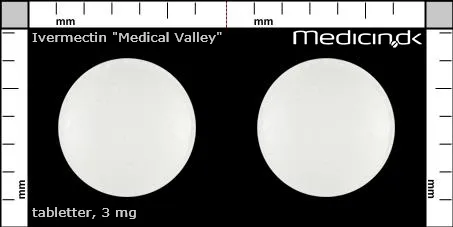
The medicine is in the form of round, white, unmarked tablets.
The medicine is available in aluminium/aluminium blisters containing 4, 8, 12 or 20 tablets,
packed in a cardboard carton.
Not all pack sizes may be marketed.
Marketing Authorisation Holder
Medical Valley Invest AB
Brädgårdsvägen 28
236 32 Höllviken
Sweden
email: [email protected]
(logo of the marketing authorisation holder)
Manufacturer
Laboratorios Liconsa, S.A.
Polígono Industrial Miralcampo, Avda. Miralcampo, 7
19200 Azuqueca de Henares – Guadalajara
Spain
Medical Valley Invest AB
Brädgårdsvägen 28
236 32 Höllviken
Sweden
This medicinal product is authorised in the Member States of the European Economic Area under the following names:
Austria: Ivergelan 3 mg- Tabletten
Denmark: Ivermectin "Medical Valley", tabletter
Finland: Ivermectin Medical Valley 3 mg tabletit
France: Ivermectine Liconsa 3 mg comprimé
Netherlands: Ivermectine Xiromed 3 mg, tabletten
Iceland: Ivermectin Medical Valley 3 mg töflur
Germany: Iveraxiro 3 mg Tabletten
Norway: Ivermectin Medical Valley
Poland: Ivermectin Medical Valley
Portugal: Ivermectina Cantabria 3 mg tablets
Czech Republic: Ivermectin Exeltis 3 mg tablety
Slovakia: Ivermectin Exeltis 3 mg tablety
Sweden: Ivermectin Medical Valley 3 mg tabletter
Italy: Ivermectina Difa
Other sources of information
Detailed information on this medicine is available on the website of the Office for Registration of Medicinal Products, Medical Devices and Biocidal Products, www.urpl.gov.pl
Similar drugs
| Brand name | Dosage form | Active substance / Dosage | Manufacturer |
|---|---|---|---|
| POSELA | tablets |
|
Europeenne de Pharmacotechnie - Europhartech |
| POSELA | tablets |
|
Substipharm |
| POSELA | tablets |
|
Substipharm |
| POSELA | tablets |
|
Substipharm |
| POSELA | tablets |
|
Substipharm |
| SCAVERTIN | tablets |
|
Orifarm Healthcare A/S |
| VESARCO | tablets |
|
Aristo Pharma GmbH, Laboratorios Medicamentos Internacionales S.A. |
The original data is available in the language of the country of manufacture.
Data source: Register of Medicinal Products of Poland (URPL)
Data last verified: September 01, 2026