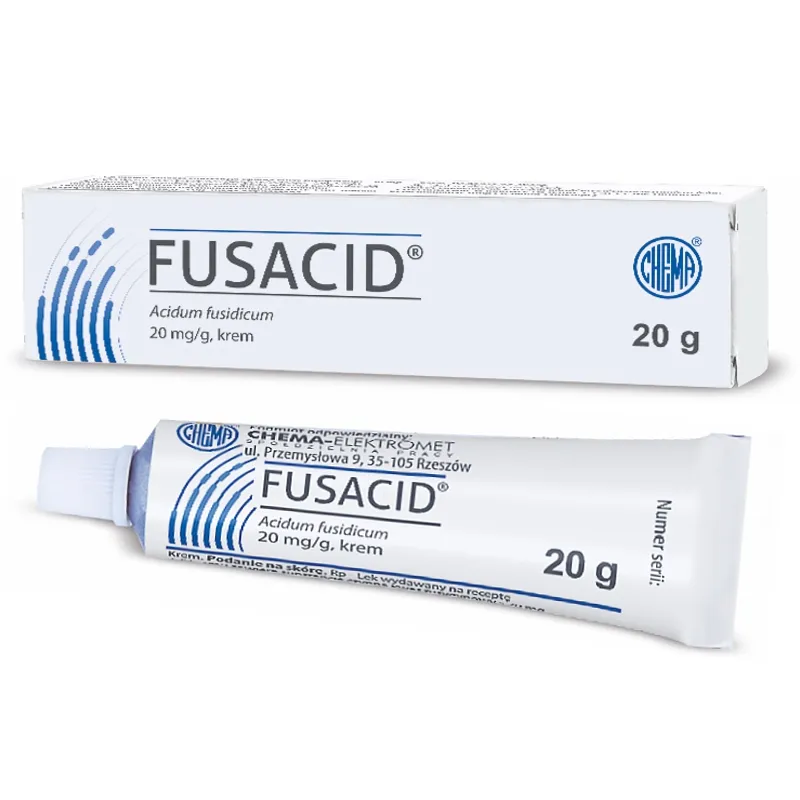
FUSACID
PolandThe medicine is used for the topical treatment of skin infections caused by bacteria sensitive to fusidic acid, especially Staphylococcus aureus (*Staphylococcus aureus*).
Frequently asked questions
How to use Fusacid?
Apply a small amount of cream to the cleaned, affected skin surface 3 to 4 times daily. If using a gauze dressing, the frequency can be reduced to 1 or 2 times daily. Wash hands after use.
When not to use this medicine?
Do not use the medicine if you are allergic to fusidic acid or any other ingredients of the preparation, or in the case of infections caused by microorganisms resistant to this medicine (e.g., *Pseudomonas aeruginosa*).
Can Fusacid cause side effects?
Fusacid may cause skin reactions at the application site, such as itching, irritation, burning, skin dryness, rash, erythema, urticaria, or contact dermatitis. Edema (e.g., of the orbit) and allergic reactions are also possible.
Can the medicine be used during pregnancy or breastfeeding?
Women who are pregnant or breastfeeding should consult a doctor or pharmacist. The medicine should not be used during pregnancy unless a doctor deems it necessary.
How to store the medicine?
The cream should be stored in a refrigerator at a temperature between 2°C and 8°C. Do not freeze. Keep the tube tightly closed, out of the sight and reach of children.
Instructions for use
Package leaflet: Information for the user
FUSACID, 20 mg/g, cream
(Acidum fusidicum)
Please read this leaflet carefully before using the medicine, because it contains important information for you.
- Keep this leaflet so that you can read it again if necessary.
- If you have any doubts, please consult your doctor or pharmacist.
- This medicine has been prescribed for a specific individual. Do not pass it on to others. The medicine may harm another person, even if their symptoms are the same.
- If you experience any adverse reactions, including any not listed in this leaflet, please inform your doctor or pharmacist. See section 4.
Contents of the leaflet
- What Fusacid is and what it is used for
- Important information before using Fusacid
- How to use Fusacid
- Possible side effects
- How to store Fusacid
- Contents of the package and other information
1. What Fusacid is and what it is used for
Fusacid is a cream containing fusidic acid – an antibiotic with strong antibacterial activity from the fusidate group.
Fusidic acid acts primarily against Staphylococcus aureus bacteria; it is also active against bacteria of the genera Streptococcus spp., Corynebacterium spp., Neisseria spp., and some species of Clostridium spp.
Fusacid is used in the topical treatment of infections caused by microorganisms sensitive to fusidic acid, especially Staphylococcus aureus.
2. Important information before using Fusacid
When not to use Fusacid
- if the patient is allergic (hypersensitive) to fusidic acid and its salts, or to any of the other ingredients of this medicine (listed in section 6);
- if the patient has an infection caused by microorganisms resistant to this medicine, especially Pseudomonas aeruginosa.
Warnings and precautions
- exercise particular caution when applying the medicine around the eyes;
- exercise particular caution if Fusacid is used for prolonged periods, as this may lead to the development of additional infections caused by resistant microorganisms, including fungi.
Fusacid and other medicines
You should tell your doctor about all medicines you are currently taking or have recently taken, as well as any medicines you plan to take.
Pregnancy and breastfeeding
If the patient is pregnant or breastfeeding, suspects she may be pregnant, or is planning to have a child, she should consult her doctor or pharmacist before using this medicine.
Fusacid should not be used during pregnancy unless considered necessary by the doctor.
Driving and operating machinery
Fusacid has no effect on the ability to drive or operate machinery.
Fusacid contains butylhydroxyanisole (E 320), propyl parahydroxybenzoate (E 216), and
methyl parahydroxybenzoate (E 218), which may cause local allergic skin reactions (e.g. contact dermatitis). Additionally, butylhydroxyanisole may cause irritation of mucous membranes.
3. How to use Fusacid
This medicine should always be used as directed by the physician. If in doubt, consult your doctor or pharmacist.
Usually, a small amount of cream is applied to the cleansed affected area of skin 3 to 4 times daily.
The cream may also be used under a protective gauze dressing, in which case the frequency of application may be reduced to 1 or 2 times daily.
After using the medicine, hands should be washed.
Discontinuation of Fusacid
If you have any further doubts regarding the use of this medicine, consult your doctor or pharmacist.
4. Possible adverse reactions
Like any medicine, Fusacid may cause adverse reactions, although not in all patients.
Various skin symptoms may occur, especially reactions at the site of application: itching,
skin irritation, burning sensation, dry skin, rash (erythematous, papular, pustular),
contact dermatitis, eczema, erythema, urticaria.
Angioedema, periorbital edema, and allergic reactions may also occur.
Reporting of adverse reactions
If any adverse symptoms occur, including any adverse reactions not listed in this leaflet,
you should inform your doctor or pharmacist. Adverse reactions can be reported directly to the Department of Monitoring of Adverse Drug Reactions, Office for Registration of Medicinal Products, Medical Devices and Biocidal Products
{current address, telephone and fax number of the above Department}
e-mail: [email protected]
Reporting of adverse reactions enables collection of further information on the safety of the medicinal product.
5. How to store Fusacid
Store in the refrigerator (at 2°C - 8°C). Do not freeze.
Keep the tube tightly closed.
Keep the medicine out of the sight and reach of children.
Take notice of the expiry date of the medicine.
Do not use this medicine after the expiry date stated on the tube. The expiry date refers to the last day of the stated month.
Medicines must not be disposed of via wastewater or household waste. Ask your pharmacist how to dispose of medicines no longer required. Such measures will help protect the environment.
6. Package contents and other information
What Fusacid contains
- The active substance is fusidic acid. 1 g of cream contains 20 mg of fusidic acid (as fusidic acid hemihydrate).
- The other ingredients are: white vaseline, glycerol, polysorbate 60, butylhydroxyanisole (E 320), liquid paraffin, cetostearyl alcohol, propyl parahydroxybenzoate (E 216), methyl parahydroxybenzoate (E 218), purified water.
What Fusacid looks like and contents of the pack
Fusacid is a homogeneous white or cream-colored mass.
The medicine is packed in tubes containing 5 g or 20 g of cream. The tube, together with the patient leaflet, is placed in a cardboard box.
Marketing Authorisation Holder and Manufacturer
CHEMA-ELEKTROMET
Labour Cooperative
Przemysłowa 9
35-105 Rzeszów
tel. 17 862 05 90
e-mail: [email protected]
Similar drugs
| Brand name | Dosage form | Active substance / Dosage | Manufacturer |
|---|---|---|---|
| DERMAFUSIN | cream |
|
Kymos, S.L. Laboratoires Chemineau Misom Labs Ltd |
| FUCIDIN | cream |
|
LEO Pharma A/S |
| FUCIDIN | cream |
|
LEO Pharma A/S |
| FUCIDIN | cream |
|
LEO Pharma A/S |
| FUCIDIN | cream |
|
LEO Pharma A/S |
| HYLOSEPT | cream |
|
Basic Pharma Manufacturing B.V. |
The original data is available in the language of the country of manufacture.
Data source: Register of Medicinal Products of Poland (URPL)
Data last verified: September 01, 2026