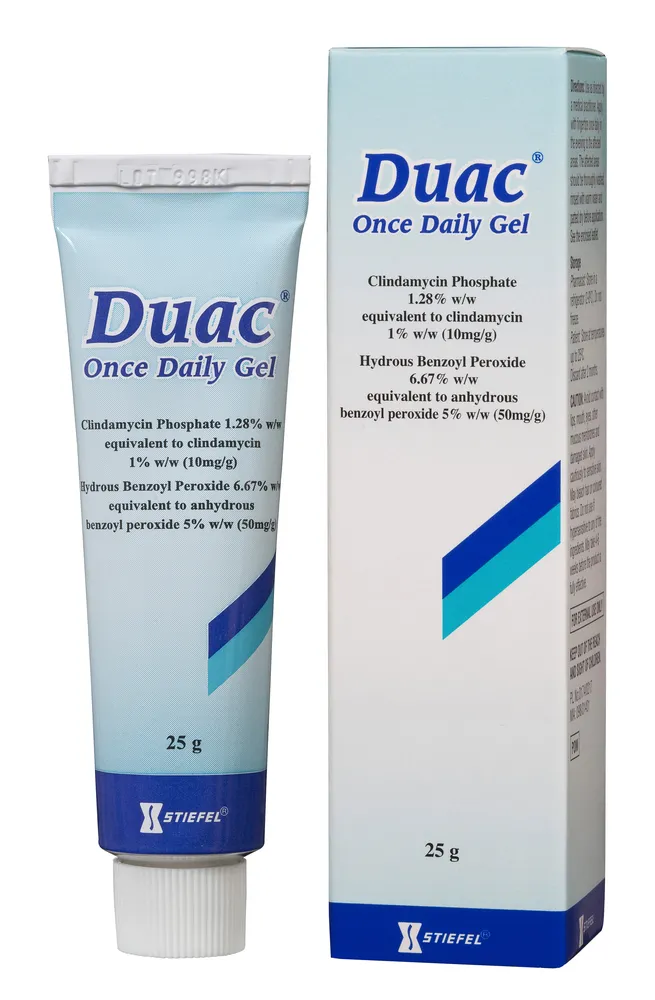
DUAC
PolandIt is used in the treatment of mild to moderate acne vulgaris. It helps to fight the bacteria responsible for acne, treats comedones (open and closed) as well as pustules and papules.
Frequently asked questions
How to use Duac?
The gel should be applied once daily, in the evening, to the entire affected area of the skin. Before use, the skin should be thoroughly washed and dried, and hands should be washed after application. Effects may be visible after 2 to 5 weeks of use.
When not to use this medicine?
Do not use if you are allergic to clindamycin, benzoyl peroxide, or other ingredients of the medicine. The gel must not be applied to irritated, damaged, or sunburnt skin (e.g., with cuts or burns). This medicine should not be used in children under 12 years of age.
What may side effects occur?
Very commonly, burning, itching, peeling, or redness of the skin may occur. More commonly, headaches and sun sensitivity may occur. Contact a doctor immediately if severe diarrhea, abdominal pain, or symptoms of an allergic reaction (e.g., facial swelling or difficulty breathing) occur.
Does Duac interact with other medicines?
Yes. You should inform your doctor if you are using other acne treatments (e.g., containing tretinoin, isotretinoin, or tazarotene), topical antibiotics, or cosmetics with strong drying or exfoliating effects. It must not be used simultaneously with medicines containing erythromycin.
What should you remember during use?
The medicine may discolor hair and colored materials (clothing, bedding). The skin may become more sensitive to the sun, so you should avoid sunbeds and use UV filter creams. After opening the tube, the medicine should be discarded after 2 months and should not be stored at temperatures above 25°C.
Instructions for use
Package leaflet: Information for the patient
Warning! Keep the leaflet. Information on the immediate packaging is in a foreign language.
Duac, 10 mg/g + 30 mg/g, gel
Clindamycinum + Benzoylis peroxidum
Please read the leaflet carefully before using the medicine, as it contains important information for the patient.
- Keep this leaflet for future reference.
- Consult your doctor or pharmacist if you have any further questions.
- This medicine has been prescribed for a specific individual. Do not give it to others. The medicine may harm another person, even if their symptoms are the same.
- If any of the side effects worsens or if you experience any side effects not listed in this leaflet, inform your doctor, pharmacist, or nurse. See section 4.
Table of contents:
- What Duac is and what it is used for
- What you need to know before using Duac
- How to use Duac
- Possible side effects
- How to store Duac
- Contents of the pack and other information
1. What Duac is and what it is used for
Duac contains two active substances: clindamycin and benzoyl peroxide. Duac belongs to a group of medicines used to treat acne.
Duac is used to treat mild to moderate acne vulgaris.
- Clindamycin is an antibiotic that inhibits the growth of bacteria responsible for acne.
- Benzoyl peroxide reduces comedones (both closed and open) and has antibacterial activity against bacteria involved in acne.
The combination of clindamycin and benzoyl peroxide in Duac:
- fights the bacteria responsible for acne,
- treats open and closed comedones, pimples, and nodules,
- reduces the number of red, inflamed pimples and nodules associated with acne.
Duac is intended for use in adults and adolescents over 12 years of age.
2. Important information before using Duac
When not to use Duac:
- If the patient is allergic to clindamycin, lincomycin, benzoyl peroxide, or any of the other ingredients of this medicine (listed in section 6 of this leaflet),
Do not use Duac if this applies to you. If you have any doubts, consult your doctor or pharmacist.
Warnings and precautions
Before starting to use Duac, speak to your doctor or pharmacist.
- Duac is for topical use only. Avoid contact of the medicine with the eyes, lips, mouth, or inside the nose.
Do not apply Duac to irritated skin, for example, if there are cuts, abrasions, sunburn, or damaged skin.
► If Duac accidentally gets into the eyes, mouth, or inside the nose, rinse the area thoroughly with water.
- Do not apply excessive amounts of Duac to sensitive areas of the skin.
- In most treated individuals, redness and peeling of the skin may occur during the first few weeks of treatment. If the skin becomes irritated, it may be necessary to use an oil-free moisturizer, reduce the frequency of application of Duac, or discontinue use until the skin condition improves.
- If skin irritation is severe (intense redness, dryness, itching, stinging, or burning), stop using Duac and contact your doctor.
- Take care to avoid contact of the medicine with coloured fabrics, including clothing, towels, bed linen, furniture, carpets, or rugs. Duac may cause discoloration of these materials.
- Duac may bleach hair.
- Duac may make the skin more sensitive to the harmful effects of sunlight. Avoid using sunbeds and minimize exposure to sunlight. While using Duac, use sunscreen products with UV filters and wear protective clothing.
Contact your doctor or pharmacist before using Duac if:
- The patient has or has had any of the following gastrointestinal disorders: intestinal inflammation, ulcerative colitis, or antibiotic-associated colitis.
- If abdominal pain or diarrhoea occurs, which does not resolve or worsens, then stop using Duac and contact your doctor immediately. Antibiotics may cause conditions characterized by severe diarrhoea and abdominal pain, although such events are unlikely when antibiotics are applied to the skin.
- The patient has recently used medicines containing clindamycin or erythromycin, as there may be an increased risk that Duac will not work as effectively.
► Consult your doctor or pharmacist if the patient has recently used any other medicine containing clindamycin or erythromycin.
Children
Duac must not be used in children under 12 years of age. It is not known whether it is safe or effective in this age group.
Other medicines and Duac
Inform your doctor or pharmacist about all medicines the patient is currently taking or has recently taken, as well as any medicines the patient plans to take.
Tell your doctor or pharmacist if you are using any of the following medicines:
- Other anti-acne medicines, including topical antibiotics,
- Medicated or exfoliating soaps and cleansing agents,
- Soaps and cosmetics with strong drying effects,
- Medicines containing high amounts of alcohol or astringents. Concurrent use of these products with Duac may lead to skin irritation.
Duac may cause some concomitantly used medicines to be less effective.
These include:
- Certain topical anti-acne medicines containing tretinoin, isotretinoin, or tazarotene.
► Inform your doctor or pharmacist if you are using any of these medicines.
It may be necessary to use them at different times of the day (e.g. one in the morning and the other in the evening). Using other anti-acne medicines simultaneously with Duac may increase the risk of skin irritation.
- Duac should not be used at the same time as other medicines containing erythromycin.
- Using Duac together with medicines such as dapsone or sulfacetamide may temporarily change the skin or facial hair colour (yellow and/or orange). This effect is not permanent.
- One of the ingredients of Duac may affect the action of medicines used in general anaesthesia (called "muscle relaxants").
► Inform your doctor or pharmacist if you are scheduled for surgery.
If you have any doubts whether any of the above situations apply to you while using Duac, contact your doctor or pharmacist.
Pregnancy, breastfeeding, and fertility
Information on the safety of using Duac during pregnancy is limited.
If you are pregnant, breastfeeding, think you may be pregnant, or are planning to have a baby, consult your doctor or pharmacist before using this medicine.
Your doctor will decide whether the benefits to you from using Duac during pregnancy outweigh the potential risks to the unborn child.
It is not known whether the ingredients of Duac pass into breast milk.
One of the components of Duac is clindamycin. When clindamycin is administered orally or by injection, it may pass into breast milk.
If you are breastfeeding, you must contact your doctor before using Duac.
Do not apply Duac to the skin of the breasts during breastfeeding.
3. How to use Duac
This medicine should always be used as directed by a doctor or pharmacist. If in doubt,
consult a doctor or pharmacist.
- Duac should be applied to affected skin once daily, in the evening.
- The effect of Duac may not become noticeable until after 2 to 5 weeks of treatment.
- Do not use the medicine for longer than 12 consecutive weeks. Your doctor will determine how long treatment should continue.
How to apply Duac:
- Completely remove any makeup from the skin area to be treated.
- Wash the affected skin thoroughly, rinse with warm water, and gently pat dry with a towel.
- Apply a small amount of gel using fingertips to the entire affected area.
- The gel should be applied to the whole surface of the affected skin, not only to individual acne lesions. If the gel does not absorb easily, this indicates that too much gel has been applied.
- To cover the face, use an amount of gel that fits between the fingertip and the first joint of the finger (first finger bend)—this amount corresponds to a "fingertip unit".
- To cover both the face and back, use a maximum of two and a half "fingertip units". 5. If the skin becomes excessively dry or starts to peel, a non-greasy moisturizer may be used, Duac may be applied less frequently, or treatment may be paused temporarily to allow the skin to adapt. This medicine may not work properly if not used daily. 6. After applying the gel, wash your hands. 7. Once the gel has dried, non-greasy makeup may be applied.
This medicine should always be used as described in the patient information leaflet or as directed by a doctor
or pharmacist. If in doubt, consult a doctor or pharmacist.
Use of more than the recommended dose of Duac
- Do not apply excessive amounts of gel. Applying more gel than recommended or using it more often than directed will not speed up healing of acne lesions and may cause skin irritation. If too much gel has been used, reduce the frequency of application or discontinue use for several days, then resume treatment.
If Duac is accidentally swallowed:
- If the gel is swallowed, contact a doctor immediately. Adverse effects may occur similar to those seen with oral antibiotics (e.g. stomach irritation).
Missed dose of Duac:
- Do not apply a double dose to make up for a missed dose.
- Apply the next recommended dose according to the usual dosing schedule.
Do not stop using Duac unless instructed by a doctor.
Do not use the gel for longer than 12 consecutive weeks without medical advice.
Duac should be used for as long as prescribed by the doctor. Do not stop treatment unless the doctor
decides otherwise.
It is important to use the gel exactly as directed by the doctor. If treatment is stopped too early,
acne may return.
If you have any further questions about the use of this medicine, consult your doctor or pharmacist.
4. Possible adverse reactions
Like all medicines, this medicine can cause adverse reactions, although not everyone experiences them.
If any of the serious adverse reactions listed below occur, stop using the medicine and contact a doctor urgently – immediate medical assistance may be required:
- symptoms of allergic reactions (such as swelling of the face, eyes, lips or tongue, hives or difficulty breathing, fainting),
- severe or persistent diarrhoea or abdominal cramps,
- severe burning, peeling or itching.
Other possible adverse reactions
If any of the following symptoms are noticed, reduce the frequency of application of Duac or discontinue use for 1 or 2 days, then resume treatment.
Very common (may occur in more than 1 in 10 patients):
- skin burning sensation, skin peeling, skin itching, skin dryness,
- at the site of application: skin redness, particularly during the first weeks of treatment. These adverse reactions are usually mild.
Common (may occur in less than 1 in 10 patients):
- headache,
- at the site of application: increased sensitivity to sunlight, skin pain, redness, skin itching, rash (dermatitis).
Uncommon (may occur in less than 1 in 100 patients):
- tingling sensation (paresthesia), worsening of acne.
Other adverse reactions
Other adverse reactions reported in a very small number of treated individuals; frequency unknown:
- allergic reactions,
- intestinal inflammation, diarrhoea, including bloody diarrhoea, abdominal pain,
- at the site of application: skin reactions, skin depigmentation, raised itchy rash (urticaria).
Reporting of adverse reactions
If any adverse reactions occur, including any adverse reactions not listed in this leaflet, inform a doctor, pharmacist or nurse. Adverse reactions can be reported directly to the Department of Monitoring of Adverse Drug Reactions at the Office for Registration of Medicinal Products, Medical Devices and Biocidal Products
Al. Jerozolimskie 181C
02-222 Warsaw
Phone: +48 (22) 49 21 301
Fax: +48 (22) 49 21 309
Website: https://smz.ezdrowie.gov.pl
Reporting adverse reactions helps to provide more information on the safety of the medicine.
5. How to store Duac
Keep this medicine out of the sight and reach of children.
Pharmacist: Store in a refrigerator (2°C–8°C). Do not freeze.
Patient: After receiving from the pharmacist, do not store above 25°C and discard
2 months after first opening the tube.
Do not use this medicine after the expiry date stated on the packaging. The expiry date refers to the last day of the stated month.
Medicines must not be disposed of via wastewater or household waste. Ask your pharmacist how to dispose of medicines no longer in use. This will help protect the environment.
6. Contents of the pack and other information
What Duac contains
The active substances in this medicine are:
- clindamycin, in the form of clindamycin phosphate,
- benzoyl peroxide (anhydrous benzoyl peroxide), in the form of benzoyl peroxide with water.
Each 1 g of gel contains 10 mg clindamycin and 30 mg benzoyl peroxide.
Other ingredients are:
glycerol, carbomer 940, dimethicone, hydrated colloidal silica, poloxamer 182, sodium
hydroxide, disodium edetate, disodium lauryl sulfosuccinate, purified water.
What Duac looks like and contents of the pack
Duac is a white to off-white gel, available in tubes containing 30 g of gel.
For more detailed information, please contact the responsible party or the parallel importer.
Responsible party in Romania, the country of export:
GlaxoSmithKline Trading Services Limited
12 Riverwalk, Citywest Business Campus
Dublin 24
Ireland
Manufacturer:
GlaxoSmithKline Trading Services Limited
12 Riverwalk, Citywest Business Campus
Dublin 24
Ireland
Parallel importer:
Delfarma Sp. z o.o.
ul. Św. Teresy od Dzieciątka Jezus 111
91-222 Łódź
Poland
Repackaged in:
Delfarma Sp. z o.o.
ul. Św. Teresy od Dzieciątka Jezus 111
91-222 Łódź
Poland
Marketing authorisation number in Romania, the country of export: 10957/2018/01
Parallel import licence number: 245/23
This medicinal product is authorised for sale in the European Economic Area countries under the following names:
Cyprus Indoxyl 10 mg/g + 30 mg/g Gel
Greece Indoxyl 10 mg/g + 30 mg/g Gel
Germany Duac 10 mg/g + 30 mg/g Gel
Italy Duac 10 mg/g + 30 mg/g Gel
Romania Duac 10 mg/g + 30 mg/g Gel
Spain Duac 10 mg/g + 30 mg/g Gel
Lithuania Duac 10 mg/30 mg/g Gelis
Poland Duac 10 mg/g + 30 mg/g gel
Malta Duac Once Daily 10 mg/g + 30 mg/g Gel
United Kingdom (Northern Ireland) Duac Once Daily 10 mg/g + 30 mg/g Gel
Similar drugs
| Brand name | Dosage form | Active substance / Dosage | Manufacturer |
|---|---|---|---|
| ACNATAC | gel |
|
Viatris Healthcare Limited |
| ACNATAC | gel |
|
Viatris Healthcare Limited |
| ACNATAC | gel |
|
Viatris Healthcare, Lda. |
| ACNATAC | gel |
|
Viatris Healthcare Limited |
| BENZACNE DUO | gel |
|
Jadran-Galenski laboratorij d.d. Orifarm Generics A/S |
| DUAC | gel |
|
GlaxoSmithKline Monoprosopi A.E.B.E. |
| DUAC | gel |
|
GlaxoSmithKline Monoprosopi A.E.B.E. |
| DUOCUTAN | gel |
|
mibe GmbH Pharmaceuticals Sun-Farm Sp. z o.o. |
| DUOCUTAN | gel |
|
mibe GmbH Pharmaceuticals Sun-Farm Sp. z o.o. |
The original data is available in the language of the country of manufacture.
Data source: Register of Medicinal Products of Poland (URPL)
Data last verified: September 01, 2026