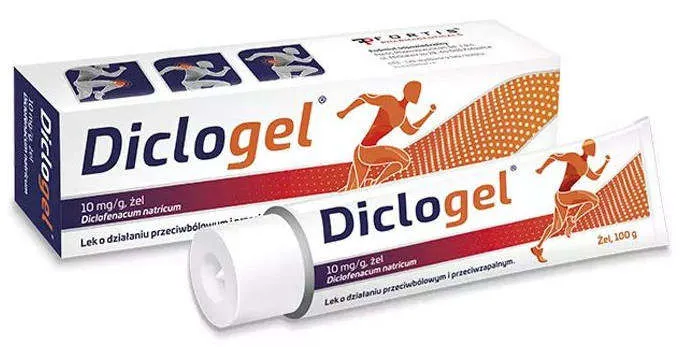
DICLOGEL
PolandThe medicine is used to relieve mild to moderate muscle pain, injuries, and post-traumatic pain.
Frequently asked questions
How to use Diclogel?
Adults and adolescents over 14 years of age should rub a thin layer of gel (approximately 2 to 4 grams, i.e., an amount from the size of a cherry to a walnut) onto the affected areas 3 to 4 times daily. The medicine should not be used for longer than 7 days without consulting a doctor.
When should you not use this medicine?
Do not use the preparation if you are allergic to diclofenac or other ingredients, hypersensitive to acetylsalicylic acid or other anti-inflammatory drugs (manifesting, for example, as asthma or urticaria), have renal impairment, or if the patient is in the third trimester of pregnancy. The medicine must not be used in children under 14 years of age.
What are the possible side effects of Diclogel?
Rash, itching, redness, or inflammation of the skin at the application site may occur frequently. Very rarely, allergic reactions such as shortness of breath, swelling of the face or throat, and skin reactions with blistering may occur. Long-term use over large areas may also cause nausea, vomiting, diarrhea, or abdominal pain.
Can the medicine be combined with other medicines?
Caution should be exercised, as diclofenac may reduce the effectiveness of diuretic and antihypertensive drugs. In elderly people or those with kidney problems, the simultaneous use of the medicine with certain blood pressure medications (ACE inhibitors or angiotensin II antagonists) may worsen kidney function.
Can the medicine be used during pregnancy or breastfeeding?
The medicine must not be used during the last three months of pregnancy. During the first six months of pregnancy, it should only be used if a doctor deems it necessary. During breastfeeding, the medicine may only be used upon a doctor's recommendation, avoiding application to the breasts or large areas of skin.
Instructions for use
Package leaflet: Information for the patient
Diclogel, 10 mg/g, gel
Diclofenacum natricum
Please read carefully the entire leaflet before using the medicine, as it contains
important information for the patient.
This medicine should always be used exactly as described in this patient leaflet or as directed by
a doctor or pharmacist.
- Keep this leaflet, as you may need to read it again.
- If you need advice or further information, consult your pharmacist.
- If you experience any adverse reactions, including any possible adverse reactions not listed in this leaflet, inform your doctor or pharmacist. See section 4.
- If there is no improvement after 7 days, or if you feel worse, consult your doctor.
Table of contents
- What Diclogel is and what it is used for
- Important information before using Diclogel
- How to use Diclogel
- Possible side effects
- How to store Diclogel
- Contents of the pack and other information
1. What Diclogel is and what it is used for
Diclogel is a gel containing 10 mg of diclofenac sodium per gram of gel.
Diclofenac is a derivative of phenylacetic acid and belongs to a group of medicines known as non-steroidal anti-inflammatory drugs (NSAIDs). Its action consists of inhibiting cyclooxygenase activity, thereby suppressing the synthesis of prostaglandins and other mediators of inflammation. Diclofenac exerts anti-inflammatory and analgesic effects in the treatment of:
- mild to moderate muscle pain
- injuries
- post-traumatic pain.
Diclogel is intended for use in adults and adolescents above the age of 14 years.
2. Important information before using Diclogel
When not to use Diclogel
- if you are allergic to diclofenac or any of the other ingredients of this medicine (listed in section 6);
- if you have hypersensitivity to acetylsalicylic acid or other non-steroidal anti-inflammatory drugs (NSAIDs), manifested as asthma, urticaria or other allergic reactions, or if angioedema is induced by acetylsalicylic acid or other NSAIDs;
- in individuals under 14 years of age;
- during the last three months of pregnancy (see also "Pregnancy and breastfeeding");
- if you have impaired kidney function.
Warnings and precautions
Before starting treatment with Diclogel, consult your doctor or pharmacist.
The occurrence of systemic side effects after topical application of diclofenac is lower compared to the frequency of adverse reactions observed with oral administration of diclofenac.
However, absorption of Diclogel through the skin is possible; therefore, systemic adverse reactions cannot be excluded. The risk of such reactions depends, among other factors, on the extent of skin surface exposed, the amount applied, and the duration of exposure.
Safety of topical NSAIDs: Severe skin reactions, some of which have been fatal, including exfoliative dermatitis, Stevens-Johnson syndrome, and toxic epidermal necrolysis, have very rarely been reported with NSAID use. The risk of adverse reactions is higher at the beginning of treatment, and symptoms usually appear within the first month of treatment. Treatment with Diclogel should be discontinued immediately upon the first signs of rash, mucosal lesions, or other symptoms of hypersensitivity.
Diclogel should be used with caution in patients with asthma or a history of peptic ulcer.
Diclogel should be applied only to intact skin surfaces. Avoid contact of Diclogel gel with the eyes and mucous membranes (e.g. inside the mouth). Do not swallow the gel.
Exposure of skin treated with Diclogel to sunlight is not recommended.
Children and adolescents
As data on efficacy and safety in children and adolescents under 14 years of age are insufficient, Diclogel must not be used in this age group.
Diclogel with other medicines
Inform your doctor or pharmacist about any medicines you are currently taking or have recently taken, as well as any medicines you plan to take.
Non-steroidal anti-inflammatory drugs (NSAIDs), such as diclofenac, may reduce the effectiveness of diuretics and other antihypertensive drugs. In some patients with impaired kidney function (e.g. dehydrated patients or elderly patients with kidney impairment), concomitant use of an ACE inhibitor or angiotensin II antagonist (medicines used to treat hypertension or heart failure) and a cyclooxygenase inhibitor (e.g. diclofenac) may lead to worsening of renal function, including the possibility of acute renal failure, which is usually reversible. Such interactions should be considered in patients receiving diclofenac, particularly when applied over large skin areas for prolonged periods, in combination with an ACE inhibitor or angiotensin II antagonist. Therefore, this combination of medicines should be used with particular caution in elderly patients. Patients should be adequately hydrated, and the need for monitoring of renal function should be considered at the start of concomitant treatment and periodically thereafter. Since systemic absorption of diclofenac from the site of application is very low, such interactions are highly unlikely.
Diclogel with food and drink
Interactions of Diclogel with food and/or drink are not known.
Pregnancy and breastfeeding
If you are pregnant or breastfeeding, think you may be pregnant, or are planning to have a baby, consult your doctor or pharmacist before using this medicine.
Pregnancy
Do not use Diclogel during the last three months of pregnancy. During the first six months of pregnancy, Diclogel should not be used unless necessary and recommended by a doctor. If use is necessary, the lowest effective dose for the shortest possible duration should be administered.
Oral formulations of diclofenac (e.g. tablets) may cause adverse effects in the unborn child. It is not known whether the same risk applies to Diclogel when applied topically.
Breastfeeding
Diclogel passes into breast milk in small amounts. Diclogel should be used during breastfeeding only on medical advice. In such cases, Diclogel should not be applied to the breasts of breastfeeding women, nor to large skin areas or for prolonged periods.
If further information on the use of this medicine in pregnant or breastfeeding women is needed, consult your doctor or pharmacist.
Driving and operating machinery
Use of this medicine does not affect the ability to drive or operate machinery.
Diclogel contains propyl parahydroxybenzoate (E 216), methyl parahydroxybenzoate (E 218).
These may cause allergic reactions (including delayed-type reactions).
Diclogel contains 80 mg of propylene glycol in each gram.
Propylene glycol may cause skin irritation.
3. How to use Diclogel
This medicine should always be used exactly as described in this patient information leaflet or as directed by a doctor or pharmacist. If in doubt, consult your doctor or pharmacist.
Adults and adolescents over 14 years of age
Apply a thin layer of Diclogel gel to the affected area 3 to 4 times daily, as needed (approximately 2 to 4 grams, corresponding to the size of a cherry up to a walnut), and gently rub in.
The duration of treatment depends on the indication and the patient's response to therapy. Treatment should be reviewed after 7 days.
If pain and swelling do not improve within 7 days, or if symptoms worsen, consult a doctor.
Do not use Diclogel for longer than 7 days without consulting a doctor.
Diclogel may be used as an additional treatment during oral administration of non-steroidal anti-inflammatory drugs.
Children and adolescents under 14 years of age
Diclogel should not be used in children under 14 years of age, as there is no data on safety and efficacy in this patient group (see section 2. When not to use Diclogel).
Liver and kidney function disorders
Dose adjustment is not required in patients with impaired liver function.
Diclogel is contraindicated in patients with impaired kidney function.
Use in elderly patients
The dosage recommended for adults should be used.
Method of administration
For topical application only.
After application, wash hands unless the hands themselves are being treated.
Apply only to intact, healthy skin.
In case of accidental contact with Diclogel
If the medicine comes into contact with the eyes, mucous membranes (e.g. inside the mouth), or damaged skin, rinse the affected area thoroughly with running water. If irritation persists, consult a doctor or pharmacist.
In case of accidental ingestion of Diclogel
If Diclogel is accidentally swallowed, seek immediate medical advice or go to a hospital. Remember to bring the medicine packaging with you.
Use of more than the recommended dose of Diclogel
Diclofenac is very poorly absorbed into the systemic circulation; therefore, overdose is unlikely. If excessive amounts of Diclogel have been applied, remove the excess gel.
Missed dose of Diclogel
If a dose is missed, apply the medicine as soon as remembered, then continue treatment according to the recommended schedule. Do not use a double dose to make up for a missed dose.
Stopping Diclogel treatment
Diclogel therapy may be discontinued at any time without consulting a specialist. However, there is a possibility of recurrence of pain or swelling at the treated site.
If you have any further doubts about the use of this medicine, consult your doctor or pharmacist.
4. Possible adverse effects
Like all medicines, this medicine can cause adverse effects, although not everyone will experience them.
You must stop using Diclogel immediately and contact your doctor immediately
if any of the following adverse effects occur (occur in fewer than 1 in 10,000
people):
- Hypersensitivity, which is a type of allergic reaction characterized by skin rash with or without blisters (skin lesions with redness), urticaria, difficulty breathing, and trouble swallowing;
- Wheezing, shortness of breath, or feeling of tightness in the chest (asthma);
- Swelling, particularly of the face, lips, and throat (angioedema).
The risk of these reactions is higher at the beginning of treatment.
Common (occur in fewer than 1 in 10 people)
- Skin rash
- Skin disorders (rash)
- Redness of the skin (erythema)
- Inflammation of the skin at the application site, presenting as rash, swelling, or nodules (dermatitis, contact dermatitis)
- Itching of the skin (pruritus)
Uncommon (occur in fewer than 1 in 1,000 people)
- Extensive skin lesions with redness, scaling, and large blisters (bullous dermatitis)
Rare (occur in fewer than 1 in 10,000 people)
- Skin rash with pus-filled blisters (pustular rash)
- Increased sensitivity of the skin to sunlight (photosensitivity reaction)
Frequency not known
- Burning sensation at the site of application
- Dry skin
Prolonged use of Diclogel over large areas of the body may lead to adverse effects in other parts of the body beyond the skin, such as:
- Nausea
- Vomiting
- Diarrhea
- Abdominal pain
Reporting of adverse effects
If any adverse effects occur, including any adverse effects not listed in this leaflet, inform your doctor, pharmacist, or nurse. Adverse effects can be reported directly to the Department of Monitoring Adverse Drug Reactions at the Office for Registration of Medicinal Products, Medical Devices and Biocidal Products: Al. Jerozolimskie 181C, 02-222 Warsaw, tel.: +48 22 49 21 301, fax: +48 22 49 21 309, website: https://smz.ezdrowie.gov.pl
Adverse effects can also be reported to the marketing authorization holder.
Reporting adverse effects helps to provide more information on the safety of this medicine.
5. How to store Diclogel
Keep this medicine out of sight and reach of children.
Do not use this medicine after the expiry date stated on the carton box and tube. The expiry date refers to the last day of the specified month.
Store below 25°C.
Do not store in the refrigerator or freeze.
Do not use this medicine if signs of deterioration are visible.
Period of use after first opening of the tube:
6 months for the 100 g pack size,
2 months for the 60 g pack size.
Medicines must not be disposed of via wastewater or household waste. Ask your pharmacist how to dispose of medicines no longer in use. This will help protect the environment.
6. Contents of the packaging and other information
What Diclogel contains
The active substance is sodium diclofenac. 1 g of gel contains 10 mg of sodium diclofenac.
The other ingredients are: propylene glycol, sodium hydroxide (for pH adjustment), medium-chain triglycerides, carbomer 980, hydroxyethylcellulose, propyl parahydroxybenzoate (E 216), methyl parahydroxybenzoate (E 218), and purified water.
What Diclogel looks like and contents of the pack
Diclogel is a white, smooth, homogeneous gel with a slight characteristic odour.
Diclogel is packed in an aluminium tube with an inner sealing membrane coated with epoxy-phenolic lacquer, fitted with a HDPE cap with a plug, and placed in a cardboard box. The tube contains 60 g or 100 g of gel.
Marketing Authorisation Holder
Fortis Pharmaceuticals Sp. z o.o.
ul. Mickiewicza 29
40-085 Katowice
e-mail: [email protected]
Manufacturer
Laboratórios Basi – Indústria Farmacêutica, S.A.
Parque Industrial Manuel Lourenço Ferreira, Lotes 8, 15 e 16
3450-232 Mortágua
Portugal
Similar drugs
The original data is available in the language of the country of manufacture.
Data source: Register of Medicinal Products of Poland (URPL)
Data last verified: September 01, 2026