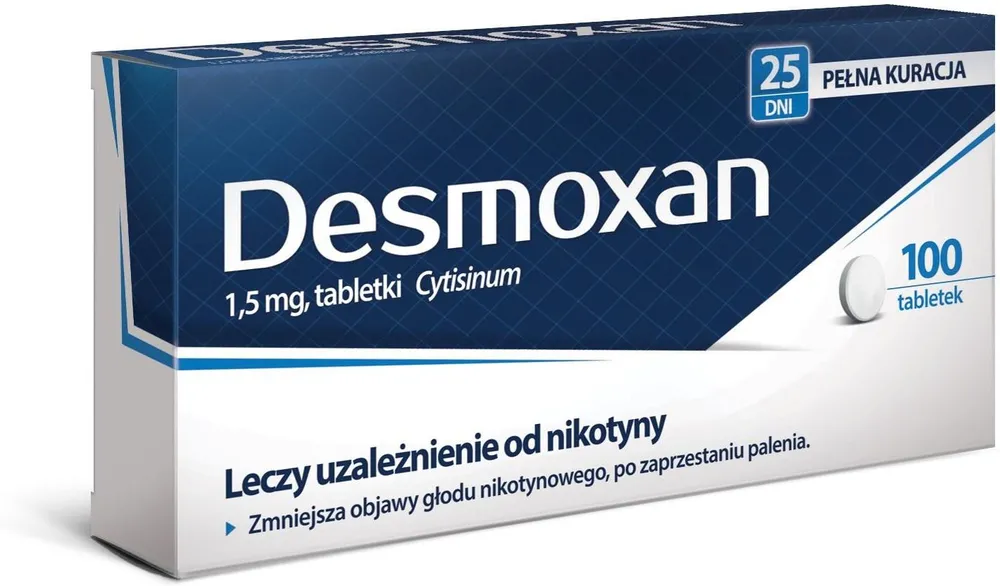
DESMOXAN
PolandThe medicine helps to reduce tobacco cravings and decreases nicotine hunger in people who want to stop smoking. Its aim is the permanent cessation of nicotine-containing products.
Frequently asked questions
How should Desmoxan be taken?
The medicine is taken orally with an adequate amount of water. The dosage changes depending on the day of therapy: from day 1 to 3, take 1 tablet every 2 hours; from day 4 to 12, 1 tablet every 2.5 hours; from day 13 to 16, 1 tablet every 3 hours; from day 17 to 20, 1 tablet every 5 hours; and from day 21 to 25, 1-2 tablets per day.
When should you not use this medicine?
It must not be used if you are allergic to any of the ingredients of the medicine, have unstable angina, a recent myocardial infarction, significant cardiac arrhythmia, or a recent stroke. The medicine must not be used during pregnancy or while breastfeeding.
Can Desmoxan be taken with other medicines?
It must not be combined with anti-tuberculosis medicines. You should inform your doctor about all medicines you are currently taking, as it may be necessary to adjust the doses of certain preparations (e.g., those used for asthma, Alzheimer's disease, schizophrenia, or Parkinson's disease). Women using hormonal contraception should additionally use a barrier method, such as a condom.
What are the possible side effects?
The most common side effects may include: change in appetite (increase), weight gain, dizziness, irritability, mood changes, anxiety, hypertension, dry mouth, diarrhea, rash, fatigue, sleep problems, headache, rapid heartbeat, nausea, taste changes, heartburn, constipation, vomiting, as well as abdominal and muscle pain.
What should you do in case of overdose?
Symptoms of overdose resemble nicotine poisoning and may include: malaise, nausea, vomiting, rapid heartbeat, fluctuations in blood pressure, breathing disturbances, vision disturbances, or seizures. In such a case, you should stop taking the medicine and contact a doctor or pharmacist.
Instructions for use
Patient Information Leaflet
Desmoxan, 1.5 mg, tablets
(Cytisiniclinum)
Please read all of this leaflet carefully before taking this medicine, because it contains important information for you.
This medicine should always be used exactly as described in this patient leaflet or as directed by your doctor or pharmacist.
- Keep this leaflet so that you can read it again if necessary.
- If you need advice or further information, please consult your pharmacist.
- If you experience any adverse reactions, including any possible side effects not listed in this leaflet, inform your doctor or pharmacist. See section 4.
- If your symptoms do not improve or if you feel worse, contact your doctor.
Table of contents
- What Desmoxan is and what it is used for
- Important information before taking Desmoxan
- How to take Desmoxan
- Possible side effects
- How to store Desmoxan
- Contents of the pack and other information
1. What Desmoxan is and what it is used for
Desmoxan is indicated for smoking cessation and reduction of nicotine craving in individuals who wish to stop smoking. The aim of using Desmoxan is the permanent discontinuation of nicotine-containing products.
Treatment with Desmoxan helps gradually reduce the body's dependence on nicotine by alleviating withdrawal symptoms.
2. Important information before using Desmoxan
When not to use Desmoxan:
- if the patient is allergic to the active substance (cytisine, previously used name: cytisine) or to any of the other ingredients of this medicine (listed in section 6),
- in case of unstable angina pectoris,
- in case of recent myocardial infarction,
- in case of clinically significant cardiac arrhythmias,
- in case of recent stroke,
- during pregnancy and breastfeeding.
Warnings and precautions
Desmoxan should be used with caution in patients with ischemic heart disease, heart failure,
arterial hypertension, pheochromocytoma, atherosclerosis and other peripheral vascular
diseases, peptic ulcer disease of the stomach and duodenum, gastroesophageal reflux disease,
hyperthyroidism, diabetes, schizophrenia, renal and hepatic impairment.
Desmoxan should only be taken by individuals with a serious intention to stop smoking.
Taking the medicine while continuing to smoke may intensify adverse effects of
nicotine.
Children and adolescents
Due to limited experience, use of Desmoxan is not recommended in children and adolescents under
18 years of age.
Elderly patients
Due to limited clinical experience, use of Desmoxan is not recommended in elderly patients (over 65 years of age).
Use in patients with hepatic or renal impairment
There is no clinical experience with Desmoxan in patients with hepatic or renal impairment; therefore, its use is not recommended in this patient group.
Desmoxan and other medicines
Inform your doctor or pharmacist about all medicines currently taken or recently used, as well as any medicines you plan to take. Do not take Desmoxan together with antituberculosis medicines.
In some cases, cessation of smoking, with or without the use of Desmoxan, may require dose adjustments of other medicines. This is particularly important for medicines containing theophylline (used in asthma), tacrine (used in Alzheimer's disease), clozapine (used in schizophrenia), and ropinirole (used in Parkinson's disease). If in doubt, consult your doctor or pharmacist.
It is currently unknown whether Desmoxan may reduce the effectiveness of systemic hormonal contraceptives. Women using systemic hormonal contraceptives should use an additional barrier method (e.g. condom).
Pregnancy and breastfeeding
If the patient is pregnant or breastfeeding, suspects she may be pregnant, or is planning to have a
child, she should consult a doctor or pharmacist before using this medicine.
Women of childbearing potential must use an effective method of contraception during treatment with
Desmoxan. Seek advice from a doctor.
Desmoxan is contraindicated during pregnancy and breastfeeding.
Driving and operating machinery
Desmoxan has no influence on the ability to drive or operate machinery.
Effect of smoking cessation
Changes in the body associated with smoking cessation, whether using Desmoxan or not,
may alter the way other medicines work. Therefore, in some cases, dose adjustments of other medicines may be necessary. More detailed information can be found above in the section
"Desmoxan and other medicines".
In some individuals, smoking cessation, whether with or without medication, has been associated with an increased risk of changes in thinking or behavior, feelings of depression and anxiety (including, rarely, suicidal thoughts and suicide attempts), and may be associated with worsening of pre-existing psychiatric disorders. If the patient has current or past psychiatric disorders, this should be discussed with the doctor.
3. How to use Desmoxan
This medicine should always be taken exactly as described in the patient leaflet or as directed by a doctor or pharmacist. If in doubt, consult a doctor or pharmacist.
One pack of Desmoxan (100 tablets) is sufficient for a full course of treatment. The duration of treatment is 25 days. Desmoxan should be taken orally with an adequate amount of water according to the following schedule:
Days of therapy Recommended dosage Maximum daily dose
Days 1 to 3 1 tablet every 2 hours 6 tablets
Days 4 to 12 1 tablet every 2.5 hours 5 tablets
Days 13 to 16 1 tablet every 3 hours 4 tablets
Days 17 to 20 1 tablet every 5 hours 3 tablets
Days 21 to 25 1-2 tablets per day up to 2 tablets
Smoking must be stopped no later than the 5th day after starting therapy. Smoking should not be continued during treatment, as it may worsen adverse effects. If the treatment outcome is unsatisfactory, treatment should be discontinued and may be restarted after 2 to 3 months.
Taking more Desmoxan than recommended
Symptoms occurring after an overdose of Desmoxan are characteristic of nicotine poisoning. Symptoms of overdose include: malaise, nausea, vomiting, increased heart rate, blood pressure fluctuations, breathing difficulties, vision disturbances, and seizures.
If even one of the described symptoms occurs, or any symptom not listed in the leaflet appears, stop taking Desmoxan and contact a doctor or pharmacist immediately.
Missed dose of Desmoxan
Do not take a double dose to make up for a missed dose.
Stopping Desmoxan treatment
If you have any further doubts regarding the use of this medicine, consult your doctor or pharmacist.
4. Possible adverse effects
Like all medicines, this medicine can cause adverse effects, although not everyone will experience them.
The following adverse effects may occur with the frequency stated below:
Very common – occurring in more than 1 in 10 people: change in appetite (mainly increased), weight gain, dizziness, irritability, mood changes, anxiety, increased blood pressure (hypertension), dry mouth, diarrhoea, rash, increased fatigue, sleep disturbances (insomnia, drowsiness, somnolence, strange dreams, nightmares), headache, rapid heartbeat, nausea, taste disturbances, heartburn, constipation, vomiting, abdominal pain (especially in the epigastric region), muscle pain.
Common – occurring in 1 to 10 people in 100: difficulty concentrating, slowing of the heartbeat, bloating, burning sensation of the tongue, malaise.
Uncommon – occurring in 1 to 10 people in 1000: feeling of heaviness in the head, decreased libido, watery eyes, shortness of breath, increased expectoration, excessive salivation, increased sweating, reduced skin elasticity, fatigue, increased liver enzyme activity.
Most of the adverse effects listed above occur mainly during the initial period of treatment and subside as treatment continues. They may also result from stopping smoking (withdrawal symptoms), rather than from taking Desmoxan.
Reporting of adverse effects
If any adverse effects occur, including any adverse effects not listed in this leaflet, inform your doctor or pharmacist. Adverse effects can be reported directly to the Department of Monitoring of Adverse Drug Reactions, Office for Registration of Medicinal Products, Medical Devices and Biocidal Products
Al. Jerozolimskie 181C
02-222 Warsaw
Tel.: + 48 22 49 21 301
Fax: + 48 22 49 21 309
Website: https://smz.ezdrowie.gov.pl .
Reporting adverse effects helps to provide more information on the safety of this medicine.
Adverse effects can also be reported to the responsible entity.
5. How to store Desmoxan
Keep this medicine out of sight and reach of children.
Store below 25°C. Keep in the original packaging to protect from moisture and light. Do not use this medicine after the expiry date stated on the packaging. The expiry date refers to the last day of the stated month.
Medicines must not be disposed of via wastewater or household waste. Ask your pharmacist how to dispose of medicines no longer required. This will help protect the environment.
6. Contents of the pack and other information
What Desmoxan contains
- The active substance is cytisine hydrochloride (previously used name: cytisine). One coated tablet contains 1.5 mg of cytisine hydrochloride.
- Other ingredients are: mannitol, microcrystalline cellulose, magnesium stearate, glycerol dibehenate, hypromellose.
What Desmoxan looks like and contents of the pack
Desmoxan is a round, biconvex, white tablet with a diameter of 6 mm.
PVC/PCTFE/Aluminium or PVC/PE/PVDC/Aluminium blisters placed in a cardboard box containing a total of 100 tablets.
Marketing Authorisation Holder:
Aflofarm Farmacja Polska Sp. z o.o.
Partyzancka 133/151
95-200 Pabianice
Poland
tel. (42) 22-53-100
Manufacturer:
Aflofarm Farmacja Polska Sp. z o.o.
Szkolna 31
95-054 Ksawerów
Poland
The original data is available in the language of the country of manufacture.
Data source: Register of Medicinal Products of Poland (URPL)
Data last verified: September 01, 2026