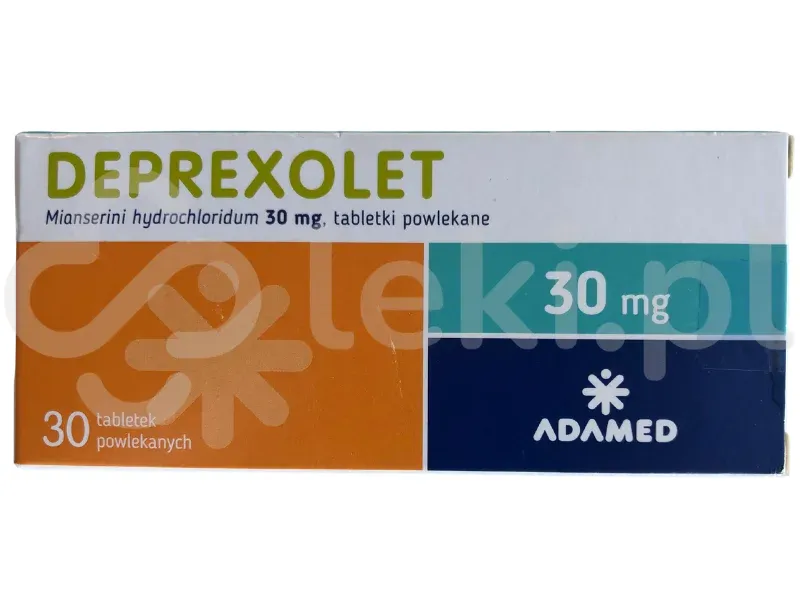
DEPREXOLET
PolandThe medicinal product is used in the treatment of depressive disorder. It also possesses calming and sleep-inducing properties.
Frequently asked questions
How should Deprexolet be taken?
Tablets should be swallowed whole, without chewing. Initially, a dose of 30 mg per day is taken in the evening (in one or divided doses), followed by a maintenance dose ranging from 30 mg to 90 mg per day. Always follow the strictly specified instructions of a physician.
When should this medicine not be used?
It must not be used if you are allergic to any of the ingredients of the medicine, if you are in a manic state, or if you have severe liver damage. It must also not be taken simultaneously with MAO inhibitors (or up to 2 weeks after discontinuing them). The medicine should not be used in children.
What are the possible side effects of Deprexolet?
The most common side effects are drowsiness (especially at the beginning of treatment), weight gain, sedation, edema, and increased liver enzyme levels. Less commonly, changes in blood count, seizures, jaundice, hypomania, or joint pain may occur. You must contact a physician immediately if suicidal thoughts or symptoms of infection (e.g., fever, sore throat) occur.
Can alcohol be consumed during treatment?
Alcohol must not be consumed during treatment, as it may enhance the effect of the medicine on the central nervous system.
Does the medicine affect the ability to drive vehicles?
Due to possible side effects, such as fatigue or drowsiness, you should not drive vehicles or operate machinery while taking the medicine.
Can the medicine be used during pregnancy or breastfeeding?
During pregnancy, the medicine may be used only if the physician considers that the benefit to the mother outweighs the risk to the fetus. The medicine should not be used during breastfeeding – in such a case, breastfeeding should be discontinued.
What interactions may occur with other medicines?
Particular caution should be exercised when using sedatives, anti-anxiety medications, barbiturates, and alcohol, as the medicine enhances their effects. It may also interact with antiarrhythmic drugs, anticoagulants, and certain blood pressure-lowering medications.
Instructions for use
Package leaflet: Information for the patient
Deprexolet, 10 mg, coated tablets
Deprexolet, 30 mg, coated tablets
Mianserini hydrochloridum
Please read the entire leaflet before taking the medicine, as it contains
important information for the patient.
- Keep this leaflet for future reference.
- Consult your doctor, pharmacist, or nurse if you have any further questions.
- This medicine has been prescribed for a specific individual. Do not pass it on to others.
- This medicine may harm another person, even if their symptoms are the same.
- If any of the adverse effects worsen or if any adverse effects occur, including those not listed in this leaflet, inform your doctor, pharmacist, or nurse.
Table of contents of the leaflet
- What Deprexolet is and what it is used for
- Important information before taking Deprexolet
- How to take Deprexolet
- Possible side effects
- How to store Deprexolet
- Contents of the pack and other information
1. What Deprexolet is and what it is used for
Deprexolet is an antidepressant medicine containing mianserin hydrochloride as the active substance.
Mianserin is a tetracyclic antidepressant with a complex mechanism of action. The medicine also has sedative properties. The antidepressant effect occurs after several days of treatment, while clinical improvement is usually observed after several weeks. The sedative and sleep-inducing effects of the medicine may appear already within the first day of treatment and are strongest during the first week of treatment.
Compared to tricyclic antidepressants, mianserin is better tolerated by patients and, at therapeutic doses, does not affect the cardiovascular system.
After oral administration, mianserin is rapidly absorbed, but its bioavailability is only about 30%. Mianserin is highly bound (90%) to plasma proteins. It readily penetrates tissues, including the central nervous system. It is metabolized in the liver and primarily excreted in the urine.
Indications
Treatment of depressive disorder.
2. Important information before using Deprexolet
When not to use Deprexolet
- if the patient is allergic to mianserin or any of the other ingredients of this medicine (listed in section 6);
- if the patient has been diagnosed with manic excitement;
- if the patient has severe liver damage.
Do not use simultaneously with monoamine oxidase inhibitors (MAOIs) or within 2 weeks after discontinuation of such treatment.
Warnings and precautions
Before starting treatment with Deprexolet, discuss this with your doctor or pharmacist.
Below are situations in which special caution should be exercised when using Deprexolet.
Warnings regarding suicide and suicidal thoughts
If the patient experiences suicidal thoughts or thoughts of self-harm, seek immediate medical attention by contacting a doctor or going to a hospital.
It may be helpful to inform family members or friends about the depression or anxiety disorders and ask them to read this leaflet. The patient may ask relatives or friends for support and request them to inform the patient if they notice worsening of depression or anxiety, or concerning changes in behaviour.
Exercise caution if the patient:
- recently suffered a myocardial infarction or has heart block;
- has bone marrow impairment;
- has diabetes (patients should have blood glucose levels regularly monitored);
- has hypertension (patients should have blood pressure regularly monitored);
- has liver and/or kidney impairment;
- suffers from epilepsy;
- has narrow-angle glaucoma;
- has benign prostatic hyperplasia;
- suffers from bipolar disorder (a hypomanic state may occur; in such a case, treatment should be discontinued).
The medicine may enhance the central nervous system depressant effect of alcohol.
If undergoing planned surgery, inform the anaesthetist that mianserin is being taken.
Treatment should be discontinued in case of jaundice or seizures.
During the first three months of treatment, especially in elderly patients, a complete blood count should be monitored every 4 weeks. The doctor will also recommend periodic monitoring of liver and kidney function.
Because improvement may not occur until 2–4 weeks after starting treatment, patients treated with mianserin should be under close supervision during this period.
In some cases, clinical improvement may only be achieved after several months of mianserin treatment.
Discuss this with your doctor, even if the above warnings refer to conditions that occurred in the past.
Children
Do not use this medicine in children.
Elderly patients
Exercise caution, although mianserin is generally better tolerated than tricyclic antidepressants.
Dosage: see section 3.
Deprexolet with other medicines
Inform your doctor about all medicines currently taken or recently taken, as well as any medicines the patient plans to take.
Mianserin must not be administered simultaneously or within 2 weeks after discontinuation of monoamine oxidase inhibitors (MAOIs).
Clinically significant interactions with antihypertensive drugs such as betanidine, clonidine, hydralazine, guanethidine, and propranolol have not been observed. However, more frequent blood pressure monitoring is recommended in such cases.
In patients treated with phenytoin, blood levels of the drug should be monitored when mianserin is used concomitantly.
Mianserin may be used in patients receiving oral anticoagulants derived from hydroxycoumarin. However, blood coagulation parameters should be monitored more frequently in such cases.
No interactions have been observed between mianserin and sympathomimetic agents.
Mianserin enhances the effects of alcohol, barbiturates, sedatives, anxiolytics, and the antidepressant effect of fluoxetine.
Concomitant administration of mianserin with digitalis glycosides or antiarrhythmic drugs with quinidine-like effects increases the risk of cardiac arrhythmias.
Mianserin reduces blood levels of 1,25-dihydroxycholecalciferol.
The medicine may enhance the effects of drugs blocking the parasympathetic nervous system.
Deprexolet with food and drink
No data available.
Alcohol must not be consumed during treatment with mianserin.
Pregnancy and breastfeeding
During pregnancy, while breastfeeding, or if pregnancy is suspected or planned, consult a doctor before using this medicine.
Mianserin crosses the placenta to a small extent. The medicine may be used during pregnancy only if, in the doctor's opinion, the benefit to the mother outweighs the potential risk to the fetus.
Mianserin passes into breast milk to a small extent. The medicine should not be used in breastfeeding women. If antidepressant treatment with mianserin is necessary, breastfeeding should be discontinued.
Consult a doctor before using this medicine.
Driving and operating machinery
Due to the possibility of adverse effects on the central nervous system, such as fatigue or drowsiness, driving vehicles or operating machinery should be avoided during treatment with mianserin.
Deprexolet contains sodium
The medicine contains less than 1 mmol (23 mg) of sodium per coated tablet, meaning it is considered "sodium-free".
3. How to use Deprexolet
This medicine should always be used exactly as prescribed by the doctor. In case of doubt, consult your doctor.
Tablets should be swallowed whole, without chewing.
Initially, for the first few days, 30 mg (3 tablets of 10 mg or 1 tablet of 30 mg) should be administered daily as a single evening dose or in divided doses. The usual maintenance dose is typically between 30 mg and 90 mg (3 to 9 tablets of 10 mg or 1 to 3 tablets of 30 mg) daily. Some patients may require higher doses.
The medicine is generally well tolerated at divided doses up to 200 mg daily. However, the maximum recommended dose in the treatment of depression is 120 mg (12 tablets of 10 mg or 4 tablets of 30 mg) daily.
Antidepressant treatment should be continued for at least several months (4 to 6 months) after depression symptoms have subsided.
In elderly patients, the initial daily dose should not exceed 30 mg (3 tablets of 10 mg). The dose should be increased cautiously.
Use in children
This medicine should not be used in children.
Elderly patients
Exercise caution, although mianserin is generally better tolerated than tricyclic antidepressants.
Taking more than the recommended dose of Deprexolet
In case of overdose, seek immediate medical advice from a doctor.
The most common symptom of mianserin overdose is prolonged sedation and drowsiness. Rarely, cardiac arrhythmias, severe hypotension, seizures, or respiratory disturbances may occur. There is no specific antidote for mianserin. Gastric lavage and symptomatic treatment are recommended.
Missed dose of Deprexolet
Take the missed dose as soon as possible. If it is almost time for the next dose, do not take the missed dose. Do not take a double dose to make up for a missed dose.
If you have any further questions about the use of this medicine, consult your doctor.
4. Possible adverse effects
Like all medicines, this medicine can cause adverse effects, although not everyone experiences them.
The most common adverse effect of mianserin is drowsiness, especially
during the first days of treatment. This effect may be intensified by alcohol consumption.
During mianserin treatment, bone marrow damage may occur, manifesting as
changes in blood parameters, most commonly between the 4th and 6th week of treatment. This complication
is more frequent in elderly patients, is reversible, and resolves completely after discontinuation of the drug.
Jaundice, hypomania, or seizures may occur even at therapeutic doses and constitute
indications for discontinuation of mianserin. The occurrence of signs of infection (e.g., fever,
sore throat, oral inflammation, or other inflammatory conditions) indicates the need to discontinue
the drug and to perform a blood morphology test with smear examination.
The frequency of possible adverse effects listed below is defined as follows:
Common (may affect up to 1 in 10 patients): weight gain, sedation
occurring at the beginning of treatment, decreasing with continued therapy (Note:
reducing the dose usually does not reduce sedation but may compromise the antidepressant
efficacy of the drug), drowsiness (especially during the first days of treatment), increased
liver enzyme levels, edema.
Uncommon (may affect up to 1 in 100 patients): orthostatic hypotension,
skin rashes, joint pain.
Rare (may affect up to 1 in 1000 patients): changes in blood parameters (usually
granulocytopenia or agranulocytosis), hypomania (prolonged disturbances in mood, drive, and activity),
seizures, hyperkinesia (restless legs syndrome), neuroleptic malignant syndrome,
tetany after initial dose, jaundice.
Frequency not known (cannot be estimated from available data): anemia,
increased appetite, suicidal thoughts, suicidal behaviour, in patients with bipolar disorder phase shift,
worsening of psychotic symptoms, dizziness, liver damage, excessive sweating, tremor, weakness,
gynecomastia (enlargement of breasts in males), breast tenderness, galactorrhea.
Suicidal thoughts, worsening of depression or anxiety disorders
Patients with depression or anxiety disorders may sometimes experience thoughts
about self-harm or suicide. Such symptoms or behaviours may worsen at the
beginning of antidepressant treatment, as these medicines usually start to work after
about 2 weeks, sometimes later.
The occurrence of suicidal thoughts, thoughts of self-harm, or suicide attempts is
more likely:
- if the patient has previously experienced suicidal thoughts or self-harm;
- if the patient is a young adult; clinical trial data indicate an increased risk of suicidal behaviour in individuals under 25 years of age with psychiatric disorders who are treated with antidepressants.
If any adverse effects occur, including any possible adverse effects
not listed in this leaflet, consult a doctor or pharmacist.
Reporting of adverse effects
If any adverse effects occur, including those not listed in this leaflet, inform your doctor or pharmacist. Adverse effects
can be reported directly to the Department of Monitoring of Adverse Drug Reactions of the Office for Registration of Medicinal Products, Medical Devices and Biocidal Products: Al. Jerozolimskie 181C, 02-222 Warsaw, tel.: +48 22 49 21 301, fax: +48 22 49 21 309, website: https://smz.ezdrowie.gov.pl
Reporting adverse effects helps to collect more information on the safety of the medicine.
5. How to store Deprexolet
Keep the medicine out of the reach and sight of children.
Do not use this medicine after the expiry date stated on the packaging.
Store below 25°C. Keep in the original packaging to protect from light.
Medicines must not be disposed of via the sewage system or household waste. Ask
your pharmacist how to dispose of medicines no longer required. This will help
protect the environment.
6. Contents of the pack and other information
What Deprexolet contains
- The active substance is mianserin hydrochloride. One tablet contains 10 mg or 30 mg of mianserin hydrochloride.
- The other ingredients are: microcrystalline cellulose, sodium croscarmellose, povidone, citric acid monohydrate, magnesium stearate, macrogol 8000, hypromellose (E5), hypromellose (E15), hydroxypropylcellulose, titanium dioxide (E 171).
What Deprexolet looks like and contents of the pack
Deprexolet 10 mg: white or almost white, round, smooth, biconvex coated tablets with engraved mark "10".
Deprexolet 30 mg: white or almost white, round, smooth, biconvex coated tablets with engraved mark "30".
Pack contains 30, 60 or 90 coated tablets.
Marketing Authorisation Holder
Adamed Pharma S.A.
Pieńków, ul. M. Adamkiewicza 6A
05-152 Czosnów
Manufacturer
Adamed Pharma S.A.
Pieńków, ul. M. Adamkiewicza 6A
05-152 Czosnów
Similar drugs
| Brand name | Dosage form | Active substance / Dosage | Manufacturer |
|---|---|---|---|
| DEPREXOLET | tablets, film-coated |
|
Adamed Pharma S.A. |
| LERIVON | tablets, film-coated |
|
Organon Heist bv |
| LERIVON | tablets, film-coated |
|
Organon Heist bv |
| LERIVON | tablets, film-coated |
|
N.V. Organon Schering-Plough Labo N.V. |
| MIANNSEGEN | tablets, film-coated |
|
Mylan Hungary Kft./Mylan Hungary Ltd |
| MIANSEC 30 | tablets, film-coated |
|
Jelfa Pharmaceutical Enterprise S.A. |
| MIANSEGEN | tablets, film-coated |
|
Mylan Hungary Kft./Mylan Hungary Ltd |
| MIANSEGEN | tablets, film-coated |
|
Mylan Hungary Kft./Mylan Hungary Ltd |
| MIANSERIN | tablets, film-coated |
|
Jelfa Pharmaceutical Enterprise S.A. |
The original data is available in the language of the country of manufacture.
Data source: Register of Medicinal Products of Poland (URPL)
Data last verified: September 01, 2026