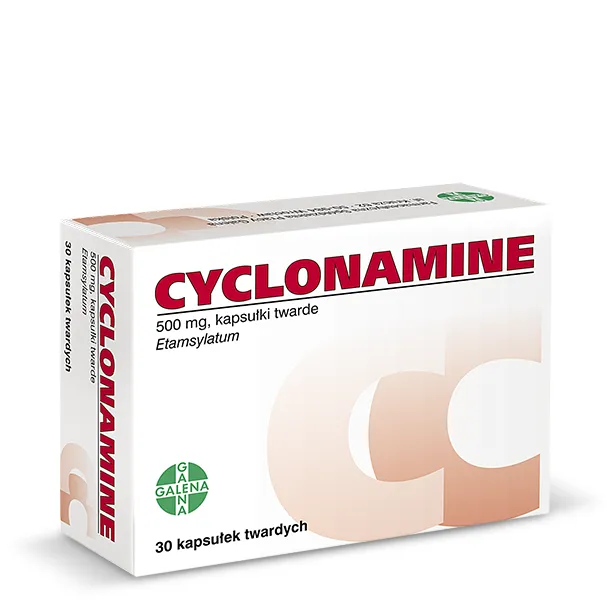
CYCLONAMINE
PolandThe medicine is used for the prevention and treatment of capillary bleeding (from small vessels). It is also used to treat spotting and excessive or prolonged menstrual bleeding.
Frequently asked questions
How to use Cyclonamine?
The medicine should be taken orally, as directed by a doctor. In internal medicine, the usual dose is 1 capsule 2-3 times daily with food. In gynecology, 1 capsule is taken 3 times daily for 10 days, starting 5 days before menstruation. Before surgical procedures, 1 capsule is taken one hour before surgery, and after the procedure, 1 capsule every 4-6 hours as long as there is a risk of bleeding.
When should you not take this medicine?
Do not use this medicine if you are allergic to etamsylate or any of its other ingredients, or if you have porphyria. The medicine is not intended for children.
Can Cyclonamine cause side effects?
Possible side effects include, among others, headache, rash, abdominal pain, nausea, diarrhea, vomiting, fatigue, and less commonly, joint pain. Very rarely, fever, allergic reactions, blood clotting disorders, or a decrease in white blood cell or platelet counts may occur. If fever, skin reactions, or persistent vomiting (lasting at least 2 days) occur, you should discontinue treatment and consult a doctor.
Can the medicine be used during pregnancy or breastfeeding?
During pregnancy, avoidance of the medicine is recommended due to a lack of sufficient data. Breastfeeding is not recommended while using this preparation; if breastfeeding is continued, treatment should be discontinued.
Can you take other medicines together with Cyclonamine?
You should inform your doctor or pharmacist about all medicines you are currently taking, have recently taken, or are planning to take.
Can you drive while undergoing treatment?
In adults, the medicine does not affect the ability to drive vehicles or operate machinery.
Instructions for use
Package leaflet: Information for the patient
CYCLONAMINE
500 mg, hard capsules
Etamsylatum
Please read the entire leaflet carefully before using this medicine, as it contains
important information for the patient.
- Keep this leaflet for future reference.
- If you have any questions, consult your doctor or pharmacist.
- This medicine has been prescribed for a specific individual. Do not share it with others. This medicine may harm others, even if their symptoms are the same.
- If you experience any adverse reactions, including any not listed in this leaflet, inform your doctor or pharmacist. See section 4.
Table of contents
- What Cyclonamine is and what it is used for
- Important information before taking Cyclonamine
- How to take Cyclonamine
- Possible side effects
- How to store Cyclonamine
- Contents of the pack and other information
1. What Cyclonamine is and what it is used for
Cyclonamine is a haemostatic agent that shortens bleeding time and reduces blood loss.
Cyclonamine is used for the prevention and treatment of capillary bleeding (bleeding from small vessels), regardless of the cause or location of the bleeding.
Cyclonamine is used in the treatment of metrorrhagia (bleeding occurring outside the menstrual cycle) and excessive or prolonged menstrual bleeding, whether related to or independent of the use of intrauterine devices.
2. Information before using Cyclonamine
When not to use Cyclonamine
- if the patient is allergic to etamsylate or any of the other ingredients of this medicine (listed in section 6).
- if the patient has porphyria (a disorder characterized by disturbances in hemoglobin synthesis). In such a case, this fact should be reported to the physician, who will decide on further treatment.
Warnings and precautions
Before starting treatment with Cyclonamine, discuss it with your doctor or pharmacist.
Before laboratory tests, keep in mind: during treatment with Cyclonamine,
collection of samples for testing (e.g. blood samples) should be performed before the first dose of the medicine
to minimize any potential influence of Cyclonamine on laboratory test results.
A woman must be examined by a gynecologist before using Cyclonamine for treatment related to menstrual bleeding.
Children
Cyclonamine is not intended for use in children.
Cyclonamine and other medicines
Tell your doctor or pharmacist about all medicines the patient is currently taking or has recently taken, as well as any medicines the patient plans to take.
Cyclonamine with food and drink
The medicine may be taken with food, drinking water (except when administered before surgical procedures, when the medicine should be taken on an empty stomach).
Pregnancy, breastfeeding and fertility
If the patient is pregnant or breastfeeding, suspects she may be pregnant, or is planning to have a child, she should consult a doctor or pharmacist before using this medicine.
Pregnancy
There is insufficient data on the use of Cyclonamine in pregnant women.
Animal studies have not shown direct or indirect harmful effects on pregnancy, embryonic and fetal development, and/or postnatal development.
As a precautionary measure, it is recommended to avoid using Cyclonamine during pregnancy.
Breastfeeding
Due to lack of sufficient data on the passage of the drug into human milk, breastfeeding is not recommended during treatment. Otherwise, if breastfeeding is continued, treatment should be discontinued.
Fertility
No data available.
Driving and operating machinery
Cyclonamine has no influence on the ability to drive or operate machinery in adults.
3. How to use Cyclonamine
This medicine should always be used as directed by the physician. In case of doubt, consult your
doctor or pharmacist.
Cyclonamine is intended for use in adults. The medicine is administered orally.
Internal diseases: usually 1 capsule 2–3 times daily (1000–1500 mg). Take the medicine with food,
swallowing it with water. The duration of treatment depends on the results achieved.
Before surgical procedure: 1 capsule (500 mg) one hour before surgery.
After surgical procedure: 1 capsule (500 mg) every 4–6 hours, as long as bleeding risk persists.
Gynecology: 1 capsule 3 times daily (1500 mg), taken with food, swallowing it with water.
Treatment lasts 10 days and begins 5 days before the expected onset of menstruation.
If Cyclonamine is used to reduce excessive and (or) prolonged menstrual bleeding, and no improvement
occurs, possible pathological causes should be identified and ruled out. In such a case, consult your
doctor immediately for further evaluation and determination of further treatment.
Cyclonamine should be used with caution in patients with impaired liver or kidney function.
Use in children
Cyclonamine is not intended for use in children.
Inform your doctor or pharmacist if you have any doubts regarding an effect of Cyclonamine that seems
too strong or too weak.
Do not discontinue use of this medicine without consulting your doctor or pharmacist.
Use of a higher than recommended dose of Cyclonamine
If a dose higher than recommended is taken, contact your doctor or pharmacist immediately. In case
of overdose, symptomatic treatment should be initiated.
Missed dose of Cyclonamine
Do not take a double dose to make up for a missed capsule.
If a dose is missed, contact your doctor or pharmacist.
Discontinuation of Cyclonamine
The consequences of discontinuing treatment are unknown.
If you have any further questions regarding use of this medicine, consult your doctor or pharmacist.
4. Possible adverse reactions
Like all medicines, this medicine can cause adverse reactions, although not everyone will experience them.
Common (occur in 1 to 10 people out of 100)
- headache,
- rash,
- abdominal pain, nausea, diarrhoea, vomiting, discomfort in the abdominal cavity,
- feeling of fatigue.
Rare (occur in 1 to 10 people out of 10,000)
- joint pain.
Very rare (occur in less than 1 person out of 10,000)
- fever,
- coagulation disorders with formation of blood clots in blood vessels (thromboembolic disease),
- significant decrease in white blood cell count, increasing the likelihood of infections,
- decrease in platelet count, increasing the risk of bleeding or bruising,
- allergic reaction.
The adverse reactions listed above are transient in nature and resolve after discontinuation of treatment. If skin adverse reactions or fever occur, treatment must be discontinued immediately and the physician should be informed, as these may be the first signs of hypersensitivity reactions. In case of repeated vomiting persisting for at least 2 days, treatment should be discontinued.
Reporting of adverse reactions
If any adverse symptoms occur, including any adverse reactions not listed in this leaflet, inform your doctor or pharmacist. Adverse reactions can be reported directly to the Department of Monitoring Adverse Drug Reactions at the Office for Registration of Medicinal Products, Medical Devices and Biocidal Products
Al. Jerozolimskie 181C
02-222 Warsaw
Phone: +48 22 49 21 301
Fax: +48 22 49 21 309
Website: https://smz.ezdrowie.gov.pl
Adverse reactions can also be reported to the marketing authorization holder.
Reporting adverse reactions enables collection of additional information on the medicine's safety profile.
5. How to store Cyclonamine
Store below 30 °C.
Keep the medicine out of the sight and reach of children.
Do not use this medicine after the expiry date stated on the packaging. The expiry date refers to the last day of the stated month.
Medicines must not be disposed of via wastewater or household waste. Ask your pharmacist how to dispose of medicines no longer required. Such measures help protect the environment.
6. Contents of the package and other information
What Cyclonamine contains
- The active substance in Cyclonamine is etamsylate 500 mg.
- The other ingredients are: stearic acid, titanium dioxide (E 171), erythrosine (E 127), quinoline yellow (E 104), gelatine.
What Cyclonamine looks like and contents of the pack
Cyclonamine is available as hard capsules. The capsule is cylindrical-oval, closed, two-part, orange in colour. The capsule content is white or almost white powder.
Available pack sizes:
30 pieces, 60 pieces, 90 pieces.
PVC/PVDC/Aluminium blisters in a cardboard box.
Not all pack sizes may be marketed.
Marketing Authorisation Holder and Manufacturer
Farmaceutyczna Spółdzielnia Pracy „GALENA”
ul. Dożynkowa 10
52-311 Wrocław
Poland
Similar drugs
| Brand name | Dosage form | Active substance / Dosage | Manufacturer |
|---|---|---|---|
| CYCLOREG | capsules, hard |
|
Pharmaceutical Workers' Cooperative 'GALENA' |
The original data is available in the language of the country of manufacture.
Data source: Register of Medicinal Products of Poland (URPL)
Data last verified: September 01, 2026