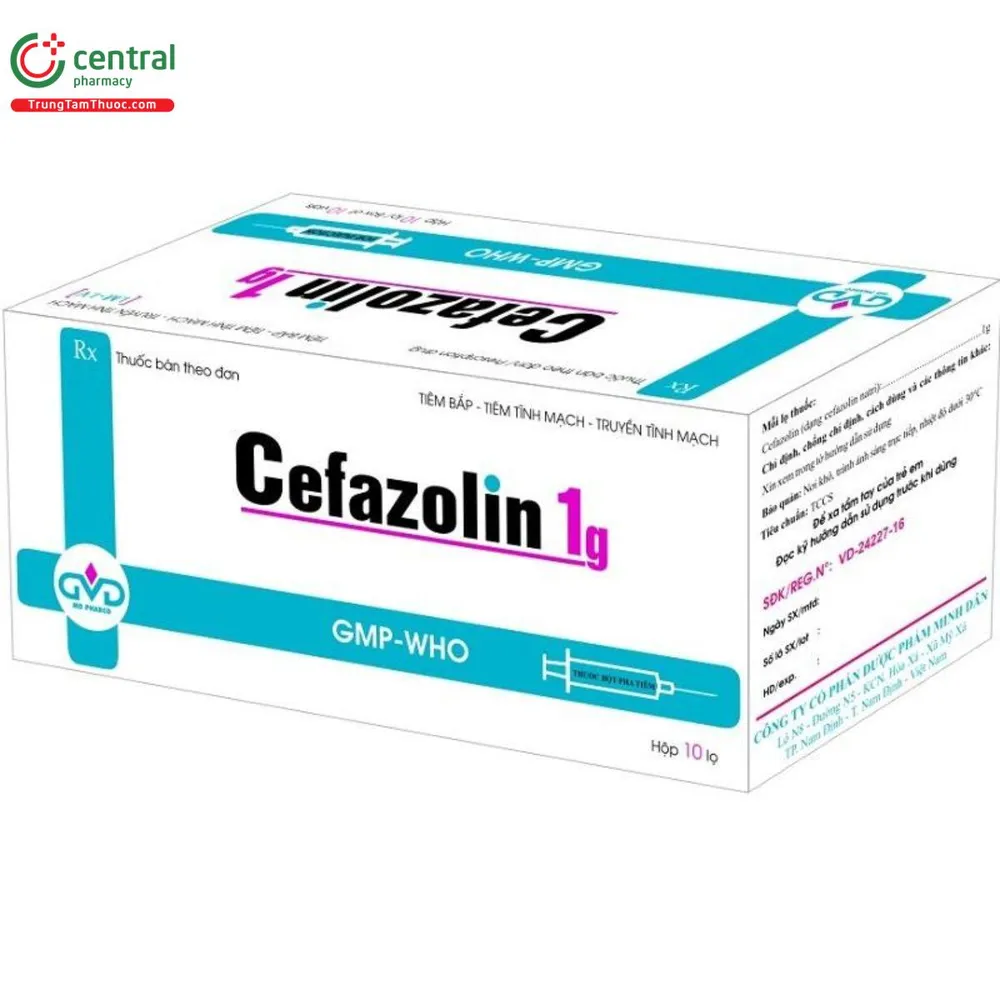
CEFAZOLIN PHAGECON
PolandThe medicine is used to treat infections of the respiratory tract, kidneys and urinary tract, skin, bones, and joints, as well as in the treatment of endocarditis. It may also be administered before or after surgical procedures to prevent infections.
Frequently asked questions
How is Cefazolin Phagecon administered?
The medicine is administered by a doctor via intramuscular injection, slow intravenous injection, or by intravenous infusion.
Who must not take this medicine?
It must not be used if there is an allergy to cefazolin or if the patient has ever had a severe anaphylactic reaction (e.g., facial swelling, difficulty breathing) to other beta-lactam antibiotics (e.g., penicillins). The medicine should not be used in premature infants and newborns under 1 month of age.
What are the recommended doses?
The dosage is determined by a doctor based on age, body weight, severity of infection, and kidney function. In adults, the dose depends on the purpose of treatment (from 1 g to 12 g per day), and in children, the dose is calculated based on body weight.
Does Cefazolin Phagecon interact with other medicines?
Yes, the medicine may affect the action of other substances. The doctor should be informed about the use of, among others, other antibiotics, probenecid, vitamin K, anticoagulants, furosemide, and oral contraceptives.
What are the possible side effects of Cefazolin Phagecon?
Common side effects may include: rash, nausea, vomiting, diarrhea, abdominal pain, or pain at the injection site. Less commonly, blood clotting problems or kidney problems may occur. Very rarely, a severe allergic reaction occurs (e.g., swelling of the throat and difficulty breathing) – in such a case, the doctor must be notified immediately.
Instructions for use
Table of contents
- 1. What Cefazolin Phagecon is and what it is used for
- 2. Important information before using Cefazolin Phagecon
- 3. How to use Cefazolin Phagecon
- 4. Possible adverse reactions
- 5. How to store Cefazolin Phagecon
- 6. Contents of the pack and other information
- Information intended exclusively for healthcare professionals:
Package leaflet: Information for the user
Cefazolin Phagecon, 1 g, powder for solution for injection/infusion
Cefazolin sodium
Please read carefully all the information in this leaflet before using this medicine, as it contains
important information for the patient.
- Keep this leaflet, as you may need to read it again.
- If you have any questions, ask your doctor, pharmacist, or nurse.
- This medicine has been prescribed for a specific individual. Do not pass it on to others. It may harm someone else, even if their symptoms are the same.
- If you experience any adverse reactions, including any not listed in this leaflet, inform your doctor, pharmacist, or nurse. See section 4.
Leaflet contents
- What Cefazolin Phagecon is and what it is used for
- Important information before using Cefazolin Phagecon
- How to use Cefazolin Phagecon
- Possible side effects
- How to store Cefazolin Phagecon
- Contents of the pack and other information
1. What Cefazolin Phagecon is and what it is used for
Cefazolin Phagecon contains the active substance cefazolin (in the form of cefazolin sodium). Cefazolin belongs to a group of antibiotics called cephalosporins, which destroy bacteria. Cefazolin is used when an infection is definitely or probably caused by bacteria sensitive to cefazolin. It is used to treat the following infections:
- respiratory tract infections;
- kidney and urinary tract infections;
- skin infections;
- bone and joint infections;
- endocarditis (inflammation of the inner lining of the heart or heart valve).
Cefazolin Phagecon may also be administered before or after surgery to prevent infections.
2. Important information before using Cefazolin Phagecon
When not to use Cefazolin Phagecon
- if the patient is allergic to cefazolin or to any of the other ingredients of this medicine (listed in section 6);
- if the patient has ever had a severe anaphylactic reaction (hypersensitivity) (for example, severe skin peeling, swelling of the face, hands, feet, lips, tongue, or throat, difficulty swallowing or breathing) in response to any other type of beta-lactam antibiotics (penicillins, monobactams, and carbapenems).
Warnings and precautions
Before starting treatment with Cefazolin Phagecon, discuss this with your doctor, pharmacist, or nurse.
- if the patient has previously experienced a mild allergic reaction to penicillin or similar antibiotics (for example, itchy skin rash);
- if the patient is allergic to any medicine not previously mentioned in this leaflet;
- if the patient has previously had intestinal problems, particularly inflammation of the large intestine (colitis);
- if the patient has kidney problems;
- if the patient is on a low-sodium diet.
Risk factors causing vitamin K deficiency or risk factors causing other disturbances in blood coagulation mechanisms.
Rarely, treatment with cefazolin may lead to disturbances in blood coagulation.
Additionally, blood coagulation may be impaired in patients with diseases that may cause or exacerbate bleeding, such as haemophilia, gastric or duodenal ulcers. In such cases, the patient's blood coagulation system will be monitored.
This medicine must not be administered by intrathecal injection (into the space surrounding the spinal cord) because neurotoxic effects on the central nervous system (including seizures) have been reported.
Cefazolin Phagecon 1 must not be used in premature infants or newborns below the age of 1 month.
Prolonged use of Cefazolin Phagecon may lead to superinfection. The doctor will closely monitor the patient and, if necessary, recommend appropriate treatment.
Cefazolin Phagecon and other medicines
Inform your doctor about all medicines the patient is currently taking or has recently taken, as well as any medicines the patient plans to take.
Cefazolin Phagecon may affect the action of certain medicines and, conversely, certain medicines may affect the way Cefazolin Phagecon works.
Inform your doctor if the patient is taking any of the following medicines, particularly:
- aminoglycosides or other antibiotics (used to treat infections);
- probenecid (used to treat gout);
- vitamin K;
- anticoagulants (blood-thinning medicines);
- furosemide (a diuretic);
- oral contraceptives ("the pill").
You should also inform your doctor if the patient undergoes urine tests for glucose or blood tests.
Pregnancy, breastfeeding, and fertility
If the patient is pregnant or breastfeeding, suspects she may be pregnant, or is planning to have a child, she should consult her doctor before using this medicine.
Driving and operating machinery
Cefazolin Phagecon 1 g powder for solution for injection/infusion has a notable effect on the ability to drive and use machines, particularly due to the possibility of encephalopathy (see sections 3 and 4).
Cefazolin Phagecon contains sodium
This medicine contains 48.3 mg of sodium (the main component of table salt) per gram. This corresponds to 2.5% of the maximum recommended daily dietary sodium intake for adults. This should be taken into account in patients who are monitoring their dietary sodium intake.
3. How to use Cefazolin Phagecon
This medicine should always be used as directed by the physician. If in doubt, consult the
physician or pharmacist.
Cefazolin Phagecon will be administered to the patient by a physician in one of the following ways:
- by intramuscular injection (e.g. into the muscle of the arm)
- by slow injection into a vein. The injection will last from 3 to 5 minutes.
- through a small tube inserted into a vein. This is known as an "intravenous infusion".
Recommended doses
The physician will determine the dose of Cefazolin Phagecon based on the patient's age, body weight, severity of
infection, and kidney function. The physician will explain this to the patient.
Adults, adolescents, and elderly patients
- In case of infection, the dose may range from 1 g to 6 g or 12 g per day, depending on the severity of the infection.
- Prior to planned surgery, the patient will receive a 1 g dose, administered 30–60 minutes before the start of surgery.
- For prolonged surgical procedures, the patient may additionally receive 500 mg to 1 g of the medicine during surgery. Administration of Cefazolin Phagecon may continue for 24 hours after surgery to prevent the risk of infection.
Use in children and infants (aged 1 month and older)
The physician will determine the appropriate dose based on the child's body weight. In children, the daily dose may
range from 25 mg to 50 mg per kg of body weight. This dose may be increased to 100 mg per kg of body weight, depending on the severity of the infection.
Data are insufficient to recommend dosing in children under 1 month of age.
Adults and children with impaired kidney function
If the patient has impaired kidney function, the dose of the medicine may be reduced. Blood tests may be
necessary to determine whether the patient is receiving the correct dose.
4. Possible adverse reactions
Like all medicines, this medicine can cause adverse reactions, although not everyone will experience them.
Severe allergic reactions (very rare, may occur in less than 1 in 10,000 people)
If a patient experiences a severe allergic reaction, you must tell the doctor immediately.
Symptoms may include:
- Sudden swelling of the face, throat, lips, or mouth; which may cause difficulty breathing or swallowing.
- Sudden swelling of the hands, feet, or ankles.
Other possible adverse reactions
Common (may occur in less than 1 in 10 people)
- Skin rash
- Nausea and vomiting
- Diarrhea
- Loss of appetite
- Abdominal bloating
- Abdominal pain
- Pain and hardening at the injection site
Uncommon (may occur in less than 1 in 100 people)
- Increased number of a specific type of blood cells
- Low white blood cell count
- Low platelet count (cells involved in blood clotting)
- Phlebitis (inflammation of veins)
- Severe hypersensitivity reactions, drug fever
- Skin redness, skin itching, joint pain, skin lesions, generalized rash, urticaria
- Transient increase in liver function test parameters
Rare (may occur in less than 1 in 1,000 people)
- Blood clotting may take longer than usual. This may be observed with nosebleeds or minor cuts.
- Kidney problems
Very rare (may occur in less than 1 in 10,000 people)
- Yellowing of the skin or whites of the eyes (jaundice)
Unknown (frequency cannot be determined from available data)
- Candidiasis (fungal infection of the vagina, mouth, or skin folds); the doctor may recommend treatment for candidiasis.
- Headache
- Dizziness
- Unpleasant, sometimes painful sensations such as tingling, numbness, limb numbness, disturbances in perception of cold and heat
- Central nervous system excitation
- Involuntary muscle contractions
- Seizures
- Inflammation of the large intestine (colitis). Symptoms include: diarrhea, usually with blood and mucus, abdominal pain, and fever.
Reporting of adverse reactions
If any adverse reactions occur, including any not listed in this leaflet, you should inform your doctor, pharmacist, or nurse. Adverse reactions can be reported directly to the Department of Monitoring Adverse Drug Reactions of the Office for Registration of Medicinal Products, Medical Devices and Biocidal Products
Al. Jerozolimskie 181C
02-222 Warsaw
Tel.: +48 22 49 21 301
Fax: +48 22 49 21 309
Website: https://smz.ezdrowie.gov.pl
Adverse reactions can also be reported to the marketing authorization holder.
Reporting adverse reactions helps to provide more information on the safety of the medicine.
5. How to store Cefazolin Phagecon
Keep this medicine out of sight and reach of children.
Do not use this medicine after the expiry date stated on the carton: "Expiry date".
The expiry date refers to the last day of the stated month.
Before reconstitution: this medicinal product does not require special storage conditions.
To protect from light, store the vial in the outer carton.
After reconstitution:
Chemical and physical in-use stability has been demonstrated for 8 hours at 25°C and for 24 hours at 2–8°C in water for injections.
From a microbiological point of view, the product should be used immediately.
If the medicine is not used immediately, the user is responsible for the storage conditions and duration prior to use, which should not usually exceed 8 hours at 25°C and 24 hours at 2–8°C.
Medicines must not be disposed of via wastewater or household waste. Ask your pharmacist how to dispose of medicines no longer in use.
This will help protect the environment.
6. Contents of the pack and other information
What Cefazolin Phagecon contains
The active substance is cefazolin.
Each vial contains 1.048 g of cefazolin sodium, equivalent to 1 g of cefazolin.
What Cefazolin Phagecon looks like and contents of the pack
Cefazolin Phagecon is a white or almost white powder.
Cefazolin Phagecon is available in a vial containing 1 g of cefazolin as the sodium salt, closed with a chlorobutyl rubber stopper and sealed with an aluminium-polipropylene cap, packed in a cardboard box.
Cefazolin Phagecon is packed in cardboard boxes containing 10 or 100 vials.
Not all pack sizes may be marketed.
Marketing Authorisation Holder and Manufacturer
Marketing Authorisation Holder
Phagecon – Serviços e Consultoria Farmacêutica Lda.
Avenida Jose Malhoa n 2 Edificio Malhoa Plaza 3º Piso Escritorio 3.7
1070-325 Lisbon
Portugal
Manufacturer
LDP-LABORATORIOS TORLAN, S.A.
Ctra de Barcelona, 135-B
08290 Cerdanyola del Vallès
Barcelona
Spain
Laboratórios Basi Indústria Farmacêutica S.A.
Parque Industrial Manuel Lourenco Ferreira 8, 15 and 16
Mortagua
3450-232 Viseu
Portugal
This medicinal product is authorised for sale in the European Economic Area countries under the following names:
Portugal Cefazolina Phagecon
Belgium Cefazolin Phagecon 1 g Powder for solution for injection/infusion
Cefazolin Phagecon 1 g poeder voor oplossing voor injectie/infusie
Cefazolin Phagecon 1 g Pulver zur Herstellung einer Injektions-/Infusionslösung
Italy Cefazolin Phagecon
Czech Republic Cefazolin Phagecon
Poland Cefazolin Phagecon
WHAT YOU SHOULD KNOW ABOUT ANTIBIOTICS?
Antibiotics are effective in fighting infections caused by bacteria. They are not effective against infections caused by viruses.
Furthermore, your doctor has decided to prescribe this antibiotic because it is appropriate for the patient and their illness.
Bacteria have the ability to survive or multiply despite the action of an antibiotic. This phenomenon is known as resistance and causes certain antibiotics to become ineffective.
Resistance increases due to excessive or inappropriate use of antibiotics.
The patient risks contributing to the emergence of resistant bacteria, and thus delaying recovery or even rendering this medicine ineffective, if they do not follow the instructions regarding:
- the dose to be taken,
- the time at which the dose should be taken,
- and the duration of treatment.
Therefore, to maintain the effectiveness of this medicine:
1 - Use the antibiotic only when prescribed by a doctor.
2 - Strictly follow the instructions provided on the prescription.
3 - Do not reuse the antibiotic without a doctor's advice, even if the patient believes they have a similar illness.
4 - Never give your antibiotic to another person, as it may not be suitable for their condition.
5 - After completing the treatment, return all opened packaging to a pharmacist for proper and safe disposal of this medicine.
Information intended exclusively for healthcare professionals:
Cefazolin Phagecon can be administered intramuscularly or intravenously. In both cases, the total daily doses are the same. The dosage and route of administration depend on the site and severity of infection, as well as on clinical and bacteriological progression.
Adults and adolescents (aged over 12 years and weighing ≥ 40 kg):
- Infections caused by susceptible microorganisms: 1 g to 2 g of cefazolin per day, divided into 2–3 equal doses.
- Infections caused by microorganisms with moderate susceptibility: 3 g to 4 g of cefazolin per day, divided into 3–4 equal doses.
In severe infections, doses up to 6 g per day may be administered, divided into three or four equal doses (one dose every 6 or every 8 hours).
Prophylactic use for prevention of perioperative infections: the recommended dose for prevention of postoperative infections in contaminated or potentially contaminated surgical procedures is: 1 g of cefazolin 30–60 minutes before surgery.
Children and adolescents
Children and infants older than 30 months (im.):
25 to 50 mg/kg body weight every 24 hours (divided into three or four equal doses).
In severe infections, the total daily dose may be increased to 100 mg/kg body weight.
Cefazolin is not recommended for use in preterm infants and infants under 1 month of age due to lack of established safety in these patient populations.
Patients with renal impairment
In patients with renal impairment, dosage should be adjusted by the physician according to creatinine clearance or serum creatinine concentration (see table).
- Severe or very severe infection:
| Creatinine clearance | Loading dose | Maintenance dose |
| 50 to 20 ml/min 20 to 10 ml/min 10 to 5 ml/min < 5 ml/min in patients undergoing hemodialysis | 500 mg 500 mg 500 mg 500 mg intravenously | 250 mg every 6 h or 500 mg every 12 h 250 mg every 12 h or 500 mg every 24 h 250 mg every 24–36 h or 500 mg every 48–72 h 500 mg every 72 hours |
- Mild or moderate infection:
| Creatinine clearance | Loading dose | Maintenance dose |
| 50 to 20 ml/min 20 to 10 ml/min 10 to 5 ml/min < 5 ml/min in patients undergoing hemodialysis | 500 mg 500 mg 500 mg 500 mg intravenously | 125 to 250 mg every 12 h 125 to 250 mg every 24 h 75 to 125 mg every 24 h 50 to 75 mg every 72 h |
Prevention of postoperative infections in surgery: administration should be short-term, usually limited to the duration of the procedure, sometimes extended to 24 hours, but never longer than 48 hours.
2 g iv at induction of anesthesia,
followed by repeated 1 g injections every 4 hours throughout the duration of surgery.
If administration extends beyond the intraoperative period, repeat 1 g injections every 8 hours.
In cardiac surgery involving extracorporeal circulation (ECC), an additional 1 g injection should be administered after ECC initiation.
In cesarean sections, the injection should be given after clamping of the umbilical cord.
Administration method
Cefazolin Phagecon can be administered intravenously, either as a direct injection or via continuous or intermittent infusion.
For direct intravenous injection, this medicinal product may be slowly injected into the vein over 3 to 5 minutes.
The solution of this medicinal product may also be administered as a slow intravenous infusion.
Cefazolin may be administered deep intramuscularly.
Intramuscular administration: this formulation should not be used in children under 30 months of age (due to lidocaine hydrochloride as solvent).
Special precautions for disposal and preparation of the medicinal product for use
- Direct intravenous injection: Reconstitute the vial of cefazolin powder with 5 ml of water for injections and administer slowly over 3 to 5 minutes, directly into a vein or into an infusion set.
- Deep intramuscular injection:
Reconstitute the vial of cefazolin powder with 4 ml of 1% lidocaine solution or 5 ml of water for injections and administer deep intramuscularly. - Intravenous infusion: Dilute the reconstituted cefazolin solution in 50 ml of water for injections or one of the following intravenous solutions:
- 0.9% sodium chloride,
- 5% or 10% glucose,
- 5% glucose with 0.9% sodium chloride,
- 5% glucose with 0.2% or 0.45% sodium chloride,
- Ringer's solution,
- Lactated Ringer's solution,
- 5% glucose with lactated Ringer's solution.
Do not use intrathecally.
- Reconstitution: Reconstitute Cefazolin Phagecon with water for injections: 1 g is stable in 2 ml. Although Cefazolin Phagecon is highly soluble, for intravenous use it is preferable to add 5 ml of water for injections to 1 g vials. Shake to dissolve and withdraw the entire contents of the vial into a syringe. For intramuscular administration, Cefazolin Phagecon may be reconstituted with 1% lidocaine solution: 1 g is stable in 4 ml. Shake to dissolve and withdraw the entire contents of the vial into a syringe. Intramuscular administration: this formulation should not be used in children under 30 months of age (solvent is lidocaine hydrochloride). The reconstituted solution may have a yellow coloration, which is normal.
- Dilution: The reconstituted solution should be diluted with one of the solvents listed above in section 6.6: add approximately 45 ml of solvent to the reconstituted solution to achieve a final volume of 50 ml. After reconstitution/dilution, use immediately. Any unused medicinal product or waste material should be disposed of in accordance with local regulations.
Shelf life
3 years.
Physicochemical stability of the reconstituted solution has been demonstrated for 8 hours at 25°C and for 24 hours at 2–8°C.
From a microbiological standpoint, the product should be used immediately. If not used immediately, the responsibility for storage conditions and duration prior to use lies with the user and should generally not exceed 8 hours at 25°C and 24 hours at 2–8°C.
Similar drugs
| Brand name | Dosage form | Active substance / Dosage | Manufacturer |
|---|---|---|---|
| CEFAZOLIN APTAPHARMA | powder for preparation of solution for injection / infusion |
|
ACS Dobfar S.p.A. |
| CEFAZOLIN DALI PHARMA | powder for preparation of solution for injection / infusion |
|
SciencePharm Ltd. |
| CEFAZOLIN NORIDEM | powder for preparation of solution for injection / infusion | — | DEMO S.A. Pharmaceutical Industry |
| CEFAZOLIN NORIDEM | powder for preparation of solution for injection / infusion | — | DEMO S.A. Pharmaceutical Industry |
| CEFAZOLIN PHAGECON | powder for preparation of solution for injection / infusion |
|
Laboratórios Basi Indústria Farmacêutica S.A. LDP-LABORATORIOS TORLAN S.A. |
| CEFAZOLIN TZF | powder for preparation of solution for injection / infusion |
|
Tarchomin Pharmaceutical Works 'Polfa' S.A. |
The original data is available in the language of the country of manufacture.
Data source: Register of Medicinal Products of Poland (URPL)
Data last verified: September 01, 2026