ALLERGODIL
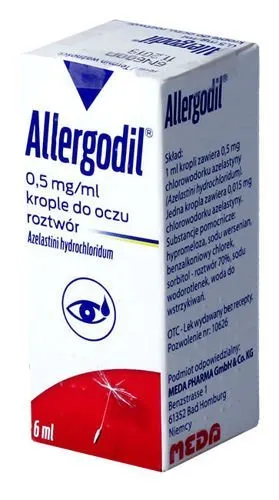
PolandThe medicine is used for the treatment and prevention of symptoms of allergic conjunctivitis. It helps to relieve redness, itching, and tearing of the eyes caused by hay fever or reactions to dust mites and animal hair.
Frequently asked questions
How to use Allergodil eye drops?
The usual dosage is 1 drop in each eye twice daily (morning and evening). In more severe cases, the dose may be 1 drop in each eye four times daily. It should be noted that the medicine should not be used for longer than 6 weeks without consulting a doctor.
When should the medicine not be used?
Do not use the preparation if you are allergic to azelastine or any of the ingredients of the medicine. It should also not be used to treat eye infections.
Can contact lenses be worn during treatment?
Wearing contact lenses is not recommended while using the medicine. They should be removed before applying the drops, and you should wait at least 15 minutes before putting them back in.
What side effects may occur?
Mild and transient eye irritation, such as stinging, itching, or tearing, may occur frequently. An unpleasant bitter taste in the mouth may occur uncommonly, and allergic reactions very rarely.
What should I do if I experience a bitter taste after applying the drops?
The bitter taste in the mouth should subside after drinking a non-alcoholic beverage, such as juice or milk.
How long can the opened bottle be stored?
The medicine should be used within 4 weeks of opening the bottle for the first time.
Instructions for use
Package leaflet: Information for the patient
Warning! Keep this leaflet! Information on the immediate packaging is in a foreign language.
Allergodil, eye drops, solution, 0,5 mg/ml (0,05%)
Azelastini hydrochloridum
Please read the entire leaflet carefully before using the medicine, as it contains
important information for the patient.
This medicine should always be used exactly as described in this patient leaflet or as directed by
a doctor or pharmacist.
- Keep this leaflet for future reference.
- If advice or additional information is needed, consult a pharmacist.
- If the patient experiences any adverse reactions, including any possible side effects not listed in this leaflet, inform a doctor or pharmacist. See section 4.
- If there is no improvement after 2 days or if the patient feels worse, contact a doctor.
Table of contents of the leaflet
- What Allergodil eye drops are and what they are used for
- Important information before using Allergodil eye drops
- How to use Allergodil eye drops
- Possible side effects
- How to store Allergodil eye drops
- Contents of the pack and other information
1. What Allergodil eye drops are and what they are used for
Allergodil eye drops belong to a group of medicines called antihistamines. Antihistamine medicines work by preventing the action of histamine, a substance produced by the body during an allergic reaction.
Allergodil eye drops are indicated for:
- treatment and prevention of symptoms of seasonal allergic conjunctivitis in adults and children over 4 years of age;
- treatment of symptoms of perennial allergic conjunctivitis in adults and children over 12 years of age.
Allergodil eye drops are used to relieve redness, itching, and watering of the eyes occurring in hay fever or as a result of allergic reactions to allergens such as house dust mites and animal dander.
Allergodil eye drops are used for eye problems associated with hay fever in adults and children aged 4 years and older.
Allergodil eye drops are used for eye problems caused by allergies to allergens such as house dust mites and animal dander in adults and children aged 12 years and older.
Allergodil eye drops must not be used for the treatment of eye infections.
2. Important information before using Allergodil eye drops
When not to use Allergodil eye drops
If the patient is allergic to azelastine hydrochloride or any of the other ingredients of this medicine (listed in section 6).
Warnings and precautions
Before starting treatment with Allergodil eye drops, discuss this with your doctor or pharmacist.
Contact your doctor if:
- There is uncertainty whether symptoms are caused by allergy. This particularly applies when symptoms affect only one eye, when there are vision disturbances, or when there is eye pain not accompanied by nasal symptoms.
- Symptoms worsen or do not improve within 48 hours, despite using Allergodil eye drops.
Allergodil eye drops are not indicated for the treatment of eye infections.
This medicine contains benzalkonium chloride as a preservative. Benzalkonium chloride may cause punctate keratitis and/or toxic ulcerative keratitis. (See also "Allergodil eye drops contain benzalkonium chloride" below).
While using Allergodil eye drops, wearing contact lenses is not recommended. Contact lenses must be removed before instillation of the drops and at least 15 minutes should elapse before reinserting them.
Children
Seasonal allergic conjunctivitis:
Allergodil eye drops should not be used in children under 4 years of age.
Perennial (year-round) allergic conjunctivitis:
Allergodil eye drops should not be used in children under 12 years of age.
Allergodil eye drops and other medicines
Tell your doctor about all medicines the patient is currently taking or has recently taken, as well as any medicines the patient plans to use.
No cases of interactions with other medicines have been reported.
Pregnancy and breastfeeding
If the patient is pregnant or breastfeeding, suspects she may be pregnant, or is planning to become pregnant, she should consult her doctor or pharmacist before using this medicine.
Driving and operating machinery
Mild, transient eye irritation after instillation of the drops may occur. Allergodil eye drops should not impair vision. However, patients experiencing any transient visual disturbances should not drive, operate machinery, or work without proper protection until these symptoms have resolved.
Allergodil eye drops contain benzalkonium chloride
Benzalkonium chloride may cause punctate keratitis and/or toxic ulcerative keratitis.
Benzalkonium chloride may be absorbed by soft contact lenses and may change their color. Contact lenses must be removed before instillation of the drops and at least 15 minutes should elapse before reinserting them.
Benzalkonium chloride may also cause eye irritation, especially in patients with dry eye syndrome or corneal disorders (the transparent layer at the front of the eye). If any abnormal sensations, stinging, or eye pain occur after using the medicine, contact your doctor.
3. How to use Allergodil eye drops
This medicine should always be used exactly as directed by your doctor or pharmacist. If in doubt,
consult your doctor or pharmacist.
Usual dose, unless otherwise advised by your doctor:
1 drop of Allergodil eye drops in each eye twice daily (morning and evening). In severe cases, the dose
may be increased to 1 drop in each eye four times daily.
Seasonal allergic conjunctivitis:
The above dosage applies to adults and children over 4 years of age. In case of anticipated exposure
to allergens, Allergodil eye drops should be used prophylactically before leaving the house.
Perennial (year-round) allergic conjunctivitis:
The above dosage applies to adults and children over 12 years of age.
Instructions for administration
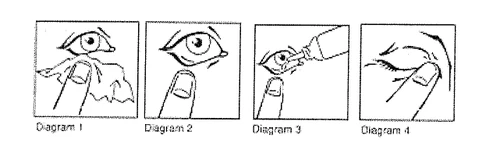
- Gently wipe the skin around the eyes with a tissue to remove excess moisture (see: diagram 1). Unscrew the cap of the dropper bottle.
- Tilt the head slightly backwards, gently pull down the lower eyelid (see: diagram 2) and carefully instill 1 drop into the conjunctival sac (see: diagram 3).
- Take care not to touch the eye with the tip of the dropper.
- Release the lower eyelid and gently press the inner corner of the eye towards the nose (see: diagram 4). Slowly blink several times to spread the drop evenly over the surface of the eye.
- Remove any excess medicine.
- To administer the drop into the other eye, repeat the above steps.
Allergodil eye drops should be continued after symptoms have subsided for as long as exposure to
allergens persists (e.g. pollen, dust).
Duration of treatment
In the case of perennial (year-round) allergic conjunctivitis, treatment with Allergodil eye drops should
be limited to a maximum of 6 weeks, as safety and tolerability have only been studied for a period of
6 weeks in clinical trials.
Use beyond 6 weeks should only occur under medical supervision, even in seasonal allergic
conjunctivitis.
Allergodil eye drops should not be used for longer than 6 weeks without consulting a doctor.
Use of a higher than recommended dose of Allergodil eye drops
No specific overdose reactions are known after instillation of this medicine into the eyes, and such
reactions are not expected with this route of administration.
Missed dose of Allergodil eye drops
If a dose of Allergodil eye drops is missed, no special action is required. Continue treatment as
planned. If necessary, Allergodil eye drops may also be administered between two scheduled
doses.
Stopping Allergodil eye drops
Allergodil eye drops should be used regularly, if possible, until symptoms have resolved.
If treatment with Allergodil eye drops is stopped, there is a likelihood of recurrence of typical
symptoms.
If in doubt about the use of this medicine, consult your doctor or pharmacist.
4. Possible adverse effects
Like all medicines, this medicine can cause adverse effects, although not everyone will experience them.
Common (less than 1 in 10, but more than 1 in 100 patients treated): mild, transient
eye irritation (e.g. burning, itching, tearing).
Uncommon (less than 1 in 100, but more than 1 in 1,000 patients treated): bitter
taste in the mouth.
Very rare (less than 1 in 10,000 patients treated): allergic reactions.
Management
The adverse effects listed above usually resolve quickly. Therefore, no specific action is required.
A bitter taste in the mouth after using Allergodil eye drops should disappear after drinking a non-alcoholic beverage (e.g. juice, milk).
Reporting adverse effects
If any adverse effects occur, including any not listed in this leaflet, patients should inform their doctor or pharmacist. Adverse effects can also be reported directly to the Department of Monitoring Adverse Drug Reactions, Office for Registration of Medicinal Products, Medical Devices and Biocidal Products, Al. Jerozolimskie 181C, 02-222 Warsaw, phone: +48 22 4921301, fax: +48 22 4921309; website: https://smz.ezdrowie.gov.pl.
Reporting adverse effects helps to provide more information on the safety of the medicine.
5. How to store Allergodil eye drops
Keep out of the sight and reach of children.
No special storage conditions required.
Do not use this medicine after the expiry date stated on the packaging. The expiry date refers to the last day of the stated month.
Period of use after first opening the bottle
Do not use Allergodil eye drops for longer than 4 weeks after first opening the bottle.
Medicines should not be disposed of via wastewater or household waste. Ask your pharmacist how to dispose of medicines no longer required. These measures will help protect the environment.
6. Contents of the packaging and other information
What Allergodil eye drops contains
The active substance is azelastine hydrochloride. 1 ml of solution contains 0.5 mg of azelastine hydrochloride. One drop with a volume of approximately 30 microliters contains 0.015 mg of azelastine hydrochloride.
Excipients: benzalkonium chloride (see also "Allergodil eye drops contain benzalkonium chloride" in section 2), disodium edetate, hypromellose, liquid sorbitol 70% crystallizing solution, sodium hydroxide, water for injections.
What Allergodil eye drops looks like and contents of the pack
Allergodil eye drops is a clear, colourless solution.
Allergodil eye drops is available in packs containing 6 ml of solution.
For more detailed information, please contact the marketing authorisation holder or parallel importer.
Marketing authorisation holder in France, the country of export:
Viatris Medical/Viatris Santé
1 bis place de la Défense – Tour Trinity
F 92400 Courbevoie
France
Manufacturer:
Tubilux Pharma S.p.A.
Via Costarica 20/22
00071 Pomezia (RM)
Italy
Parallel importer:
InPharm Sp. z o.o.
ul. Strumykowa 28/11
03-138 Warsaw
Repackaged by:
InPharm Sp. z o.o. Services sp. k.
ul. Chełmżyńska 249
04-458 Warsaw
Marketing authorisation number in France, the country of export: 3400934767203
Parallel import authorisation number: 388/25
Similar drugs
| Brand name | Dosage form | Active substance / Dosage | Manufacturer |
|---|---|---|---|
| ALLESTIN | drops, ophthalmic solution |
|
Farma Mediterrania, S.L. NOVOCAT FARMA S.A. |
| AZEL-DROP ALERGIA | drops, ophthalmic solution |
|
Dr. Gerhard Mann Chem. - Pharm. Fabrik GmbH |
| AZEL-DROP FREE | drops, ophthalmic solution |
|
Laboratoire Chauvin S.A. |
| AZELAMED | drops, ophthalmic solution |
|
mibe GmbH Pharmaceuticals |
| AZELASTIN COMOD | drops, ophthalmic solution |
|
Ursapharm Arzneimittel GmbH |
| AZELASTINE MISOM | drops, ophthalmic solution |
|
Eurofins BioPharma Product Testing Budapest Kft. |
The original data is available in the language of the country of manufacture.
Data source: Register of Medicinal Products of Poland (URPL)
Data last verified: September 01, 2026