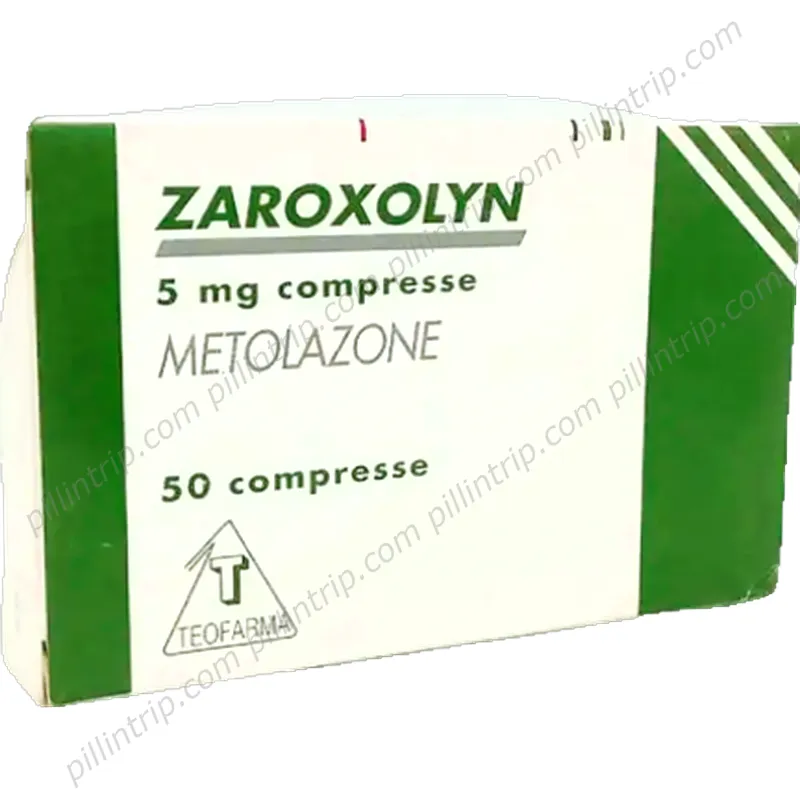
ZAROXOLYN
ItalyThis medicine is a diuretic that increases urine production by the kidneys. It is used to treat high blood pressure (hypertension), either alone or in combination with other medicines, and to treat fluid retention in the body.
Frequently asked questions
When should you not take Zaroxolyn?
This medicine must not be taken if you are allergic to metolazone or any of its ingredients, if you suffer from severe liver or kidney disease, if you have low potassium levels in the blood, if you have high uric acid levels (such as in gout), or if you suffer from Addison's disease.
How should the drug be taken?
Tablets should be taken in the morning, following your doctor's instructions exactly. For high blood pressure, the initial dose is 2.5 mg or 5 mg per day; for swelling due to heart problems, the dose is 5-10 mg per day, while for kidney problems it may vary between 5 and 20 mg per day.
What are the possible side effects of Zaroxolyn?
Common side effects may include headache, vomiting, muscle cramps, dizziness, and abdominal disturbances. Rarer side effects have also been reported, such as changes in heart rhythm, fatigue, vision problems, changes in blood sugar or salt levels, and skin reactions.
Are there interactions with other medicines or substances?
Yes. It is important to inform your doctor if you are taking other diuretics (such as furosemide), blood pressure medications, digitalis, lithium, anti-inflammatory drugs (NSAIDs), anticoagulants, or diabetes medications. Alcohol can also increase the effect of the drug on blood pressure.
Can it be taken during pregnancy or breastfeeding?
Metolazone crosses the placenta and must not be used during pregnancy. Furthermore, as it passes into breast milk, breastfeeding must be discontinued during the use of this medicine.
What to do in case of a missed dose or overdose?
If you forget a dose, do not take a double dose to compensate. In case of accidental ingestion of an excessive dose, you must immediately inform your doctor or go to the nearest hospital, as dehydration or a drop in blood salt levels may occur.
Instructions for use
Package leaflet: Information for the patient
Zaroxolyn 5 mg tablets, 10 mg tablets
metolazone
Please read this leaflet carefully before taking this medicine because it contains
important information for you.
- Keep this leaflet. You may need to read it again.
- If you have any questions, ask your doctor or pharmacist.
- This medicine has been prescribed for you only. Do not give it to other people, even if their symptoms are the same as yours, because it may be harmful.
- If you experience any adverse reactions, including those not listed in this leaflet, contact your doctor or pharmacist. See section 4.
Contents of this leaflet:
- What Zaroxolyn is and what it is used for
- What you need to know before taking Zaroxolyn
- How to take Zaroxolyn
- Possible side effects
- How to store Zaroxolyn
- Contents of the pack and other information
1. What Zaroxolyn is and what it is used for
Zaroxolyn contains the active substance metolazone. Metolazone belongs to a class of
medicines called "diuretics", which increase urine production by the kidneys.
Zaroxolyn is used for the treatment of high blood pressure (hypertension), either alone or, in more severe cases, in combination with other antihypertensive medicines.
Zaroxolyn is also indicated as a diuretic in all conditions involving fluid retention in the body
(hydrosaline retention).
2. What you need to know before taking Zaroxolyn
Do NOT take Zaroxolyn
- if you are allergic to metolazone or to any of the other ingredients of this medicine (listed in section 6);
- if you have severe liver disease (hepatic insufficiency);
- if you have severe kidney disease (renal insufficiency);
- if you have low levels of potassium in your blood;
- if you have high levels of uric acid in your blood (symptomatic hyperuricemia, one of the causes of gout);
- if you have a disease causing insufficient hormone production by the adrenal glands (Addison's disease).
Warnings and precautions
Talk to your doctor or pharmacist before taking Zaroxolyn.
Be especially careful with Zaroxolyn:
- if you have or have had gout or if you have high levels of nitrogen and uric acid in your blood. In predisposed individuals, Zaroxolyn may trigger gout attacks. In such cases, Zaroxolyn must be discontinued;
- if you have diabetes. Your doctor will prescribe regular monitoring of your blood sugar levels, as increased blood sugar levels (hyperglycemia) and sugar in the urine (glycosuria) may occur;
- if you have liver disorders (hepatic insufficiency), because low potassium levels in the blood may trigger brain disorders (encephalopathy);
- if you have kidney disorders, because blood levels of this medicine may increase. If elevated blood nitrogen levels (hyperazotemia) and reduced urine output (oliguria) worsen during treatment in patients with reduced kidney function (renal insufficiency), Zaroxolyn must be discontinued;
- if you produce a very large amount of urine, because a drop in blood pressure (acute hypotension) may occur;
- if electrolyte imbalances occur, as detected by specific diagnostic tests, i.e. conditions characterized by low levels of potassium, sodium, and chloride, and high levels of calcium. Symptoms of electrolyte imbalances may include: dry mouth, thirst, weakness, tendency to prolonged sleep (lethargy), drowsiness, restlessness, muscle pain or cramps, muscle fatigue (muscle fatigability), low blood pressure (hypotension), reduced urine output (oliguria), rapid heartbeat (tachycardia), or gastrointestinal disturbances (nausea, vomiting, etc.).
Your doctor may perform regular tests to monitor your blood levels of potassium,
sodium, chloride, and calcium.
This is particularly important if you:
- experience excessive vomiting or are receiving intravenous fluids,
- have fluid accumulation (edema) associated with impaired heart function (heart failure) or reduced kidney function (renal insufficiency),
- follow a low-salt diet,
- live in a hot climate.
Your doctor will also prescribe periodic checks to monitor blood levels of nitrogen (azotemia),
uric acid (uricemia), glucose (glycemia), and fats.
If these tests reveal low potassium levels in your blood, your doctor may prescribe
additional potassium supplementation or the use of a potassium-sparing medicine.
Low potassium levels in the blood (hypokalemia) may cause:
- muscle weakness (asthenia),
- cramps,
- heart rhythm disturbances (cardiac arrhythmias).
Children and adolescents
The use of Zaroxolyn is not recommended in pediatric patients.
Other medicines and Zaroxolyn
Tell your doctor or pharmacist if you are currently using, have recently used, or might use any
other medicines.
If you are taking the following medicines, your doctor will monitor you closely and assess whether
adjustments to the dose of Zaroxolyn or your other medicines are needed:
- diuretics (such as furosemide). Administering metolazone with furosemide increases urine production, which may increase the risk of low potassium levels in the blood (hypokalemia);
- other medicines to lower blood pressure, because their effect on blood pressure may be enhanced, and their dosage may need to be reduced;
- digitalis for treating heart problems, because low potassium levels in the blood may cause potentially fatal heart rhythm disturbances;
- barbiturates and opioid analgesics, because they may enhance the blood pressure-lowering effect of metolazone;
- cyclosporine;
- captopril;
- corticosteroids and adrenocorticotropic hormone (ACTH);
- lithium;
- neuromuscular blocking agents, because Zaroxolyn enhances their effect, potentially leading to respiratory depression up to apnea. Your doctor will instruct you to stop Zaroxolyn at least 3 days before surgery if neuromuscular blocking agents are to be used for anesthesia;
- non-steroidal anti-inflammatory drugs (NSAIDs), because they increase the risk of kidney toxicity. NSAIDs may also reduce the effectiveness of Zaroxolyn;
- sympathomimetics (such as norepinephrine);
- medicines for diabetes;
- medicines used to thin the blood (anticoagulants), such as warfarin, because they may increase bleeding time.
Zaroxolyn may be administered, when indicated, together with a potassium-sparing diuretic (a medicine used to increase urine production). Your doctor will prescribe frequent monitoring of blood potassium levels, and you should avoid taking potassium supplements. Your doctor may also reduce the doses.
Zaroxolyn and alcohol
Alcohol may enhance the blood pressure-lowering effect of metolazone.
Pregnancy, breastfeeding, and fertility
If you are pregnant, think you may be pregnant, are planning to become pregnant, or are breastfeeding,
please consult your doctor or pharmacist before taking this medicine.
Metolazone crosses the placenta and therefore should not be used during pregnancy.
In newborns of mothers who took the medicine, yellowing of the skin, mucous membranes, and eyes (jaundice) and reduced platelet count in the blood (neonatal thrombocytopenia) have been reported.
Metolazone passes into breast milk; therefore, breastfeeding must be discontinued during treatment
with Zaroxolyn.
Driving and using machines
No effects of metolazone on the ability to drive or operate machinery are known.
For those engaged in sports activities
Using this medicine without therapeutic need constitutes doping and may lead to a positive result in anti-doping tests.
3. How to take Zaroxolyn
Take this medicine exactly as prescribed by your doctor or pharmacist.
If you have any doubts, consult your doctor or pharmacist.
High blood pressure (hypertension)
The recommended starting dose is 2.5 mg (half a tablet) or 5 mg once daily in the morning.
Swelling due to fluid retention (edema) caused by heart failure
The recommended starting dose is 5–10 mg once daily in the morning.
Swelling due to fluid retention (edema) caused by kidney failure
The recommended starting dose is 5–20 mg once daily in the morning.
Once the desired treatment effect has been achieved, your doctor will assess reducing the dose to the lowest maintenance level (2.5 mg or 5 mg on alternate days).
The duration of initial treatment with the higher dose may vary from a few days (in the treatment of fluid retention-related swelling) up to 3–4 weeks (in the treatment of high blood pressure).
Use in elderly patients
If you are an elderly patient, your doctor will prescribe lower starting doses.
Use in patients with kidney problems (renal impairment)
If you have kidney problems, your doctor will adjust the dose of Zaroxolyn according to your kidney function.
Use in children and adolescents
Zaroxolyn is not recommended for use in pediatric patients.
If you take more Zaroxolyn than you should
If you accidentally take too much of this medicine, contact your doctor immediately or go to the nearest hospital.
After taking an excessive dose, dehydration and a decrease in blood salts (electrolyte depletion) may occur.
If you forget to take Zaroxolyn
Do not take a double dose to make up for the missed dose.
If you stop taking Zaroxolyn
If you have any questions about how to use this medicine, consult your doctor or pharmacist.
4. Possible side effects
Like all medicines, this medicine can cause side effects, although not everybody will experience them.
During treatment with Zaroxolyn, the following have been occasionally reported:
- headache,
- anorexia,
- vomiting,
- abdominal discomfort,
- muscle cramps,
- dizziness,
- increased levels of uric acid (hyperuricaemia) and nitrogen (azotaemia) in the blood, particularly in patients with impaired kidney function.
In addition, the following rare (may affect up to 1 in 1,000 people) or very rare (may affect up to 1 in 10,000 people) side effects have been reported with metolazone (the active substance contained in Zaroxolyn):
- reduced number of white blood cells in the blood (leucopenia), reduced number of red blood cells, white blood cells and platelets in the blood (aplastic anaemia),
- reduced number of platelets in the blood (thrombocytopenia),
- painful swelling and redness of the joints (gout attacks),
- dizziness,
- drowsiness,
- headache,
- tingling sensations (paraesthesia),
- agitation,
- difficulty sleeping,
- loss of consciousness (syncope),
- blurred vision,
- irregular heartbeat (palpitations),
- chest pain,
- sudden drop in blood pressure (orthostatic hypotension) when standing up from a lying position,
- reduction in circulating blood volume (hypovolaemia),
- formation of a blood clot in a vein (venous thrombosis),
- constipation,
- dry mouth,
- nausea,
- vomiting,
- anorexia,
- diarrhoea,
- gas production,
- stomach heaviness,
- inflammation of the pancreas (pancreatitis),
- retention of bile within the liver (intrahepatic cholestasis),
- inflammation of the liver (hepatitis),
- skin rash (exanthems),
- severe skin reactions,
- cramps, sudden and involuntary muscle contractions (muscle spasms),
- low levels of potassium, sodium, chloride and phosphorus in the blood,
- decreased chloride levels in the blood and consequent increase in blood bases (hypochloraemic alkalosis),
- presence of sugar in the urine (glycosuria),
- elevated levels of nitrogen, creatinine, uric acid (hyperuricaemia) and blood sugar (hyperglycaemia),
- urticaria,
- purple or red-brown skin spots (purpura),
- disease affecting blood vessels associated with tissue death (necrotising vasculopathy),
- chills,
- fatigue.
If you experience side effects of moderate or severe intensity, your doctor will assess whether to reduce the dose of Zaroxolyn or discontinue treatment.
Reporting of side effects
If you experience any side effect, including those not listed in this leaflet, talk to your doctor or pharmacist. You can also report side effects directly via the national reporting system at www.aifa.gov.it/content/segnalazioni-reazioni-avverse. By reporting side effects, you can help provide more information on the safety of this medicine.
5. How to store Zaroxolyn
Keep this medicine out of the sight and reach of children.
Store in the original packaging to protect the medicine from light.
Do not use this medicine after the expiry date stated on the pack after "Exp".
The expiry date refers to the last day of that month.
Do not dispose of medicines via wastewater or household waste. Ask your pharmacist how to dispose of medicines you no longer use. This will help protect the environment.
6. Package contents and other information
What Zaroxolyn contains
Zaroxolyn 5 mg tablets
- The active substance is metolazone. Each tablet contains 5 mg of metolazone.
- The other components are microcrystalline cellulose, magnesium stearate.
Zaroxolyn 10 mg tablets
- The active substance is metolazone. Each tablet contains 10 mg of metolazone.
- The other components are microcrystalline cellulose, magnesium stearate, E 127 (as 15% aluminium lake).
Description of the appearance of Zaroxolyn and contents of the pack
Zaroxolyn 5 mg tablets
Each pack contains 50 tablets of 5 mg.
Zaroxolyn 10 mg tablets
Each pack contains 50 tablets of 10 mg.
Marketing Authorization Holder
Teofarma S.r.l.
Via F.lli Cervi, 8
27010 Valle Salimbene (PV)
Manufacturer
Teofarma S.r.l
Viale Certosa, 8/A
27100 Pavia
The original data is available in the language of the country of manufacture.
Data source: Italian Medicines Agency (AIFA)
Data last verified: September 21, 2026