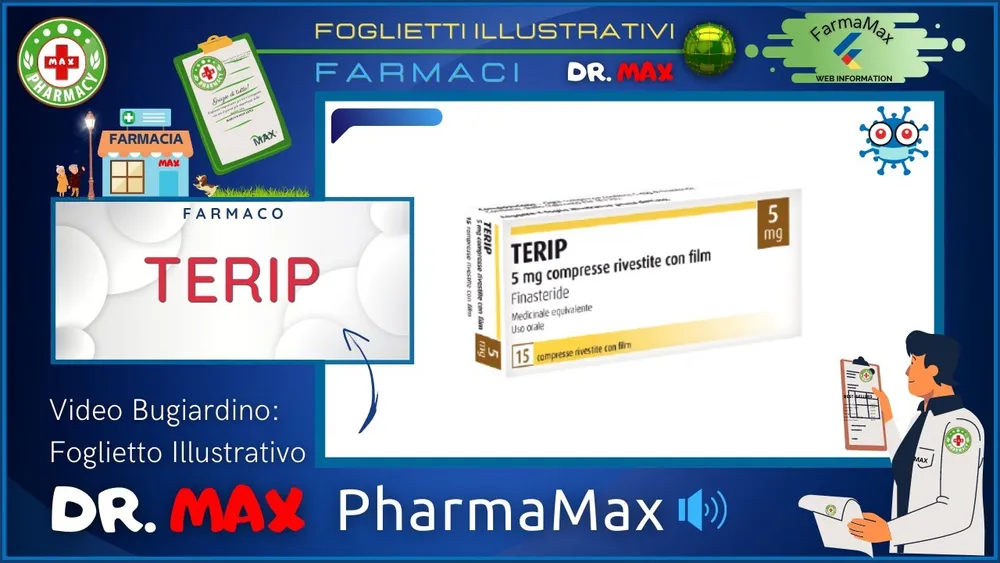
TERIP
ItalyThis medicine is used to shrink an enlarged prostate gland in men (benign prostatic hyperplasia), helping to reduce urinary difficulties and the risk of surgery.
Frequently asked questions
How should TERIP be taken?
The recommended dose is one 5 mg tablet to be taken orally once a day, with or without food. It is important to always follow your doctor's instructions, as they may prescribe treatment for at least six months.
Who should not take this medicine?
People allergic to finasteride or any of its ingredients, women, and children should not take this medicine. Women who are pregnant or suspect they may be pregnant should not take the medicine and must also avoid handling broken or crushed tablets.
What are the common side effects of TERIP?
The most frequent side effects may include decreased semen volume, impotence, and decreased libido. These symptoms often appear at the start of therapy and tend to resolve as treatment continues.
Are there other side effects to monitor?
Less common side effects may occur, such as skin rashes, ejaculation disorders, or breast changes. Problems related to mood (such as depression or suicidal thoughts) and severe allergic reactions (swelling of the face, tongue, or throat and difficulty breathing) have also been reported. In the latter cases, it is necessary to stop treatment and contact a doctor immediately.
Does the drug interact with other medicines?
No clinically significant interactions with other drugs have been identified, including some used for high blood pressure, heart rhythm, diabetes, prevention of blood clots, asthma, or inflammation.
What do I need to know regarding blood tests?
If blood tests are to be performed to measure PSA levels (an indicator for prostate cancer), it is important to inform the doctor, as finasteride can alter the results of this test.
Instructions for use
Package leaflet: Information for the user
TERIP 5 mg film-coated tablets
Finasteride
Generic medicine
Please read this leaflet carefully before taking this medicine because it contains important information for you.
- Keep this leaflet. You may need to read it again.
- If you have any questions, ask your doctor or pharmacist.
- This medicine has been prescribed for you only. Do not give it to other people, even if their symptoms are the same as yours, as it may be harmful.
- If you experience any adverse reaction, including those not listed in this leaflet, consult your doctor, pharmacist, or nurse. See section 4.
Contents of this leaflet:
- What TERIP is and what it is used for
- What you need to know before taking TERIP
- How to take TERIP
- Possible side effects
- How to store TERIP
- Contents of the pack and other information
1. What TERIP is and what it is used for
TERIP belongs to a group of medicines called 5-alpha reductase inhibitors. This medicine works by shrinking an enlarged prostate gland in men.
Your doctor has prescribed TERIP because you have a condition known as benign prostatic hyperplasia or BPH. Your prostate gland, located near the bladder, has become enlarged, causing significant difficulty in urinating.
TERIP helps shrink the enlarged prostate, thereby relieving your symptoms. TERIP will also help reduce the risk of developing sudden difficulty in urinating (also known as acute urinary retention) and the need for subsequent surgical intervention.
2. What you need to know before taking TERIP
Do not take TERIP:
- if you are allergic (hypersensitive) to finasteride or to any of the other ingredients of this medicine
- if you are a woman or a child
- if you are a pregnant woman or suspect you may be pregnant (see section “Pregnancy and Breastfeeding”).
Warnings and precautions
Benign prostatic hyperplasia (BPH) is not a malignant tumour and cannot become one, but both conditions may be present simultaneously. Your doctor will evaluate your symptoms, their possible causes, and the appropriate treatment for you. Inform your doctor:
- if you have or have had any medical conditions, diseases or allergies;
- if you have difficulty completely emptying your bladder or a markedly reduced urine flow.
Inform your doctor if you have been taking finasteride for 6 months or longer and if you need to have blood tests to determine your PSA levels (a marker for possible prostate cancer), as finasteride may affect the results of this test.
Mood changes and depression
Mood changes such as depressed mood, depression, and, less frequently, suicidal thoughts have been reported in patients treated with TERIP. If you experience any of these symptoms, contact your doctor as soon as possible for further advice.
Children and adolescents
Finasteride is not indicated for pediatric use, as its safety and efficacy in children have not been established.
Other medicines and TERIP
Inform your doctor or pharmacist if you are taking, have recently taken, or might take any other medicines, including those not requiring a prescription.
No clinically significant interactions between finasteride and other medicines have been identified. In particular, NO significant interactions have been observed with the following medicines:
- propranolol (used to treat high blood pressure and angina pectoris);
- digoxin (used to treat heart rhythm problems);
- glibenclamide (used to lower blood sugar levels);
- warfarin (used to prevent blood clots);
- theophylline (used to treat asthma);
- phenazone (used to treat inflammation).
TERIP with food and drinks
TERIP may be taken with or without food.
Pregnancy and breastfeeding
If you are pregnant, suspect you may be pregnant, plan to become pregnant, or are breastfeeding, ask your doctor or pharmacist for advice before taking this medicine.
Pregnancy
If your sexual partner is pregnant or suspects she may be pregnant, you must avoid exposing her to your semen, as it may contain a small amount of the medicine.
If a woman is pregnant or suspects she may be pregnant, she must not take TERIP (see section “Do not take TERIP”).
Furthermore, such women should not handle crushed or broken tablets, as the active ingredient in the tablets could be absorbed through the skin and may interfere with the normal development of a male fetus.
The entire TERIP tablet is coated to prevent contact with the active ingredient during normal handling of the medicine.
Breastfeeding
It is not known whether finasteride is excreted in human milk; however, women should not take TERIP.
Driving and using machines
There are no data suggesting that TERIP affects the ability to drive or operate machinery.
TERIP contains sunset yellow
This medicine contains the colour sunset yellow FCF (E110), which may cause allergic reactions.
TERIP contains sodium
This medicine contains less than 1 mmol (23 mg) of sodium per dose, i.e. essentially ‘sodium-free’.
3. How to take TERIP
Take this medicine exactly as your doctor has told you. If you have any doubts, consult your doctor or pharmacist. The recommended dose is one tablet containing 5 mg of finasteride, to be taken orally once daily, with or without food.
Your doctor may prescribe TERIP together with another medicine called doxazosin to help control your BPH.
Although improvement is often seen after a short period, treatment may need to be continued for at least six months. Your doctor will advise you on how long to take TERIP.
Use in patients with renal impairment
If you have reduced kidney function (renal impairment), it is not necessary to adjust the dose of TERIP.
Use in elderly patients
If you are elderly, it is not necessary to adjust the dose of TERIP, although in patients over 70 years of age, finasteride is eliminated to a lesser extent.
If you take more TERIP than you should
If you have taken an excessive amount of tablets by mistake, contact your doctor immediately.
No adverse effects have been reported in patients who have taken high doses of TERIP for periods up to three months.
If you forget to take TERIP
Do not take a double dose to make up for the forgotten dose.
If you stop taking TERIP
If you have any questions about the use of this medicine, ask your doctor or pharmacist.
4. Possible side effects
Like all medicines, this medicine can cause side effects, although not everyone experiences them.
Impotence and decreased sexual desire are the most common adverse reactions. These adverse reactions
occur during the initial phase of treatment and resolve in most patients during the course of therapy.
Common side effects (may affect up to 1 in 10 people):
- reduced semen volume
- impotence
- decreased sexual desire
Uncommon side effects (may affect up to 1 in 100 people):
- rash
- ejaculation disorders
- breast tenderness
- breast enlargement
Side effects with unknown frequency (frequency cannot be estimated from the available data):
- irregular heartbeat
- hypersensitivity reactions such as itching, urticaria, and swelling (angioedema) of various body parts including lips, tongue, throat, and face
- increased liver enzymes
- testicular pain
- presence of blood in semen
- erectile dysfunction, which may persist after discontinuation of finasteride
- male infertility and/or poor semen quality, which normalizes or improves after discontinuation of finasteride
- breast cancer in men
- depression
- persistent reduction in sexual desire after stopping treatment
- persistent ejaculation problems after stopping treatment
- anxiety
- suicidal thoughts
Diagnostic tests
If you need to have blood tests to determine PSA levels (a marker for possible prostate cancer), be aware that finasteride may affect the results of this test.
Promptly inform your doctor of any changes in breast tissue, such as the appearance of lumps, pain, breast enlargement, or nipple discharge, as these may be signs of a serious condition such as breast cancer.
Stop treatment with TERIP and contact your doctor immediately if you experience any of the following symptoms of angioedema:
- swelling of the face, tongue, or throat
- difficulty swallowing
- urticaria
- difficulty breathing
Reporting of side effects
If you experience any side effect, including those not listed in this leaflet, talk to your doctor, pharmacist, or nurse. You can also report side effects directly via the national reporting system: https://www.aifa.gov.it/content/segnalazioni-reazioni-avverse
By reporting side effects, you can help provide more information on the safety of this medicine.
5. How to store TERIP
Keep this medicine out of the sight and reach of children.
This medicinal product does not require any special storage conditions.
Do not use this medicine after the expiry date stated on the packaging. The expiry date refers to the last day of the month.
Do not dispose of any medicine via wastewater or household waste. Ask your pharmacist how to dispose of medicines you no longer use. This will help protect the environment.
6. Package contents and other information
What TERIP contains
- The active substance is finasteride.
- The other excipients are: microcrystalline cellulose, pregelatinized corn starch, sodium starch glycolate, yellow iron oxide (E172), sodium docusate, magnesium stearate. Coating: hypromellose, titanium dioxide (E171), talc, propylene glycol, indigo carmine (E132), quinoline yellow FCF (E104), sunset yellow FCF (E110).
Description of the appearance of TERIP and package contents
TERIP is available as blue, round, biconvex film-coated tablets with a score line on one side.
TERIP is available in blisters containing 15 film-coated tablets.
Marketing Authorisation Holder and manufacturer
Marketing Authorisation Holder
Pharmacare S.r.l.
Via Marghera, 29
20149 Milan
Italy
Manufacturer
Pharmathen S.A.
6 Dervenakion str.
Pallini 15351
Attica
Greece
KLEVA S.A.
189, Parnithos Ave.,
Acharnai Attica,
13675 Greece
Pharmathen International S.A
Industrial Park Sapes,
Rodopi Prefecture, Block No 5
Rodopi 69300
Greece
Similar drugs
| Brand name | Dosage form | Active substance / Dosage | Manufacturer |
|---|---|---|---|
| ASTERID | tablets, film-coated | EPIFARMA S.R.L | |
| FINASTERIDE ABC | tablets, film-coated | ABC FARMACEUTICI S.P.A. | |
| FINASTERIDE ALTER | tablets, film-coated | LABORATORI ALTER S.R.L. | |
| FINASTERIDE AUROBINDO | tablets, film-coated | AUROBINDO PHARMA (ITALIA) S.R.L. | |
| FINASTERIDE DOC GENERICI | tablets, film-coated | DOC GENERICI SRL | |
| FINASTERIDE IPSOPHARMA | tablets, film-coated | IPSO PHARMA S.R.L. | |
| FINASTERIDE MEDREG | tablets, film-coated | MEDREG S.R.O. | |
| FINASTERIDE MYLAN ITALIA | tablets, film-coated | MYLAN S.P.A. | |
| FINASTERIDE SANDOZ | tablets, film-coated | SANDOZ S.P.A. | |
| FINASTERIDE TECNIGEN | tablets, film-coated | TECNIMEDE - SOCIEDADE TECNICO-MEDICINAL, SA | |
| FINASTERIDE TEVA ITALIA | tablets, film-coated | TEVA ITALIA S.R.L. | |
| FINASTERIDE ZENTIVA | tablets, film-coated | ZENTIVA ITALIA S.R.L. |
The original data is available in the language of the country of manufacture.
Data source: Italian Medicines Agency (AIFA)
Data last verified: September 21, 2026