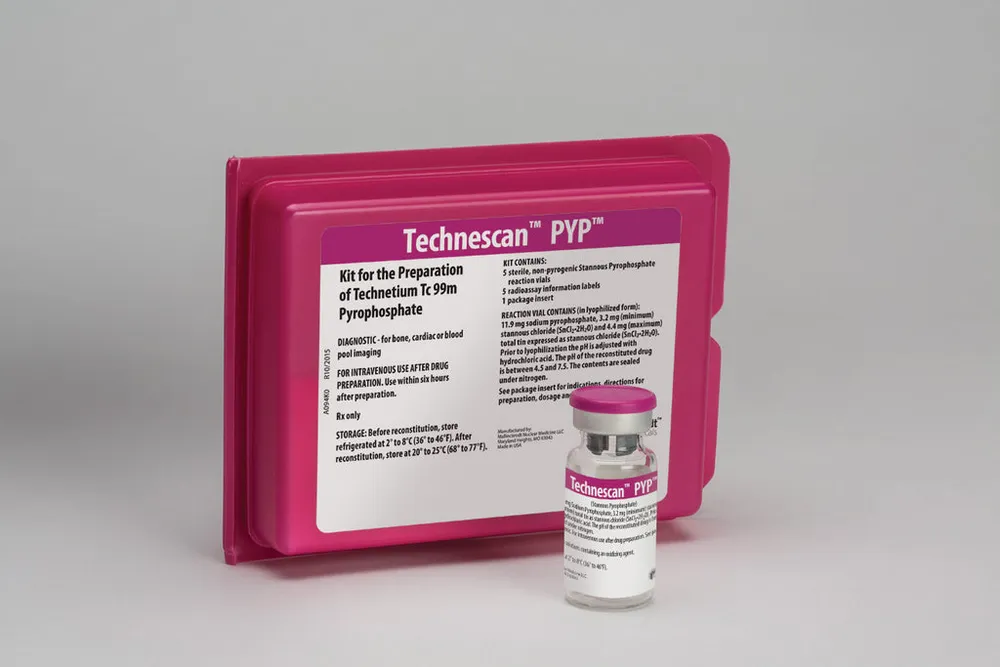
TECHNESCAN PYP
ItalyIt is a radiopharmaceutical product used for diagnostic examinations via scanning. It is used to examine the spleen, cardiac function, blood flow between organs, blood volume, and to detect occult abdominal or intestinal bleeding.
Frequently asked questions
When must Technescan PYP not be used?
It must not be used if you are allergic to sodium pyrophosphate decahydrate or any of the other components of the medicinal product.
What precautions should be taken before administration?
It is necessary to inform the specialist in case of pregnancy or suspected pregnancy, breastfeeding, or kidney disease. Before the examination, it is important to drink plenty of water to promote urination in the following hours.
Are there any drugs that can interfere with the examination?
Yes, some medicines may affect the interpretation of the images. These include: coagulation drugs (such as heparin), tin- or aluminum-based medicines, blood pressure drugs, certain treatments for heart disorders, some cancer drugs, iodine-based contrast media, and teflon catheters.
How is Technescan PYP administered?
It is administered via intravenous injection by qualified personnel. It can be injected directly or mixed with a blood sample before being re-injected.
What should be done after the injection?
You should urinate frequently to eliminate the medicine from the body and, for the 2 hours following the procedure, avoid close contact with children and pregnant women.
What are the side effects of Technescan PYP?
Allergic reactions (such as itching, hives, swelling, nausea, difficulty breathing, or rapid heartbeat), vasovagal reactions (such as fainting, dizziness, headache, or blurred vision), and local reactions at the injection site (such as pain, redness, or swelling) may occur.
What to do in case of adverse reactions?
If any symptom or undesirable effect occurs, it is necessary to contact the nuclear medicine specialist immediately.
Instructions for use
Package leaflet: Information for the patient
Technescan PYP 20 mg
Kit for radiopharmaceutical preparation
sodium pyrophosphate decahydrate
Please read this leaflet carefully before you are given this medicine because it contains important information for you.
- Keep this leaflet. You may need to read it again.
- If you have any questions, ask the nuclear medicine specialist supervising the procedure.
- If you experience any side effects, including those not listed in this leaflet, contact the nuclear medicine specialist.
Contents of this leaflet
- What Technescan PYP is and what it is used for
- What you need to know before Technescan PYP is used
- How Technescan PYP is used
- Possible side effects
- How Technescan PYP is stored
- Contents of the pack and other information
1. What Technescan PYP is and what it is used for
The medicinal product is a radiopharmaceutical for diagnostic use only.
Technescan PYP is used during a scan to examine:
- spleen
- cardiac function
- blood flow through organs
- occult abdominal or intestinal bleeding
- blood volume
The medicine is a non-radioactive powder. When prepared by qualified personnel, it is used to induce "stannous loading" of red blood cells prior to the use of a radioactive solution of sodium pertechnetate (Tc), which is required for red blood cell labelling.
When injected into the body, it accumulates in certain organs such as the spleen or in red blood cells.
The radioactive substance can be detected from outside the body using special machines that produce an image called a scan. This scan shows the distribution of radioactivity within the organ and body. Furthermore, the scan provides the physician with valuable information about the structure and function of the organ.
The use of Technescan PYP followed by sodium pertechnetate (Tc) involves exposure to low levels of radioactivity. Your physician and the nuclear medicine specialist have determined that the clinical benefit you will receive from the radiopharmaceutical procedure outweighs the risk associated with radiation exposure.
2. What you need to know before Technescan PYP is used
Technescan PYP must not be used:
- If you are allergic to disodium pyrophosphate decahydrate or to any of the other ingredients of this medicine (listed in section 6).
Warnings and precautions
Exercise particular caution with Technescan PYP
- If you are pregnant or suspect you may be pregnant
- If you are breastfeeding
- If you have kidney disease
Before administration of Technescan PYP you should
- Drink plenty of water before the examination begins, in order to urinate as frequently as possible during the first hours following the procedure.
Children and adolescents
Consult the nuclear medicine specialist if you are under 18 years of age.
Other medicines and Technescan PYP
Inform the nuclear medicine specialist if you are taking, have recently taken, or might take any other medicines, as they could interfere with the interpretation of the images.
The following medicines/materials may affect the Technescan PYP examination:
- Medicines to prevent blood clotting, such as heparin
- Medicines containing tin
- Gastric acid-binding medicines containing aluminium
- Medicines to reduce blood pressure, such as prazosin, methyldopa, hydralazine, verapamil, nifedipine
- Medicines for treating heart conditions, such as
- quinidine
- Medicines whose active substance names end in "olol", such as propranolol
- digitoxin or similar medicines
- nitrates, such as nitroglycerin
- Some anticancer medicines, whose active substance names generally end in "rubicin"
- Iodine-based contrast agents
- Teflon catheters
Pregnancy and breastfeeding
If you are pregnant, suspect you may be pregnant, plan to become pregnant, or are breastfeeding, consult the nuclear medicine specialist before receiving this medicine.
Inform the nuclear medicine specialist before administration of Technescan PYP if there is any possibility you are pregnant, if you have missed a menstrual period, or if you are breastfeeding.
If you have any doubts, it is important to consult the nuclear medicine specialist supervising the procedure.
If you are pregnant
The nuclear medicine specialist will administer the medicine during pregnancy only if the expected benefits outweigh the risks.
If you are breastfeeding
Inform the nuclear medicine specialist, as he/she may advise you to interrupt breastfeeding until radioactivity has been eliminated from your body. This takes approximately 4 to 12 hours, depending on the radiolabelling procedure.
Breast milk produced during this period must be discarded. Ask the nuclear medicine specialist when you can resume breastfeeding.
Additionally, you may be advised to avoid close contact with the baby for up to two hours after the procedure.
Driving and using machines
It is unlikely that Technescan PYP will affect your ability to drive or operate machinery.
Technescan PYP contains sodium
This medicine contains less than 1 mmol (23 mg) of sodium per vial, i.e. it is essentially "sodium-free".
3. How Technescan PYP is used
There are very strict regulations regarding the use, handling, and disposal of radiopharmaceuticals. Technescan PYP will only be used in specially designated and controlled areas. This medicine will be handled and administered exclusively by trained and qualified personnel experienced in the safe use of such products. These personnel will ensure the safe use of this medicine and will inform you about the actions being taken. The nuclear medicine specialist supervising the procedure will determine the amount of Technescan PYP and sodium pertechnetate (Tc) to be used in your case. This will be the minimum quantity necessary to obtain the required diagnostic information.
The usual recommended dose of sodium pertechnetate (Tc) to be administered in adults ranges from 1 to 925 MBq (megabecquerels, the units used to express radioactivity) when injected intravenously. This may be performed directly (method for in vivo red blood cell labelling) or after mixing with a sample of your blood (method for in vitro red blood cell labelling).
Use in children and adolescents
In children and adolescents, the administered dose will be adjusted according to the child's body weight.
Administration of Technescan PYP and procedure performance
Technescan PYP is administered by intravenous injection, followed 30 minutes later by an injection of sodium pertechnetate (Tc) (in vivo labelling method).
Alternatively, Technescan PYP may be added to a sample of your blood and mixed with a solution of sodium pertechnetate (Tc). Your radiolabelled red blood cells are then re-injected intravenously.
A single injection of Technescan PYP is sufficient to perform the test requested by the physician.
Duration of the procedure
The nuclear medicine specialist will inform you about the expected duration of the procedure.
After administration of Technescan PYP, you must
- avoid close contact with children and pregnant women for the next 2 hours following the radiolabelling procedure.
- urinate frequently to help eliminate the medicine from your body.
Repeating the procedure is not recommended within 3 months, as the tin component of this medicine remains in red blood cells for extended periods.
The nuclear medicine specialist will inform you if any special precautions are required after taking the medicine. For any questions, please consult the nuclear medicine specialist supervising the procedure.
If you are given more Technescan PYP than you should
An overdose is unlikely, as the nuclear medicine specialist supervising the procedure will administer a carefully controlled single dose of Technescan PYP.
However, in the event of an overdose, your doctor will provide appropriate treatment. In particular, the nuclear medicine specialist performing the procedure may recommend drinking large amounts of fluids and urinating frequently to help remove traces of radioactivity from the body.
If you have any further questions about the use of Technescan PYP, please consult the nuclear medicine specialist supervising the procedure.
4. Possible side effects
Like all medicines, this medicine can cause side effects, although not everybody gets them.
Side effects with unknown frequency (frequency cannot be estimated from the available data):
- Allergic reactions:
- flushing
- generalized itching, urticaria, redness
- vasodilation with drop in blood pressure
- sweating
- swelling of the arm or face
- nausea, vomiting
- rapid heartbeat
- loss of consciousness
- shortness of breath
- difficulty swallowing
- muscle cramps and pain
- excessive tearing
- taste disturbances
- Vasovagal reactions:
- fainting
- headache, dizziness
- confusion
- slow heartbeat
- ringing in the ears
- tremor, chills
- pallor
- blurred vision
- abnormal skin sensations such as tingling
- Local and general reactions:
- chest pain
- local skin reactions at the injection site: skin rash, itching, pain, swelling, inflammation and cellulitis (skin infection)
If you experience any of these symptoms, contact the nuclear medicine specialist immediately.
This radiopharmaceutical emits low amounts of ionizing radiation, which carry a very low risk of cancer and hereditary abnormalities.
Reporting of side effects
If you get any side effect, including those not listed in this leaflet, talk to the nuclear medicine specialist. You can also report side effects via
https://www.aifa.gov.it/content/segnalazioni-reazioni-avverse.
By reporting side effects, you can help provide more information on the safety of this medicine.
5. How Technescan PYP is stored
It is not your responsibility to store this medicine. This medicine is stored by a specialist under appropriate conditions. Storage of radiopharmaceuticals must comply with national regulations concerning radioactive materials.
The following information is intended exclusively for the specialist.
Do not use Technescan PYP after the expiry date stated on the label after "EXP".
Do not use Technescan PYP if you notice any visible signs of deterioration.
6. Package contents and other information
What Technescan PYP contains
- The active substance is sodium pyrophosphate decahydrate. Each vial contains 20 mg of sodium pyrophosphate decahydrate.
- The other excipients are stannous chloride dihydrate, sodium hydroxide, and hydrochloric acid.
Description of the appearance of Technescan PYP and contents of the pack
Technescan PYP contains a powder contained in a 10 mL glass vial with a bromobutyl rubber stopper and sealed with an aluminum cap. Pack: 5 vials.
Marketing Authorization Holder and Manufacturer
Curium Netherlands B.V.
Westerduinweg 3
1755 LE Petten
The Netherlands
The following information is intended exclusively for healthcare professionals:
The complete product characteristics summary (SmPC) for Technescan PYP is provided as a separate document within the product packaging, aimed at providing healthcare professionals with additional scientific and practical information on the administration and use of this radiopharmaceutical.
Refer to the SmPC of Technescan PYP.
The original data is available in the language of the country of manufacture.
Data source: Italian Medicines Agency (AIFA)
Data last verified: September 21, 2026