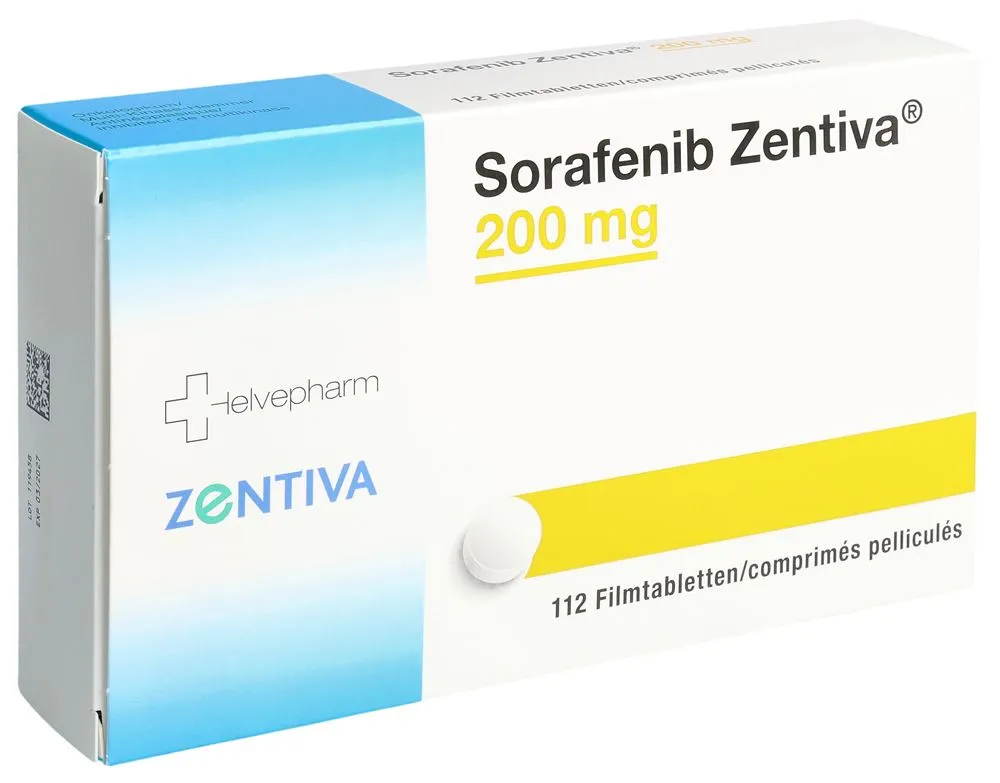
SORAFENIB ZENTIVA
ItalyIt is used for the treatment of liver cancer (hepatocellular carcinoma), advanced kidney cancer (when standard therapy is not effective or suitable), and thyroid cancer (differentiated carcinoma).
Frequently asked questions
How should I take Sorafenib Zentiva?
The adult dose is two 200 mg tablets twice daily (for a total of four tablets per day). The tablets should be taken with a glass of water, away from meals or with low or medium-fat foods. It is important to avoid high-fat foods during administration or to take them at least 1-2 hours before or after a fatty meal. It is recommended to take the medication at approximately the same time every day.
When should I not take this medicine?
You must not take it if you are allergic to sorafenib or any of its components. It is necessary to inform the doctor if you have skin problems, high blood pressure, aneurysms, diabetes, bleeding problems, heart disorders, liver or kidney failure, or if you are taking certain medications such as warfarin, fenprocumone, or certain antibiotics.
What are the most common side effects of Sorafenib Zentiva?
Very common side effects reported include diarrhea, nausea, fatigue, pain (in the mouth, abdomen, head, bones), hair loss, skin reactions (redness or pain in hands and feet), itching, vomiting, bleeding, high blood pressure, infections, loss of appetite, constipation, fever, and weight loss.
What should I do if I forget a dose or take too much?
If you forget a dose, take it as soon as you remember, unless it is almost time for the next dose; in that case, skip the forgotten dose and do not take a double dose. If you take a quantity greater than the prescribed amount, you must inform the doctor immediately, as the risk of side effects such as diarrhea and skin reactions increases.
Can the drug affect pregnancy or breastfeeding?
Yes. Pregnancy must be avoided during treatment and, if of childbearing age, an effective contraceptive method should be used. You must not breastfeed the child during therapy, as the medicine may interfere with their growth and development.
Are there symptoms that require immediate medical intervention?
Yes. It is necessary to contact a doctor immediately if nausea, shortness of breath, irregular heartbeat, muscle cramps, seizures, cloudy urine, or extreme fatigue occur, as these could indicate serious metabolic complications.
Instructions for use
Table of contents
Patient Information Leaflet
Sorafenib Zentiva 200 mg film-coated tablets
Generic medicine
Please read all of this leaflet carefully before you start taking this medicine, because it contains important information for you.
- Keep this leaflet. You may need to read it again.
- If you have any questions, ask your doctor or pharmacist.
- This medicine has been prescribed for you only. Do not pass it on to others, even if they have the same symptoms as you, because it may be harmful.
- If you experience any side effects, including any not listed in this leaflet, talk to your doctor or pharmacist. See section 4.
Contents of this leaflet:
- What Sorafenib Zentiva is and what it is used for
- What you need to know before taking Sorafenib Zentiva
- How to take Sorafenib Zentiva
- Possible side effects
- How to store Sorafenib Zentiva
- Contents of the pack and other information
1. What Sorafenib Zentiva is and what it is used for
Sorafenib Zentiva is used to treat:
- liver cancer (hepatocellular carcinoma).
- kidney cancer (advanced renal cell carcinoma) when it is in an advanced stage and when standard therapy has not helped to stop it or is considered unsuitable.
- thyroid cancer (differentiated thyroid carcinoma).
Sorafenib Zentiva is a so-called multikinase inhibitor. It works by slowing down the growth rate of tumour cells and blocking the blood supply that allows tumour cells to grow.
2. What you should know before taking Sorafenib Zentiva
Do not take Sorafenib Zentiva
- If you are allergic to sorafenib or to any of the other ingredients of this medicine (listed in section 6).
Warnings and precautions
Talk to your doctor or pharmacist before taking Sorafenib Zentiva.
Take special care with Sorafenib Zentiva
- If you develop skin problems. Sorafenib Zentiva can cause rashes and skin reactions, especially on the hands and feet. These effects can usually be managed by your doctor. Otherwise, your doctor may suspend or completely discontinue treatment.
- If you have high blood pressure. Sorafenib Zentiva can cause an increase in blood pressure. Your doctor will monitor your blood pressure regularly and may prescribe medication to treat high blood pressure.
- If you have or have had an aneurysm (a bulge and weakening of a blood vessel wall) or a tear in the wall of a blood vessel.
- If you have diabetes. In diabetic patients, blood glucose levels should be monitored regularly to determine whether the dose of anti-diabetic medication needs to be adjusted, in order to minimize the risk of low blood sugar levels.
- If you have bleeding problems or if you are taking warfarin or phenprocoumon. Treatment with Sorafenib Zentiva may increase the risk of bleeding. If you are taking warfarin or phenprocoumon, which are anticoagulant medicines used to prevent blood clots, there may be an increased risk of bleeding.
- If you have chest pain or heart problems. Your doctor may decide to suspend or completely discontinue treatment.
- If you have a heart disorder, such as an electrical conduction abnormality known as “QT interval prolongation”.
- If you are scheduled for surgery or have recently undergone an operation. Sorafenib Zentiva may affect wound healing. If you are due to have surgery, treatment with Sorafenib Zentiva will usually be stopped temporarily. Your doctor will decide when to restart treatment.
- If you are being treated with irinotecan or docetaxel, which are also anticancer medicines. Sorafenib Zentiva may increase the effects of these medicines, particularly their side effects.
- If you are taking neomycin or other antibiotics. The effectiveness of Sorafenib Zentiva may be reduced.
- If you have severe liver impairment. You may experience a worsening of side effects when taking this medicine.
- If you have reduced kidney function. Your doctor will monitor your fluid and electrolyte balance.
- Fertility. Sorafenib Zentiva may reduce fertility in both men and women. If you have concerns about this, discuss them with your doctor.
- Holes in the intestinal wall (gastrointestinal perforation) may occur during treatment (see section 4: Possible side effects). If this happens, your doctor will discontinue treatment.
- If you have thyroid cancer, your doctor will monitor your blood calcium and thyroid hormone levels.
- If you experience any of the following symptoms, contact your doctor immediately, as they may indicate a potentially life-threatening condition: nausea, shortness of breath, irregular heartbeat, muscle cramps, seizures, cloudy urine, and fatigue. These symptoms may be caused by a series of metabolic complications that can occur during cancer treatment due to the breakdown products of dying tumor cells (tumor lysis syndrome, TLS), which may lead to impaired kidney function and acute kidney failure (see also section 4: Possible side effects).
Inform your doctor if any of these conditions apply to you. You may require treatment for these conditions, or your doctor may decide to adjust your dose of Sorafenib Zentiva or discontinue treatment altogether (see also section 4: Possible side effects).
Children and adolescents
Sorafenib Zentiva has not yet been studied in children and adolescents.
Other medicines and Sorafenib Zentiva
Some medicines may affect Sorafenib Zentiva or be affected by it. Inform your doctor or pharmacist if you are taking, have recently taken, or might take any of the medicines listed below or any other medicine, including those without a prescription:
- Rifampicin, neomycin, or other medicines used to treat infections (antibiotics)
- St. John’s wort, a herbal remedy used for depression
- Phenytoin, carbamazepine, or phenobarbital, treatments for epilepsy and other conditions
- Dexamethasone, a corticosteroid used for various diseases
- Warfarin or phenprocoumon, anticoagulants used to prevent blood clots
- Doxorubicin, capecitabine, docetaxel, paclitaxel, and irinotecan, used in cancer treatment
- Digoxin, used to treat mild to moderate heart failure
Pregnancy and breastfeeding
Avoid becoming pregnant while being treated with Sorafenib Zentiva. If you are of childbearing age, you must use an effective method of contraception during treatment. If you become pregnant while taking Sorafenib Zentiva, inform your doctor immediately so that they can decide whether treatment should continue.
You must not breastfeed during treatment with Sorafenib Zentiva, as this medicine may interfere with the growth and development of the infant.
Driving and using machines
There are no known reasons to believe that Sorafenib Zentiva affects the ability to drive or operate machinery.
Sorafenib Zentiva contains sodium
This medicine contains less than 1 mmol (23 mg) of sodium per dose, i.e., essentially “sodium-free”.
3. How to take Sorafenib Zentiva
Take this medicine exactly as your doctor or pharmacist has told you. If you are not sure, consult your doctor or pharmacist.
The recommended dose of Sorafenib Zentiva in adults is two 200 mg tablets twice daily. This corresponds to a daily dose of 800 mg, or four tablets per day.
Take Sorafenib Zentiva tablets with a glass of water, on an empty stomach or with low- or medium-fat food. Do not take this medicine with high-fat meals, as they may reduce the effectiveness of Sorafenib Zentiva. If you plan to eat a high-fat meal, take the tablets at least 1 hour before or 2 hours after the meal.
Take this medicine exactly as directed by your doctor. If you have any doubts, consult your doctor or pharmacist.
It is important to take this medicine at approximately the same time each day to maintain a constant concentration in the blood.
This medicine is usually taken for as long as you are benefiting from it and do not experience intolerable side effects.
If you take more Sorafenib Zentiva than you should
Inform your doctor immediately if you (or anyone else) have taken more than the prescribed dose. Taking too much Sorafenib Zentiva makes side effects more likely or more severe, especially diarrhoea and skin reactions. Your doctor may instruct you to stop taking this medicine.
If you forget to take Sorafenib Zentiva
If you forget to take a dose, take it as soon as you remember. If it is almost time for your next dose, skip the missed dose and take the next dose at the usual time. Do not take a double dose to make up for a forgotten tablet.
4. Possible side effects
Like all medicines, this medicine can cause side effects, although not everybody gets them. This medicine may also alter the results of certain blood tests.
Very common:
may affect more than 1 in 10 people
- Diarrhoea
- Nausea
- Feeling weak or tired (fatigue)
- Pain (including mouth, abdominal pain, headache, bone pain, cancer pain)
- Hair loss (alopecia)
- Redness or pain on the palms of the hands or soles of the feet (hand-foot skin reaction)
- Itching or rash
- Vomiting
- Bleeding (including brain haemorrhage, intestinal wall bleeding, and respiratory tract bleeding; haemorrhage)
- High blood pressure, or increased blood pressure (hypertension)
- Infections
- Loss of appetite (anorexia)
- Constipation
- Joint pain (arthralgia)
- Fever
- Weight loss
- Dry skin
Common:
may affect up to 1 in 10 people
- Flu-like illness
- Indigestion (dyspepsia)
- Difficulty swallowing (dysphagia)
- Inflammation or dryness of the mouth, tongue pain (stomatitis and mucosal inflammation)
- Low levels of calcium in the blood (hypocalcaemia)
- Low levels of potassium in the blood (hypokalaemia)
- Low levels of glucose in the blood (hypoglycaemia)
- Muscle pain (myalgia)
- Sensory disturbances in fingers and toes, including tingling and numbness (peripheral sensory neuropathy)
- Depression
- Erectile problems (impotence)
- Voice changes (dysphonia)
- Acne
- Inflamed, dry, or peeling skin (dermatitis, skin desquamation)
- Heart failure
- Heart attack (myocardial infarction) or chest pain
- Tinnitus (ringing in the ears)
- Kidney failure
- High levels of protein in the urine (proteinuria)
- General weakness or loss of strength (asthenia)
- Reduced number of white blood cells (leucopenia and neutropenia)
- Reduced number of red blood cells (anaemia)
- Low number of platelets in the blood (thrombocytopenia)
- Inflammation of hair follicles (folliculitis)
- Reduced thyroid activity (hypothyroidism)
- Low levels of sodium in the blood (hyponatraemia)
- Changes in taste sensation (dysgeusia)
- Flushing of the face and often other areas of the skin (flushing)
- Runny nose (rhinorrhoea)
- Heartburn (gastroesophageal reflux disease)
- Skin tumour (keratoacanthoma/squamous cell carcinoma)
- Thickening of the outer layer of the skin (hyperkeratosis)
- Sudden, involuntary muscle contractions (muscle spasms)
Uncommon:
may affect up to 1 in 100 people
- Inflammation of the stomach (gastritis)
- Stomach (abdominal) pain due to pancreatitis, inflammation of the gallbladder and/or bile ducts
- Yellowing of the skin or eyes (jaundice) caused by high levels of bile pigments (hyperbilirubinaemia)
- Allergic-type reactions (including skin reactions and urticaria)
- Dehydration
- Breast enlargement (gynaecomastia)
- Difficulty breathing (lung disease)
- Eczema
- Overactivity of the thyroid gland (hyperthyroidism)
- Multiple skin rashes (erythema multiforme)
- Abnormal high blood pressure
- Holes in the intestinal wall (gastrointestinal perforation)
- Reversible swelling in the back part of the brain that may be associated with headache, altered consciousness, seizures, and visual symptoms including loss of vision (reversible posterior leucoencephalopathy syndrome)
- Sudden, severe allergic reaction (anaphylactic reaction)
Rare:
may affect up to 1 in 1,000 people
- Allergic reaction with swelling of the skin (e.g. face, tongue) which may cause difficulty breathing and swallowing (angioedema)
- Abnormal heart rhythm (QT prolongation)
- Inflammation of the liver, which may lead to nausea, vomiting, abdominal pain, and jaundice (drug-induced hepatitis)
- Appearance of a sunburn-like rash on skin previously exposed to radiotherapy, which may be severe (radiation-like dermatitis)
- Severe skin and/or mucous membrane reactions which may include painful blisters and fever, with shedding of large areas of skin (Stevens-Johnson syndrome and toxic epidermal necrolysis)
- Abnormal muscle damage which may lead to kidney problems (rhabdomyolysis)
- Kidney damage causing loss of large amounts of protein in the urine (nephrotic syndrome)
- Inflammation of blood vessels in the skin which may appear as a rash (leucocytoclastic vasculitis)
Not known:
frequency cannot be estimated from the available data
- Impaired brain function which may be associated with, for example, drowsiness, behavioural changes, or confusion (encephalopathy)
- Dilation and weakening of the wall of a blood vessel or a tear in the wall of a blood vessel (aneurysms and arterial dissections)
- Nausea, shortness of breath, irregular heartbeat, muscle cramps, seizures, cloudy urine, and fatigue [tumour lysis syndrome (TLS)] (see section 2)
Reporting of side effects
If you experience any side effects, including those not listed in this leaflet, talk to your doctor or pharmacist. You can also report side effects directly via the national reporting system at: https://www.aifa.gov.it/content/segnalazioni-reazioni-avverse.
By reporting side effects, you can help provide more information on the safety of this medicine.
5. How to store Sorafenib Zentiva
Keep this medicine out of the sight and reach of children.
Do not use this medicine after the expiry date which is stated on the carton and on the blister after
Exp. The expiry date refers to the last day of that month.
Do not store above 30°C.
Do not dispose of any medicine via wastewater or household waste. Ask your pharmacist how to
dispose of medicines you no longer use. This will help protect the environment.
6. Package contents and other information
What Sorafenib Zentiva contains
- The active substance is sorafenib. Each film-coated tablet contains 200 mg of sorafenib (as tosylate).
- The other components are:
Tablet core: hypromellose 2910 (E464), sodium croscarmellose (E468), microcrystalline cellulose (E460), magnesium stearate (E470b), sodium lauryl sulfate (E514).
Tablet coating: hypromellose 2910 (E464), titanium dioxide (E171), macrogol (E1521), iron oxide red (E172).
Description of the appearance of Sorafenib Zentiva and package contents
Sorafenib Zentiva 200 mg film-coated tablets are red-brown, round, biconvex, film-coated tablets, marked with "200" on one side and smooth on the other side, with a tablet diameter of 12.0 mm ± 5%.
Available in packs of 112 film-coated tablets in aluminum-PVC/PE/PVDC blisters.
Also available in packs of 112 x 1 film-coated tablet in unit-dose divisible blisters made of aluminum-PVC/PE/PVDC.
Not all pack sizes may be marketed.
Marketing Authorization Holder
Zentiva Italia S.r.l. – Via P. Paleocapa, 7, 20121 Milano, Italy
Manufacturer
Remedica Ltd
Aharnon Street, Limassol Industrial Estate
Limassol 3056
Cyprus
PharOS MT Ltd.
HF62X, Hal Far Industrial Estate, Birzebbugia BBG3000
Malta
This medicinal product is authorized in the European Economic Area (EEA) Member States and in the United Kingdom (Northern Ireland) under the following names:
Netherlands: Sorafenib Zentiva 200 mg, filmomhulde tabletten
Estonia: Sorafenib Zentiva
France: SORAFENIB ZENTIVA 200 mg, comprimé pelliculé
Italy: Sorafenib Zentiva
Latvia: Sorafenib Zentiva 200 mg apvalkotās tabletes
Lithuania: Sorafenib Zentiva 200 mg plėvele dengtos tabletės
Bulgaria: Сорафениб Зентива 200 mg филмирани таблетки
Poland: Sorafenib Zentiva
Slovakia: Sorafenib Zentiva
Romania: Sorafenib Zentiva 200 mg comprimate filmate
Czech Republic: Sorafenib Zentiva
United Kingdom (Northern Ireland): Sorafenib Zentiva 200 mg film-coated tablets
Similar drugs
| Brand name | Dosage form | Active substance / Dosage | Manufacturer |
|---|---|---|---|
| NEXAVAR | tablets, film-coated | BAYER AG | |
| SORAFENIB ACCORD | tablets, film-coated | ACCORD HEALTHCARE, S.L.U. | |
| SORAFENIB MEDAC | tablets, film-coated | MEDAC PHARMA SRL | |
| SORAFENIB MYLAN | tablets, film-coated | MYLAN S.P.A. | |
| SORAFENIB TEVA | tablets, film-coated | TEVA ITALIA S.R.L. |
The original data is available in the language of the country of manufacture.
Data source: Italian Medicines Agency (AIFA)
Data last verified: September 21, 2026