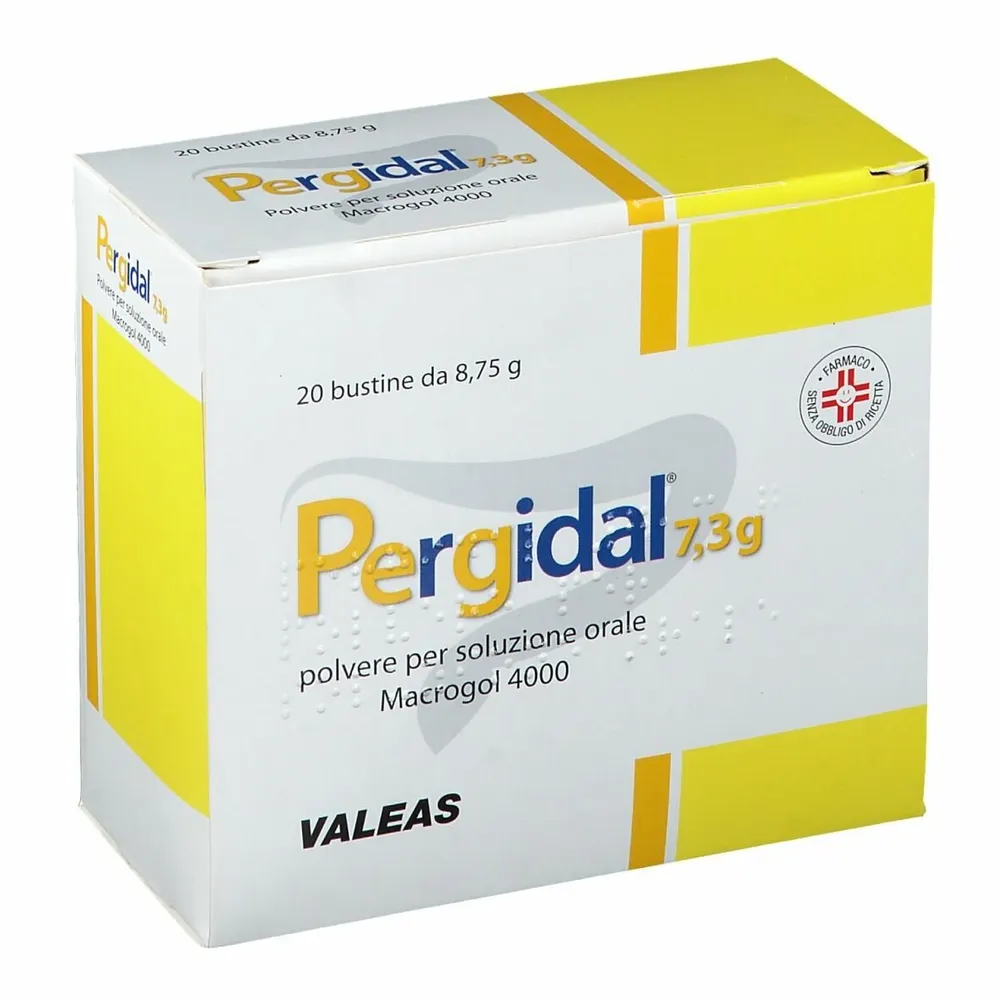
PERGIDAL
ItalyIt is used for the treatment of constipation. It is indicated for children from 6 months to 12 years (3.6 g version) and for adults, the elderly, and adolescents over 12 years (7.3 g version).
Frequently asked questions
How should Pergidal be taken?
The powder should be dissolved in water shortly before use: approximately 50 ml for the 3.6 g version and approximately 250 ml for the 7.3 g version. It should be taken away from meals, in the morning if one sachet is taken per day, or in the morning and evening if more are taken. The effect may manifest within 24-48 hours.
What is the recommended dosage for Pergidal?
For children (3.6 g), the dose varies by age from 1 sachet (6 months-1 year) up to 4 sachets (8-12 years). For adults and adolescents (7.3 g), the recommended dose is 1 to 3 sachets per day.
When should the medicine not be taken?
It must not be taken in case of allergy to the components, acute abdominal pain of unknown origin, nausea, vomiting, rectal bleeding, or changes in intestinal motility. It is necessary to consult a doctor to rule out serious intestinal diseases, obstructions, perforations, or severe dehydration.
What are the side effects of Pergidal?
Common effects include abdominal pain or bloating, diarrhea, and nausea. Vomiting, gas, or anal irritation may also occur. In very rare cases, allergic reactions (such as hives or swelling of the face and lips) and breathing difficulties may occur.
Are there interactions with other drugs or foods?
At least 2 hours should be waited between taking other oral medicines and Pergidal. It should not be taken together with licorice, as this increases the risk of reduced potassium levels in the blood. Certain drugs such as anti-epileptics, digoxin, and immunosuppressants must not be taken concurrently to avoid loss of efficacy.
What happens if an excessive dose is taken?
In case of accidental intake of a dose higher than the recommended one, it is necessary to immediately inform a doctor or go to the hospital. Abdominal pain and diarrhea may occur.
Instructions for use
Table of contents
- Pergidal bambini 3.6 g powder for oral solution
- 1. What Pergidal is and what it is used for
- 2. What you should know before giving Pergidal to your child
- 3. How to take Pergidal
- 4. Possible adverse reactions
- 5. How to store Pergidal
- 6. Package contents and other information
- Patient Information Leaflet
- Pergidal 7.3 g powder for oral solution
- 1. What Pergidal is and what it is used for
- 2. What you need to know before taking Pergidal
- 3. How to take Pergidal
- 4. Possible side effects
- 5. How to store Pergidal
- 6. Contents of the pack and other information
Package leaflet: Information for the patient
Pergidal bambini 3.6 g powder for oral solution
Macrogol 4000
Please read this leaflet carefully before taking this medicine because it contains important information for you.
Always take this medicine exactly as described in this leaflet or as your doctor or pharmacist has told you to do.
- Keep this leaflet. You may need to read it again.
- If you need more advice or information, consult your pharmacist.
- If you experience any side effects, including those not listed in this leaflet, contact your doctor or pharmacist. See section 4.
- Contact your doctor if you do not notice any improvement or if your symptoms worsen.
Contents of this leaflet:
- What Pergidal is and what it is used for
- What you need to know before taking Pergidal
- How to take Pergidal
- Possible side effects
- How to store Pergidal
- Contents of the pack and other information
1. What Pergidal is and what it is used for
The active substance of Pergidal is macrogol 4000, a substance that facilitates the evacuation of stools by drawing water into the intestinal lumen (osmotic laxative).
This medicine is used for the treatment of constipation in children from 6 months up to 12 years of age.
2. What you should know before giving Pergidal to your child
Do not give Pergidal to your child
If he/she is allergic to macrogol 4000 or to any of the other ingredients of this medicine
(listed in section 6);
If he/she has sudden (acute) abdominal pain of unknown origin;
If he/she has nausea or vomiting;
If he/she has markedly increased or reduced intestinal motility (peristalsis);
If he/she has rectal bleeding.
In all these cases, a doctor must carry out an appropriate assessment (diagnosis) to
exclude any condition that would make the use of this medicine inappropriate, for example:
- severe inflammatory bowel diseases (such as ulcerative colitis, Crohn's disease);
- abnormal enlargement of the colon (toxic megacolon) associated with narrowing of the intestinal lumen and evident complications;
- intestinal perforation or risk of intestinal perforation;
- intestinal obstruction without an evident cause (paralytic ileus), blockage (obstruction) or narrowing (stenosis) of the intestine;
- severe state of dehydration.
Warnings and precautions
Talk to your doctor or pharmacist before giving Pergidal to your child.
The doctor must rule out that constipation is due to specific underlying conditions (organic disorders).
Treatment of constipation with any medicine should only be supportive to a healthy lifestyle and proper diet, for example: a diet rich in fluids and fiber, adequate physical activity, and restoration of normal bowel reflexes.
Be especially careful and consult your doctor:
if your child develops allergic reactions during treatment. Very rare cases of hypersensitivity reactions (skin rash, urticaria, edema) and exceptionally anaphylactic shock have been reported with medicines containing macrogol (polyethylene glycol);
if your child suffers from chronic constipation. Continuous treatment of constipation always requires medical supervision for diagnosis, prescription of medicines, and monitoring during therapy;
if the use of this medicine follows a sudden change in previous bowel habits (frequency and characteristics of bowel movements) lasting more than two weeks;
if the use of the laxative fails to produce an effect;
if your child is elderly and/or in poor general health;
if your child develops persistent diarrhea;
In case of diarrhea, if there is a predisposition to disturbances in water-electrolyte balance, for example in elderly patients, if liver or kidney function is impaired, or if taking medicines that increase urine excretion (diuretics), the doctor will evaluate whether blood electrolyte monitoring should be considered.
Consult your doctor after three months of treatment for a complete clinical review of your child.
Abuse of laxatives (frequent or prolonged use, or excessive doses) may cause persistent diarrhea with excessive loss of water, electrolytes (especially potassium), and other essential nutrients. In more severe cases, imbalances may occur that can lead to heart problems or disturbances in nerve-muscle signal transmission (neuromuscular disturbances). These effects may occur especially if your child is also taking medicines for heart arrhythmias (cardiac glycosides), medicines that increase urine excretion (diuretics), or anti-inflammatory medicines (corticosteroids).
Excessive use of laxatives, especially those that increase intestinal contractions (stimulant laxatives, different from Pergidal), may lead to dependence (requiring progressively higher doses), chronic constipation, and loss of normal intestinal function (intestinal atony).
Pergidal does not contain significant amounts of sugars or polyols and can be prescribed for diabetic patients or patients on a galactose-free diet.
Health education notes
First of all, it should be remembered that in most cases, a balanced diet rich in water and fiber (bran, vegetables, and fruit) can permanently resolve constipation.
Many people believe they suffer from constipation if they do not have a bowel movement every day.
This is a mistaken belief, as this condition is completely normal for many individuals.
Instead, consider that constipation occurs when bowel movements are reduced compared to your child's usual pattern and are associated with the passage of hard stools.
Consult your doctor if episodes of constipation occur repeatedly.
Children under 2 years of age
Data on the efficacy of this medicine in children under 2 years of age are limited.
Other medicines and Pergidal
Inform your doctor or pharmacist if your child is taking, has recently taken, or might take any other medicines.
Avoid giving your child other oral medicines at the same time as Pergidal. After giving your child an oral medicine, wait at least 2 hours before administering Pergidal. Indeed, like other laxatives, Pergidal may reduce the intestinal transit time of other orally administered medicines, thereby altering their effectiveness.
Some medicines with a narrow therapeutic index, such as antiepileptics, digoxin, and immunosuppressants, should not be administered concomitantly with Pergidal to avoid a potential loss of efficacy due to transiently reduced absorption.
Do not give your child Pergidal together with liquorice. The use of liquorice increases the risk of low potassium levels in the blood (hypokalaemia).
If you need to thicken liquids to facilitate swallowing, Pergidal may interfere with the thickening agent's effect.
Pregnancy and breastfeeding
If you are pregnant, think you may be pregnant, are planning a pregnancy, or are breastfeeding, consult your doctor or pharmacist before taking this medicine.
During pregnancy and breastfeeding, use Pergidal only if necessary and under direct medical supervision.
Driving and using machines
No studies have been conducted on the ability to drive or use machinery.
Pergidal contains the colour Sunset Yellow FCF (E110)
Sunset Yellow FCF (E110) may cause allergic reactions.
3. How to take Pergidal
Give this medicine to your child exactly as stated in this leaflet or as directed by your doctor or pharmacist. If you have any doubts, consult your doctor or pharmacist.
The correct dose is the lowest amount needed to produce easy passage of soft stools.
Initially, give your child the minimum recommended dose. If necessary, you may increase the dose, but never exceed the maximum dose indicated.
The recommended dose for children is:
Age | Number of sachets/day | Amount of Macrogol
6 months - 1 year | 1 sachet | 3.644 g
1 – 4 years | 1-2 sachets | 3.644 g – 7.288 g
4 – 8 years | 2-3 sachets | 7.288 g – 10.932 g
8 – 12 years | 3-4 sachets | 10.932 g – 14.576 g
Duration of treatment
Treatment should not last longer than 3 months.
Method of administration
Give this medicine to your child away from meals, in the morning if taking one sachet per day, or in the morning and evening if taking more than one sachet per day.
Dissolve the powder immediately before use in approximately 50 ml of water (roughly half a glass).
Do not add any other ingredients.
It is preferable that your child drinks the entire amount fairly quickly (within a few minutes), avoiding sipping it slowly over a long period.
The effect may occur within 24–48 hours after administration.
Restoration of normal bowel movements induced by treatment can be maintained by a healthy lifestyle and a proper diet. A diet rich in fluids enhances the effect of the medicine.
Depending on the response observed, the doctor should adjust the daily dose of the medicine for your child, as well as the duration and manner of discontinuation of treatment.
If your child takes more Pergidal than they should
In case of accidental ingestion or overdose of Pergidal, contact your doctor immediately or go to the nearest hospital.
If your child takes more medicine than prescribed, adverse effects such as abdominal pain and diarrhoea may occur, which resolve upon reducing the dose or temporarily stopping treatment. Excessive loss of fluids and minerals (electrolytes) due to diarrhoea or vomiting may require specific treatment. See also the section “Warnings and precautions” regarding laxative abuse.
Cases of pulmonary aspiration have been reported when high volumes of this medicine and electrolytes were administered via a nasogastric tube (a tube used in children who cannot swallow). Children with neurological impairment and speech articulation disorders (oromotor dysfunction) are particularly at risk of aspiration.
In addition, cases of inflammation around the anus (perianal) and soreness have been reported when high volumes of macrogol solution (from 4 to 11 litres) were administered for bowel cleansing, either prior to colonoscopy (an exploratory examination of the intestine) or during procedures to remove faeces from the intestine (faecal disimpaction) in cases of uncontrolled defecation (encopresis).
If you forget to give Pergidal
Do not give your child a double dose to make up for a missed dose.
If you have any doubts about using this medicine, consult your doctor or pharmacist.
4. Possible adverse reactions
Like all medicines, this medicine can cause adverse reactions, although not everyone experiences them.
Adverse reactions in children:
Common (may affect up to 1 in 10 people)
- abdominal pain
- diarrhoea (which may cause perianal irritation)
Uncommon (may affect up to 1 in 100 people)
- vomiting
- gas in the stomach (flatulence)
- nausea
Rare (may affect up to 1 in 1,000 people)
- severe diarrhoea
Frequency not known (frequency cannot be estimated from the available data)
- hypersensitivity reactions, which may manifest as itching, skin rashes, urticaria, or localized swelling, especially of the face or hands, swelling or tingling of the lips or throat (edema)
- breathing difficulties
Adverse reactions in adults:
Common (may affect up to 1 in 10 people)
- abdominal pain and/or abdominal swelling
- diarrhoea
- nausea
Uncommon (may affect up to 1 in 100 people)
- vomiting
- urgency to defecate
- faecal incontinence
- anal irritation
Rare (may affect up to 1 in 1,000 people)
- severe diarrhoea
Very rare (may affect up to 1 in 10,000 people)
- hypersensitivity reactions, which may manifest as itching, skin rashes, urticaria, or localized swelling, especially of the face or hands, swelling or tingling of the lips or throat (edema)
- Quincke's edema, a condition characterized by the rapid onset of extensive swelling of the face, hands, feet, genitals, or mucous membranes
- breathing difficulties, anaphylactic shock
Frequency not known (frequency cannot be estimated from the available data)
- sodium deficiency (hyponatremia)
- potassium deficiency (hypokalemia)
- dehydration, especially in elderly patients
If any of the adverse reactions listed above occur, consult your doctor and, if necessary, stop taking the medicine.
Following the instructions in this leaflet reduces the risk of adverse reactions.
Reporting of adverse reactions
If you experience any adverse reaction, including those not listed in this leaflet, talk to your doctor or pharmacist. You can also report adverse reactions directly via the national reporting system: https://www.aifa.gov.it/content/segnalazioni-reazioni-avverse. By reporting adverse reactions, you can help provide more information on the safety of this medicine.
5. How to store Pergidal
Keep this medicine out of the sight and reach of children.
Do not use this medicine after the expiry date which is stated on the packaging after "Exp".
The expiry date refers to the last day of that month. The expiry date applies to the product in its original intact packaging, properly stored.
Do not dispose of any medicine via wastewater or household waste. Ask your pharmacist how to dispose of medicines you no longer use. This will help protect the environment.
6. Package contents and other information
What Pergidal contains
- The active substance is macrogol 4000. One sachet contains 3.644 g of macrogol 4000.
- The other components are: simethicone, acesulfame potassium, tangerine flavour (dextrose, maltodextrins, gum arabic), sunset yellow FCF (E110) colour.
Description of the appearance of Pergidal and contents of the pack
Pergidal is a powder for oral solution.
Pack contents: 20 sachets of 3.75 g each.
Marketing Authorization Holder
NEOPHARMED GENTILI S.p.A. – Via San Giuseppe Cottolengo 15 – 20143 Milan
Manufacturer
Sigmar Italia s.p.a. - Via Sombreno 11, 24011 - Almé (BG)
Patient Information Leaflet
Pergidal 7.3 g powder for oral solution
Macrogol 4000
Please read this leaflet carefully before taking this medicine because it contains important information for you.
Always take this medicine exactly as described in this leaflet or as your doctor or pharmacist has instructed you.
- Keep this leaflet. You may need to read it again.
- If you need more information or advice, consult your pharmacist.
- If you experience any side effects, including those not listed in this leaflet, contact your doctor or pharmacist. See section 4.
- Contact your doctor if you do not notice any improvement, or if you notice a worsening of symptoms.
Contents of this leaflet:
- What Pergidal is and what it is used for
- What you need to know before taking Pergidal
- How to take Pergidal
- Possible side effects
- How to store Pergidal
- Contents of the pack and other information
1. What Pergidal is and what it is used for
The active substance of Pergidal is macrogol 4000, a substance that facilitates faecal evacuation by drawing water into the intestinal lumen (osmotic laxative).
This medicine is used for the treatment of constipation in adults, the elderly, and children over 12 years of age (adolescents).
2. What you need to know before taking Pergidal
Do not take Pergidal
If you are allergic to macrogol 4000 or to any of the other ingredients of this medicine
(listed in section 6);
If you have sudden (acute) abdominal pain of unknown origin;
If you have nausea or vomiting;
If you have markedly increased or reduced intestinal motility (peristalsis);
If you have rectal bleeding.
In all these cases, it is necessary that a doctor performs an adequate assessment (diagnosis) in order to
exclude any condition that makes the use of this medicine inappropriate, for example:
- severe inflammatory bowel diseases (such as ulcerative colitis, Crohn's disease);
- abnormal enlargement of the colon (toxic megacolon) associated with narrowing of the intestinal lumen and evident complications;
- intestinal perforation or risk of intestinal perforation;
- intestinal obstruction without an evident cause (paralytic ileus), blockage (obstruction) or narrowing (stenosis) of the intestine;
- severe state of dehydration.
Warnings and precautions
Talk to your doctor or pharmacist before taking Pergidal.
In children over 12 years of age (adolescents), the doctor must exclude that constipation is due to
specific problems (an organic disorder).
The treatment of constipation with any medicine is only supportive to a healthy lifestyle and proper
diet, for example: a diet rich in fluids and fibre, adequate physical activity, and restoration of
intestinal reflexes.
Pay special attention and consult your doctor:
if you experience allergic reactions during treatment. Very rare cases of hypersensitivity reactions (skin rash, urticaria, edema) and exceptionally anaphylactic shock have been reported with medicines containing macrogol (polyethylene glycol);
if you suffer from chronic constipation. Continuous treatment of constipation always requires
medical intervention for diagnosis, prescription of medicines, and monitoring during therapy;
if the use of this medicine is due to a sudden change in previous bowel habits (frequency and characteristics of bowel movements) lasting for more than two weeks;
if the use of the laxative fails to produce an effect;
if you are an elderly patient and/or your general health condition is poor;
if you develop persistent diarrhea;
if you experience sudden abdominal pain or rectal bleeding during Pergidal administration for bowel preparation.
In case of diarrhea, if there is a predisposition to disturbances in water-electrolyte balance, for example in elderly patients, if liver or kidney function is impaired, or if you are taking medicines that increase urine excretion (diuretics), your doctor will evaluate whether monitoring of blood electrolytes should be considered.
Consult your doctor after three months of treatment for a complete clinical review.
Abuse of laxatives (frequent or prolonged use, or excessive doses) may cause persistent diarrhea with excessive loss of water, minerals (especially potassium), and other essential nutrients. In more severe cases, imbalances may occur that can lead to heart disorders or disturbances in signal transmission from the brain to the muscles (neuromuscular disturbances). These phenomena may occur especially if you are also taking medicines for the treatment of cardiac arrhythmias (cardiac glycosides), medicines that increase urine excretion (diuretics), or anti-inflammatory medicines (corticosteroids).
Excessive use of laxatives, especially those that increase intestinal contractions (stimulant laxatives, different from Pergidal), may lead to dependence (thus requiring progressive dose increases), chronic constipation, and loss of normal intestinal function (intestinal atony).
Pergidal does not contain significant amounts of sugars or polyols and can be prescribed to diabetic patients or patients on a galactose-free diet.
Health education notes
First of all, it should be remembered that, in most cases, a balanced diet rich in
water and fibre (bran, vegetables and fruit) can durably resolve constipation problems.
Many people believe they suffer from constipation if they do not have a bowel movement every day.
This is a misconception, as this situation is completely normal for many individuals.
Consider instead that constipation occurs when bowel movements are reduced compared to your personal habits and are associated with the passage of hard stools.
Consult your doctor if episodes of constipation occur repeatedly.
Other medicines and Pergidal
Inform your doctor or pharmacist if you are taking, have recently taken, or might take any other medicine.
Avoid taking other oral medicines by mouth at the same time as Pergidal. After taking a medicine, wait at least 2 hours before taking Pergidal. Indeed, Pergidal, like other laxatives, may reduce the intestinal transit time of other orally administered medicines, thereby altering their effectiveness.
Some medicines with a narrow therapeutic index, such as antiepileptics, digoxin, and immunosuppressants, should not be administered concomitantly with Pergidal to avoid a potential loss of efficacy due to transiently reduced absorption.
Do not take Pergidal together with liquorice. The use of liquorice increases the risk of low potassium levels in the blood (hypokalaemia).
If you need to thicken liquids to be able to swallow them without difficulty, Pergidal may counteract the thickening agent's effect.
Pregnancy and breastfeeding
If you are pregnant, think you may be pregnant, are planning to become pregnant, or are breastfeeding, ask your doctor or pharmacist for advice before taking this medicine.
During pregnancy and breastfeeding, use Pergidal only if necessary and under direct medical supervision.
Driving and using machines
No studies have been conducted on the ability to drive vehicles and use machinery.
Pergidal contains the colouring agent sunset yellow FCF (E110)
Sunset yellow FCF (E110) may cause allergic reactions.
Pergidal contains sodium and potassium
Pergidal contains 359.25 mg of sodium (a main component of table salt) per sachet. This corresponds to 18% of the maximum recommended daily dietary intake for an adult.
Talk to your doctor or pharmacist if you need to take two or more sachets per day for a prolonged period, especially if you have been advised to follow a low-sodium diet.
Pergidal contains 1.44 mmol (56.34 mg) of potassium per sachet. This should be taken into account in individuals with reduced kidney function or those following a low-potassium diet.
3. How to take Pergidal
Take this medicine exactly as stated in this leaflet or as directed by your doctor or pharmacist. If you have any doubts, consult your doctor or pharmacist.
The correct dose is the lowest amount needed to produce an easy evacuation of soft stools.
Initially take the lowest recommended dose. When necessary, you may increase the dose, but never exceed the maximum indicated dose.
The recommended dose for adults, elderly patients, and children over 12 years of age (adolescents) is 1 to 3 sachets per day.
Use in adolescents
In children over 12 years of age (adolescents), treatment should not last longer than 3 months.
Method of administration
Take this medicine away from meals, in the morning if taking one sachet daily, or in the morning and evening if taking more than one sachet per day.
Dissolve the powder immediately before use in approximately 250 ml of water (roughly the content of two glasses or one cup).
Do not add any other ingredients.
It is preferable to drink the entire amount fairly quickly (within a few minutes), avoiding sipping it slowly over a prolonged period.
The effect may occur within 24–48 hours after administration.
Restoration of intestinal movements induced by treatment can be maintained by adopting a healthy lifestyle and a proper diet. A diet rich in fluids enhances the medicine's effect.
Depending on the response observed, your doctor should adjust the daily dose, duration, and manner of discontinuation of treatment.
If you take more Pergidal than you should
In case of accidental ingestion or overdose of Pergidal, contact your doctor immediately or go to the nearest hospital.
If you take more Pergidal than recommended, adverse effects such as abdominal pain and diarrhoea may occur, which resolve upon dose reduction or temporary interruption of treatment.
Excessive loss of fluids and minerals (electrolytes) caused by diarrhoea or vomiting may require specific treatments. See also the section “Warnings and precautions” regarding laxative abuse.
Cases of pulmonary aspiration (medicine entering the respiratory tract) have been reported when high volumes of this medicine and electrolytes were administered via nasogastric tube (a tube used in children who cannot swallow). Children with neurological impairment and speech articulation disorders (oromotor dysfunction) are particularly at risk of aspiration.
Additionally, cases of perianal inflammation and soreness have been reported when high volumes of macrogol solution (from 4 to 11 litres) were administered for bowel cleansing, either in preparation for colonoscopy (an exploratory examination of the bowel) or for faecal disimpaction in cases of uncontrolled defecation (encopresis).
If you forget to take Pergidal
Do not take a double dose to make up for a missed dose.
If you have any doubts about how to use this medicine, consult your doctor or pharmacist.
4. Possible side effects
Like all medicines, this medicine can cause side effects, although not everyone experiences them.
Side effects in adults:
Common (may affect up to 1 in 10 people)
- abdominal pain and/or abdominal swelling
- diarrhoea
- nausea
Uncommon (may affect up to 1 in 100 people)
- vomiting
- urgency to defecate
- faecal incontinence
- anal irritation
Rare (may affect up to 1 in 1,000 people)
- severe diarrhoea
Very rare (may affect up to 1 in 10,000 people)
- hypersensitivity reactions, which may present as itching, skin rashes, hives, or localized swelling, especially of the face or hands, swelling or tingling of the lips or throat (edema)
- Quincke's edema (angioedema), a condition characterized by the rapid onset of extensive swelling of the face, hands, feet, genitals, or also the mucous membranes
- breathing difficulties, anaphylactic shock
Frequency not known (frequency cannot be estimated from the available data)
- sodium deficiency (hyponatremia)
- potassium deficiency (hypokalemia)
- dehydration (especially in elderly patients)
Side effects in children:
Common (may affect up to 1 in 10 children)
- abdominal pain
- diarrhoea (which may cause perianal irritation)
Uncommon (may affect up to 1 in 100 children)
- vomiting
- bloating (flatulence)
- nausea
Rare (may affect up to 1 in 1,000 children)
- severe diarrhoea
Frequency not known (frequency cannot be estimated from the available data)
- hypersensitivity reactions, which may present as itching, skin rashes, hives, or localized swelling, especially of the face or hands, swelling or tingling of the lips or throat (edema), breathing difficulties
If any of the side effects listed above occur, consult your doctor and, if necessary, stop taking the medicine.
Following the instructions in this leaflet reduces the risk of side effects.
Reporting of side effects
If you experience any side effects, including those not listed in this leaflet, tell your doctor or pharmacist. You can also report side effects directly via the national reporting system: https://www.aifa.gov.it/content/segnalazioni-reazioni-avverse. By reporting side effects, you can help provide more information on the safety of this medicine.
5. How to store Pergidal
Keep this medicine out of the sight and reach of children.
Do not use this medicine after the expiry date stated on the packaging after "Exp.": The expiry date refers to the last day of that month. The expiry date applies to the product in its original, unopened packaging, stored correctly.
Do not dispose of any medicine via wastewater or household waste. Ask your pharmacist how to dispose of medicines no longer in use. This will help protect the environment.
6. Contents of the pack and other information
What Pergidal contains
- The active substance is macrogol 4000. One sachet contains 7.287 g of macrogol 4000.
- The other components are: anhydrous sodium sulfate, sodium bicarbonate, sodium chloride, potassium chloride, simeticone, potassium acesulfame, tangerine flavour (dextrose, maltodextrins, gum arabic), sunset yellow FCF (E110) colouring.
Description of the appearance of Pergidal and contents of the pack
Pergidal is a powder for oral solution.
Pack contents: 20 sachets of 8.75 g each.
Marketing Authorization Holder
NEOPHARMED GENTILI S.p.A – Via San Giuseppe Cottolengo 15 – 20143 Milan
Manufacturer
Sigmar Italia s.p.a. - Via Sombreno 11, 24011 - Almé (BG)
The original data is available in the language of the country of manufacture.
Data source: Italian Medicines Agency (AIFA)
Data last verified: September 21, 2026