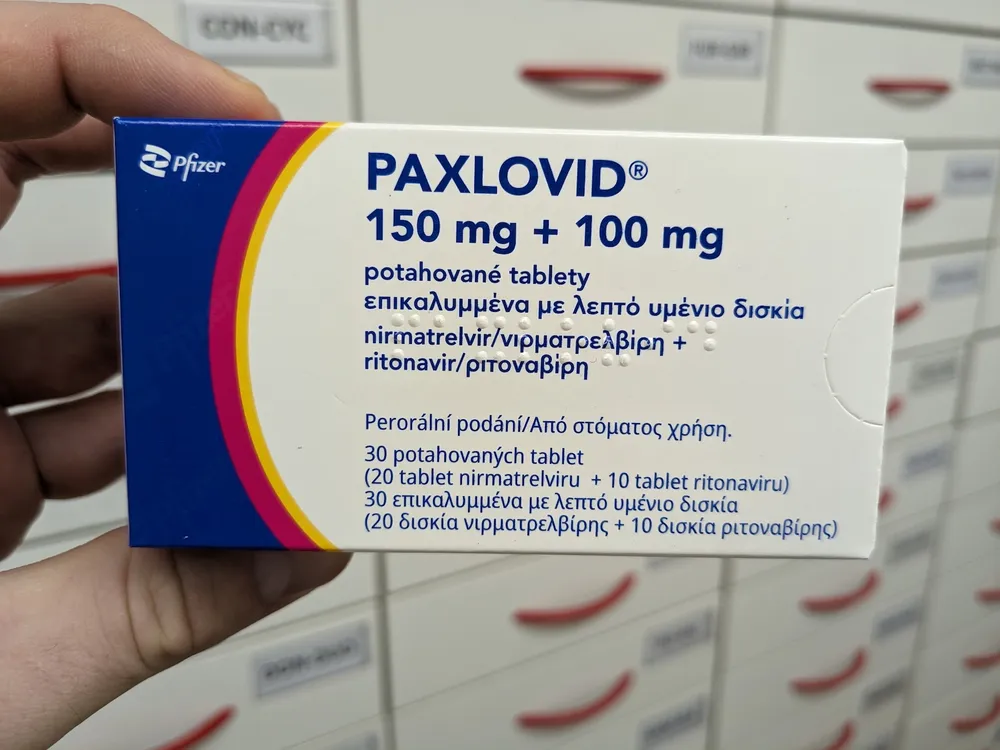
PAXLOVID
ItalyIt is an antiviral drug used to treat adults, children, and adolescents (from 6 years of age and weighing at least 20 kg) with COVID-19 who do not require oxygen and are at risk of developing a severe form of the disease.
Frequently asked questions
How should I take Paxlovid?
The treatment lasts for 5 days. Adults must take 2 pink tablets (nirmatrelvir) and 1 white tablet (ritonavir) every 12 hours, morning and evening. For children and adolescents, the dose varies based on weight: 1 pink tablet and 1 white tablet every 12 hours if they weigh between 20 and less than 40 kg, and 2 pink tablets and 1 white tablet every 12 hours if they weigh 40 kg or more. Tablets should be swallowed whole, without chewing or breaking, with or without food.
When should this medicine not be taken?
It must not be taken if you are allergic to the active substances or if you are taking many types of other medicines (such as some used for cancer, heart conditions, anxiety, HIV, or cholesterol). It is essential to inform your doctor about all the medicines you are currently taking.
What are the common side effects of Paxlovid?
The most frequent side effects may include diarrhea, vomiting, nausea, headache, and taste changes (such as a metallic or bitter taste).
What are the serious side effects that should be reported immediately?
You must contact a doctor immediately if you experience serious allergic reactions (difficulty breathing or swallowing, swelling of the tongue, mouth, or face, rashes, blisters, or mouth ulcers) or serious skin reactions such as red, painful, or peeling skin.
Are there any special warnings for women who are pregnant or breastfeeding?
During pregnancy, the drug is not recommended unless strictly necessary for clinical conditions. During treatment and for 7 days after, it is recommended to use non-hormonal contraceptive methods or condoms. For breastfeeding, you should not breastfeed during treatment and for 48 hours after the end of therapy.
What should I do if I miss a dose?
If you remember within 8 hours of the usual time, you can take the missed dose. If more than 8 hours have passed, you should skip the dose and take the next one at the usual time, never taking two doses together to make up for it.
Instructions for use
Patient Information Leaflet
Paxlovid 150 mg + 100 mg film-coated tablets
nirmatrelvir + ritonavir

This medicinal product is subject to additional monitoring. This will allow rapid identification of new safety information.
You can help by reporting any side effects you experience while taking this medicine.
See the end of section 4 for information on how to report side effects.
Please read this leaflet carefully before taking this medicine, as it contains important information for you.
- Keep this leaflet. You may need to read it again.
- If you have any questions, ask your doctor or pharmacist.
- This medicine has been prescribed for you only. Do not give it to others, even if their symptoms are the same as yours, as it may be harmful.
- If you experience any side effect, including those not listed in this leaflet, talk to your doctor or pharmacist. See section 4.
Contents of this leaflet
- What Paxlovid is and what it is used for
- What you need to know before taking Paxlovid
- How to take Paxlovid
- Possible side effects
- How to store Paxlovid
- Contents of the pack and other information
1. What Paxlovid is and what it is used for
Paxlovid contains two active substances, nirmatrelvir and ritonavir, in two separate tablets. Paxlovid is an antiviral medicine used to treat adults, children, and adolescents aged 6 to less than 18 years with a body weight of at least 20 kg, who have COVID-19 that does not require supplemental oxygen therapy and who are at risk of progressing to severe disease.
COVID-19 is an illness caused by a virus called coronavirus. This medicine stops the virus from multiplying in human cells, thereby preventing the virus from replicating in the body. This helps the body overcome the viral infection and may prevent progression to severe disease.
Contact your doctor if you do not feel better or if you feel worse after 5 days.
2. What you should know before taking Paxlovid
Do not take Paxlovid
- if you are allergic to nirmatrelvir, ritonavir, or any of the other ingredients of this medicine (listed in section 6)
- if you are taking any of the following medicines. Taking Paxlovid with these medicines could cause serious side effects that may be life-threatening or could affect the effectiveness of Paxlovid:
- alfuzosin (used to treat symptoms of an enlarged prostate)
- ranolazine (used to treat chronic chest pain [angina])
- dronedarone, propafenone, quinidine (used to treat heart rhythm disorders and to correct irregular heartbeats)
- rifampicin, rifapentine (used to treat bacterial infections)
- apalutamide, enzalutamide, neratinib, venetoclax (used to treat cancer)
- carbamazepine, phenobarbital, phenytoin, primidone (used to prevent and control seizures)
- colchicine (used to treat gout)
- terfenadine (used to treat allergies)
- cariprazine and lurasidone (used to treat schizophrenia)
- pimozide, quetiapine (used to treat schizophrenia, bipolar disorder, severe depression, and abnormal thoughts or emotions)
- silodosin (used to treat enlargement of the prostate gland)
- eplerenone and ivabradine (used to treat heart and/or blood vessel problems)
- dihydroergotamine and ergotamine (used to treat migraine)
- ergonovine and methylergonovine (used to stop excessive bleeding that may occur after childbirth or abortion)
- cisapride (used to relieve certain stomach problems)
- St. John’s wort (Hypericum perforatum) (a herbal preparation used to treat depression and anxiety)
- voclosporin (used to treat immune disorders)
- lovastatin, simvastatin, lomitapide (used to lower cholesterol in the blood)
- eletriptan (used to treat migraine)
- lumacaftor/ivacaftor (used for cystic fibrosis)
- finerenone (used to treat chronic kidney disease associated with type 2 diabetes)
- naloxegol (used to treat opioid-induced constipation)
- avanafil, vardenafil (used to treat erectile dysfunction [also known as impotence])
- sildenafil, tadalafil (used to treat erectile dysfunction [impotence] or pulmonary arterial hypertension [high blood pressure in the pulmonary artery])
- clorazepate, diazepam, estazolam, flurazepam, triazolam, oral midazolam (used to relieve anxiety and/or sleep disorders)
- tolvaptan used to treat hyponatremia (low sodium levels in the blood)
Warnings and precautions
Allergic reactions
Allergic reactions, including severe allergic reactions (known as “anaphylaxis”) and serious skin reactions (known as “toxic epidermal necrolysis” and “Stevens-Johnson syndrome”) may occur in people taking this medicine, even after a single dose. Stop taking this medicine and contact your doctor immediately if you experience any of the following symptoms of an allergic reaction:
- difficulty swallowing or breathing
- swelling of the tongue, mouth, or face
- tightness in the throat
- hoarseness
- itching
- red, painful skin
- blistering and peeling of the skin
- blisters or ulcers in the mouth or on the lips
Liver disease
Inform your doctor if you have or have had liver disease. Patients treated with ritonavir have experienced abnormalities in liver enzymes, hepatitis, and jaundice.
Kidney disease
Inform your doctor if you have or have had kidney disease.
High blood pressure
Inform your doctor if you have high blood pressure. Your doctor may need to measure your blood pressure before and during treatment with this medicine. Cases of high blood pressure have been reported in people taking this medicine, particularly in elderly individuals.
Risk of developing HIV-1 resistance
If you have untreated or uncontrolled HIV infection, Paxlovid may cause future treatment failure of certain HIV medicines.
Children and adolescents
Do not give this medicine to children under 6 years of age or to children and adolescents aged between 6 and under 18 years weighing less than 20 kg, as this medicine has not been studied in this population.
Other medicines and Paxlovid
There are other medicines that should preferably not be taken together with Paxlovid. Inform your doctor(s) or pharmacist if you are taking, have recently taken, or might take any other medicines:
- medicines used to treat cancer, such as afatinib, abemaciclib, ceritinib, dasatinib, encorafenib, fostamatinib, ibrutinib, ivosidenib, nilotinib, vinblastine, and vincristine
- medicines used to thin the blood (anticoagulants), such as warfarin, rivaroxaban, dabigatran, and apixaban
- medicines used to treat seizures, such as divalproex, lamotrigine, and clonazepam
- medicines used to stop smoking, such as bupropion
- medicines used to treat allergies, such as fexofenadine and loratadine
- medicines used to treat fungal infections (antifungals), such as itraconazole and voriconazole
- medicines used to treat parasitic infections, such as albendazole
- medicines used to treat Cushing’s syndrome—when the body produces too much cortisol—such as ketoconazole tablets
- medicines used to treat HIV infection, such as efavirenz, maraviroc, raltegravir, zidovudine, and bictegravir/emtricitabine/tenofovir
- medicines used to treat infections (e.g., antibiotics and antimycobacterials), such as atovaquone, clarithromycin, erythromycin, fusidic acid (taken orally or administered intravenously), bedaquiline, rifabutin, delamanid, and sulfamethoxazole/trimethoprim
- medicines used to treat schizophrenia and abnormal thoughts or emotions, such as clozapine
- medicines used to treat mental disorders or mood disorders, such as haloperidol, risperidone, and thioridazine
- medicines used to treat high pressure in the blood vessels supplying the lungs, such as bosentan and riociguat
- medicines used to treat high blood pressure (hypertension), such as amlodipine, diltiazem, felodipine, lercanidipine, nicardipine, nifedipine, and verapamil
- medicines used to treat heart and/or blood vessel problems, such as aliskiren, ticagrelor, cilostazol, and clopidogrel
- medicines used to treat heart rhythm disorders and correct arrhythmias, such as digoxin, amiodarone, flecainide, and disopyramide
- medicines used to treat cystic fibrosis, such as ivacaftor, elexacaftor/tezacaftor/ivacaftor, and tezacaftor/ivacaftor
- medicines used to treat diabetes, such as saxagliptin
- medicines used to treat hepatitis C, such as glecaprevir/pibrentasvir and sofosbuvir/velpatasvir/voxilaprevir
- medicines used to lower cholesterol in the blood, such as atorvastatin, fluvastatin, pravastatin, and rosuvastatin
- medicines used to treat migraine, such as rimegepant
- medicines used to treat urinary incontinence, such as darifenacin and solifenacin
- medicines used to treat mental health conditions, such as aripiprazole and brexpiprazole
- medicines used to suppress the immune system, such as cyclosporine, everolimus, sirolimus, and tacrolimus
- medicines used to treat autoimmune disorders including rheumatoid arthritis, psoriatic arthritis, or ulcerative colitis, such as tofacitinib and upadacitinib
- medicines used to treat acute pain, such as morphine, fentanyl, oxycodone, methadone, buprenorphine, other morphine-like medicines, meperidine, and piroxicam
- medicines used as sedatives, hypnotics, or sleep aids, such as alprazolam, buspirone, and zolpidem
- medicines used to treat attention deficit disorder or a sleep disorder called narcolepsy, such as amphetamines
- steroids including corticosteroids used to treat inflammation, such as budesonide, dexamethasone, fluticasone, prednisolone, and triamcinolone
- medicines used to treat asthma and other lung problems such as chronic obstructive pulmonary disease [COPD], such as salmeterol and theophylline
- medicines used to treat depression, such as amitriptyline, fluoxetine, imipramine, nortriptyline, paroxetine, and sertraline
- medicines used as thyroid replacement therapy, such as levothyroxine
- medicines used to treat an enlarged prostate, such as tamsulosin
- any of the following specific medicines:
- oral contraceptive or patch containing ethinylestradiol used to prevent pregnancy
- midazolam administered by injection (used for sedation [a state of extreme relaxation in which you remain awake but feel calm or drowsy, during a medical examination or procedure] or for anesthesia)
Many medicines interact with Paxlovid. Make a list of all the medicines you are taking and show it to your doctor(s) and pharmacist. Do not start taking a new medicine without informing your doctor(s). Your doctor(s) will tell you whether it is safe to take Paxlovid with other medicines.
Pregnancy and breastfeeding
If you are pregnant, think you may be pregnant, or are planning to become pregnant, consult your doctor before taking this medicine.
There is insufficient information to definitively confirm the safety of using Paxlovid during pregnancy. If you are pregnant, it is not recommended to use this medicine unless your clinical condition requires this treatment. It is recommended to abstain from sexual activity or to use contraceptive methods during treatment with this medicine and, as a precaution, for 7 days after completing treatment. If you are taking hormonal contraceptives, since this medicine may reduce the effectiveness of these medicines, it is recommended to use a condom or another non-hormonal contraceptive method. Your doctor can advise you on how long this change in contraceptive method should be maintained.
A small amount of Paxlovid passes into breast milk. You must not breastfeed during treatment with this medicine and for 48 hours after completing treatment, as a precaution.
Driving and using machines
Paxlovid is not expected to affect your ability to drive or use machines.
Paxlovid contains lactose
If your doctor has diagnosed you with an intolerance to certain sugars, contact them before taking this medicine.
Paxlovid contains sodium
Nirmatrelvir and ritonavir tablets each contain less than 1 mmol (23 mg) of sodium per dose, i.e., essentially “sodium-free”.
3. How to take Paxlovid
Take this medicine exactly as prescribed by your doctor or pharmacist. If you have any doubts, consult your doctor or pharmacist.
Paxlovid consists of two medicines: nirmatrelvir and ritonavir.
The treatment course lasts 5 days.
Swallow the tablets whole. Do not chew, break, or crush the tablets. This medicine can be taken with or without food.
Recommended dose
Adults
The recommended dose is 2 pink nirmatrelvir tablets and 1 white ritonavir tablet taken orally every 12 hours (in the morning and evening).
Children and adolescents aged 6 years to less than 18 years
Weight between 20 kg and less than 40 kg:
The recommended dose is 1 pink nirmatrelvir tablet and 1 white ritonavir tablet taken orally every 12 hours (in the morning and evening).
Weight 40 kg and above:
The recommended dose is 2 pink nirmatrelvir tablets and 1 white ritonavir tablet taken orally every 12 hours (in the morning and evening).
If you or your child has kidney disease, the dose of Paxlovid must be reduced. Please consult your doctor to determine the appropriate dose of PAXLOVID.
Severe kidney disease
If you have SEVERE kidney disease, the recommended dose is 2 pink nirmatrelvir tablets and 1 white ritonavir tablet taken orally once on Day 1, followed by 1 pink nirmatrelvir tablet and 1 white ritonavir tablet once daily on Days 2 to 5.
If you take more Paxlovid than you should
If you take an excessive dose of this medicine, contact your doctor or go immediately to the nearest hospital emergency department.
If you forget to take Paxlovid
If you forget to take a dose within 8 hours of your usual time, take it as soon as you remember. If you forget to take a dose of Paxlovid for more than 8 hours, do not take the missed dose; take the next dose at your regular time. Do not take a double dose to make up for a forgotten dose.
If you stop taking Paxlovid
Even if you feel better, do not stop taking this medicine without first consulting your doctor.
If you have any questions about how to use this medicine, consult your doctor or pharmacist.
4. Possible side effects
Like all medicines, this medicine can cause side effects, although not everybody gets them.
Common: may affect up to 1 in 10 people
- diarrhoea
- vomiting
- nausea
- taste disturbance (such as metallic or bitter taste)
- headache
Uncommon: may affect up to 1 in 100 people
- allergic reactions
- high blood pressure
- abdominal pain
- muscle pain
- skin rash (also reported as part of an allergic reaction)
Rare: may affect up to 1 in 1,000 people
- severe allergic reaction known as “anaphylaxis” (such as swelling of the tongue, mouth and face, difficulty swallowing or breathing, tightness in the throat or hoarseness)
- serious skin reactions known as “toxic epidermal necrolysis” and “Stevens-Johnson syndrome” (such as red, painful skin, blistering and peeling of the skin, blisters or ulcers in the mouth or on the lips)
- malaise
- itching (also reported as part of an allergic reaction)
Reporting of side effects
If you get any side effects, talk to your doctor or pharmacist. This includes any side effects not listed in this leaflet.
You can also report side effects directly via the national reporting system listed in Annex V. By reporting side effects, you can help provide more information on the safety of this medicine.
5. How to store Paxlovid
Keep this medicine out of the sight and reach of children.
Do not use this medicine after the expiry date stated on the carton or blister after "Exp.". The expiry date refers to the last day of that month.
This medicine does not require any special storage conditions.
Do not dispose of medicines via wastewater or household waste. Ask your pharmacist how to dispose of medicines you no longer use. This will help protect the environment.
6. Package contents and other information
What Paxlovid contains
- The active substances in this medicine are nirmatrelvir and ritonavir.
- Each pink film-coated tablet of nirmatrelvir contains 150 mg of nirmatrelvir.
- Each white film-coated tablet of ritonavir contains 100 mg of ritonavir.
- The other components of the nirmatrelvir tablet are microcrystalline cellulose, lactose monohydrate (see section 2, “Paxlovid contains lactose”), croscarmellose sodium, colloidal silicon dioxide, and sodium stearyl fumarate (see section 2, “Paxlovid contains sodium”). The coating contains hypromellose, titanium dioxide, macrogol/polyethylene glycol, and red iron oxide.
- The other components of the ritonavir tablet are copovidone, sorbitan laurate, anhydrous colloidal silica, calcium hydrogen phosphate, and sodium stearyl fumarate. The coating contains hypromellose, titanium dioxide, macrogol/polyethylene glycol, hydroxypropylcellulose, talc, anhydrous colloidal silica, and polysorbate 80.
Description of the appearance of Paxlovid and contents of the pack
The 150 mg film-coated nirmatrelvir tablets are pink, oval-shaped, and imprinted with “PFE” on one side and “3CL” on the other.
The 100 mg film-coated ritonavir tablets are white to off-white, capsule-shaped, and imprinted with “H” on one side and “R9” on the other.
The film-coated tablets of Paxlovid are available in packs of 5 blisters, each containing a daily dose, for a total of 30 tablets or 20 tablets packaged in a box.
In the 30-tablet pack, each daily blister contains 4 nirmatrelvir tablets (150 mg each) and 2 ritonavir tablets (100 mg each), indicating which tablets should be taken in the morning and which in the evening (sun and moon symbols).
In the 20-tablet pack, each daily blister contains 2 nirmatrelvir tablets (150 mg each) and 2 ritonavir tablets (100 mg each), indicating which tablets should be taken in the morning and which in the evening (sun and moon symbols).
Film-coated Paxlovid tablets are also available in 5-day blister packs, with a total of 11 tablets packaged in a box. The 5-day blister pack contains 6 nirmatrelvir tablets (150 mg each) and 5 ritonavir tablets (100 mg each), indicating which tablets should be taken once daily for 5 days.
Not all pack sizes may be marketed.
Marketing Authorisation Holder
Pfizer Europe MA EEIG
Boulevard de la Plaine 17
1050 Brussels
Belgium
Manufacturer
Pfizer Manufacturing Deutschland GmbH
Mooswaldallee 1
79108 Freiburg im Breisgau
Germany
Pfizer Italia S.r.L
Località Marino del Tronto
63100 Ascoli Piceno
Italy
Pfizer Ireland Pharmaceuticals Unlimited Company
Little Connell
Newbridge
County Kildare
Ireland
For further information about this medicine, please contact the local representative of the Marketing Authorisation Holder:
België/Belgique/Belgien Latvija
Luxembourg/Luxemburg Pfizer Luxembourg SARL filiāle Latvijā
Pfizer NV/SA Tel: +371 670 35 775
Tél/Tel: +32 (0)2 554 62 11
България Lietuva
Пфайзер Люксембург САРЛ, Клон Pfizer Luxembourg SARL filialas Lietuvoje
България Tel: +370 5 251 4000
Teл: +359 2 970 4333
Česká republika Magyarország
Pfizer, spol. s r.o. Pfizer Kft.
Tel: +420 283 004 111 Tel.: +36 1 488 37 00
Danmark Malta
Pfizer ApS Vivian Corporation Ltd.
Tlf.: +45 44 201 100 Tel: +356 21344610
Deutschland Nederland
PFIZER PHARMA GmbH Pfizer bv
Tel: +49 (0)30 550055-51000 Tel: +31 (0)800 63 34 636
Eesti Norge
Pfizer Luxembourg SARL Eesti filiaal Pfizer AS
Tel: +372 666 7500 Tlf: +47 67 52 61 00
Ελλάδα Österreich
Pfizer Ελλάς A.E. Pfizer Corporation Austria Ges.m.b.H.
Τηλ.: +30 210 6785800 Tel: +43 (0)1 521 15-0
España Polska
Pfizer, S.L. Pfizer Polska Sp. z o.o.
Tel: +34 91 490 99 00 Tel.: +48 22 335 61 00
France Portugal
Pfizer Laboratoires Pfizer, Lda.
Tél: +33 (0)1 58 07 34 40 Tel: +351 21 423 5500
Hrvatska România
Pfizer Croatia d.o.o. Pfizer Romania S.R.L
Tel: +385 1 3908 777 Tel: +40 (0)21 207 28 00
Ireland Slovenija
Pfizer Healthcare Ireland Unlimited Pfizer Luxembourg SARL
Company Pfizer, podružnica za svetovanje s področja
Tel: 1800 633 363 (toll free) farmacevtske dejavnosti, Ljubljana
+44 (0)1304 616161 Tel: +386 (0)1 52 11 400
Ísland Slovenská republika
Icepharma hf. Pfizer Luxembourg SARL,
Sími: +354 540 8000 organizačná zložka
Tel: +421 2 3355 5500
Italia Suomi/Finland
Pfizer S.r.l. Pfizer Oy
Tel: +39 06 33 18 21 Puh/Tel: +358 (0)9 430 040
Κύπρος Sverige
Pfizer Ελλάς Α.Ε. (Cyprus Branch) Pfizer AB
Tηλ: +357 22817690 Tel: +46 (0)8 550 520 00
Scan the code with a mobile device to access the package leaflet in multiple languages.

URL: www.covid19oralrx.com/en
Other sources of information
More detailed information on this medicine is available on the website of the European Medicines Agency: https://www.ema.europa.eu.
This leaflet is available in all languages of the European Union/European Economic Area on the European Medicines Agency website.
ANNEX IV
CONCLUSIONS OF THE ANNUALLY VALID COMMERCIAL PROPERTY PROTECTION REQUEST SUBMITTED BY THE EUROPEAN MEDICINES AGENCY
Conclusions presented by the European Medicines Agency on:
- one-year commercial protection
Considering the provisions laid down in Article 14(11) of Regulation 726/2004/EC, the Committee for Medicinal Products for Human Use (CHMP) has reviewed the data submitted by the marketing authorisation holder and considers that the new therapeutic indication provides a significant clinical benefit compared to currently available therapies, as further described in the European Public Assessment Report (EPAR).
The original data is available in the language of the country of manufacture.
Data source: Italian Medicines Agency (AIFA)
Data last verified: September 21, 2026