OCTANINE
ItalyIt is used for the treatment and prevention of bleeding in patients with hemophilia B, a condition caused by a hereditary deficiency of coagulation factor IX.
Frequently asked questions
How should OCTANINE be taken?
The medicinal product must be injected intravenously (via intravenous route) after being reconstituted with the provided solvent. The exact dose and frequency must be determined by a physician based on the severity of the deficiency and the patient's response.
When should you not use this medicine?
It must not be used if you are allergic to human coagulation factor IX or any of its components, or if you suffer from heparin-induced type II thrombocytopenia.
What are the possible side effects of OCTANINE?
Allergic reactions (such as hives, rash, swelling, difficulty breathing, rapid heartbeat, or low blood pressure), chills, headache, fatigue, or vomiting may occur. In rare cases, serious reactions such as anaphylaxis or the formation of blood clots in the blood vessels may occur. A reduction in platelet count (heparin-induced thrombocytopenia) is also possible.
Are there any interactions with other medicines?
To the best of our knowledge, products containing human blood coagulation factor IX do not interact with other medicines, but it is always advisable to inform your doctor if you are taking other medications.
How should the product be stored?
It must be stored at a temperature below 25°C, protected from light and in the outer packaging. It must not be frozen. Once the solution is prepared, it must be used immediately and within 8 hours at room temperature.
Instructions for use
Table of contents
PACKAGE LEAFLET: INFORMATION FOR THE USER
OCTANINE 500 IU / 1000 IU, Powder and Solvent for solution for injection
HUMAN COAGULATION FACTOR IX.
Please read this leaflet carefully before using this medicine because it contains important information for you.
- Keep this leaflet. You may need to read it again.
- If you have any questions, consult your doctor, pharmacist or nurse.
- This medicine has been prescribed for you only. Do not give it to others, even if they have the same symptoms as yours, because it could be harmful.
- If you experience any side effects, including those not listed in this leaflet, inform your doctor, pharmacist or nurse. See section 4.
Contents of this leaflet:
-
What OCTANINE is and what it is used for.
-
What you need to know before using OCTANINE
-
How to use OCTANINE
-
Possible side effects
-
How to store OCTANINE
-
Contents of the pack and other information.
1. WHAT OCTANINE IS AND WHAT IT IS USED FOR
OCTANINE belongs to a class of medicines called coagulation factors and contains human blood coagulation Factor IX. This is a special protein that enhances the blood's ability to form clots.
OCTANINE is used for the treatment and prevention of bleeding episodes in patients with coagulation disorders (haemophilia B). This is a clinical condition in which bleeding may last longer than expected. This is due to an inherited deficiency of blood coagulation Factor IX.
OCTANINE is supplied as a powder and solvent for injectable solution. After reconstitution, it is administered by intravenous infusion (injected into a vein).
2. WHAT YOU SHOULD KNOW BEFORE TAKING OCTANINE
Do not use OCTANINE:
- if you are allergic to human blood coagulation factor IX or to any of the other ingredients of this medicine (listed in section 6).
- if you have heparin-induced thrombocytopenia type II, which is characterized by a decrease in the number of platelets in the blood following heparin administration. Platelets are blood cells that help stop bleeding. Heparin is a drug used to prevent blood clot formation.
Warnings and precautions
Talk to your doctor or pharmacist before using OCTANINE.
- As with all products containing proteins administered intravenously, allergic or hypersensitivity reactions may occur. OCTANINE contains a very small amount of human proteins in addition to Factor IX and heparin. Early signs of hypersensitivity include:
- urticaria
- skin rash (urticaria)
- chest tightness
- shortness of breath
- low blood pressure
- severe acute allergic reactions (anaphylaxis, when one or more of the above symptoms develop rapidly and intensely)
If these symptoms occur, stop the infusion immediately and consult your doctor. In case of anaphylactic shock, appropriate medical treatment should be started as soon as possible.
- Your doctor may recommend that you consider vaccination against hepatitis A and B if you regularly and/or repeatedly receive factor IX products derived from human plasma.
- It is known that individuals with haemophilia B may develop inhibitors (neutralizing antibodies) to factor IX, produced by immune system cells. Inhibitors may increase the risk of anaphylactic shock (severe allergic reactions). Therefore, if you experience an allergic reaction, you should be tested for the presence of inhibitors. Patients with factor IX inhibitors may be at higher risk of anaphylaxis if treated with factor IX. Your doctor may then decide to administer the first injection of factor IX under medical supervision so that appropriate medical care can be provided in case of allergic reactions.
- Factor IX protein concentrates may cause blood vessel blockage due to clot formation. Because of this risk, which is higher with less pure products, you should be monitored for signs of blood clot formation after administration of factor IX products if you:
- show signs of fibrinolysis (dissolved blood clots)
- have disseminated intravascular coagulation (widespread blood clotting within blood vessels)
- have been diagnosed with liver disease
- have documented cardiovascular risk factors
- have recently undergone surgery
- are at increased risk of clot formation or disseminated intravascular coagulation.
If you are at significant risk of developing any of the above conditions, your doctor will administer OCTANINE only if the benefits outweigh the risks.
- After repeated treatment with human coagulation factor IX products, patients should be monitored for the development of neutralizing antibodies (inhibitors), which should be quantified in Bethesda Units (BU) using appropriate biological assays.
Viral safety of human plasma-derived products
- When medicines are manufactured from human blood or plasma, certain measures are taken to prevent transmission of infections to patients. These include careful selection of blood or plasma donors to exclude those at risk of carrying infections, and testing of each donation and plasma pools for the presence of viruses. Manufacturers of such products include during processing steps that inactivate or remove viruses. Despite these measures, when administering medicinal products prepared from human blood or plasma, the possibility of transmitting infectious agents cannot be completely ruled out. This also applies to unknown or emerging viruses or other types of infections.
- The measures taken are considered effective against enveloped viruses such as human immunodeficiency virus (HIV), hepatitis B virus (HBV), hepatitis C virus (HCV), and non-enveloped hepatitis A virus (HAV). The measures may have limited effectiveness against non-enveloped viruses such as parvovirus B19. Parvovirus B19 infection can be severe in pregnant women (fetal infection) and in individuals with immunosuppression or certain types of anemia (e.g., sickle cell anemia or hemolytic anemia). It is strongly recommended that each time you are administered OCTANINE, the name and batch number of the product be recorded, in order to maintain a link between the patient and the product batch used.
Children
If OCTANINE is administered to a newborn, the child must be closely monitored for signs of disseminated intravascular coagulation.
Other medicines and OCTANINE
- To the best of current knowledge, human blood coagulation factor IX products do not interact with other medicines. Inform your doctor or pharmacist if you are taking, have recently taken, or might take any other medicines.
Pregnancy and breastfeeding
There is no experience with the use of factor IX during pregnancy and breastfeeding.
Therefore, during pregnancy and breastfeeding, factor IX should be administered only if clearly indicated.
Ask your doctor or pharmacist for advice before taking this medicine.
Driving and using machines
No effects on the ability to drive vehicles or use machines have been observed.
OCTANINE contains sodium
This medicine contains up to 69 mg of sodium (a main component of common salt) per vial of OCTANINE 500 IU, equivalent to 3.45% of the recommended maximum daily dietary intake of 2 g of sodium for an adult,
and up to 138 mg of sodium per vial of OCTANINE 1000 IU, equivalent to 6.9% of the recommended maximum daily dietary intake of 2 g of sodium for an adult, per dose. Please take this into account if you are on a low-sodium diet.
3. HOW TO TAKE OCTANINE
Use OCTANINE exactly as directed by your doctor. If you have any doubts, consult your doctor or pharmacist.
OCTANINE must be administered intravenously (injected into a vein) after reconstitution with the solvent provided.
Use only the infusion set supplied. Using other injection/infusion equipment may cause additional risks and treatment failure.
Treatment should be initiated under the supervision of a physician experienced in the treatment of hemophilia.
The dose of OCTANINE and the duration of replacement therapy depend on the severity of your factor IX deficiency. This also depends on the site and extent of bleeding, as well as your clinical condition.
Dose calculation:
Your doctor will tell you how often and how much OCTANINE you should be injected.
The dose of factor IX is expressed in International Units (IU). Factor IX activity in plasma refers to the amount of factor IX present in the plasma and is expressed as a percentage (relative to normal human blood plasma) or in International Units (relative to an international standard for factor IX in plasma).
One International Unit (IU) of factor IX activity is equivalent to the amount of factor IX in 1 ml of normal human plasma. The calculation of the required factor IX dose is based on the observation that 1 IU of factor IX per kg of body weight raises plasma factor IX activity by 1% above normal levels. To calculate the dose you need, your plasma factor IX activity level is measured. This indicates by how much the activity needs to be increased.
The required dose is calculated using the following formula:
Required units = body weight (kg) × desired factor IX increase (%) (IU/dl) × 0.8
The amount to be administered and the frequency of administration will depend on your response to the medication and will be determined by your doctor. It is rare to need to administer factor IX products more than once a day.
Your response to factor IX products may vary. Therefore, during treatment, your factor IX levels should be monitored to determine the correct dose and infusion frequency. Especially during surgical procedures, your doctor will use blood tests (plasma factor IX activity) to monitor replacement therapy more precisely.
Hemorrhage prophylaxis:
If you have severe hemophilia B, you should receive a dose of 20 to 40 IU of factor IX per kg of body weight twice weekly for long-term prophylaxis. The dose should be adjusted according to your response. In some cases, especially in younger patients, shorter dosing intervals or higher doses may be necessary.
Use in children:
In a study conducted in children under 6 years of age, the average daily dose administered was 40 IU/kg body weight.
If your bleeding cannot be controlled due to inhibitors:
If the expected factor IX activity is not achieved after administration or bleeding does not stop after the correct dose, you must inform your doctor, who will evaluate and verify whether you have developed inhibitors (antibodies) against factor IX protein through appropriate laboratory tests. These inhibitors can reduce factor IX activity. In such a case, a different treatment may be required. Your doctor will discuss this with you and recommend further treatment if necessary.
If you take more OCTANINE than you should:
No symptoms of overdose have been reported with human coagulation factor IX. However, the recommended dose should not be exceeded.
For "Instructions for home treatment," please refer to the packaging of the device kit.
4. POSSIBLE ADVERSE REACTIONS
Like all medicines, this medicine can cause adverse reactions, although not everyone experiences them.
- Hypersensitivity or allergic reactions have been observed rarely in patients treated with products containing factor IX. These may include:
- involuntary contraction of blood vessels (spasms) with swelling of the face, mouth, and throat (angioedema)
- burning and irritation at the infusion site
- chills
- hot flushes
- rash
- headache
- urticaria
- low blood pressure (hypotension)
- fatigue
- feeling unwell
- restlessness
- rapid heartbeat (tachycardia)
- chest tightness (thoracic constriction)
- tingling sensation
- vomiting
- shortness of breath (dyspnea). In some cases, these allergic reactions may lead to a severe reaction called anaphylaxis, which may result in shock. These reactions are mostly associated with the development of factor IX inhibitors. If you experience any of the symptoms listed above, inform your doctor immediately.
- If you have haemophilia B, you may develop neutralizing antibodies (inhibitors) against factor IX. These antibodies may interfere with the proper functioning of the medicine. Your doctor will discuss this with you and may, if necessary, recommend further treatment. A study was conducted in 25 children with haemophilia B, including 6 previously untreated patients. During the study, no development of inhibitors was observed. The tolerability of all injections was assessed as "very good" or "good".
- Some patients with haemophilia B undergoing immune tolerance induction therapy due to development of factor IX inhibitors and with a history of allergic reactions have developed nephrotic syndrome (a condition of severe kidney dysfunction).
- Fever has been observed rarely.
- Factor IX products of low purity may rarely cause formation of blood clots in blood vessels. This may lead to any of the following complications:
- heart attack
- widespread clotting in blood vessels (disseminated intravascular coagulation)
- blood clots in veins (venous thrombosis)
- blood clots in the lungs (pulmonary embolism).
These adverse reactions are more common when using factor IX in low-purity products and occur only rarely when using high-purity products such as OCTANINE.
- Heparin in the formulation may cause a sudden drop in platelet count below 100,000 per microliter or to less than 50% of the baseline value. This is an allergic reaction known as "heparin-induced type II thrombocytopenia". In rare cases, in patients not previously hypersensitive to heparin, this severe drop in platelet count may occur 6–14 days after starting treatment. In patients with prior hypersensitivity to heparin, this change may develop within a few hours of starting treatment. This serious form of reduced platelet count in the blood may be accompanied by, or cause:
- blood clots in arteries or veins (thrombosis)
- blockage of a blood vessel by a clot that formed elsewhere (embolism)
- a serious blood clotting disorder called consumption coagulopathy
- skin gangrene at the injection site (necrosis)
- flea-bite-like bleeding (petechiae)
- purple bruises (purpuric haematomas)
- tarry stools (melena).
If you notice these allergic reactions, stop treatment with OCTANINE immediately and do not use
medicines containing heparin in the future. Due to this rare effect on blood platelets, your doctor must closely monitor your platelet count, especially at the beginning of treatment.
For information on safety with respect to transmissible infectious agents, see section 2.
Reporting of adverse reactions
If you experience any adverse reaction, including those not listed in this leaflet, consult your doctor, pharmacist, or nurse. You may also report adverse reactions directly via the national reporting system at the website:
https://www.aifa.gov.it/content/segnalazioni-reazioni-avverse
5. HOW TO STORE OCTANINE
Keep this medicine out of the sight and reach of children.
Store below 25°C.
Do not freeze.
Keep the vial in the outer packaging to protect the medicine from light.
Do not use this medicine after the expiry date stated on the label and carton. The expiry date refers to the last day of that month.
It is recommended to use the reconstituted product immediately, and in any case within 8 hours after reconstitution, stored at room temperature (25°C).
Use OCTANINE for single administration only. Do not use this medicine if you notice that the solutions are cloudy or contain particles.
Do not dispose of any medicine via wastewater or household waste. Ask your pharmacist how to dispose of medicines no longer in use. This will help protect the environment.
6. PACKAGING CONTENTS AND OTHER INFORMATION
What OCTANINE contains
The active substance is human coagulation factor IX.
The other components are: heparin, sodium chloride, sodium citrate, arginine hydrochloride, lysine hydrochloride.
Appearance of OCTANINE and packaging contents
OCTANINE is supplied in two separate packages with the following dosages:
- OCTANINE 500 IU is presented as a powder and solvent for injectable solution, nominally containing 500 IU of human coagulation factor IX per vial.
After reconstitution with 5 ml of water for injections, the product contains approximately 100 IU/ml of human coagulation factor IX.
- OCTANINE 1000 IU is presented as a powder and solvent for injectable solution, nominally containing 1000 IU of human coagulation factor IX per vial.
When reconstituted with 10 ml of water for injections, the product contains approximately 100 IU/ml of human coagulation factor IX.
OCTANINE is produced from human donor plasma.
The potency (IU) is determined by a one-stage clotting assay according to the European Pharmacopoeia, using the World Health Organization (WHO) international standard as reference. The specific activity of OCTANINE is approximately 100 IU/mg of protein.
Packaging description:
OCTANINE is supplied in a package consisting of two boxes held together by a cellophane film:
One box contains 1 vial of powder for injectable solution and the package leaflet.
The other box contains the solvent vial (water for injections); 5 ml for OCTANINE 500 IU and 10 ml for OCTANINE 1000 IU.
This package also includes the following medical devices:
- 1 intravenous administration kit (1 transfer set, 1 infusion set, 1 disposable syringe)
- 2 alcohol-impregnated swabs
Marketing Authorization Holder and Manufacturer
For further information about this medicinal product, please contact the local representative of the Marketing Authorization Holder.
OCTAPHARMA ITALY S.p.A.
Via Cisanello, 145
56124 Pisa (IT)
Manufacturers
Octapharma Pharmazeutika Produktionsges.m.b.H.
Oberlaaer Str. 235
A-1100 Vienna - Austria
or
Octapharma S.A.S
70-72 Rue du Maréchal Foch
BP 33, F - 67381 Lingolsheim - France
Instructions for Home Treatment
- Please read all instructions carefully and follow them precisely!
- Sterility must be maintained throughout the procedure described below!
- Do not use OCTANINE after the expiry date stated on the label and carton.
- The reconstituted medicine should be inspected visually for particulate matter and discoloration before administration.
- The solution in the syringe must be clear or slightly opalescent. Do not inject turbid solutions or those containing deposits.
- Use the prepared solution immediately to avoid microbial contamination.
- Use only the infusion set provided. The use of other injection/infusion equipment may cause additional risks and treatment failure.
Instructions for preparing the solution:
- Do not use the product immediately after removing it from the refrigerator. Allow the solvent and powder in their closed vials to reach room temperature.
- Remove the flip-off caps from both vials and clean the rubber stoppers with one of the supplied alcohol-impregnated swabs.
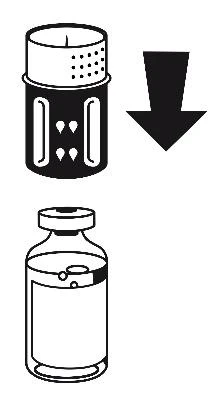
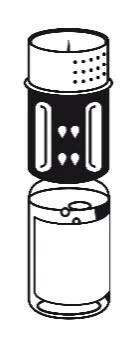
- The transfer set is shown in Fig. 1: Place the solvent vial on a flat surface and hold it firmly. Take the transfer set and turn it upside down. Place the blue end of the transfer set onto the top of the solvent vial and, without twisting, press firmly downward until it locks into place (Fig. 2 + 3).

- Place the powder vial on a flat surface and hold it firmly.
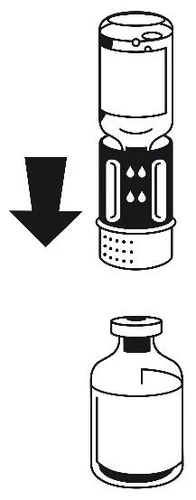
Take the solvent vial attached to the transfer set and
turn it upside down.
Place the white end onto the top of the vial containing the
powder and, without twisting, press firmly downward until it locks into place (Fig. 4). The solvent will automatically flow into the powder vial.
- With both vials still connected, gently invert the
powder vial and swirl gently until the product is completely dissolved.
Dissolution occurs within less than 10 minutes at room temperature.
Slight foaming may occur during reconstitution.
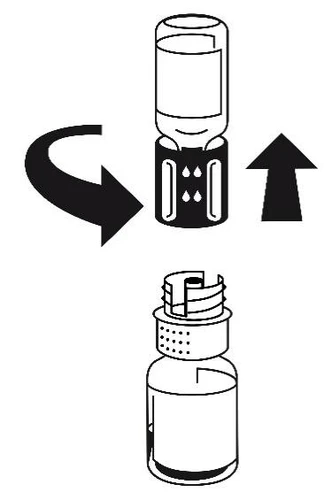
Unscrew the transfer set into two parts (Fig. 5).
Foam will dissipate.
Dispose of the empty solvent vial with the blue part of the transfer set.
Instructions for injection
As a precaution, heart rate should be monitored before and during injection. If a marked increase in heart rate occurs, reduce the injection rate or temporarily interrupt administration.
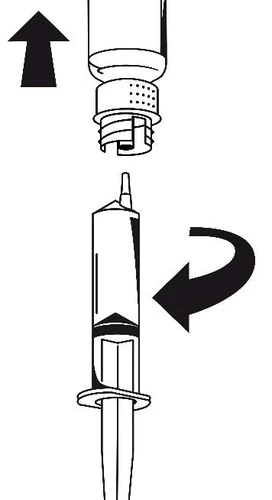
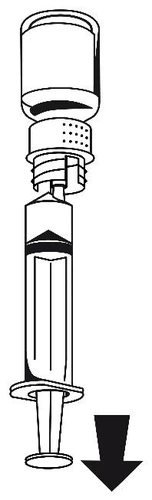
- Attach the syringe to the white end of the transfer set. Turn the vial upside down and draw the solution into the syringe (Fig. 6). The solution should be clear or slightly opalescent. Once the solution has been transferred, hold the syringe plunger firmly (with plunger facing downward) and remove the syringe from the transfer set (Fig. 7). Dispose of the empty vial with the white part of the transfer set.
- Clean the chosen injection site with one of the supplied alcohol-impregnated swabs.
- Attach the provided infusion set to the syringe.
- Insert the injection needle into the selected vein. If a tourniquet was used to make the vein more visible, it should be released before starting the injection of OCTANINE.
- Blood must not enter the syringe due to the risk of fibrin clot formation.
- Inject the solution intravenously slowly, at a rate no faster than 2–3 ml per minute.
If more than one vial of OCTANINE powder is used for a single treatment, the same infusion set and syringe may be reused. The transfer set is for single use only.
Any unused medicine and waste materials derived from this medicine must be disposed of in accordance with local regulations.
Similar drugs
| Brand name | Dosage form | Active substance / Dosage | Manufacturer |
|---|---|---|---|
| ALPROLIX | solution for injection, powder and solvent | SWEDISH ORPHAN BIOVITRUM AB (PUBL) | |
| FIXNOVE | solution for injection, powder and solvent | BAXALTA INNOVATIONS GMBH | |
| IDELVION | solution for injection, powder and solvent | CSL BEHRING GMBH | |
| REFIXIA | solution for injection, powder and solvent | NOVO NORDISK A/S | |
| RIXUBIS | solution for injection, powder and solvent | BAXALTA INNOVATIONS GMBH |
The original data is available in the language of the country of manufacture.
Data source: Italian Medicines Agency (AIFA)
Data last verified: September 21, 2026