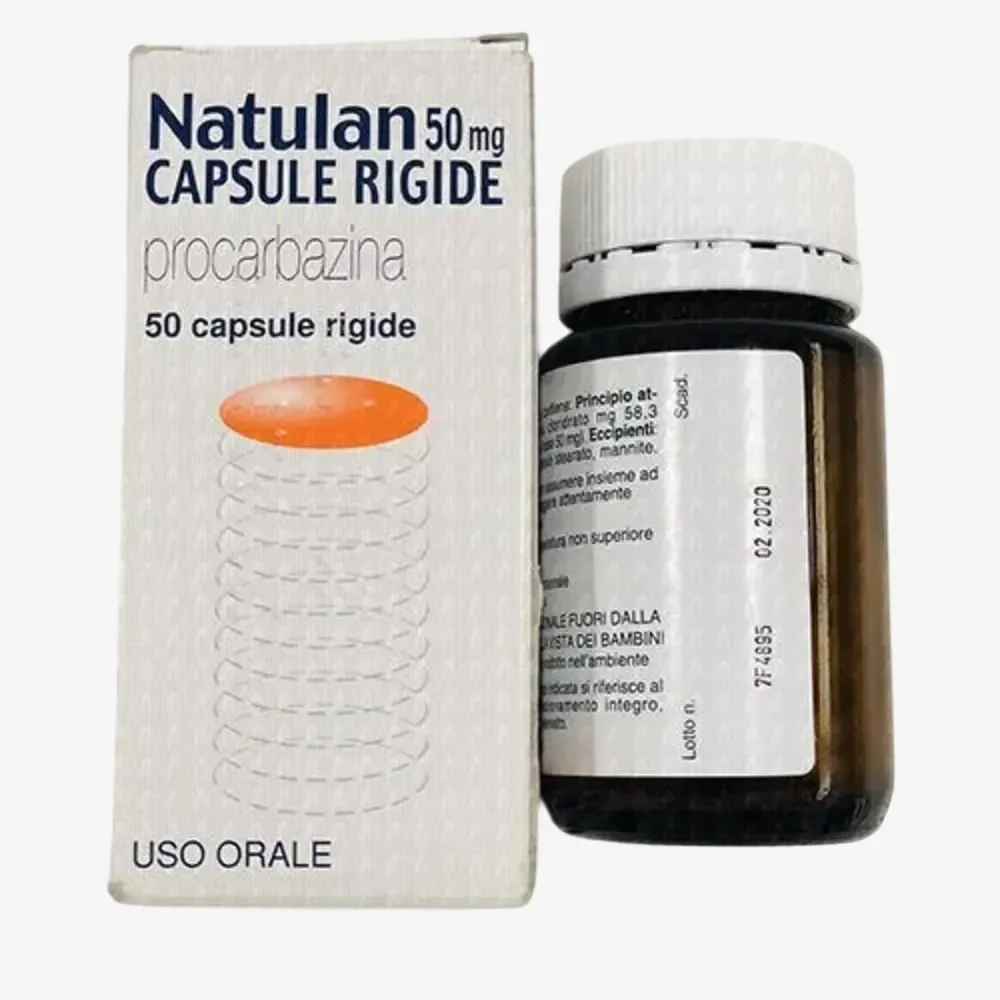
NATULAN
ItalyThis medicine is used for the treatment of certain types of tumors, including Hodgkin's lymphoma, lymphosarcoma, reticulosarcoma, and Brill-Symmers disease. In children and adolescents between 2 and 18 years of age, it is indicated for Hodgkin's lymphoma, but only if administered together with other anticancer drugs according to a medical protocol.
Frequently asked questions
How should Natulan be taken?
The drug should be taken orally following the doctor's instructions exactly. In adults, treatment begins with low doses that gradually increase until reaching a maximum dose of 250-300 mg per day. Once disease remission is achieved, the doctor may prescribe a maintenance dose between 50 and 150 mg per day.
When should you not take this drug?
Natulan should not be taken in case of allergy to procarbazine or its components, if you have severe liver or kidney problems, or if you have blood problems of a certain severity (such as a reduction in white blood cells or platelets). It is also contraindicated during pregnancy or breastfeeding.
What are the side effects of Natulan?
Effects may vary. In the first few days, nausea and decreased appetite are common. Other reported effects include hair loss, anemia, diarrhea, vomiting, inflammation of the mouth, a tingling or numbness sensation in the hands and feet, and possible neurological or cardiac problems. It is important to inform the doctor immediately in case of allergic reactions, confusion, vomiting, or diarrhea.
Are there interactions with other drugs or foods?
Natulan should not be taken together with medicines that stimulate the nervous system (sympathomimetics) or nasal decongestants. You must inform the doctor if you are using anesthetics, pain medications, anti-epileptics, antidepressants, psychotropic drugs, or blood pressure medications. It is also necessary to avoid alcohol and foods rich in tyramine, such as cheeses, yogurt, and bananas.
What precautions should be taken regarding fertility and pregnancy?
The drug can cause permanent sterility in both men and women. Women must use contraceptive methods for up to 6 months after the end of treatment, while men must do so for up to 3 months. It must not be taken during pregnancy as it can cause malformations or miscarriage.
Can the drug affect the ability to drive?
Yes, Natulan can cause dizziness and drowsiness. If these symptoms occur, it is necessary to avoid driving or using machinery until they disappear.
Instructions for use
Package leaflet: Information for the patient
Natulan 50 mg hard capsules
procarbazine
Please read all of this leaflet carefully before taking this medicine because it contains important information for you.
- Keep this leaflet. You may need to read it again.
- If you have any questions, ask your doctor or pharmacist.
- This medicine has been prescribed for you only. Do not give it to other people, even if their symptoms are the same as yours, as it may be harmful.
- If you experience any adverse reactions, including those not listed in this leaflet, contact your doctor or pharmacist. See section 4.
Contents of this leaflet:
- What Natulan is and what it is used for
- What you need to know before taking Natulan
- How to take Natulan
- Possible side effects
- How to store Natulan
- Contents of the pack and other information
1. What Natulan is and what it is used for
Natulan contains the active substance procarbazine, a compound belonging to the class of cytostatic medicines. Procarbazine acts against the growth of certain types of cells and is used to treat certain types of tumours.
Adults
Natulan is indicated for the treatment of certain types of tumours:
• Hodgkin's lymphoma
• Lymphosarcoma
• Reticulosarcoma
• Brill-Symmers disease
Children and adolescents aged between 2 and 18 years
Natulan is indicated for the treatment of Hodgkin's lymphoma only when administered in combination with other antitumour medicines according to an appropriate medical protocol.
2. What you should know before taking Natulan
Do not take Natulan
- if you are allergic to procarbazine or any of the other ingredients of this medicine (listed in section 6)
- if you have significant blood disorders due to any cause (including previous chemotherapy or radiotherapy treatment), such as:
- reduced number of white blood cells in the blood (leucopenia)
- reduced number of platelets in the blood (thrombocytopenia)
- if you have severe liver problems
- if you have severe kidney problems
- if you are pregnant or breastfeeding (see section “Pregnancy, breastfeeding and fertility”)
Warnings and precautions
Talk to your doctor or pharmacist before taking Natulan. Natulan will be administered only by physicians experienced in chemotherapy treatments.
Inform your doctor before taking Natulan:
- if you have liver or kidney problems, as Natulan may not be suitable for you (see section “Do not take Natulan”) or you may need to start treatment with Natulan in hospital.
- if you have received or are scheduled to receive a vaccine containing live attenuated microorganisms.
During treatment with Natulan, your doctor will carry out the following tests:
- blood tests: before each treatment cycle and then twice weekly.
- liver and kidney function tests: before each treatment cycle and then once weekly.
If any of the following occur, consult your doctor, as treatment with Natulan should be discontinued:
- Decrease in white blood cells and platelets (leucopenia, thrombocytopenia)
- Numbness or tingling in hands or feet (paraesthesia), peripheral nerve disease (neuropathy), confusion
- Allergic reactions
- Diarrhoea
- Inflammation of the mouth mucosa (stomatitis)
- Vomiting
Pay particular attention:
- procarbazine may cause absence of spermatozoa in semen (azoospermia) and permanent sterility (see section “Pregnancy, breastfeeding and fertility”).
- Natulan (when used in combination with other medicines and/or radiotherapy) may lead to development of other tumours, such as lung cancer and acute leukaemia.
Children and adolescents
Natulan is usually administered to children and adolescents at the same dosage as adults, in combination with other anticancer drugs. Natulan may cause excessive toxicity in children, resulting in tremors, coma and convulsions. Therefore, the doctor will carefully evaluate the dose and closely monitor the child’s condition during treatment.
Other medicines and Natulan
Inform your doctor or pharmacist if you are currently taking, have recently taken or might take any other medicines.
Do not take Natulan together with:
- medicines that stimulate the nervous system (sympathomimetics)
- medicines that reduce nasal congestion (decongestants)
Inform your doctor, who will pay particular attention, if you are taking or need to take:
- medicines that inhibit the central nervous system, for example:
- medicines used to induce anaesthesia (anaesthetics)
- medicines used to relieve pain (narcotic analgesics)
- medicines used for epilepsy (barbiturates)
- medicines used for depression (tricyclic antidepressants)
- phenothiazines (psychotropic drugs)
- medicines used for high blood pressure (antihypertensives)
Natulan with food and alcohol
Do not take Natulan with alcohol or foods containing high levels of tyramine, such as cheese, yoghurt and bananas.
Pregnancy, breastfeeding and fertility
If you are pregnant, suspect you may be pregnant, plan to become pregnant, or are breastfeeding, consult your doctor or pharmacist before taking this medicine.
Pregnancy
Do not take Natulan during pregnancy, as miscarriages, premature births, low birth weight infants and congenital malformations have been observed in children of women treated with procarbazine during pregnancy.
If you are a woman of childbearing age, you must avoid becoming pregnant during treatment with Natulan. Contact your doctor immediately if you discover or suspect you are pregnant.
Both men and women treated with Natulan should be advised about contraceptive methods.
Women should use contraception for at least 6 months after completion of Natulan treatment, and men for at least 3 months after.
Breastfeeding
The use of Natulan during breastfeeding should be avoided.
Fertility
Procarbazine may cause absence of spermatozoa in semen (azoospermia) and permanent sterility (see section “Warnings and precautions”). Both men and women treated with Natulan should be informed about the risk of sterility.
Driving and using machines
Natulan may cause dizziness and drowsiness. If you experience dizziness or drowsiness, do not drive or operate machinery until these effects have disappeared.
3. How to take Natulan
Take this medicine exactly as directed by your doctor. If you have any doubts, consult your
doctor or pharmacist.
Use in adults
Take Natulan by mouth.
At the beginning of treatment, your doctor will prescribe a low dose of the medicine and then gradually
increase the dose up to the maximum dose of 250–300 mg per day according to the following
treatment schedule:
Day 1: 50 mg
Day 2: 100 mg
Day 3: 150 mg
Day 4: 200 mg
Day 5: 250 mg
Day 6: 250–300 mg
Subsequent days: 250–300 mg
You must continue taking Natulan until the disease is in the most complete remission possible. After that, your
doctor will prescribe a maintenance dose of 50–150 mg per day.
Use in children and adolescents
Your doctor will carefully determine the most appropriate dose.
Use in the elderly
Procarbazine should be used with caution in elderly patients. During treatment, your doctor will perform
regular check-ups to monitor for early signs of treatment inefficacy or intolerance.
Impaired liver function
Procarbazine must be administered with caution in patients with impaired liver function. During treatment, your doctor will carry out blood tests and liver function tests.
Impaired kidney function
Procarbazine must be administered with caution in patients with impaired kidney function. During treatment, your doctor will carry out blood tests and kidney function tests.
Caution is also advised in patients with a type of adrenal gland tumour (pheochromocytoma), epilepsy, or heart and brain vessel diseases.
If you take more Natulan than you should
In case of accidental overdose of Natulan, contact your doctor immediately or go to the nearest hospital.
An overdose may cause:
- dizziness
- nausea
- vomiting
- diarrhoea
- low blood pressure
- rapid heartbeat (tachycardia)
- tremors
- hallucinations
- depression
- seizures
Your doctor will treat the overdose of Natulan according to your condition.
If you forget to take Natulan
Do not take a double dose to make up for the missed dose.
If you stop taking Natulan
It is important that you never stop treatment without consulting your doctor.
If you have any questions about the use of this medicine, consult your doctor or pharmacist.
4. Possible side effects
Like all medicines, this medicine can cause side effects, although not everyone will experience them.
During the first days of treatment, patients often experience loss of appetite and nausea, which usually disappear after a short time.
Immediately inform your doctor if you notice any of the following symptoms:
- Decrease in white blood cells and platelets (leucopenia, thrombocytopenia)
- Numbness or tingling in the hands or feet (paraesthesia), peripheral nerve disease (neuropathy), confusion
- Allergic reactions
- Diarrhoea
- Inflammation of the mucous membrane of the mouth (stomatitis)
- Vomiting
Side effects reported after use of Natulan
Common (affecting more than 1 in 100 but less than 1 in 10 patients):
Reduction in the number of red blood cells in the blood (anaemia); reduction in the number of white blood cells in the blood (leucopenia); reduction in the number of platelets in the blood (thrombocytopenia); hair loss; infection; decrease in white blood cells (granulocytopenia, neutropenia); blood disorders and toxicity (haematological toxicity); brain dysfunction (neurotoxicity); breathlessness; nausea; vomiting; inflammation of the stomach or intestine (gastrointestinal toxicity); inflammation of mucous membranes; respiratory disorders;
Uncommon (affecting more than 1 in 1,000 but less than 1 in 100 patients):
Allergic reactions, including severe and sudden allergic reaction that may be fatal (anaphylaxis) and swelling of the skin or mucous membranes (angioedema); loss or decrease in appetite; nerve disease that may cause weakness, tingling or numbness (peripheral neuropathy); sensation of numbness or tingling in the hands or feet (paraesthesia); cardiac and vascular toxicity; respiratory tract infections; pulmonary toxicity; lung disorders; skin rash; drug-induced skin toxicity; redness (skin eruptions); disorders of the urinary and genital organs (urogenital disorders); increased liver enzymes (gamma-glutamyltransferase, transaminases).
Rare (affecting more than 1 in 10,000 but less than 1 in 1,000 patients):
Redness in the white of the eye or inner eyelid (conjunctivitis); burning sensation during urination and urgent need to urinate (cystitis); lung infections; infection with Pneumocystis jirovecii; Pneumocystis jirovecii pneumonia; a very serious and potentially life-threatening condition occurring with infections affecting the entire body (septic shock); reduction in all blood cells (pancytopenia); decrease in a certain type of white blood cells (lymphopenia); increased blood glucose (hyperglycaemia, diabetes mellitus); iron accumulation in organs (haemosiderosis); headache; nerve problems affecting involuntary body functions, which may influence blood pressure, temperature control, digestion, bladder function, and sexual function (autonomic neuropathy); ear damage (ototoxicity); heart failure due to cardiovascular disorders (cardiovascular disorder); cardiac arrest (myocardial infarction); recurrent disruption of blood flow (vasospasm) in fingers and toes, usually occurring in response to stress or cold exposure (Raynaud's phenomenon); respiratory failure; pulmonary embolism and pulmonary infarction; diarrhoea; inflammation of the oesophageal mucosa (oesophagitis); liver inflammation (hepatitis); liver disease; liver problems (liver necrosis; hepatic steatosis); urticaria; drug-induced skin rashes; kidney toxic effects; kidney damage; increased creatinine levels in blood indicating impaired kidney function.
Very rare (affecting less than 1 in 10,000 patients):
Fungal infection of the oesophagus (oesophageal candidiasis); acquired immunodeficiency syndrome; lung infection caused by atypical organisms different from common bacteria (atypical pneumonia); a medical condition characterised by fever, enlargement of the liver and/or spleen with blood cell abnormalities (haemophagocytic histiocytosis); metabolic disturbances occurring after initiation of cancer treatment (tumour lysis syndrome); psychotic disorder characterised by personality change (personality alteration); affective disorder; poor blood flow due to blockage or rupture of an artery in the brain (cerebrovascular accident); progressive multifocal or inflammatory damage to the brain due to viral infection (progressive multifocal leucoencephalopathy); fainting (syncope); brain disease (encephalopathy); changes in heart rate (sinus arrhythmia); inflammation of the thin membrane surrounding the heart (pericarditis); inflammation of veins (phlebitis); respiratory distress; lung inflammation caused by inhalation of bacteria or toxic substances from oral and gastric contents (aspiration pneumonia); lung fibrosis; gastric bleeding; yellowing of the skin, mucous membranes and eyes (jaundice); acne; inflammation of one or more spinal joints (spondylitis); weakened bones with increased risk of fractures (osteoporosis); sudden cardiac arrest usually due to an electrical heart disorder (sudden cardiac death).
Not known (frequency cannot be estimated from available data):
Infections affecting the entire body and potentially fatal (sepsis); Herpes zoster; reduced bone marrow activity (bone marrow failure); reduction in red blood cells due to their destruction (haemolytic anaemia); increased number of a type of white blood cells in the blood (eosinophilia); bleeding from damaged blood vessels (haemorrhage); lung disease (interstitial pneumonia); inflammation of the mucous membrane of the mouth (stomatitis); constipation; muscle pain; death of bone and ligament cells; pain; fever; fatigue; liver toxicity; development of new tumours such as lung cancer* and acute myeloid leukaemia*; Leukaemia*; altered production by the bone marrow of red blood cells, white blood cells and platelets (myelodysplasia)*; dehydration; low potassium levels in blood (hypokalaemia); hallucination; depression; confusion; severe psychiatric disorders (psychotic disorder); taste disturbances (dysgeusia); visual disturbances; difficulty breathing (dyspnoea); abdominal pain; acute allergic reactions involving skin and mucous membranes potentially fatal (toxic epidermal necrolysis, Stevens-Johnson syndrome); absence of sperm in semen (azoospermia)*; malaise; disease progression; ineffectiveness of the medicine; feeling strange; weight loss; cough.
*: Late toxicity includes secondary tumours and certain organ toxicities. The number of patients affected by late toxicity may increase over time.
Additional side effects in adolescents and children
Common (affecting more than 1 in 100 but less than 1 in 10 patients):
Nervous system disorders.
Uncommon (affecting more than 1 in 1,000 but less than 1 in 100 patients):
Chickenpox; lung infections; painful collection of pus (abscess); blood infections (pneumococcal bacteraemia); inflammation of the stomach and intestine (gastroenteritis); inflammation of the colon causing rectal bleeding, diarrhoea, abdominal pain, and abdominal spasms (colitis); insufficient thyroid hormone (hypothyroidism); convulsive crisis; difficulty breathing (dyspnoea); respiratory arrest; red urine with burning sensation during urination (haemorrhagic cystitis); abnormal levels of calcium and magnesium in blood.
Rare (affecting more than 1 in 10,000 but less than 1 in 1,000 patients):
Collection of pus in the abdomen (subdiaphragmatic abscess); brain inflammation (tuberculous meningitis); severe bacterial infection; hepatitis B; reduction in red blood cells due to their destruction by the immune system (autoimmune haemolytic anaemia); diffuse toxic goitre (Graves' disease); increased sodium in blood (hypernatraemia); abnormal behaviour; confusion; weakness on one side of the body (hemiparesis) or in a single limb (monoparesis); state of fatigue or lack of energy (lethargy); absence of reflexes (areflexia); vision problems; redness; vomiting blood (haematemesis); insufficient liver function; skin rash or irritation (allergic dermatitis); muscle weakness; eye movement abnormalities; need for blood transfusions.
Not known (frequency cannot be estimated from available data):
Acute myeloid leukaemia*, Leukaemia*, Myelodysplastic syndrome*, secondary neoplasms*; Azoospermia*
*: Late toxicity includes secondary tumours and certain organ toxicities. The number of patients affected by late toxicity may increase over time.
Reporting of side effects
If you experience any side effect, including those not listed in this leaflet, consult your doctor or pharmacist. You may also report side effects directly via the national reporting system at http://www.aifa.gov.it/content/segnalazioni-reazioni-avverse.
By reporting side effects, you can help provide more information on the safety of this medicine.
5. How to store Natulan
Do not store above 25°C.
Keep this medicine out of the sight and reach of children.
Do not use this medicine after the expiry date stated on the packaging after "Exp.".
The expiry date refers to the last day of that month.
Do not dispose of any medicine via wastewater or household waste. Ask your pharmacist how to dispose of
medicines you no longer use. This will help protect the environment.
6. Package contents and other information
What Natulan contains
- The active substance is procarbazine. Each hard capsule contains 58.3 mg of procarbazine hydrochloride equivalent to 50 mg of procarbazine base.
- The other components are:
- Capsule contents: mannitol (E421), maize starch, talc (E553b), magnesium stearate (E572)
- Capsule shell: yellow iron oxide (E172), titanium dioxide (E171), gelatin
- .
Description of the appearance of Natulan and contents of the pack
Each pack contains 50 hard capsules in a dark glass bottle with screw cap or 50 hard capsules in a blister pack.
Marketing Authorisation Holder and Manufacturer
Leadiant GmbH
Liebherrstr. 22
80538 Munich, Germany
Manufacturer
Haupt Pharma Amareg GmbH
Donaustaufer Str. 378
93055 Regensburg, Germany
The original data is available in the language of the country of manufacture.
Data source: Italian Medicines Agency (AIFA)
Data last verified: September 21, 2026